Jazz Crazy Records

An Archive of Early Jazz on 78 RPM

Category: Cuban

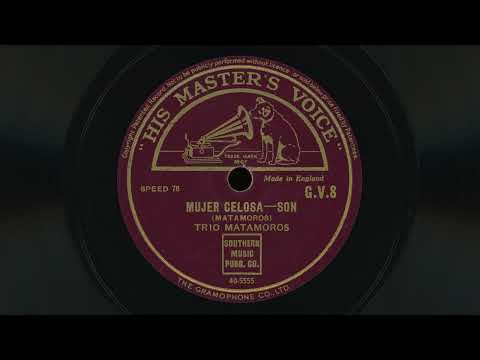
  • “Mujer Celosa” – Trio Matamoros (1928)

    “Mujer Celosa” – Trio Matamoros (1928)

    My interest in Congolese Rumba has had me seeking out records from His Master’s Voice G.V. series – which were quite influential in the development of African music in the 40s and 50s.

    The G.V. series was made up of Cuban and Latin American music made by Victor in the U.S. They started releasing records in 1933 and the series was marketed to audiences in Africa as “Hits from Cuban and South American Shores”.

    This early disc from Trio Matamoros features the son clave rhythm that underlies much Afro-Cuban music and prominent guitars. I was struck, in particular, by how the melodic guitar part that here begins at 0:32 and ends at 0:43 resembles one of my favorite guitar parts played by Papa Noel in Léon Bukasa’s “Monique Wa Baba” starting at the one minute mark. Could Papa Noel have been paying homage to the Trio Matamoros quoting the line from this record? It sure sounds like it!

    Recorded in Camden, New Jersey on May 29, 1928.
    Released as His Master’s Voice G.V. 8.
    Originally released as Victor 81614.

    Credits:
    Miguel Matamoros – guitar, tenor vocals
    Rafael Cueto – guitar
    Siro Rodríguez – claves, baritone vocals

    Go listen to Léon Bukasa’s “Monique Wa Baba” and compare the guitar part mentioned above!
    https://youtu.be/Zl6hNQ0xtv8
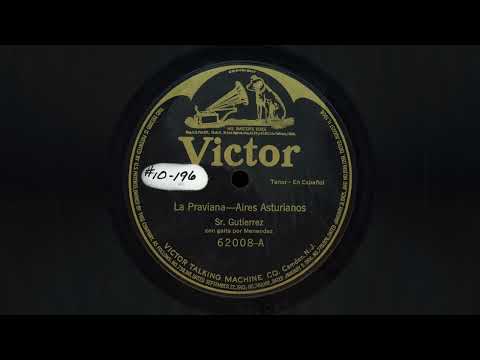
  • “La Praviana – Aires Asturianos” – Ramón Gutiérrez (1909) con gaita

    “La Praviana – Aires Asturianos” – Ramón Gutiérrez (1909) con gaita

    Here’s a really interesting recording: a Spanish vocalist singing an Asturian popular tune (taken from a play of the same name that premiered in Madrid in 1896) with gaita (bagpipes) accompaniment.

    A reminder that although we tend to think of bagpipes as a Scottish instrument, it came through Europe via North Africa nearly 1,000 years before it reached Scotland.

    The song begins “Soy de Pravia” (I am from Pravia) and its title indicates it refers to the Asturian town of Pravia in northern Spain.

    I am from Pravia
    I am from Pravia
    and my mother is a Pravian
    and my mother is a Pravian
    and that is why there is no room
    for any bad game in me.

    Recorded in Havana, Cuba on February 7, 1909.
    Released as Victor 62008.

    This batwing repressing was dubbed (as noted in DAHR). You can actually hear the dubbing apparatus at the very end of the record as the gaita fades out – first you hear the surface noise of the original record, then the needle lifts and you hear the much quieter surface noise of the dubbed copy.

    Credits:
    Ramón Gutiérrez – vocals
    Menéndez – gaita

    The flip side of this record can be heard at:
    https://youtu.be/5dCjo-vmgHM

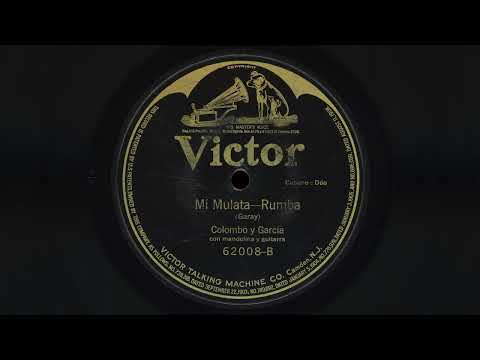
  • “Mi Mulata” – Colombo Y Garcia (1909) early recorded rumba from Havana, Cuba

    “Mi Mulata” – Colombo Y Garcia (1909) early recorded rumba from Havana, Cuba

    My interest in Congolese rumba of the 40s and 50s has led me to seek out early Cuban records that served as their inspiration. Here we have a very interesting early recording of a rumba made in Havana, Cuba in 1909 featuring two vocalists accompanied by a mandolin and guitar.

    It starts out pretty lively – and then the whistling kicks in at 0:24 and you get hooked pretty fast after that.

    Recorded in Havana, Cuba on February 8, 1909.
    Released as Victor 62008.

    This batwing repressing was dubbed from an original source – as noted in DAHR. You can hear the dubbing apparatus at the end of the track – the surface noise of the original comes to an abrupt halt as the stylus is lifted – then you hear a low mechanical noise as the tonearm is pulled back.

    Credits
    Adolfo Colombo – tenor vocals
    Claudio García – baritone vocals

    The flip side of this record can be heard at:
    https://youtu.be/9IMXKCIKqY4

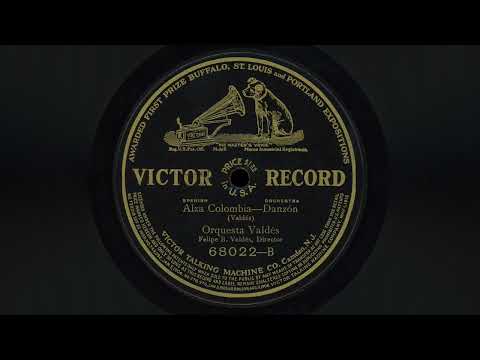
  • “Alza Columbia” – Orquesta de Felipe Valdés (1907) – Danzón

    “Alza Columbia” – Orquesta de Felipe Valdés (1907) – Danzón

    Another tune by Felipe Valdés.

    The cornet in this tune can be heard more clearly and prominently. At times it even seems to lapse into mild improvisations over the melody.

    Recorded in Havana, Cuba on March 6, 1907.
    Released as Victor 68022.

    Credits:
    Felipe Valdés – bandleader, cornet
    Unknown Artists – violins (3), clarinets (2), trombone, contrabajo, saxophone, guiro, and timbales.

    Side A of this record can be heard here:
    https://youtu.be/zJJHqvEpW2k

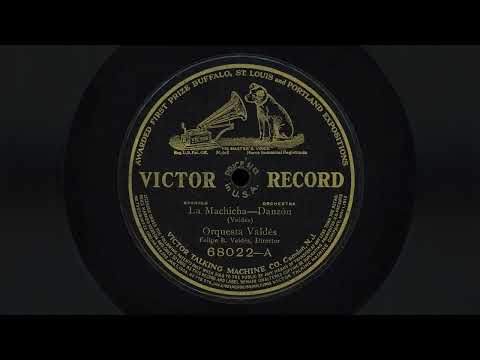
  • “La Machicha” – Orquesta de Felipe Valdés (1907) – Danzón

    “La Machicha” – Orquesta de Felipe Valdés (1907) – Danzón

    Something quite interesting that I pulled out of the non-jazz deep freeze archive over the weekend – a 12″ Victor containing some early Cuban Danzón from the Orquesta de Felipe Valdés.

    Valdés, a cornetist, formed the orchestra in 1899. According to Cuban music historian Cristobal Diaz-Ayala, Valdés “recorded more danzons than any other típica in the twentieth century.” He recorded over 300 sides in total.

    In his doctoral thesis on Valdés and the role of the Cornet, Gerardo Garcia Mata goes into detail on the structure and sound of danzón at the time – which showcased a violin and clarinet as the “prominent melodic voices”.

    Starting in 1907, Valdés began to integrate the cornet to a larger degree into his compositions and arrangements. In this 1907 recording, the cornet begins by playing with the ensemble, then lays out for the B section and returning A section. It is only at 1:10 at the start of the C section that we hear the cornet take the melodic spotlight, which it moves in and out of for the remainder of the tune.

    Dr. Mata writes that this formative period marked a growing confidence by Valdés in his abilities – and that subsequent works see the “increased presence” of his cornet.

    Recorded in Havana, Cuba on March 6, 1907.
    Released as Victor 68022.

    Credits:
    Felipe Valdés – bandleader, cornet
    Unknown Artists – violins (3), clarinets (2), trombone, contrabajo, saxophone, guiro, and timbales.

    “Felipe Valdes And The Role Of The Cornet In The Cuban Orquesta Típica”
    by Gerardo Garcia Mata – can be found here:
    https://uh-ir.tdl.org/items/b8380db2-97ef-4f66-ae7a-82ddc5b28a0e/full

    Side B of this record can be heard here:
    https://youtu.be/qCVEv4IVqBk