Jazz Crazy Records

An Archive of Early Jazz on 78 RPM

Category: Greek

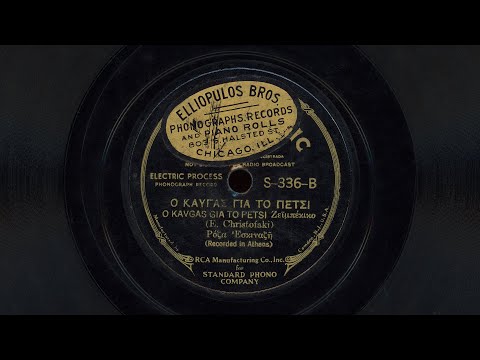
  • “Ο Καυγάς Για Το Πετσί” – Ρόζα Εσκενάζυ (1934) 🇬🇷

    “Ο Καυγάς Για Το Πετσί” – Ρόζα Εσκενάζυ (1934) 🇬🇷

    This rebetiko by the legendary Roza Eskenazē was originally recorded in Athens with a Gramophone matrix for the HMV label but was released domestically as a dubbed copy on Victor’s Orthophonic label – which specialized in Greek recordings. It was later reissued on RCA Victor in the late 40s.

    The tune was composed as a Zeibekiko by the santouri player, Manolis Chrysafakis, a man who went by the nickname Fystixis (Φιστιξή), or “Peanut”. The title translates to: “The Fight Over the Loot,” A street dispute over a found wallet (πετσί – literally: “Skin”) is performed as a back and forth between a protagonist (Kóllia) and an uncouth petitioner. Roza sings both parts to the song. After tense words, the protagonist resentfully shares the plunder after being told an unrevealed secret.

    Lyrics:

    Το πετσί που βρήκες Κόλλια, σκάστο, δωσ’ μου τα μισά.
    The loot you found, Kóllia, cough it up and give me half!

    Δεν σου δίνω πενταράκι, γιατί έχω συντροφιά.
    I’m not giving you a single penny, not in front of my crew.

    Κόλλια θα σου την καρφώσω, φέρτα κι άφησέ τα αυτά.
    Kóllia, I’ll rat you out – hand it over and stop your nonsense!

    Εγώ βλάμη δεν σου δίνω κοροϊδίστικα λεφτά.
    Listen, pal, I’m not giving you money for nothing.

    Στο ‘πα και στο ξαναλέγω, Κόλλια θα σου ‘ξηγηθώ.
    I told you and I’m telling you again, Kóllia, I’m gonna straighten you out.

    Λόγια εγώ πολλά δεν ξέρω, άντε, στρίβε από δώ.
    I’m not one for big talk – now get lost!

    Τότε ο βλάμης του το σκάει στο αυτί το μυστικό.
    Then his buddy drops a secret in his ear.

    Ναι, ο Κόλλιας του μετράει κι αυτουνού το μερδικό.
    Yes, Kóllia begrudgingly counts out his cut as well.

    Γειά σου Κόλλια τσίφτη!
    Good for you, Kóllia, you slick bastard!

    This disc sports a lovely store sticker from where it was originally purchased: Elliopulos Brothers, a purveyor of phonographs, records, and piano rolls on 803 S. Halsted Street in Chicago, Illinois – just south of what is now called Greektown. It came from a large collection of Greek discs owned by George Psiropoulos, who grew up in Fond du Lac, Wisconsin but moved to South Dakota to work as a restaurateur in the 1950s.

    Recorded in Athens, Greece on December 15, 1934.
    Released in the U.S. as Orthophonic S-336.
    Originally released in Greece as His Master’s Voice AO-2226.

    Credits:
    Roza Eskenazē (Ρόζα Εσκενάζυ) – vocals
    Dimitris Semsis (Δημήτρης Σέμσης) – violin (βιολί)
    Unknown Artist – guitar (κιθάρα)
    Manolis Chrysafakis (Μανώλη Χρυσαφάκης) – santouri (σαντούρι)
    Tetos Demetriades (Τετος Δημητριαδης) – session supervisor

    Sources:
    https://rebetiko.sealabs.net/
    DAHR – https://adp.library.ucsb.edu/index.php/matrix/detail/2000250997/0GA122-O_kaugas_gia_to_petsi_
    https://www.brewerfuneral.com/obituaries/George-Psiropoulos?obId=32501137

    Translation assisted by AI.
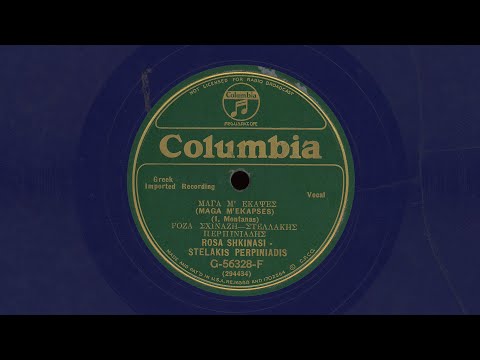
  • “Μάγα Μ’ Έκαψες” – Ρόζα Σχινάζη & Στελλάκης Περπινιάδης (1932)

    “Μάγα Μ’ Έκαψες” – Ρόζα Σχινάζη & Στελλάκης Περπινιάδης (1932)

    A wonderful duet between rebetiko legends Stellakis Perpiniadis and Roza Eskenazi from 1932 Athens composed by Iakovos Montanaris (Ιάκωβος Μοντανάρης).

    I had to chuckle when I first translated the title of this one, “Μάγα Μ’ Έκαψες” one translation app called it “MAGA you burned me”, which seems quite apropos at the moment here in the U.S.

    As it turns out, Μάγκα is a Greek slang term meaning a “tough guy” or “cool dude” – a streetwise man with swagger who is possibly involved with the underworld in some way. The song is a fun back-and-forth between Stellakis (playing the role of the Μάγκα) and Roza (who is rejecting his advances).

    – – –

    Lyrics
    Τα ματάκια σου, κυρά μου
    έχουν κάψει την καρδιά μου
    ό,τι έχω θα πουλήσω
    Ρόζα μου, να σ’ αποκτήσω
    (Your little eyes, my lady, have burned my heart.
    I’ll sell everything I own, Rosa, just to have you)

    Σύρε, φύγε, βρ’ εσύ μάγκα
    έμαθα πως είσαι μάρκα
    μάρκα φίν’ από τις πρώτες
    κι απ’ αυτές που κλείνουν πόρτες
    (Beat it, tough guy – I’ve heard you’re a real piece of work
    a top-class player – the kind that slams doors shut)

    Το ντουνιά μην τον πιστεύεις
    κι από με ό,τι γυρεύεις
    στα μετάξια θα σε δούνε
    και τα μάτια τους θα βγούνε
    (Don’t believe the world – and whatever you ask of me
    they’ll see you dressed in silks and their eyes will pop out)

    Σύρε, φύγε, βρ’ εσύ μάγκα
    και δεν πιάνει η ματσαράγκα
    είσαι μάρκα φίνα, πρώτη
    κι απ’ τον καφενέ του Φώτη
    (Go away, tough guy – your tricks don’t work on me
    you’re a top-notch big shot straight out of Foti’s café)

    Θα σου βάλω βραχιολάκια
    και ολόχρυσα γοβάκια
    σα χορεύεις να γυαλίζουν
    και τους μάγκες να ζαλίζουν
    (I’ll put bracelets on you – and golden little shoes
    so they shine when you dance – and dazzle all the other tough guys)

    Στρίβε, φύγε, βρ’ εσύ μάγκα
    βρε, έμαθα πως είσαι μάρκα
    μάρκα μ’ έκαψες στην τρίχα
    και γι’ αυτό κόψε το βήχα
    (Turn around and leave, tough guy – I heard you’re a real smooth operator
    a playa that burned me to the core – so cut the sweet talk)

    Άντε βρε Στελλάκη είσαι μάρκα μ’ έκαψες!
    (Come on, Stellakis, you’re a real hotshot — you burned me!)

    – – –

    This disc looked pretty beat – lots of scuffs and laminate cracking – but it played like a dream – these laminated royal blue Columbias from the early 1930s really hold up well.

    Recorded in Athens, Greece in 1932.
    Dubbed and released as Columbia G-56328-F in 1933.
    Originally released in Greece as Parlophon Β.21656.

    Credits:
    Stellakis Perpiniadis – vocals, guitar
    Roza Eskenazi – vocals
    Unknown Artist – bouzouki

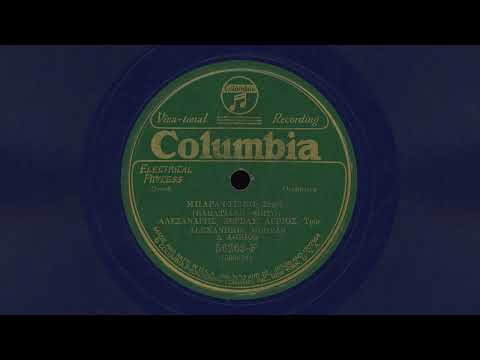
  • “Στα Σάλωνα / Μπαραïτιανο” – The Mouskas Trio (1928)

    “Στα Σάλωνα / Μπαραïτιανο” – The Mouskas Trio (1928)

    By request – another 12″ Greek disc from the collection. These beautiful royal blue laminated Columbia records were pressed in the middle of the Great Depression starting in late 1932 and continuing until 1935. The laminated shellac generally sounds excellent – even when slightly worn, like this one.

    This release, by a group of three musicians called the Mouskas Trio recording in 1928 in New York City. The group recorded six sides that day – and does not appear to have recorded again. The longer playing surface of these 12″ discs means the two sides together deliver nearly nine minutes of recorded music.

    Side A, “In Salona”, is a Τσάμικο (Tsamiko).
    The tsamiko Sta Salona is quite well known and especially popular in the early 20th century, there being dozens of recordings from both Greece and USA, both instrumental and sung. Salona is a village near Mt Parnassos in central Greece (Sterea Ellas or Roumeli) now called Amfissa as it was in ancient times. Salona was its medieval name up to and during the Greek War of Independence. The tune is also known as “Sta Salona Sfazun Arnia, Maria Pentayiotissa” (In Salona they are slaughtering lambs, Maria Pentayiotissa).*

    Side B, “Baraïtiano”, is a Συρτό (Syrto).
    Baraitiano is also a well known tune but usually called Beratiano Μπερατιανό or Berati Μπεράτι The tune is also called Himariotiko Χειμαριώτικο, from the Greek inhabited town of Himara in southern Albania. The tune has traveled such that in the Peloponnese it is often called Peratiano and on the island of Kalymnos it is known as Thimariotiko Θυμαριώτικο where it is a specific dance for males.*

    Recorded in New York City on Oct 16, 1928.
    Released as Columbia 56263-F.
    Originally released as Okeh 82521.

    Credits:
    clarinet, violin, cimbalom
    Αλεξανδρής (Alexanders)
    Ζέρβας (Gervas)
    Άγριος (Agrios)

    Sources:
    Ethnic Music on Records, Vol 3, Dick Spottswood, p. 1134
    * Joe Graziosi – @romeikos2

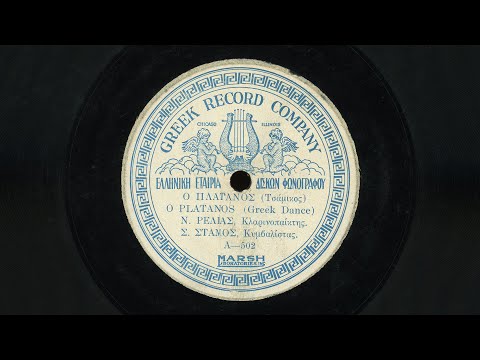
  • “Ο Πλάτανος / Μπαρμπουνάρα” – Κυρία Ελένη, Νίκος Ρέλλιας & Σπύρος Στάμος (1923)

    “Ο Πλάτανος / Μπαρμπουνάρα” – Κυρία Ελένη, Νίκος Ρέλλιας & Σπύρος Στάμος (1923)

    By request from a Discogs user: an early record on the Greek Record Company label recorded at Marsh Laboratories in Chicago, Illinois. Both sides of this 12″ disc are included in this video.

    502 A – Ο Πλάτανος (The Plane Tree)
    502 B – Μπαρμπουνάρα (Little Red Mullet)

    Nikos Rellias was born in Goura, Corinth in 1892 and was a shepherd there until he emigrated to the U.S. in 1906, where he studied clarinet in New York City starting in 1909. He also performed with Marika Papagika and Kostas Papagikas around this same time.

    Marsh Laboratories was founded by Orlando Marsh in Chicago in 1922. Marsh was a pioneer in electrical recordings with microphones – and a few years ahead of the big labels who were all recording acoustically (through an acoustic horn).

    Recorded in Chicago circa 1923.
    Released as Greek Record Company 502

    Arapaki Eleni – vocals (on Μπαρμπουνάρα)
    Nikos Rellias – clarinet
    Spyros Stamos – santouri

    The Πλάτανος (Plane Tree – or as it is commonly known in the U.S., a Sycamore tree) refers to a type of long-lived revered tree that often stands at the center of a village square in Greece. They can symbolize community, wisdom, and longevity. They could also have spiritual importance in Greek mythology and ancient Greek religious practices.

    “Μπαρμπουνάρα μου” (my little red mullet) is a playful, affectionate nickname. In Greek slang of the time, it could imply someone flashy, desirable, or stylish—like the prized red mullet fish. It might also carry a flirtatious or teasing tone, especially in a rebetiko or cabaret-style song such as this one.
    Μπαρμπουνάρα lyrics:

    Εγώ με όλους παίζω κόρτε και γελούν
    κι έτσι περνάω τον ωραίο μου καιρό
    με μια ματιά μου μένουν όλοι σαν χαζοί
    ξοδεύουν χρήμα για ένα μόνο μου φιλί

    Αχ, μπαρμπουνάρα μου, νέοι, γέροι ψιθυρίζουν
    τα μαύρα μάτια σου την καρδιά ραΐζουν

    Έχω μανία να ανεβαίνω στα auto
    μα η τρέλα μου είναι το τιμόνι να κρατώ
    έτσι μ’ αρέσει να γλεντάω τη ζωή
    δεν δίνω δυάρα ο κοσμάκης τι θα ειπεί

    Αχ, μπαρμπουνάρα μου, νέοι, γέροι ψιθυρίζουν
    τα μαύρα μάτια σου την καρδιά ραΐζουν

    English Translation:

    I flirt with everyone and they all laugh.
    That’s how I spend my lovely time.
    With just one glance, they all look like fools.
    they spend money for a single kiss of mine.

    Ah, my little red mullet, young and old whisper.
    Your dark eyes shatter hearts.

    I’ve got a craze for riding in cars,
    But my real thrill is holding the wheel.
    that’s how I like to party through life.
    I don’t give a damn what people say.

    Ah, my little red mullet, young and old whisper.
    Your dark eyes shatter hearts.

    NOTE: AI was used for translation. If you have suggestions to improve the translation, please let me know.

    SOURCES:
    https://vmrebetiko.gr/item/?id=4607
    https://www.korinthia.net.gr/2025/03/23/107243/
    https://el.wikipedia.org/wiki/%CE%A0%CE%BB%CE%AC%CF%84%CE%B1%CE%BD%CE%BF%CF%82

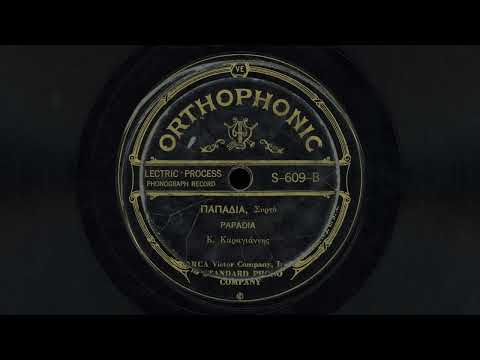
  • “Παπαδιά” – Κώστας Καραγιάννης (1931) – Greek Clarinet

    “Παπαδιά” – Κώστας Καραγιάννης (1931) – Greek Clarinet

    The Ted Lewis record I posted yesterday had me digging through the stacks to find interesting clarinet records – both in and outside the jazz tradition. I found a few that I wanted to share and this is one of them.

    I am very happy to have learned more about Kóstas Karagiánnis, the clarinetist on this record from viewer @henridelagardere264. He was born in the late 1880s to a family of folk artists and seems to have learned clarinet from a local master – perhaps from a Turkish-born musician named Ζεκύλ (Zekyll).

    I found his energetic playing on this record to be inspired and lively.

    The Orthophonic label is an interesting one – made by Victor and sold domestically, they reissued many imported Greek records from the late 1920s and early 1930s. DAHR said that this 12″ Orthophonic issue was “re-recorded” from a 10″ record – which I take to mean was dubbed. If so – it holds up quite well for a dubbed copy.

    Συρτο (Syrto)

    Recorded in Athens, Greece on May 13, 1931.
    Re-recorded (dubbed) from 10″ on December 3, 1931.
    Released as Orthophonic S-609.

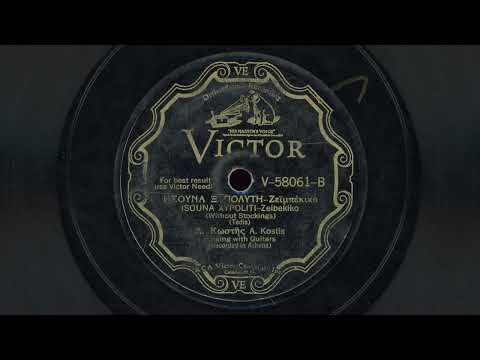
  • “You Were Barefoot” – Kostas Bezos (A. Kostis) (1930) “Ήσουνα Ξυπόλυτη” – Α. Κωστής

    “You Were Barefoot” – Kostas Bezos (A. Kostis) (1930) “Ήσουνα Ξυπόλυτη” – Α. Κωστής

    Fulfilling a special request for viewer @someoneunknown2003: the B side of Victor V-58061.

    Recorded in Athens in 1930 by Victor representative Tetos Dimitriadis and released in the U.S.

    This mysterious rebetiko artist recorded a handful of records in the early 30s – most of which were pressed in very small numbers and all of which did not attain widespread awareness until much later.

    Unlike typical rebetikos who came from among the poorest population in urban Athens, Bezos was somewhat of outlier. He was born outside of Athens to a middle-class family and came to Athens to work as a journalist and cartoonist. He began a Hawaiian band called the “White Birds” that he played guitar in. At the age of 25, in 1930, he recorded this track and went on to record a total of 12 sides.

    After 1932, he appears to have stopped making records. While he continued his work at the newspaper, he also tried his hand at acting. He died of tuberculosis during the Nazi occupation of Greece in 1943. He was 37.

    An excellent article about him can be found here:
    https://www.lifo.gr/culture/music/poios-itan-o-mystiriodis-kai-afanis-rempetis-kostas-mpezos
    (Use Google translate to translate this page)

    The A side of Victor V-58061 can be heard at:
    https://youtu.be/-hewLiZFxhQ

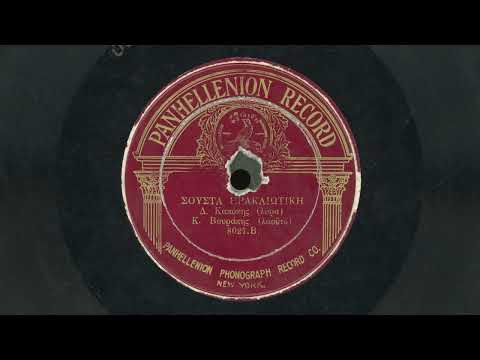
  • “Σούστα Ηρακλιωτικη” (Sousta Heraklion) – Δ. Καπόκης, Κ. Βουράκης (1921)

    “Σούστα Ηρακλιωτικη” (Sousta Heraklion) – Δ. Καπόκης, Κ. Βουράκης (1921)

    Give a listen to this astonishing duet by Greek musicians D. Kapokis and K. Vourakis, about whom I’ve been able to find out very little. Kapokis plays a λύρα – a bowed lyre – while Vourakis plays the λαούτο – a long-necked lute.

    The Σούστα (Sousta) is a greek folk dance performed at weddings. The title of this Sousta is Heraklion – a city in Crete.

    Recorded in New York City circa 1921.
    Released as Panhellenion 8027.

    Credits
    λαούτο (Laouto) – Κ. Βουράκης (K. Vourakis)
    λύρα (Cretan Lyre) – Δ. Καπόκης (D. Kapokis)

  • Ρόζα Εσκενάζυ [ROZA ESKENAZI] – Λιλι Η Σκανδαλιαρα  [“Scandalous Lily”] (1931)

    Ρόζα Εσκενάζυ [ROZA ESKENAZI] – Λιλι Η Σκανδαλιαρα [“Scandalous Lily”] (1931)

    Roza Eskenazi was a famous singer of Greek Rebetiko music who began performing in the cabaret nightclubs of Athens in the 1920s. Discovered by Vassilis Toumbakaris of Columbia Records, she began recording the first of a great many sides for Columbia and became one of Columbia’s most popular Greek artists.

    This scorcher, “Scandalous Lily”, is believed to have been released on Columbia in the U.S. in 1934 on beautiful royal blue shellac – but it was most likely recorded earlier – perhaps in 1931. Released as Columbia G-56320-F on the green Columbia label – designated for ethnic musical releases.

    The song seems to detail the life of a bold and tough woman, Lily (Λιλι), who declares her immunity to the puffed-up machismo that surrounds her. She’s not afraid of knives or smoking and likes to drink and hang out with the guys.

    Roza’s vocal delivery is immediately compelling – she communicates so much without being overly expressive or dramatic.

    It would be wonderful to get a good English translation of the lyrics, which I awkwardly deciphered via Google Translate with mixed results. There seem to be many instances of slang that don’t translate well. Here are the original lyrics in Greek:

    Λιλι Η Σκανδαλιαρα

    Δε με μέλλει εμένα αν είσαι αλάνι
    απ’ τον Κοπανά
    και τον ντούρο βρε μάγκα μη μου κάνεις
    και με φοβερνάς

    Γιατί είμαι εγώ η αλανιάρα
    η Λιλή η πρώτη σκανταλιάρα
    που δε δίνω γρόσι για τους μάγκες
    και δεν τρώγω τρίχες ματσαράγκες

    Βρε αλάνι να φύγεις από μένα
    κοίταξε κι αλλού
    μην πλερώσεις βρε μόρτη τα σπασμένα
    κι είμαι μπελαλού

    Και δε φοβούμαι τα μαχαίρια
    τα νταήδικά σου τα μπεγλέρια
    και νταμίρα όσο κι αν φουμάρεις
    βρε αλάνι δε θα με τουμπάρεις

    Μη σε μέλλει αν είμαι απ’ τον Περαία
    ή απ’ την Κοκκινιά
    κι αν μεθάω και κάνω εγώ παρέα
    με όλο τον ντουνιά

    Εγώ είμαι εκείνη η αλανιάρα
    η Λιλή η πρώτη σκανταλιάρα
    που δε δίνω γρόσι για του μάγκες
    και δεν τρώγω τρίχες ματσαράγκες

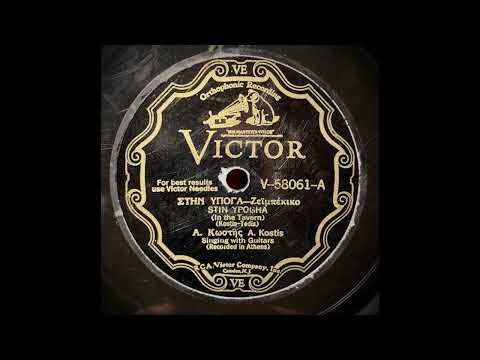
  • “In the Tavern” – Kostas Bezos (A. Kostis) (1930) “Στην Υπόγα” – Κώστα Μπέζου (Α. Κωστής)

    “In the Tavern” – Kostas Bezos (A. Kostis) (1930) “Στην Υπόγα” – Κώστα Μπέζου (Α. Κωστής)

    “Στην Υπόγα” – Κώστα Μπέζου (Α. Κωστής)
    “In the Tavern” – Kostas Bezos (A. Kostis)

    Recorded in Athens in 1930 by Victor representative Tetos Dimitriadis and released in the U.S. as Victor V-58061.

    This mysterious rebetiko artist recorded a handful of records in the early 30s – most of which were pressed in very small numbers and all of which did not attain widespread awareness until much later.

    Unlike typical rebetikos who came from among the poorest population in urban Athens, Bezos was somewhat of outlier. He was born outside of Athens to a middle-class family and came to Athens to work as a journalist and cartoonist. He began a Hawaiian band called the “White Birds” that he played guitar in. At the age of 25, in 1930, he recorded this track and went on to record a total of 12 sides.

    After 1932, he appears to have stopped making records. While he continued his work at the newspaper, he also tried his hand at acting. He died of tuberculosis during the Nazi occupation of Greece in 1943. He was 37.

    An excellent article about him can be found here:
    https://www.lifo.gr/culture/music/poios-itan-o-mystiriodis-kai-afanis-rempetis-kostas-mpezos
    (Use Google translate to translate this page)

    The B Side of Victor V-58061 can be heard at:
    https://youtu.be/NXRTuQeJblI

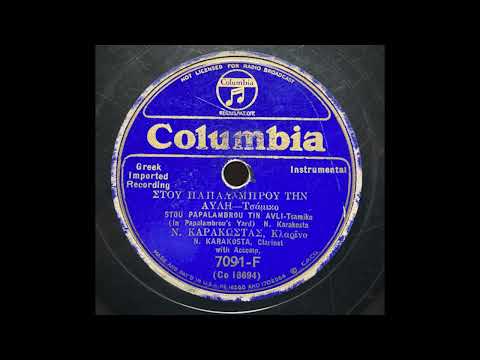
  • Νίκος Καρακώστας – “Στου Παπαλάμπρου Την Αυλή” – Greek Clarinet (1935)

    Νίκος Καρακώστας – “Στου Παπαλάμπρου Την Αυλή” – Greek Clarinet (1935)

    Νίκος Καρακώστας (Nikos Karakostas)
    “Στου Παπαλάμπρου Την Αυλή” (“In Papalambrou’s Yard”)
    Clarinet with accompaniment
    Recorded circa 1935
    Released as Columbia 7091-F