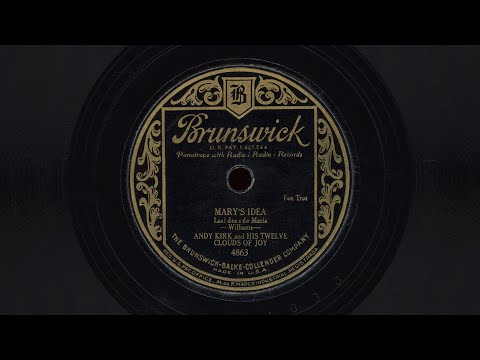
“Mary’s Idea” is an invigorating Mary Lou Williams composition performed by the Kansas City-based Andy Kirk and his Twelve Clouds of Joy. This session finds the band coming off a long series of engagements out East at the Roseland Ballroom. Savoy Ballroom and Apollo Theater. They sound super tight and they fly through this unique proto-swing arrangement like a well-oiled machine.
Lots of brief beautiful moments of inspired solos throughout – though curiously, the composer herself does not take a piano solo.
Recorded in Chicago, Illinois on May 1, 1930. Released as Brunswick 4863.
Credits: Andy Kirk – director, bass sax, tuba Edgar Battle, Harry Lawson – trumpet Allen Durham – trombone John Harrington – clarinet, alto sax John Williams – alto sax, baritone sax Lawrence Freeman – tenor sax Claude Williams – violin Mary Lou Williams – piano, arranger William Dirvin – guitar Edward McNeil – drums
The Great Depression caused many jazz acts to call it quits – but Andy Kirk and his Twelve Clouds of Joy were able to keep working throughout the early 1930s in the thriving dance halls of Kansas City.
Though they recorded a total of nine sessions in 1929-1930, they did not record at all from 1931 – 1935. When they finally got back into the studio in March of 1936, they recut two tunes from their very first 1929 session – “Froggy Bottom” and this one. It’s interesting to hear the differences (and similarities) that a little over six years could make.
Ross Russell, in his “Jazz Style in Kansas City and the Southwest” found the new Decca version of “Corky Stomp” to be a “fresh and superior version.” The Decca version does swing pretty hard – but I think which version you prefer depends greatly on whether your overall jazz preferences tend toward the hotter 20s style or refined 30s swing style.
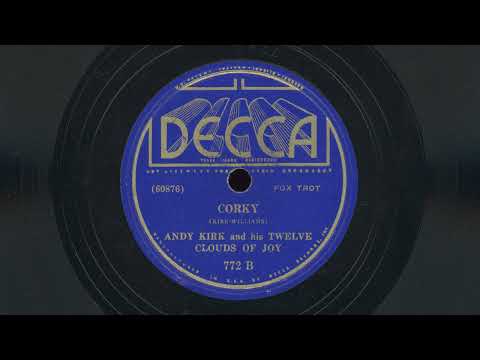
In the new Decca recording, the tune’s title is cut to simply “Corky”. There’ll be no stomping in this version. Also cut is the ensemble introduction. Instead, we open affably with a immediately charming clarinet delivering the melodic head. Noticeably backed by the new combination of bass and guitar in the rhythm section. While there is some ensemble playing – it is more structured and syncopated, with fewer overlapping instruments. After a brief clarinet solo, Mary Lou still takes a piano solo, albeit a little shorter than the 1929 version. Next, a jaunty sax solo spills forward – and we end with a brief clarinet reprise and tightly arranged ending.
Take a listen to both versions – tell me what you think in the comments.
Recorded in New York City on March 7, 1936. Released as Decca 772.
Andy Kirk – bass saxophone, director Harry Lawson, Paul King, Earl Thomson – trumpet Ted Donnelly, Henry Wells – trombone John Harrington – clarinet, alto sax, baritone sax John Williams – alto sax, baritone sax Dick Wilson – tenor sax Mary Lou Williams – piano, arranger Ted Robinson – guitar Booker Collins – string bass Ben Thigpen – drums
One thing that is always interesting to me is to listen to different recordings of the same tune by different jazz bands – or in this case, different recordings of the same tune by the same band that were recorded several years apart.
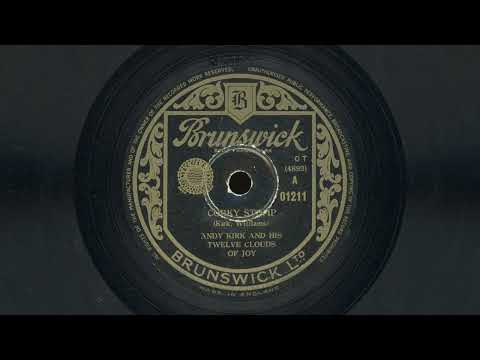
Here we have a 1929 recorded version of “Corky Stomp”, a tune written by pianist Mary Lou Williams. The lead melody is played by Durham’s trombone. The rhythm section includes the banjo and tuba/bass sax that were more common in 20s jazz. In the middle of the tune, we get a brief hot trumpet solo followed by a delightful extended piano solo from Mary Lou Williams. The coda is marked by ensemble playing.
Take a listen to both versions – tell me what you think in the comments.
Recorded in Kansas City, Missouri on November 11, 1929. Originally released in the U.S. as Brunswick 4893. Released in the U.K. as Brunswick 01211 (master pressing).
Credits: Andy Kirk – bass saxophone, tuba, director Gene Prince, Harry Lawson – trumpet Allen Durham – trombone John Harrington – clarinet, alto sax John Williams – alto sax, baritone sax Lawrence Freeman – tenor sax Claude Williams – violin Mary Lou Williams – piano, arranger William Dirvin – banjo, guitar Edward McNeil – drums
Andy Kirk was a tuba player who grew up in Denver, Colorado where he studied music with the father of Paul Whiteman. From 1925-29, he was a member of a group led by Terence Holder in Dallas, Texas. The group was known as “Clouds of Joy”. In the winter of 1928-29, Holder left the group stranded in Oklahoma City. Kirk become the new band leader, pulled the group together, finished the tour, and began a gig at a ballroom in Kansas City, where they attracted the notice of A&R scouts from Brunswick.
At their audition for Brunswick, their piano player was a no-show, so Saxophonist John Williams called his wife to come in, who was a pianist with perfect pitch and a good ear for jazz. She arrived and played through the band’s charts flawlessly. This was Mary Lou Williams’ big break, as when the band showed up to the recording session with their regular pianist, the A&R scouts insisted that Mary Lou be on the recording – securing her place in the band.
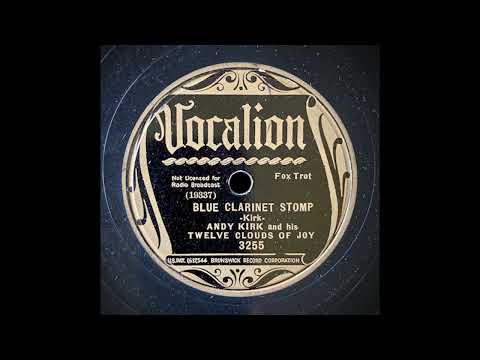
This first recording session resulted in four released tracks, including this tune, “Blue Clarinet Stomp”.
Recorded in Kansas City, Missouri circa November 7-8, 1929. Originally released as Brunswick 4694. This Vocalion dubbed reissue was from the late 1930s.
Credits: Andy Kirk – bass sax, tuba, director Gene Prince, Harry Lawson – trumpet Allen Durham – trombone John Harrington – clarinet, alto sax John Williams – alto sax, baritone sax Lawrence Freeman – tenor sax Claude Williams – violin Mary Lou Williams – piano William Dirvin – banjo, guitar Edward “Crackshot” McNeil – drums
Sources: “Jazz Style in Kansas City and the Southwest” by Ross Russell University of California Press, 1971 pp 163-165