Jazz Crazy Records

An Archive of Early Jazz on 78 RPM

Tag: Duke Ellington and his Famous Orchestra

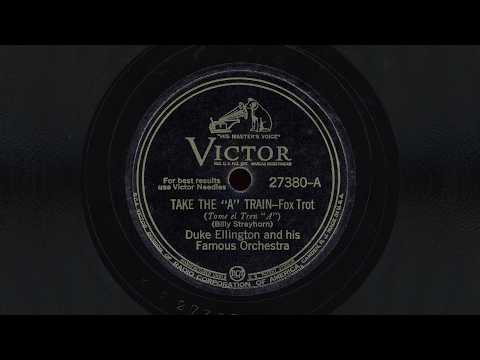
  • “Take the A Train” – Duke Ellington and his Famous Orchestra (1941)

    “Take the A Train” – Duke Ellington and his Famous Orchestra (1941)

    In celebration of Pride month 🏳️‍🌈 all of my posts this month will feature the music of LGBTQ+ artists of the 78 rpm era!

    Of all the tunes Billy Strayhorn wrote for Duke Ellington’s Orchestra, “Take the A Train” – while a more straightforward swing number that was atypical of Strayhorn’s usual style – stands out as a shining example as his most successful composition. The proto-bop intro riff and Ray Nance’s trumpet solo at 0:51 are real highlights.

    “Take the A Train” was adopted by Ellington as the signature tune of his orchestra, who literally played it “virtually every day for decades.” Scholars have counted over 1100 recorded performances by the Ellington band alone. “To the general audience the piece became virtually synonymous with Duke Ellington.”

    It is worth discussing the importance of Duke as an true ally to Strayhorn. I’ll quote from a long passage in Lush Life to illustrate this:

    “Famously egalitarian, Ellington accepted Strayhorn’s homosexuality much as he had long embraced gifted musicians regardless of their backgrounds or idiosyncrasies. ‘Pop never cared one bit that Strayhorn was gay,’ said Mercer Ellington. ‘He was never prejudiced against anybody he thought was really worthy… Pop knew the story. He backed up Strayhorn all the way.’”

    “Another gay musician who was a close friend of Strayhorn’s evoked the virtue of Ellington’s patronage empathetically. ‘For those of us who were both black and homosexual in that time, acceptance was of paramount importance, absolutely paramount importance. Duke Ellington afforded Billy Strayhorn that acceptance. That was something that cannot be undervalued or under-appreciated. To Billy, that was gold.’”

    “The most amazing thing of all about Billy Strayhorn to me was that he had the strength to make an extraordinary decision – that is, the decision not to hide the fact that he was homosexual. And he did this in the 1940s, when nobody but nobody did that… He wasn’t afraid. We were. And you know what the difference between us was? Duke Ellington.”’
    [Lush Life, p. 79]

    In Duke Ellington’s on words, Strayhorn was “the biggest human being who ever lived, a man with the greatest courage, the most majestic artistic stature, a highly skilled musician whose impeccable taste commanded the respect of all musicians and the admiration of all listeners… He was a beautiful human being, adored by a wide range of friends, rich, poor, famous, and unknown.”

    Happy Pride! 🏳️‍🌈 🏳️‍⚧️

    Recorded in Hollywood, California on February 15, 1941.
    Released as Victor 27380.

    Credits:
    Duke Ellington – piano, director
    Billy Strayhorn – arranger
    Wardell Jones, Ray Nance – trumpet
    Rex Stewart – cornet
    Joe Nanton, Lawrence Brown – trombone
    Juan Tizol – valve trombone
    Barney Bigard – clarinet
    Johnny Hodges – clarinet, soprano sax, alto sax
    Harry Carney – alto sax, bass sax
    Ben Webster – tenor sax
    Fred Guy – guitar
    Jimmy Blanton – string bass
    Sonny Greer – drums

    Sources:
    Lush Life
    Something to Live For: The Music of Billy Strayhorn, Walter van de Leur, Oxford University Press, 2002
    Jazz and Ragtime Records (1897-1942), Brian Rust, 6th Ed.
    Homophobia in Jazz – JazzTimes – https://www.jazztimes.com/features/profiles/homophobia-in-jazz/

  • “Chelsea Bridge” – Duke Ellington and his Famous Orchestra (1941)

    “Chelsea Bridge” – Duke Ellington and his Famous Orchestra (1941)

    In celebration of Pride month 🏳️‍🌈 all of my posts this month will feature the music of LGBTQ+ artists of the 78 rpm era! Today, we continue our showcase on composer and pianist Billy Strayhorn.

    Chelsea Bridge is a composition inspired by the impressionistic paintings of James McNeill Whistler. Take a look at a Whistler painting such as “Nocturne in Black and Gold, the Falling Rocket” or perhaps more relevantly, “Nocturne: Blue and Gold – Old Battersea Bridge” to get an idea of the aesthetic spirit from which Strayhorn developed his stylistic motifs.

    Chelsea Bridge has often been framed as classical in approach – most commonly compared with the work of French composer Claude Debussy. It stands out as something very different from the typical Ellington sound, though Ellington himself had been experimenting with a new styles of jazz composition influenced by modernistic classical music in works from the 1930s such as Mood Indigo or Reminiscing in Tempo.

    While bebop would dominate jazz in the year’s after the war, the effect of Strayhorn’s work would go on to have a huge effect on the upcoming next generation of jazz artists who rose to prominence in the 50s and 60s.

    Gerry Mulligan wrote, “When Strayhorn came on the scene, he just blew us away, because he was doing very complicated, sophisticated things, and they didn’t sound complicated to the ear at all – they sounded completely natural and very emotional. To bring all that complexity to bear and have it be so beautiful was something incredible to everybody who knew anything.”

    Composer and arranger Gil Evans – who famously collaborated with Miles Davis on such exquisite records as Miles Ahead and Sketches of Spain wrote: “From the moment I first heard ‘Chelsea Bridge,’ I set out to try to do that. That’s all I did – that’s all I ever did – try to do what Billy Strayhorn did.”

    The moody and melodic tones of Chelsea Bridge suggest a contemplative state of impressionistic moments. Childhood friend Mickey Scrima offered his explanation of what was called the Strayhorn Sound: “The guy went through a lot of shit in his life, from his father right on through school – the kids calling him a sissy, you know. He kept it all in and put on a big front that everything was fine, nothing bothered him. Then he sat down and wrote all that music with all that emotion. All his feelings came out in the music. That’s what made his stuff so incredible and different from Duke’s. It was great music, like Duke’s was, and it was so full of dark feelings.”

    As Duke Ellington wrote in 1967 after Strayhorn’s passing: “God Bless Billy Strayhorn.”

    Happy Pride! 🏳️‍🌈 🏳️‍⚧️

    Recorded in Hollywood, California on December 2, 1941.
    Released as Victor 27740.

    Credits:
    Duke Ellington – piano, director
    Billy Strayhorn – arranger
    Wardell Jones, Ray Nance – trumpet
    Rex Stewart – cornet
    Joe Nanton, Lawrence Brown – trombone
    Juan Tizol – valve trombone
    Barney Bigard – clarinet
    Johnny Hodges – clarinet, soprano sax, alto sax
    Harry Carney – alto sax, bass sax
    Ben Webster – tenor sax
    Fred Guy – guitar
    Junior Raglin – string bass
    Sonny Greer – drums

    Sources:
    Lush Life: A Biography of Billy Strayhorn, David Hajou, Farrar Straus Giroux, 1996
    Something to Live For: The Music of Billy Strayhorn, Walter van de Leur, Oxford University Press, 2002
    Jazz and Ragtime Records (1897-1942), Brian Rust, 6th Ed.

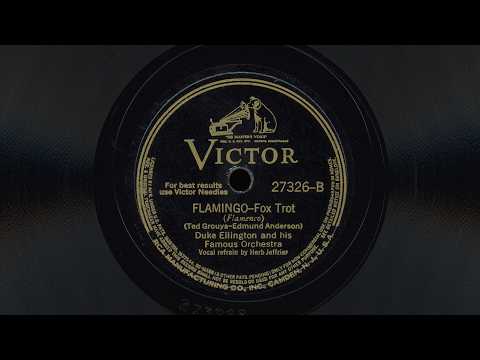
  • “Flamingo” – Duke Ellington and his Famous Orchestra (1940) 🦩

    “Flamingo” – Duke Ellington and his Famous Orchestra (1940) 🦩

    In celebration of Pride month 🏳️‍🌈 all of my posts this month will feature the music of LGBTQ+ artists of the 78 rpm era!

    Today we’ll continue with our focus on Billy Strayhorn – with his arrangement of Flamingo, a song written by Romanian-born Ted Grouya, who brought the song to Ellington via Herb Jeffries and Billy Strayhorn, who arranged the song after Ellington heard. him playing it.

    The arrangement he came up with is considered a breakthrough revelation. composer John Lewis said that Flamingo “had nothing to do with what had gone on in jazz at all before. It sounded as if Stravinsky were a jazz musician.” and Ellington himself called Flamingo “A turning point in vocal background orchestration, a renaissance in elaborate ornamentation for the accompaniment of singers.”

    Compositionally, what Strayhorn has achieved is beyond my capacity to articulate – but Walter van de Leur does a fine job describing its innovations – involving compmlex modulations between keys to create “tonal detachment,” along with the vocalist’s participation in that modulation at one point.

    The record was also a hit for the Ellington band and a boon to the career of vocalist Herb Jeffries, who made it his theme song and later named a nightclub in Florida “The Flamingo Club” after the song.

    Happy Pride! 🏳️‍🌈 🏳️‍⚧️

    Recorded in Chicago, Illinois on December 28, 1940.
    Released as Victor 27326.

    Credits:
    Duke Ellington – piano, director
    Billy Strayhorn – arranger
    Wardell Jones, Ray Nance – trumpet
    Rex Stewart – cornet
    Joe Nanton, Lawrence Brown – trombone
    Juan Tizol – valve trombone
    Barney Bigard – clarinet
    Johnny Hodges – clarinet, soprano sax, alto sax
    Harry Carney – alto sax, bass sax
    Ben Webster – tenor sax
    Fred Guy – guitar
    Jimmy Blanton – string bass
    Sonny Greer – drums

    Sources:
    Something to Live For: The Music of Billy Strayhorn, Walter van de Leur, Oxford University Press, 2002
    Jazz and Ragtime Records (1897-1942), Brian Rust, 6th Ed.

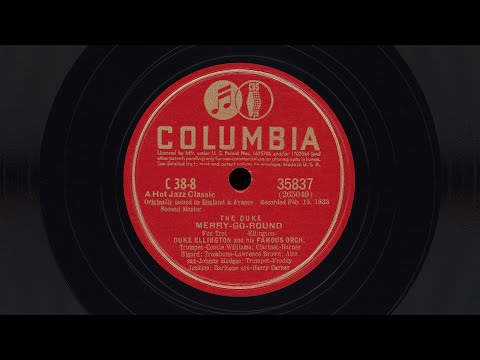
  • “Merry-Go-Round” – Duke Ellington and his Famous Orchestra (1933)

    “Merry-Go-Round” – Duke Ellington and his Famous Orchestra (1933)

    Here’s the 1933 version of “Merry-Go-Round”. See what you think.

    Compare it to the 1935 Brunswick version:
    https://youtu.be/r7EudWdagLc

    Recorded in New York City on February 15, 1933.
    This is take 2.
    Released as Columbia 35837 as part of Columbia’s Hot Jazz Classics series “The Duke” (C 38). Since this is the first issue of this take, it is the original issue.
    Take 3 was released in 1933 only on Columbia in Europe and Australia.

    Credits:
    Duke Ellington – piano, arranger, director
    Arthur Whetsel Freddy Jenkins, Cootie Williams – trumpet
    Joe Nanton, Lawrence Brown – trombone
    Juan Tizol – valve trombone
    Johnny Hodges – clarinet, soprano sax, alto sax
    Harry Carney – clarinet, alto sax, baritone sax
    Otto Hardwick – alto sax, bass sax
    Barney Bigard – clarinet, tenor sax
    Fred Guy – banjo, guitar
    Wellman Braud – string bass
    Sonny Greer – drums

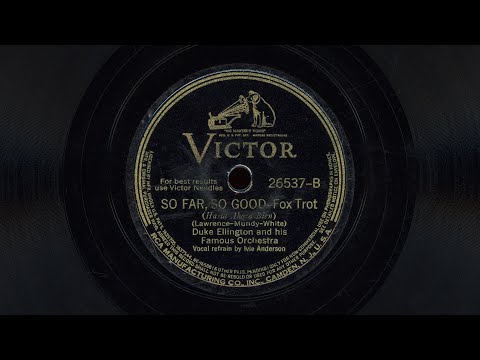
  • “So Far, So Good” – Duke Ellington and his Famous Orchestra (1940)

    “So Far, So Good” – Duke Ellington and his Famous Orchestra (1940)

    This week I’ll be highlighting some really lovely jazz vocal records – starting with a tune that was on the CD set that first turned me on to jazz back in the late 1980s: The Blanton–Webster Band by Duke Ellington, which collected together Duke’s singles from 1940-42.

    I was working at photo-video checkout as a student at the Kansas City Art Institute and my boss, jazz musician Reverend Dwight Frizzell, would constantly play jazz at work – and narrate the history of the bands or comment on the arrangements of each tune. This set was one of the first that perked my ears up and I ended up buying a copy.

    Reading the excellent liner notes of that set – which gave a historical background of the Blanton-Webster band, along with detailed notes on each of the sixty six songs – was like a master class in learning to listen to and understand jazz.

    Decades later when I got into collecting 78s I have tried to find as many of the outstanding tunes on this release as I could on 78 rpm.

    Here we have the lovely Ivie Anderson singing “So Far, So Good”. It was a song I often skipped in my younger years – wanting to focus on the instrumental numbers. This could have been influenced by the liner notes, which introduced this as “a pop song that had been previously recorded by several white artists” and went on to call the arrangement “workaday” and said the band “sounds ready to go home.”

    But this perhaps misses the larger point: The star of this number is the delightful vocal performance by Ivie Anderson. I’ve grown to love it – and hope you do too.

    Recorded in Chicago, Illinois on March 6, 1940.
    Released as Victor 26537.

    Credits:
    Duke Ellington – piano, arranger, director
    Wallace Jones, Cootie Williams – trumpet
    Rex Stewart – cornet
    Joe Nanton, Lawrence Brown – trombone
    Juan Tizol – valve trombone
    Barney Bigard – clarinet
    Johnny Hodges – clarinet, soprano sax, alto sax
    Harry Carney – clarinet, alto sax, baritone sax
    Otto Hardwick – alto sax, bass sax
    Ben Webster – tenor sax
    Fred Guy – guitar
    Jimmy Blanton – string bass
    Sonny Greer – drums
    Ivie Anderson – vocals

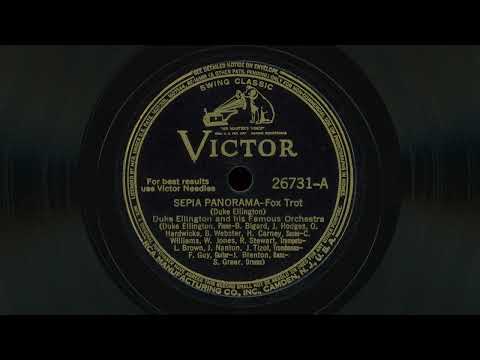
  • “Sepia Panorama” – Duke Ellington and his Famous Orchestra (1940)

    “Sepia Panorama” – Duke Ellington and his Famous Orchestra (1940)

    The first jazz CD I ever bought was Duke Ellington’s “The Blanton-Webster Band” – a 3 disc set of one of Duke’s most polished and innovative bands. I listened to it countless times at work where my supervisor, jazz musician and artist Reverend Dwight Frizzell, would play it – often commenting on the tracks as they played. Noting a performer or a particularly interesting solo.

    For a 19 year old whose taste in music was firmly in 70s and 80s punk and art rock, this music was a revelation. It was not at all predictable. The performances were absolutely perfect. Most importantly, it effortlessly and authentically expressed joy. To this day, the Ellington recordings from 1940-1942 on Victor remain favorites that I return to often.

    Here we have one of the more interesting compositions to fit on a 78 rpm record: an ABCDDCBA song form.

    0:00 A section (12 bars)
    0:26 B section (16 bars)
    1:01 C section (8 bars)
    1:18 D section (12 bars)
    1:45 D section (12 bars)
    2:12 C section (8 bars)
    2:29 B section (8 bars)
    2:46 A section (12 bars)

    The D section is the inner core of the tune – a 12 bar blues that features Ellington and Blanton in the first go round and a quiet lush Ben Webster in the second. The rest of the sections seem to arc us first toward and then away from that beautiful moment in the middle.

    Recorded in New York City on July 24, 1940.
    Released as Victor 26731

    Credits
    Duke Ellington – piano, arranger, director
    Wardell Jones, Cootie Williams – trumpet
    Rex Stewart – cornet
    Joe Nanton, Lawrence Brown – trombone
    Juan Tizol – valve trombone
    Barney Bigard – clarinet
    Johnny Hodges – clarinet, soprano sax, alto sax
    Harry Carney – alto sax, bass sax
    Ben Webster – tenor sax
    Fred Guy – guitar
    Jimmy Blanton – string bass
    Sonny Greer – drums

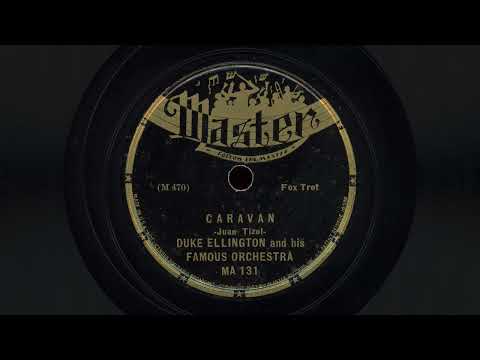
  • “Caravan” – Duke Ellington and his Famous Orchestra (1937)

    “Caravan” – Duke Ellington and his Famous Orchestra (1937)

    Earlier this year I posted the original recording of this Juan Tizol tune, “Caravan” on the Variety label from December of 1936 featuring a smaller subset of the Ellington orchestra billing themselves as Barney Bigard and his Jazzopaters:
    https://youtu.be/M17eZcf_hOw

    Here, in this recording from about five months later, we hear the tune with the full Ellington orchestra with a few interesting differences. There is a more complex polyrhythmic introduction by Sonny Greer on drums that goes on for a few more bars, setting a tone that feels both Cuban and North African simultaneously. This is followed by Juan Tizol’s trombone laying down the theme, very softly accompanied by a reedman. The unmistakable growl of Cootie Williams’ trumpet then can be heard simmering in the background.

    Barney Bigard’s clarinet then takes a solo, followed by Williams. All-in-all, this version seems to be more complex and subdued that the original, swinging a little less but more richly ornamental and evocative. Even though the entire Ellington orchestra is credited, this recording has a very intimate feel due to the focused arrangement.

    Recorded in New York City on May 14, 1937.
    Released as Master MA 131. Later reissued as Brunswick m7997 and Columbia 36120.

    The Master label was created in 1936 by Ellington manager Irving Mills (along with the Variety label). Only 40 records were issued by Master and it folded in 1937, with some of its masters then being reissued by Brunswick.

    Credits (as per Brian Rust’s “Jazz and Ragtime Records, 1897-1942”, 6th Ed.)
    Duke Ellington – piano, arranger, director
    Wallace Jones, Cootie Williams – trumpet
    Rex Stewart – cornet
    Joe Nanton, Lawrence Brown – trombone
    Juan Tizol – valve trombone
    Barney Bigard – clarinet
    Johnny Hodges – clarinet, soprano sax, alto sax
    Harry Carney – clarinet, alto sax, baritone sax
    Otto Hardwick – alto sax, bass sax
    Fred Guy – guitar
    Hayes Alvis, Billy Taylor – string bass
    Sonny Greer – drums