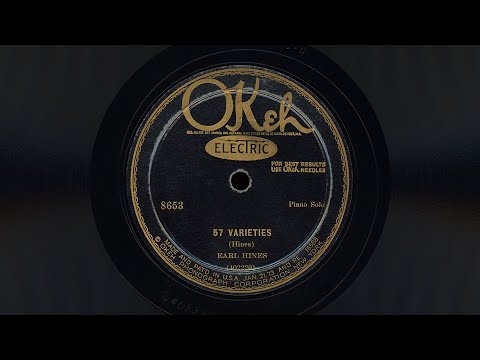
An outstanding Earl Hines original composition played on an early electric piano.
The Storytone electric piano was introduced at the 1939 World’s Fair, and was “probably the first to be produced commercially.” It used electromagnetic pickups located behind each string – much like an electric guitar – whose output is then amplified. Only 150-250 units were produced and production ceased in 1942.
Recorded in New York City on February 26, 1940. Released as Bluebird B-10642
After wrapping up a full summer of recording some of the most beloved classics of early jazz with Louis Armstrong and his Hot Five, pianist Earl Hines was surreptitiously recorded while messing around on the piano. Satch and the Savoy Ballroom Five had just recorded Heah Me Talkin’ To Ya?, St. James Infirmary, and Tight Like This in the studio and took a break. I’ll let Hines tell the rest:
“It was an accident. I was recording with Louis, we were down making a session. In the intermission, the guys were all back in the room having dinner and drinking, having a ball. I didn’t feel like it, so I was out front playing piano, just fooling around. Finally somebody comes out after I’d played awhile and he whispers, “Put an ending, put an ending.” I didn’t know they were recording me. So I put an ending, and they said “Shhhh… we’ll finish it.” That was it. After I come out, they say, “What are we going to call it?”. So one boy says, “His name is Hines, call it ‘Hines 57 Varieties’.” I never played it since. I don’t know what I did, I was just playing.” – Earl Hines, in an interview with Anthony Baldwin in September of 1979.
The 57 Varieties connection is a play on the advertising slogan of the H.J. Heinz Company, which was introduced in 1896 to market its wide selection of food products such as pickles, horseradish, relishes, and ketchup. The slogan has appeared on bottles of Heinz Ketchup for decades and also led to the creation of a steak sauce called “Heinz 57”.
Enjoy!
Recorded in Chicago, Illinois on December 12, 1928. Released as Okeh 8653.
Credits: Earl Hines – piano
Sources:
Jazz and Ragtime Records (1897-1942), 6th Ed, Brian Rust