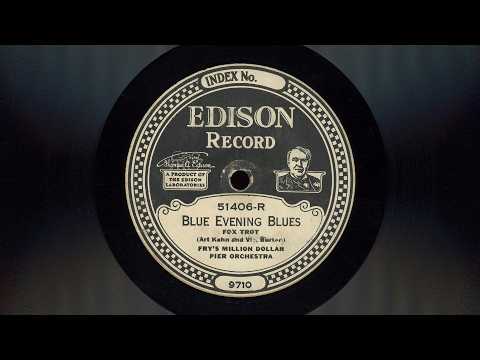
Here’s a treat – a jazz record from 1924 on Edison Records – which could hold more music than a standard 78 rpm shellac disc. This tune clocks out at over four minutes and ten seconds!
If you’re a frequent 78 listener, around the 3 minute mark you’ll have to resist the urge to get up to flip the record.
Some fun doo-wacka-doo sections, a piano solo at 1:44, a sax solo at 2:08, a muted trumpet solo at 2:31, and a clarinet solo at 3:17 round things out to make this blue evening blues quite a cheerful number.
Recorded in New York City on September 15, 1924. Released as Edison 51406.
Credits: Charlie Fry – alto sax, violin, director Julian Kurtzman, Theo Wohleben – trumpet Ben Morgan – trombone Ray Thwaite, Oscar Moldaur – clarinet, soprano sax, alto sax John Baviton – clarinet, tenor sax Ray Allen – piano Frank Kriell – banjo Herman Schmidt – tuba Fred Niehardt – drums
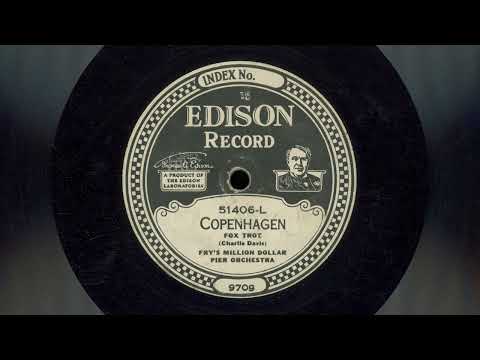
The song “Copenhagen” was written by Indiana bandleader Charlie Davis as an homage to his sousaphone player’s favorite chewing tobacco. When the band performed the newly written piece in Indianapolis in April 1924, the seven members of The Wolverine Orchestra were in the audience listening. Within a few weeks, the Wolverines became the first band to record the composition in a session for Gennett that was released in June.
Melrose Brothers publishing quickly prepared a stock arrangement of the piece based on the Wolverines record – which was published in August of 1924. The title page of the arrangement stated: “This arrangement is RED HOT as written. Play what you see and the horns will start smoking.”
On September 8, the Benson Orchestra of Chicago recorded a very popular version for Victor. A week later, Charlie Fry and his Million Dollar Pier Orchestra – who had been playing with the Benson Orchestra in Atlantic City during the summer – released this version. Coincidentally, between these two sessions, the Wolverine Orchestra began a residency at the Cinderella Ballroom in New York City.
In the last three months of 1924, ten additional versions were recorded by bands including Fletcher Henderson, California Ramblers, and Arkansas Travelers.
Fry’s version stuck closely to the stock arrangement, with an extra clarinet and sax solo for good measure – since they were recording on Edison, maybe they figured had a little extra time since Diamond Discs could hold nearly 4 minutes of music compared with a little over 3 minutes for a standard 10″ shellac disc.
0:00 Intro (ensemble) 0:17 Clarinet solo 0:30 Tenor Sax solo 0:43 Ensemble 1:00 Clarinet solo 1:13 Tenor Sax solo 1:26 Ensemble 1:43 Trumpet solo 2:01 Ensemble 2:17 Tuba solo with banjo 2:43 Ensemble
Recorded in New York, New York on September 15, 1924. Released as Edison 51406-L
Charlie Fry – Director, Alto Saxophone, Violin Julian Kurtzman, Theo Wohleben – Trumpet Oscar Moldaur, Ray Thwaite – Clarinet, Alto Saxophone, Soprano Saxophone John Baviton – Clarinet, Tenor Saxophone Ben Morgan – Trombone Ray Allen – Piano Herman Schmidt – Tuba Frank Kriell – Banjo Fred Niehardt – Drums
All the credit for the excellent information about the history of “Copenhagen” goes to the very informative article “Revisiting Fletcher Henderson’s ‘Copenhagen’” by Jeffrey Magee in the Journal of the American Musicological Society , Spring, 1995, Vol. 48, No. 1 (Spring, 1995), pp. 42-66 http://www.jstor.com/stable/3128850