The flipside of the 9″ Emerson disc by Louisiana Five I posted earlier.
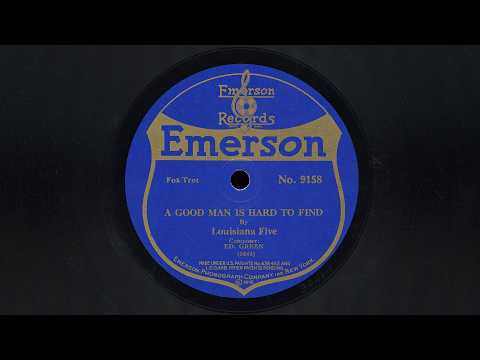
A rousing version of “A Good Man Is Hard to Find” by African-American songwriter Eddie Green. The chorus bemoans that “A good man is hard to find. You always get the other kind.”
Recorded in New York City on February 1, 1919. Released as Emerson 9158 and Medallion 847.
Credits: Charlie Panelli – trombone Alcide Nuñez – clarinet Joe Cawley – piano Karl Berger – banjo Anton Lada – drums
Today: Spinning another cute lil’ 9″ Emerson disc by Louisiana Five. Funny enough, I found an ad from May 1919 that described these 9″ records as their “large size” records (compared to their other 7″ issues).
Another ad promoting the band bears the headline: “Do they have the ‘Blues’ in Boston?” and goes on from there: “Yes indeed, ‘Blues’ one-steps and fox-trots have taken staid, conservative Bostontown by storm. All New England, for that matter! New England Folks are one-stepping and fox-trotting to the melodious dance records which the famous Louisiana Five is making, these days, for the Emerson Phonograph Company.”
This was their second recording session – but their first that resulted in released material. Their first session for Victor in November 1918 went unissued (A take of “Yellow Dog Blues”).
This was not, however, the first record issued by the group. Another tune from this session (“Heart Sickness Blues”) and a tune from another session in February (“Orange Blossom Blues”) were first issued by Emerson in April of 1919 (catalog number 9150). This record was released a month later, in May of 1919.
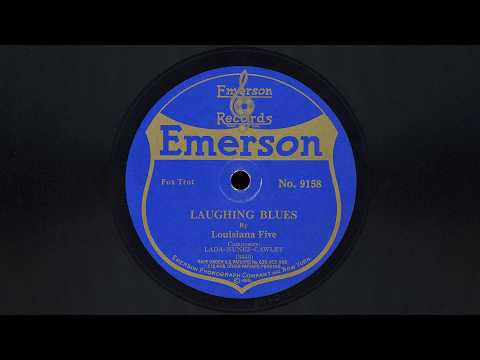
Laughing Blues was an original composition co-credited to three of the L5 members. It features New Orleans – style ensemble playing that showcases Alcide Nuñez on clarinet with support from Charlie Panelli on trombone.
As you might expect from the title and the year of release, novelty “laughing” effects are presented by Nuñez starting at 1:46. Notably, two years before Louis Panico would popularize the “laughing” technique in “Wabash Blues” by the Isham Jones Orchestra.
Recorded in New York City on February 1, 1919. Released as Emerson 9158 and reissued as Medallion 846.
Credits: Charlie Panelli – trombone Alcide Nuñez – clarinet Joe Cawley – piano Karl Berger – banjo Anton Lada – drums
The first published recordings of the Louisiana Five were made for the Emerson Phonograph Company in New York City and were released on non-standard 7″ and 9″ formats. These are not terribly common to find out there – and almost always in rough shape – so one has to wonder how large the original press runs of these discs were.
The Emerson 9 inch Universal Cut record series included releases of “quick selling, popular, dance, vocal, and patriotic selections” and retailed for only 65 cents. Jazz was still an emerging musical art form in 1919, and only a few jazz artists made it onto this series.
Besides Louisiana Five (who also appeared on Emerson 9150, 9158, 9165, and 9178), the series featured mostly popular vocalists and military bands. A few other releases in this series showcased dance and novelty bands such as Van Eps Banta Trio, Emerson Xylo-Phiends, and Emerson Dance Orchestra.
I think I was able to coax some decent sound out of this well-loved acoustically-recorded disc that suffered from a bit of warpage on the outer grooves.
As with side A of this record, Alcide Nuñez again makes the biggest impression – with the clear melodies of his clarinet shining the brightest – but this side makes Joe Cawley’s piano and Anton Lada’s percussion more audible.
In 1927, Clarence Williams recorded the exact pairing of songs that appears on this record, and it is my working theory that he must have had a copy of this record in his personal collection.
I posted a transfer of this tune as performed by Williams back in January and put the word out that I was very interested in hearing this record. VERY thankful to @Desdemona202 (Colin Hancock), who found a copy and sent it to the jazz bunker at no charge! Thank you, sir! 🎺
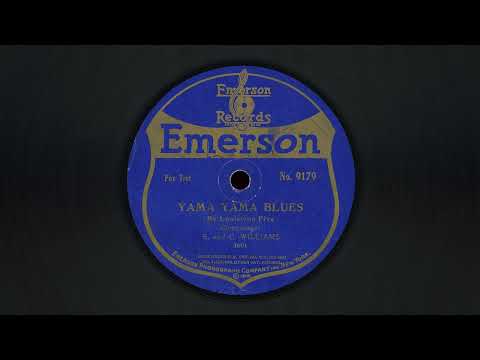
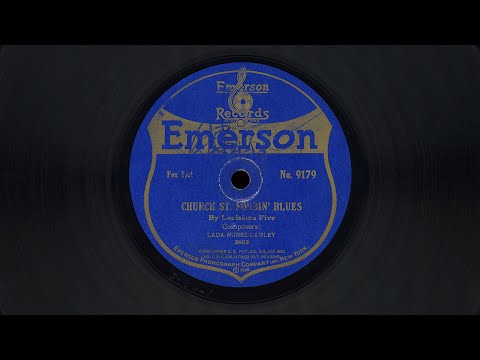
Recorded in New York City in March 1919. Released as Emerson 9179 in June of 1919. Side A: Matrix 3601-1
Credits: Charlie Panelli – trombone Alcide Nuñez – clarinet Joe Cawley – piano Karl Berger – banjo Anton Lada – drums
Sources: Emerson Records: The Complete Discography (1915-1928), 2nd Edition, by Allan Sutton (Mainspring Press) Jazz and Ragtime Records, 1897-1942, 6th Ed, Brian Rust (Mainspring Press)
The first published recordings of the Louisiana Five were made for the Emerson Phonograph Company in New York City and were released on non-standard 7″ and 9″ formats. These are not terribly common to find out there – and almost always in rough shape – so one has to wonder how large the original press runs of these discs were.
The Emerson 9 inch Universal Cut record series included releases of “quick selling, popular, dance, vocal, and patriotic selections” and retailed for only 65 cents. Jazz was still an emerging musical art form in 1919, and only a few jazz artists made it onto this series.
Besides Louisiana Five (who also appeared on Emerson 9150, 9158, 9165, and 9178), the series featured mostly popular vocalists and military bands. A few other releases in this series showcased dance and novelty bands such as Van Eps Banta Trio, Emerson Xylo-Phiends, and Emerson Dance Orchestra.
I think I was able to coax some decent sound out of this well-loved acoustically-recorded disc that suffered from some warpage.
Alcide Nuñez is the real star of this record – his clarinet sounding loud and clear – and his optimistic playing making one wonder if one is truly listening to a sobbin’ blues or if this could instead represent a celebratory revelry.
Louisiana Five famously eschewed the trumpet/cornet and made the clarinet the melodic centerpiece of the band. One wonders if Nuñez’ experience with firecracker Nick LaRocca during his stint with the Original Dixieland Jazz Band had anything to do with that decision.
In 1927, Clarence Williams recorded the exact pairing of songs that appears on this record, and it is my working theory that he must have had a copy of this record in his personal collection.
I posted a transfer of this tune as performed by Williams back in January and put the word out that I was very interested in hearing this record. VERY thankful to @Desdemona202 (Colin Hancock), who found a copy and sent it to the jazz bunker at no charge! Thank you, sir! 🎺
Recorded in New York City in March 1919. Released as Emerson 9179 in June of 1919. Side A: Matrix 3601-1
Credits: Charlie Panelli – trombone Alcide Nuñez – clarinet Joe Cawley – piano Karl Berger – banjo Anton Lada – drums
Sources: Emerson Records: The Complete Discography (1915-1928), 2nd Edition, by Allan Sutton (Mainspring Press) Jazz and Ragtime Records, 1897-1942, 6th Ed, Brian Rust (Mainspring Press)