
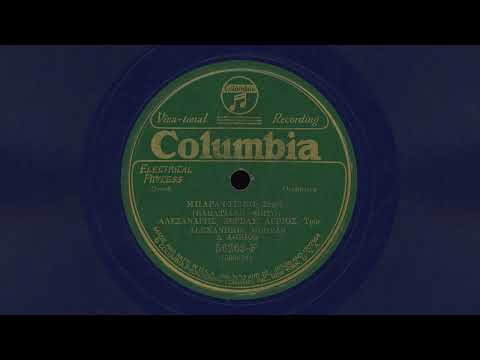
By request – another 12″ Greek disc from the collection. These beautiful royal blue laminated Columbia records were pressed in the middle of the Great Depression starting in late 1932 and continuing until 1935. The laminated shellac generally sounds excellent – even when slightly worn, like this one.
This release, by a group of three musicians called the Mouskas Trio recording in 1928 in New York City. The group recorded six sides that day – and does not appear to have recorded again. The longer playing surface of these 12″ discs means the two sides together deliver nearly nine minutes of recorded music.
Side A, “In Salona”, is a Τσάμικο (Tsamiko).
The tsamiko Sta Salona is quite well known and especially popular in the early 20th century, there being dozens of recordings from both Greece and USA, both instrumental and sung. Salona is a village near Mt Parnassos in central Greece (Sterea Ellas or Roumeli) now called Amfissa as it was in ancient times. Salona was its medieval name up to and during the Greek War of Independence. The tune is also known as “Sta Salona Sfazun Arnia, Maria Pentayiotissa” (In Salona they are slaughtering lambs, Maria Pentayiotissa).*
Side B, “Baraïtiano”, is a Συρτό (Syrto).
Baraitiano is also a well known tune but usually called Beratiano Μπερατιανό or Berati Μπεράτι The tune is also called Himariotiko Χειμαριώτικο, from the Greek inhabited town of Himara in southern Albania. The tune has traveled such that in the Peloponnese it is often called Peratiano and on the island of Kalymnos it is known as Thimariotiko Θυμαριώτικο where it is a specific dance for males.*
Recorded in New York City on Oct 16, 1928.
Released as Columbia 56263-F.
Originally released as Okeh 82521.
Credits:
clarinet, violin, cimbalom
Αλεξανδρής (Alexanders)
Ζέρβας (Gervas)
Άγριος (Agrios)
Sources:
Ethnic Music on Records, Vol 3, Dick Spottswood, p. 1134
* Joe Graziosi – @romeikos2