
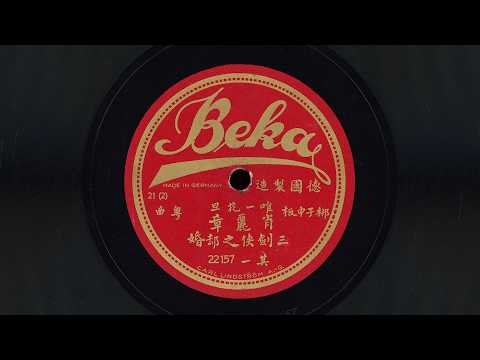
I haven’t posted a non-jazz record for a while – and for some reason I have a thing for these Beka discs of 1920s and 30s Teochew opera from Hong Kong and the Guangdong province.
Here we have Parts 1 and 2 of a a Cantonese opera work sung in medium tempo (中板). I really went down a rabbit hole in my research for this record, but discovered some fascinating things that present to you, dear viewer:
Title: 三劍俠之邦婚 (The Three Swordsmen: Refusing the Marriage Proposal)
Performer: 肖麗章 (Xiào Lì Zhāng)
A slight variation of this title (三劍俠之卻婚) appears in a 1928 Chinese booklet that recounts the plot and lyrics of this scene. It involve a young woman (who is betrothed to a man she has no affection for) who is singing to a masked swordsman who has saved her life and subsequently asks for her hand in marriage. Although she feels an attraction to him and is emotionally drawn to his proposal, she describes her inability to act upon it because of the social conventions governing marriage at the time.
In a collection of dramatic works from 1930 (戲劇彙刊), this title also appears in a section describing the repertoire of recordings on the Beka label.
The vocalist, 肖麗章 (Xiào Lì Zhāng) was born in 1879 as 古錦文 (Gu Jinwen). He was a male opera performer active in the 20s and 30s as a member of the 大班新中华班 (Daban Xin Zhonghua Opera Troupe and the 興中華劇團 Xing Zhonghua Opera Troupe.
Strong, tall and slender, Xiao was originally a physical performer who first specialized in portraying the 小武 (Xiaowu) role – a young male role specializing in heroic and fighting characters.
However, he then was to become a leading male 花旦 (Huadan) role actor – a traditional role in Chinese opera that portrayed a young or middle-aged woman with an optimistic, outspoken, strong, confident, and freedom-loving personality. Huadan were often courtesans and were often played with comedic charm. Huadan role parts could be played by either female or male performers.
Xiao was known as the “Emperor of Voice” (聲皇) in his day. He rarely employed vocal ornamentation and was instead renowned for his exceptionally clear and ringing singing voice, likened to “pearls falling onto a jade plate” (珠落玉盤). It is said that his expressions were deeply moving and that he often brought tears to the eyes of the audience during his sorrowful moments.
He is also known to have recorded for the Odeon label. He spent the later years of his life living in Honolulu, Hawaii and passed away in 1968.
True experts in Teochew opera, please help correct any errors in my description of this record and performer!
Credits:
肖麗章 (Xiào Lì Zhāng) – vocals
Unknown Artists – Unidentified instrumentation
Sources:
https://zh.wikipedia.org/wiki/%E8%82%96%E9%BA%97%E7%AB%A0
https://zh.wikipedia.org/wiki/%E8%8A%B1%E6%97%A6
http://www.yuejuopera.cn/dtxx/20210323/6676.html
https://baike.baidu.com/item/%E8%82%96%E4%B8%BD%E7%AB%A0/1742244
https://commons.wikimedia.org/wiki/File:NLC416-07jh012023-5656_%E5%85%88%E6%96%BD%E5%90%8D%E6%9B%B2%E5%A4%A7%E5%85%A8_%E7%AC%AC7%E5%8D%B7.pdf
https://commons.wikimedia.org/wiki/File:NLC416-07jh012094-21092_%E6%88%B2%E5%8A%87%E5%BD%99%E5%88%8A.pdf
Leave a Reply