
W. C. Handy first met J. Paul Wyer in Memphis in the early 1910s. He recounts:
“One evening when we were getting off the excursion steamer Pattona, a shy stranger approached me and said he had heard that I needed another good clarinetist. It was easy to see that he had been having his downs. He reminded me of myself back on the levee at St. Louis. He told me his name was J. Paul Wyer.”
Turns out Wyer’s father was a noted army bandsman who had led an orchestra in Pensacola, Florida that Handy was familiar with. Wyer had played in his father’s theatre orchestra and could sight read music.
“I took him on for the night and gave him a chance to play with our large group… under rather trying circumstances. He was asked to play second clarinet without a prepared part. But the young musician improvised a part better than if one had been written. I was deeply impressed and genuinely sorry when I had to tell him that I couldn’t see my way clear to hire a second clarinetist at the moment.
‘But I can play the violin, too,’ he suggested.
He gave us a demonstration. To my surprise, he could play any standard opera and many violin solos from memory. He left us all aghast.
‘You must have been tops in your daddy’s band,’ I said.
‘Oh, no,’ he answered promptly. ‘Not quite tops. My brother Ed has me beat.’
Naturally, I kept young Paul and lost no time sending for his brother Ed. From that time forward the boom was on where the Handy dance orchestra was concerned. Calls came from the towns and great houses down on the roads that crossed the Dog. Jim (Turner) knew every pig path in Mississippi and Alabama. He had also played the river and was favorably known in Louisiana and Arkansas. All this territory we took under control and made it our stamping ground.”
Turns out Wyer also was a close friend of Jelly Roll Morton, who he had met in 1906 while playing pool. Morton even had a nickname for him: “Pensacola Kid”.
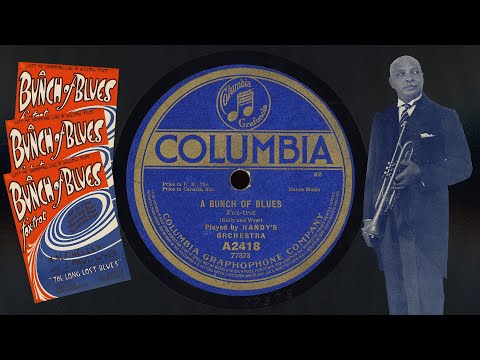
“Bunch of Blues” was a Wyer composition (with lyrics by H. Alf Kelly) that was a medley of “The Weary Blues”, “The String Beans Blues”, “Ship Wreck Blues”, and “The Long Lost Blues.” It was recorded by Handy for a marathon session for Columbia in NYC. Over a five day period, the band prolifically recorded 34 takes of 15 tunes that resulted in 10 released sides.
While J. Paul Wyer had left the band by this point, Ed Wyer was supposed to be in on this session, but he had moved to Chicago and the musician’s union there (Local 208) had told him he’d be fined up to $500 if he left town with Handy.
While J. Paul Wyer is not a well-known name in jazz and blues history – his story has a happy ending – in 1919 he joined the New York Syncopated Orchestra (NYSO) and traveled to Europe with them. In 1923 he travelled to Buenos Aires where he had a long and successful career as a bandleader. He died there in 1959.
Recorded in New York City on September 24, 1917.
Released as Columbia A2418.
Credits:
W. C. Handy – director, trumpet
Sylvester Bevard, – trombone
Wilson Townes, Alex Poole – clarinet, alto sax
Charles Harris, Nelson Kincaid – clarinet, tenor sax
Edward Alexander, William Tyler, Darnell Howard – violin
Henry Graves – violincello
Charles Hillman – piano
Archie Walls – tuba
Jasper Taylor – drums, xylophone
SOURCES:
Father of the Blues: An Autobiography – W.C. Handy
“Paul Wyer O La Metáfora Corporizada Del Atlántico Negro En La Argentina” by Berenice Corti
Leave a Reply