Jazz Crazy Records

An Archive of Early Jazz on 78 RPM

Category: Jazz

  • “Do Doodle Oom” – Fletcher Henderson and his Orchestra (1923)

    “Do Doodle Oom” – Fletcher Henderson and his Orchestra (1923)

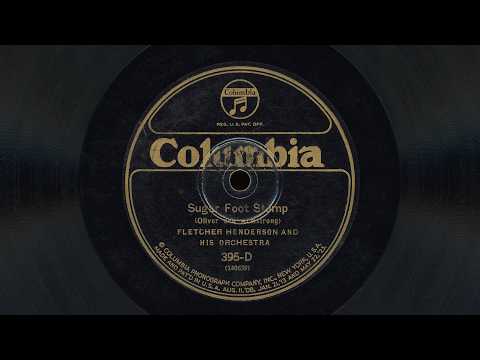
    Do Doodle Oom is a very interesting acoustic recording of the early Henderson orchestra only about a month after Coleman Hawkins joined the group. Henderson said that he found Hawkins playing with Wilbur Sweatman’s band at Connie’s Inn, after having returned from a gig playing with Mamie Smith’s Jazz Hounds out West.

    This tune was first recorded by the Henderson band for the Vocalion label in early August of 1923 as “Do Doodle Oom”. Recorded a month later for Columbia, the label misspelled the song title as “Do Doddle Oom”.

    Elmer Chambers’ cornet leads us through the intro of this Porter Grainger and Henderson co-composition. At 1:13 Don Redman’s clarinet and Coleman Hawkin’s sax take over – trading riffs in a kind of call and response. At 1:55 the song takes a dramatic left turn – the beat picks up and Hawk’s baritone sax drives the rhythm section into a frenzied funk.

    Details

    Recorded in New York City on Thursday, September 13, 1923.
    Released as Columbia A3995.

    Credits

    Fletcher Henderson – piano, director
    Elmer Chambers – cornet
    Teddy Nixon – trombone
    Don Redman – clarinet, alto sax
    Coleman Hawkins – clarinet, tenor sax, baritone or bass sax
    Charlie Dixon – banjo
    Kaiser Marshall – drums

    Sources

    Hendersonia, Walter C. Allen, p. 71

  • “You’ve Got To Stop That Running ‘Round the Town” – Pacific Coast Players (1925)

    “You’ve Got To Stop That Running ‘Round the Town” – Pacific Coast Players (1925)

    Another excellent Grey Gull track – from a decent Globe label copy on red shellac.

    Personnel on this one were hard to track down, but thanks to Javier Soria Laso – found that this was actually the Emerson Studio band directed by Paul Bolognese!

    He writes: “It’s also part of the same session on which they also recorded “What Name Is Sweeter Than Sweetheart” (Consolidated Record Corporation matrix 3766 with take A), “That Certain Party” (Consolidated Record Corporation matrix 3767 with takes A and B renumbered on Emerson 3019 as Emerson matrix 43036 with takes 1 and 2) and “You’ve Got To Say What I Mean” (Consolidated Record Corporation matrix 3768).”

    Hats off to Javier for this great information!

    Emerson Recording Laboratories began licensing its masters to Grey Gull and other chain stores starting in the spring of 1924. It then started recording new masters to order to its clients. So this was recorded in Emerson’s studio (formerly the Federal studio) in November 1925. It does not appear that it was ever released on the Emerson label – and does not appear in the Emerson discography – so it seems likely that this may have been a recording that was commissioned to be sold/licensed directly to Grey Gull.

    In January, 1926 – shortly after this recording was made – Musical Director Bolognese left Emerson and moved to Grey Gull, where he helped them start their own recording studio. This led to the end of business relationship between Emerson (then known as Consolidated Recording Corporation) beyond the occasional licensing of masters here and there.

    It makes sense then, that many of the mainstays of the Grey Gull studio band would be featured on this Emerson recording directed by Paul Bolognese – as they likely followed him when he started at Grey Gull.

    Some great playing on this one! Lots of saxophone warbling and a growly wah trumpet solo starting at 1:17 by Mike Mosiello.

    Recorded circa November, 1925.
    Released as Globe 8024.
    This recording also appears on Grey Gull 1314 and Globe 1314.

    Credits:
    Paul Bolognese – violin, director
    Mike Mosiello – trumpet
    Eph Hannaford – trombone
    Larry Abbott – alto sax, soprano sax, clarinet
    John Cali – banjo

    Sources:
    Emerson Records – The Complete Discography (1915-1928) by Allan Sutton, Mainspring Press
    Javier Soria Laso – conversation on 4/4/2026

  • “Because I’m Lonesome” – Cliff Jackson and his Krazy Kats (1930)

    “Because I’m Lonesome” – Cliff Jackson and his Krazy Kats (1930)

    Last week I found this copy in the wild in a hoard of postwar pop. Tons of RCA Victors, red Columbias, black Deccas and Capitols – and then this! It’s so clean that I ended up not even running a declicking filter on it.

    Cliff Jackson and his Krazy Kats recorded a number of HOT tunes for Grey Gull over the course of two months in early 1930, including the more well known “Horse Feathers” and “The Terror”. They also recorded some dance band numbers – including a waltz! I love this as it shows that working orchestras of the time had to be versatile in their repertoire to satisfy dancing audiences.

    This tune was recorded in a marathon session in late February – where 12 matrices were cut resulting in 10 sides – all released on Grey Gull and on sister labels Radiex and Van Dyke. Most discs were credited to “Marvin Smolev and his Syncopators” but Van Dyke labels listed the band as “Newport Syncopators”.

    Marvin Smolev was actually the songwriter of this tune – a fox trot ballad published in 1927 by himself and Berne Seaman. Not sure how the songwriter’s name became the psuedonym for the Krazy Kats, but Grey Gull worked in mysterious ways.

    Here, it begins as an jaunty upbeat dance number – with some solo melodies performed that stick very close to the source material. That said, the arrangement and energy of the band is chef’s kiss. 👩🏻‍🍳😘🤌

    Recorded in New York City on February 27, 1930.
    Released as Van Dyke 81851, Grey Gull 1851, and Radiex 947.

    Credits:
    Cliff Jackson – piano, director
    Melvin Herbert, Henry Goodwin – trumpet
    Noisy Richardson – trombone
    Rudy Powell – clarinet, alto sax
    Earl Evans – alto sax
    Horace Langhorn – tenor sax
    Andy Jackson – banjo
    Chester Campbell – tuba
    Percy Johnson – drums

    Also by Cliff Jackson and his Krazy Kats:
    “The Terror”
    https://youtu.be/04EbEgYkKbE

  • “Black Bottom Slide” – University Dance Orchestra (1926)

    “Black Bottom Slide” – University Dance Orchestra (1926)

    Despite the jazzy sounding name referencing the famous dance and the famous composition “Black Bottom Stomp” by Jelly Roll Morton, most of this tune feels like a marching band composition or college football team anthem. Boola Boola!

    Recorded in New York City circa July 1926.
    Released as Grey Gull 8109, Radiex 8109, and Madison 1613 (as “Black Bottom Strut” by Southern Melody Makers).

    Credits:
    Probably the Grey Gull Studio Band led by Mike Mosiello?

    The flip side, “Charleston Choo Choo” is MUCH more interesting:
    https://youtu.be/D4RRN3CQGwc

  • “Two Red Lips” – Synco Jazzers (1929)

    “Two Red Lips” – Synco Jazzers (1929)

    Gonna post some dime store titles this coming week for a friend.

    This one has been posted online before – but at 78 rpm it seemed off-pitch to my ears. This one is a Mosiello original composition – probably sold directly to the label – so no sheet music exists to get a key reference from.

    Had to increase speed to about 80.5 rpm – or drop down to 76.5 rpm for it to lock into a pitch. The higher speed sounded more correct – but see what you think. I could be wrong. I was pitching to Mosiello’s initial trumpet phrase starting around 0:06.

    All of that technical esoterica out of the way – we’ve got ourselves a jaunty tune by what is often called the Grey Gull Studio Band. A pleasant number with the added interest that it contains both a violin AND an accordion solo. At 1:29 an alto sax solo by Andy Sannella feels like a chase scene and – I nearly forgot to mention – a lovely cameo xylophone solo by George Hamilton Green. All in all – a lovely arrangement by Mosiello and crew with some very elegant “chamber jazz” moments.

    Recorded in New York City circa May-June, 1929.
    Released as Madison 5063 and Van Dyke 914.

    Credits:
    Mike Mosiello – trumpet, songwriter
    Charlie Butterfield or Tommy Dorsey – trombone
    Andy Sannella – clarinet, alto sax
    Al Duffy (?) – violin
    Frank Banta – piano
    Charlie Magnante – accordion
    John Cali (?) – banjo
    George Hamilton Green, Joe Green – drums, xylophone

  • “Weary Way Blues” – Bechet-Nicholas Blue Five (1946)

    “Weary Way Blues” – Bechet-Nicholas Blue Five (1946)

    A very upbeat “weary way”, if you ask me.

    A tune written and recorded by Ida Cox and Lovie Austin in 1923, resuscitated by Sydney Bechet and Albert Nicholas 23 years later for a session on the Blue Note label.

    These two legendary clarinetists sound fantastic together!

    Recorded in New York City on February 12, 1946.
    Released as Blue Note 517

    Credits:
    Sidney Bechet, Albert Nicholas – clarinet
    Art Hodes – piano
    George “Pops” Foster – bass
    Danny Alvin – drums

  • “Hejre Kati” – Eddie South and his International Orchestra (1931)

    “Hejre Kati” – Eddie South and his International Orchestra (1931)

    Hungarian violinist and composer Jenö Hubay composed “Hejre Kati” (literally “Hey, Katie”) in the 1880s. The composer was still teaching in Budapest when American jazz violinist Eddie South was touring Europe from 1928 – 1931.

    South, who was a classically trained violinist, visited with Hubay during his time there.

    When he returned to the Great Depression-ravaged U.S. in 1931, he recorded Hubay’s composition in a recording session for Victor.

    South’s version is a kind of homage to the fusion of his musical worlds: a classical composition played with a distinctively jazzy sensibility.

    The first section of the piece sets the lyrical bowing to a swung 4/4 rhythm, and the surprising highlight of the improvised section that follows is South’s scatted vocalizations, seeming to both pay tribute to the melody while delivering near-comprehensible lyrical verses. South finishes the recording with virtuostic flair on solo violin, showing his chops as both a classical artist and a jazz improviser of the highest order.

    If you’d like to hear Hubay’s original composition as traditionally performed in a classical setting, listen to Toscha Seidel’s recording from 1919:
    https://youtu.be/jtI_lEgdC0k

    Recorded in Chicago, Illinois on September 27, 1931.
    Released as Victor 22847.

    Credits:
    Eddie South – violin, vocals, director
    Clifford King – clarinet
    Antonia Spaulding – piano
    Everett Barksdale – banjo, guitar
    Jimmy Bertrand – drums, bells

  • “Stavin’ Change” – Original Indiana Five (1923)

    “Stavin’ Change” – Original Indiana Five (1923)

    An early session by the not-from-Indiana Original Indiana Five featuring trumpeter Johnny Sylvester.

    When I first read this title, I thought: “Oh, a clever play on words – they’re talking about musical staves and how jazz harmonies often change keys mid-stave!” You know, sorta like “Changes” by Walter Donaldson and Byron Gay: e.g. “Beautiful changes in different keys – Beautiful changes and harmonies”.

    The roots go deeper – as it is an Al Bernard-penned song about a street tough in New Orleans with the subtitle “The Meanest Man in New Orleans”. The lyrics referenced that Stavin’ was a rough “bad man” from New Orleans who “He had a knife long enough to row a boat [and] a big forty-four, underneath his coat”

    While I first passed this off as some Yt mythologizing, interestingly, the name “Stavin’ Chain” also appears in a couple of songs in 30s blues records by Lil Johnson and Big Joe Williams.

    Jelly Roll Morton, when asked about Stavin’ Chain by Alan Lomax said “Stavin’ Chain, well he was a pimp. Supposed to have more women in this district than any other pimp.”

    Seems to me that Al, Jelly Roll, and these later blues artists were all referencing some older NOLA folklore. Al perhaps misheard or got the name wrong, as “Stavin’ Chain” makes sense as a nickname for a street tough, but “Stavin’ Change” is more of an apt metaphor for a traditionalist who resists change.

    Lots of New Orleans-style ensemble playing with Nick Vitalo adding an extended alto solo at 1:15. Sylvester and Panelli get a few hot breaks in and Tony Colucci keeps things moving with a solid foundation of 4/4 banjo rhythm.

    Recorded in New York City on September 7, 1923.
    Released as Perfect 14173 and Pathé Actuelle 021070.

    Credits:
    Johnny Sylvester – trumpet, director
    Charlie Panelli – trombone
    Nick Vitalo – clarinet, alto sax
    Harry Ford – piano
    Tony Colucci (?) – banjo
    Tom Morton – drums

    Sources:
    https://pages.stolaf.edu/americanmusic/2017/10/03/whats-a-stavin-chain/

  • “Ain’t Cha Got Music” – Henry Allen and Coleman Hawkins and their Orchestra (1933)

    “Ain’t Cha Got Music” – Henry Allen and Coleman Hawkins and their Orchestra (1933)

    Ain’t cha got music?
    Ain’t cha got laughter?
    Ain’t cha got dancing?
    Ain’t cha got song?

    In spite of your troubles
    In spite of your worries
    In spite of your burdens
    you’ll get along

    A tune composed by pianist James P. Johnson for the musical Harlem Hotcha.

    Recorded in New York City on July 21, 1933.
    Released in the UK as Brunswick 01776.
    Originally released in the U.S. on Banner 32840, Melotone M-12769, Oriole 2746, Perfect 15808, and Romeo 2119.

    Credits:
    Henry Allen – trumpet, vocals
    Dicky Wells – trombone
    Hilton Jefferson – alto sax
    Coleman Hawkins – tenor sax
    Horace Henderson – piano
    Bernard Addison – guitar
    John Kirby – string bass
    Walter Johnson – drums

  • “Steamboat Days” – Clarence Williams’ Washboard Band (1929)

    “Steamboat Days” – Clarence Williams’ Washboard Band (1929)

    Two days after recording a solo piano version of “A Pane in the Glass”
    ( https://youtu.be/_m1A9J8Rbhg ), Clarence Williams brought his washboard quartet together in the studio to record two tracks for Okeh label.

    This original Williams tune showcases Arville Harris and Ed Allen as they effortlessly dance around one another. Williams and Casey keep the rhythm going with bouncy chords and washboard skritches respectively.

    This one was on my want list for a long while – and I nearly passed on this beat copy when it finally appeared due to the scratched surface. But those Okeh A stampers seem to be pretty resilient, and I got a decent transfer despite the condition. Unfortunately the other side has a stressed groove that causes a skip.

    Nearly saved this a half step flat, as at 78 rpm the tune was in the key of D and ran to 3:15. In Tom Lord’s Clarence Williams book, it is listed as E flat coming in at 3:08. So this is spinning near 82 rpm for those playing along at home.

    Recorded in New York City on February 14, 1929.
    Released as Okeh 8672

    Credits:
    Ed Allen – cornet
    Arville Harris – clarinet, alto sax
    Clarence Williams – piano
    Floyd Casey – washboard