Two days after recording a solo piano version of “A Pane in the Glass” ( https://youtu.be/_m1A9J8Rbhg ), Clarence Williams brought his washboard quartet together in the studio to record two tracks for Okeh label.
This original Williams tune showcases Arville Harris and Ed Allen as they effortlessly dance around one another. Williams and Casey keep the rhythm going with bouncy chords and washboard skritches respectively.
This one was on my want list for a long while – and I nearly passed on this beat copy when it finally appeared due to the scratched surface. But those Okeh A stampers seem to be pretty resilient, and I got a decent transfer despite the condition. Unfortunately the other side has a stressed groove that causes a skip.
Nearly saved this a half step flat, as at 78 rpm the tune was in the key of D and ran to 3:15. In Tom Lord’s Clarence Williams book, it is listed as E flat coming in at 3:08. So this is spinning near 82 rpm for those playing along at home.
Recorded in New York City on February 14, 1929. Released as Okeh 8672
Credits: Ed Allen – cornet Arville Harris – clarinet, alto sax Clarence Williams – piano Floyd Casey – washboard
From the very last Fess Williams session for Victor during the summer of 1930.
Recorded in Camden, New Jersey on July 31, 1930. Released as Victor 23005. 8,926 copies sold.
Credits: Fess Williams – clarinet, alto sax, vocals, director Emanuel Clark, John Brown – trumpet David “Jelly” James – trombone Bobby Holmes – clarinet, alto sax Ralph Brown or Felix Gregory – alto sax Perry Smith – clarinet, tenor sax Walter “Fats” Pichon – piano Andy Pendleton or Ollie Blackwell – banjo Emanuel Casamore – tuba Ralph Bedell – drums
Here’s a toe tapper to get you through the week – a Luis Russell scorcher featuring an interesting carefully timed arrangement driven by the non-stop string bass of Pops Foster. We hear Russell himself soloing on piano at 0:26. Henry “Red” Allen adds an uplifting trumpet solo at 1:21 and the reeds come together for an ensemble moment before J. C. Higginbotham slides in at 2:13 with an extended trombone solo.
Recorded in New York City on September 6, 1929. Originally released as Okeh 8734. Released in the U.K. as Parophone R 740.
Credits: Luis Russell – piano, director Henry Allen, Bill Coleman – trumpet J. C. Higginbotham – trombone Albert Nicholas – clarinet, alto sax Charlie Holmes – soprano sax, alto sax Teddy Hill – tenor sax Will Johnson – banjo, guitar Pops Foster – string bass Paul Barbarin – drums, vibes
Sources: Jazz and Ragtime Records (1897-1942), 6th Ed., Brian Rust
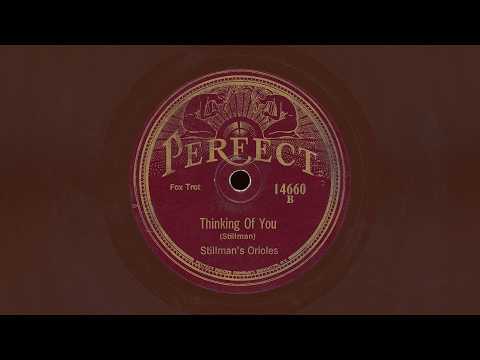
In the British jazz magazine “Storyville”, published from 1965 – 1995, there was a column called “Arthur Gainsbury’s Guide to Junkshoppers” that listed desirable dance band 78s with hot jazzy solos on various labels. This record first came onto my radar when I was reading old issues (I recently acquired a complete set – but the entire run is also available online for your reading pleasure – see link below) and read through the Pathé – Perfect columns.
This tune starts as a peppy dance number, with the uptempo banjo of Harry Reser keeping things moving. Everything changes when Ken “Goof” Moyer enters the ring at 0:33 with a baritone sax. An alto sax (Glantz) gives a response and then enjoys a further elucidation by the baritone.
I happily found a copy of this one in the wild last year and present it to you, dear listener, for your enjoyment.
Recorded in New York City on June 25, 1926. Released as Perfect 14660
Credits: Jack Stillman – trumpet, director Ephriam Hannaford – trombone Nathan Glantz – alto sax, soprano sax, clarinet Ken “Goof” Moyer – clarinet, alto sax, baritone sax, soprano sax Harry Reser – banjo
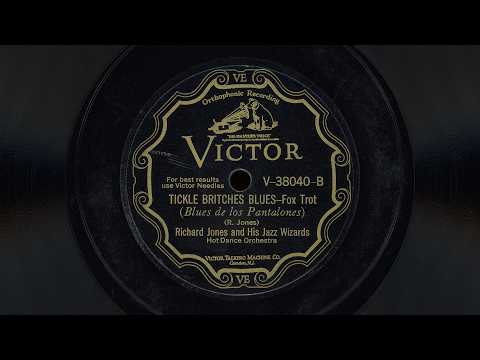
A lovely number from a jazz quartet formed from Richard M. Jones’ Jazz Wizards. While the flip side has a full band with trumpet, trombone, and tuba, this side highlights only the clarinet, piano, and violin.
Clarence Black’s bluesy violin solo starting at 0:52 is a highlight for me. He inventively comps, pizzicato style, as a rhythmic element during other sections. Now I believe I must find a copy of Paramount 12683.
Who or what “tickle britches” is, I cannot rightly say. Any guesses?
Recorded in Chicago, Illinois on February 8, 1929. Released as Victor V-38040.
Credits: Omer Simeon, Artie Starks – clarinet, alto sax Richard M. Jones – piano Clarence Black – violin
Recorded in New York City on January 30, 1940. Released as Vocalion 5458.
Credits: Benny Carter – alto sax, director Joe Thomas, Lincoln Mills, Russell Smith – trumpet Jimmy Archey, Vic Dickenson, Gene Simon – trombone James Powell, Carl Frye – alto sax Stan Payne, Coleman Hawkins – tenor sax Eddie Heywood, Jr. – piano Ulysses Livingston – guitar Hayes Alvis – string bass William Purnell – drums
The first – and probably best known – of the twenty sides Jabbo Smith recorded for Brunswick in 1929, as he was being marketed to compete with the popular Okeh recordings of Louis Armstrong and his Hot Five by producer J. Mayo Williams. Smith was twenty years old.
Many of these tunes were written and performed on record in quick succession. “Smith would make up the tunes perhaps the night before the date, but he wouldn’t write them down; in fact, he made no effort to copyright his compositions. The other musicians would learn the tunes only when he ran them down at the recording studio. He’d teach them the melodies, they’d rehearse for maybe a half hour, then they’d record.”
Jazz Battle is a small combo mad dash – intricately laced with rapid fire lines traded between Smith’s trumpet and Simeon’s clarinet. At times sounding to my ears like Tchaikovsky and Arthur Pryor were on the rear guard of the battle somehow – feeding little riffs and hot breaks like ammo to the furious horns on the front lines.
The performances here are a wild ride. Of Jabbo, French jazz critic Hugues Panassie wrote “He has astonishing force and a positive attack of great beauty.”
Unfortunately, Jabbo’s Brunswick discs would not be big sellers – and like many excellent jazz musicians, the advent of the Great Depression put an abrupt end to his recording career as a bandleader.
Recorded in Chicago, Illinois on January 29, 1929. Released as Brunswick 4244.
Credits: Jabbo Smith – trumpet Omer Simeon – clarinet Cassino Simpson – piano Ikey Robinson – banjo
Sources: Jazz and Ragtime Records (1897-1942), 6th Ed., Brian Rust Voices of the Jazz Age, Chip Deffaa, University of Illinois Press, 1990.
An outstanding Earl Hines original composition played on an early electric piano.
The Storytone electric piano was introduced at the 1939 World’s Fair, and was “probably the first to be produced commercially.” It used electromagnetic pickups located behind each string – much like an electric guitar – whose output is then amplified. Only 150-250 units were produced and production ceased in 1942.
Recorded in New York City on February 26, 1940. Released as Bluebird B-10642
Fred Rich was born in Warsaw, Poland in 1898 who began recording as a bandleader in 1925 with his Hotel Astor Orchestra, which he led from 1922 – 1928. By the time of this recording, he had recorded quite prolifically. However – fun fact – at the time of this recording, Mr. Rich was still not yet a U.S. citizen. He did not become one until 1934.
This deep depression cut was pressed on the “Hit of the Week” label – made not of shellac but on a paper base coated with Durium – a synthetic resin. They were sold at newsstands for 15 cents apiece.
Unfortunately, the brief “Auld Lang Syne” track contained a needle dig (visible in the label scan around two o’clock) that rendered it unplayable due to skips. Even so, the longer format of these discs fit nearly five minutes of music on each side – so the sweet ballad “You Call It Madness” still clocks in at nearly four minutes long.
Though the tune is a slow dance tune, it does feature some jazz players such as Venuti & Lang, Bunny Berigan, Joe Tarto, and others. A brief piano solo is heard at 3:15.
I’m not always a fan of the schmaltz – but something about this track is quite lovely. Perhaps it is the voice of Helen Hannah Rubin (performing as Helen Rowland), who had been featured on the radio singing for NBC a few times that year.
Recorded in New York City circa November 1931. Released as Hit of the Week M2.
Credits: Bunny Berigan, Tommy Gott (?) – trumpet Tommy Dorsey (?), Charlie Butterfield – trombone Elmer Feldkamp, Tony Parenti – clarinet, alto sax Joe Venuti – violin Walter Gross – piano Cornell Smelser – pac Eddie Lang – guitar Joe Tarto or Hank Stern – tuba Helen Rowland – vocals Unknown Artists – trumpet, tenor sax (x2), drums
Sources: Helen Rubin – Radio Singer, by Neal R. Simpson, Vintage Jazz Mart https://www.vjm.biz/174-helen.pdf American Dance Band Discography, Vol. 2, Brian Rust
In early March, 1927, gang warfare caused The Plantation Cafe in Chicago to close. It had been where King Oliver’s band had been in residence under a steady longstanding contract. On April 5, it was completely destroyed by a fire, putting the Oliver band out of work – and destroying the band’s collection of photographs and publicity material.
It was shortly after this event that Oliver made the decision to move the band to New York City to accept a gig at the Savoy Ballroom. This was the last recording he made in Chicago before he left.
I picked this one up recently, graded as being in Poor condition. Visually, it’s probably a G+ at worse and V- at best – so I wasn’t expecting much. Probably the seller just didn’t want a buyer to complain so they graded it ultra-conservatively. For $5 I figured it might even make a nice wall hanger. However, as you can hear, it sounds pretty good! Just goes to show that with 78s, you often can’t accurately judge the grade by appearance alone.
In the “Kings of Jazz” book series, Martin Williams was quite hard on this performance. He wrote: “Black Snake uses Omer Simeon (he took up soprano saxophone just for the arrangement) to advantage, but hardly to the near-brilliance that Morton did—it is quite possible that Simeon was always a better ensemble improviser than soloist. Ory manages again to be both witty and deeply serious. Oliver’s opening is sure and the slightest technical shakiness of his final chorus is fully overcome by his dignity and force. Black Snake is one Luis Russell arrangement for the Syncopators that does manage variety without clutter, but it is variety of a rather pointless sort, a variety of several good effects within a score, but with such little attention to over-all pattern. If the total effect of such writing is good, it is almost an accident.”
Me, I just really enjoyed the performances. 🙂
Recorded in Chicago, Illinois on April 27, 1927. Released as Vocalion 1112.
Credits: King Oliver, Thomas “Tick” Gray – cornet Kid Ory – trombone Omer Simeon – clarinet, soprano sax, alto sax Paul Barnes – clarinet, alto sax Barney Bigard – clarinetr, tenor sax Luis Russell – piano, arranger Junie Cobb – banjo Lawson Buford – tuba Paul Barbarin – drums
Sources: King Joe Oliver, B.A.L. Rust and Walter C. Allen, 1957, A Jazz Book Club Production, London Kings of Jazz: King Oliver, Martin Williams, 1961, A.S. Barnes & Co., New York