
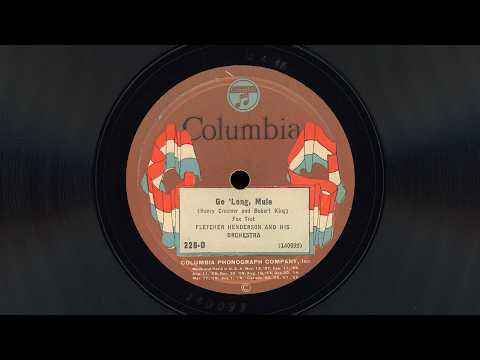
Can you imagine the scene in early October, 1924 as the Henderson band gathered at the Happy Rhone Club on 143rd Street in Harlem to rehearse – and trumpeter Louis Armstrong walked in the room and met the whole band for the first time?
Kaiser Marshall said “The band was up on the stand waiting when he got there, and Louis walked across the floor. He had on big thick-soled shoes, the kind that policemen wear, and he came walking across the floor, clump-clump and grinned and said hello to all the boys.”
Don Redman said his first impression of Armstrong was that “he was big and fat and wore high top shoes with hooks in them, and long underwear down to his socks. When I got a load of that, I said to myself, Who in the hell is this guy? It can’t be Louis Armstrong. But when he got on the bandstand, it was a different story.”
This record is notable as Satch’s first session and first recorded solo with the Henderson band. He initially had some trouble with Henderson’s difficult “fancy” arrangements – but very quickly showed that he was a fast learner. He also showed the band that he had something to teach too – as his hot solos quickly began to infuse the orchestra with a new vitality and energy.
This novelty tune, “Go ‘Long Mule”, was a Henry Creamer collaboration with Shapiro and Berstein staff composer Robert King. The sheet music hyped it as “The Dawgonedest Fool Song Ever!” and it was full of barnyard humor that spanned 44 verses written in bumpkin dialect “which harks back to minstrelsy.” As such, the Henderson version has its instruments doing animal imitations and other novelty effects to heighten the absurdity.
All of which seems an underwhelming setting for the first recorded solo by Louis Armstrong for the Henderson orchestra – but somehow Satch manages to take these indecorous surroundings and turn it into a brilliant display of his melodic storytelling abilities.
This is highlighted by a sparse style of accompaniment designed to really showcase the soloist described by Rex Stewart as “Western Style”: “A heavy accented back beat on the second and fourth bars. When you soloed, it was called ‘taking a Boston’.” We can hear this style accompanying both Charlie Green’s trombone solo and Armstrong’s trumpet solo.
0:00 Intro into A and B sections (saxes)
0:47 Trombone solo (Green)
1:07 Stop time (clarinet, bass sax, brass)
1:23 B section (ensemble)
1:32 Trumpet solo (Armstrong)
1:48 Sax mouthpiece effects with clarinet melody
2:08 Muted trumpets
2:26 Clarinets
2:43 Coda (ensemble)
Recorded in New York City on October 7, 1924.
Released as Columbia 228-D.
Credits:
Fletcher Henderson – piano, arranger, director
Louis Armstrong – trumpet
Elmer Chambers Howard Scott – cornet
Charlie Green – trombone
Don Redman – clarinet, alto sax
Cecil Scott or Buster Bailey (less likely) – clarinet, alto sax
Coleman Hawkins – clarinet, tenor sax
Charlie Dixon – banjo
Ralph Escudero – tuba
Kaiser Marshall – drums
Sources:
Hendersonia: The Music of Fletcher Henderson and his Musicians, Walter C. Allen, pp.124-125
The Uncrowned King of Swing: Fletcher Henderson and Big Band Jazz, Jeffrey Magee, pp.75-79
Leave a Reply