Jazz Crazy Records

An Archive of Early Jazz on 78 RPM

Tag: Fletcher Henderson and his Orchestra

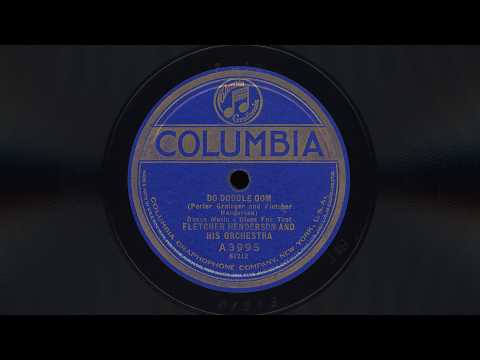
  • “Do Doodle Oom” – Fletcher Henderson and his Orchestra (1923)

    “Do Doodle Oom” – Fletcher Henderson and his Orchestra (1923)

    Do Doodle Oom is a very interesting acoustic recording of the early Henderson orchestra only about a month after Coleman Hawkins joined the group. Henderson said that he found Hawkins playing with Wilbur Sweatman’s band at Connie’s Inn, after having returned from a gig playing with Mamie Smith’s Jazz Hounds out West.

    This tune was first recorded by the Henderson band for the Vocalion label in early August of 1923 as “Do Doodle Oom”. Recorded a month later for Columbia, the label misspelled the song title as “Do Doddle Oom”.

    Elmer Chambers’ cornet leads us through the intro of this Porter Grainger and Henderson co-composition. At 1:13 Don Redman’s clarinet and Coleman Hawkin’s sax take over – trading riffs in a kind of call and response. At 1:55 the song takes a dramatic left turn – the beat picks up and Hawk’s baritone sax drives the rhythm section into a frenzied funk.

    Details

    Recorded in New York City on Thursday, September 13, 1923.
    Released as Columbia A3995.

    Credits

    Fletcher Henderson – piano, director
    Elmer Chambers – cornet
    Teddy Nixon – trombone
    Don Redman – clarinet, alto sax
    Coleman Hawkins – clarinet, tenor sax, baritone or bass sax
    Charlie Dixon – banjo
    Kaiser Marshall – drums

    Sources

    Hendersonia, Walter C. Allen, p. 71

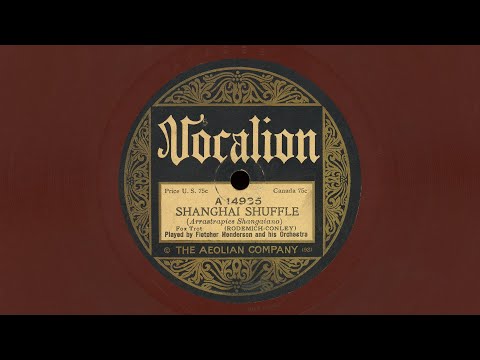
  • “Shanghai Shuffle” – Fletcher Henderson and his Orchestra (1924) f/Louis Armstrong

    “Shanghai Shuffle” – Fletcher Henderson and his Orchestra (1924) f/Louis Armstrong

    Henderson’s orchestra first recorded the Gene Rodemich song “Shanghai Shuffle” in October of 1924 for Pathé-Perfect, which was their second recording session with new cornetist Louis Armstrong, who had just moved to New York from Chicago, where he had been playing with King Oliver.

    Here we have a slightly later version of the tune from a November session with Vocalion. The title is an Eastern-inspired dance band number – but as soon as Armstrong enters the ring at 0:59, the whole center of gravity changes and for over thirty glorious seconds, we are taken on a wild melodic ride. It’s tough to imagine the shock of how good – and novel – Armstrong’s approach was when this first came out. It still sounds fresh over 100 years later!

    0:00 Intro
    0:25 Ensemble
    0:59 Trumpet solo (Armstrong)
    1:32 Clarinet trio
    1:50 Trombone solo (Green)
    2:05 “Whoopee Hey Hey” (Redman) and Coda

    An interesting bookend to this session is that the day before, on November 6, Armstrong recorded “Everybody Loves My Baby” with Clarence Williams’ Blue Five and on November 8, Armstrong recorded “Of All the Wrongs You Done to Me” with the Red Onion Jazz Babies.

    It should be noted that the original lyrics to this tune are cringe and awful. Thankfully, both Henderson versions are instrumentals.

    Recorded in New York City on November 7, 1924.
    Released as Vocalion 14935.

    Credits:
    Fletcher Henderson – piano, director
    Elmer Chambers, Howard Scott, Louis Armstrong – trumpet
    Charlie Green – trombone
    Buster Bailey – clarinet, alto sax
    Don Redman – clarinet, alto sax, arranger
    Coleman Hawkins – clarinet, tenor sax
    Charlie Dixon – banjo
    Ralph Escudero – tuba
    Kaiser Marshall – drums

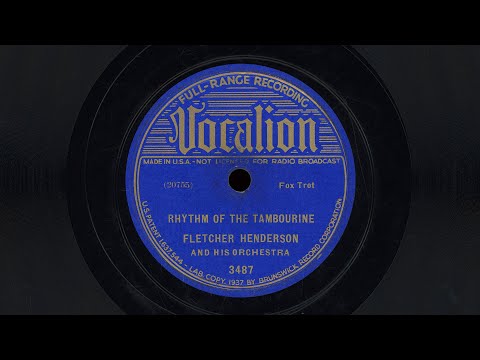
  • “Rhythm of the Tambourine” – Fletcher Henderson and his Orchestra (1937)

    “Rhythm of the Tambourine” – Fletcher Henderson and his Orchestra (1937)

    1936 saw the Henderson band at the height of its popularity – with the massive hit “Christopher Columbus” and an active association with the Benny Goodman band. They spent much of the fall touring the midwest, playing to large crowds at college campuses and hotels in St. Paul, St. Louis, Indianapolis, Kansas City, Evanston, Lawrence, and Chicago.

    Despite the popularity the band enjoyed, some were quite critical of the band. John Hammond wrote in Downbeat (March 1937) that “The rhythm section has gone to pot” and “the trumpets have thin forced tones”. He harshly concluded: “How is it that Fletcher can never imbue a band with proper discipline, for this band, which has some of the finest musicians in the city, is just as ragged as the lowliest dance relief band.”

    Hammond called Henderson “the greatest arranger in the country” but questioned his ability as bandleader. He said of his group that they “possessed not an atom of swing, personality, or vitality.”

    Hmmm. What do you think? My take on this recording of “Rhythm of the Tambourine” is that it’s snappy, swingin’ and has a good mix of interesting ensemble passages and soloists, such as Emmett Berry’s trumpet solo at 1:05, Chu Berry’s tenor solo at 1:34, and Jerry Blake’s short but fiery clarinet solo at 2:22.

    Recorded in New York City on March 2, 1937.
    Released as Vocalion 3487

    Credits:
    Fletcher Henderson – piano, director
    Dick Vance, Russell Smith, Emmett Berry – trumpet
    George Washington, Ed Cuffee, J. C. Higginbotham – trombone
    Jerry Blake – clarinet, alto sax
    Elmer Williams, Chu Berry – tenor sax
    Lawrence Lucie – guitar
    Israel Crosby – bass
    Walter Johnson – drums
    Benny Carter – arranger

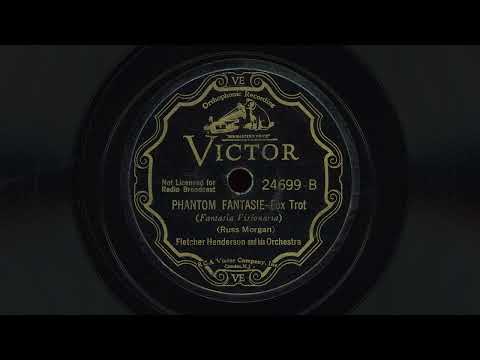
  • “Phantom Fantasie” – Fletcher Henderson and his Orchestra (1934)

    “Phantom Fantasie” – Fletcher Henderson and his Orchestra (1934)

    During the winter of 1933, Fletcher Henderson was negotiating via John Hammond with British bandleader Jack Hylton to bring his orchestra to London for a series of engagements there and in Europe. Plans were made for Hylton to hear the band at the Roseland – but he didn’t show up. A new date was set and he arrived two hours late – but left promising to make arrangements to bring the whole outfit to Europe. Henderson’s band had been through some lean depression years, so this was a big morale booster.

    Unfortunately, Hylton never made good on his promise. He did, however, negotiate a personal contract with Coleman Hawkins – and this Victor session was his last with the band – after eleven years with Henderson. Hawkins sailed for Europe right after this recording session, where he stayed for five years.

    This European let-down – coupled with accusations of non-payment by band members – gradually led to the breakup of the band. By November of 1934, all but three had quit the Henderson band to play with Benny Carter’s orchestra. He didn’t record another session until March of 1936.

    This Victor session included some of my favorite late-period Henderson works: This tune, Hocus Pocus, Harlem Madness, and Tidal Wave. “Phantom Fantasie” is a quasi-symphonic composition by Russ Morgan played with a chill groove by the Henderson band.

    In it, we are serenaded by a piano solo from Mr. Henderson himself, as well as a tenor solo from the Hawk. Two takes were recorded – the first was unissued, though it is said to exist as a test pressing.

    Recorded in New York City on March 6, 1934.
    Released as Victor 24699.

    Fletcher Henderson – piano, director
    Russell Smith, Joe Thomas, Henry Allen – trumpet
    Claude Jones, Keg Johnson – trombone
    Buster Bailey – clarinet
    Russell Procope, Hilton Jefferson – clarinet, alto sax
    Coleman Hawkins – tenor sax
    Bernard Addison – guitar
    John Kirby – string bass
    Vic Engle – drums
    Russ Morgan – arranger

    Sources:
    Hendersonia, Walter C. Allen
    Jazz and Ragtime Records, Brian Rust, 6th Ed.

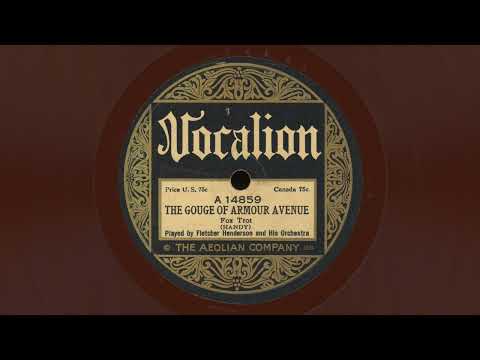
  • “The Gouge of Armour Avenue” – Fletcher Henderson and his Orchestra (1924) f/ Big Charlie Green

    “The Gouge of Armour Avenue” – Fletcher Henderson and his Orchestra (1924) f/ Big Charlie Green

    One of my favorite of Henderson’s Red Vocalions: the first recording of W. C. Handy’s “The Gouge of Armour Avenue” that features one of the most inspired and legendary trombone solos of early jazz by Big Charlie Green.

    Jazz Scholar Phil Schaap wrote a wonderful essay delving into the esoterica of mysteries surrounding this tune – and I link to it below:
    https://www.philschaapjazz.com/essays/the-gouge-of-armour-avenue-a-legendary-trombone-solo-and-a-pronunciation

    In it, we learn that “gouge” is pronounced as in “price gouging” – not “googe” as in “Scrooge” – and that Green’s solo was likely not an improvisation at all but was pre-composed. By who, we may never know.

    In any case, it is massive, epic, and sounds fresh every time I hear it.

    Recorded in New York City on July 31, 1924.
    Released as Vocalion 14859

    Credits:
    Fletcher Henderson – piano, arranger, director
    Elmer Chambers Howard Scott – cornet
    Charlie Green – trombone
    Don Redman – clarinet, alto sax
    Coleman Hawkins – clarinet, tenor sax, baritone sax
    Charlie Dixon – banjo
    Ralph Escudero – tuba
    Kaiser Marshall – drums

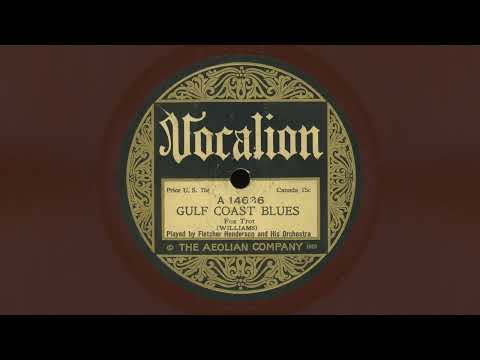
  • “Gulf Coast Blues” – Fletcher Henderson and his Orchestra (1923)

    “Gulf Coast Blues” – Fletcher Henderson and his Orchestra (1923)

    “Gulf Coast Blues” was recorded several times by the Henderson band. The first was on May 16 as Henderson’s Hot Six in a rejected session for Columbia. The same week, a session for Paramount yielded another version that was also released on Puritan, Famous, and Harmograph. Next up was a session for Pathé Actuelle in early June that was also released on Perfect. On June 7, a session for Columbia resulted in another version.

    This session for Vocalion was the 5th and last recording of “Gulf Coast Blues” by the Henderson orchestra. The session produced two takes (11662 and 11663), both of which were issued.

    On this tune we hear some excellent early bass sax playing by Billy Fowler (?), along with a showcase of Don Redman on clarinet and alto sax and Elmer Chambers on cornet. The tune lives up to its name and with each chorus the playing seems to get progressively bluesier.

    Recorded in New York City circa June 25, 1923.
    Released as Vocalion 14636.

    Fletcher Henderson – piano, arranger, director
    Elmer Chambers – cornet
    Teddy Nixon – trombone
    Don Redman – clarinet, alto sax
    Billy Fowler (?) – tenor sax, bass sax
    Charlie Dixon – banjo

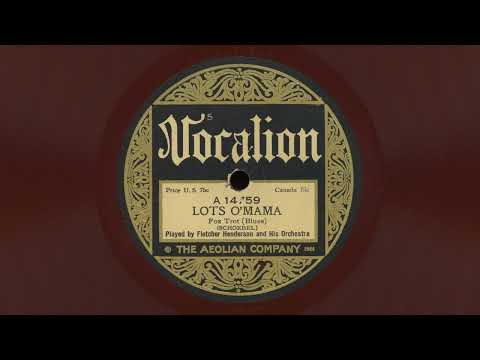
  • “Lots O’ Mama” – Fletcher Henderson and his Orchestra (1924)

    “Lots O’ Mama” – Fletcher Henderson and his Orchestra (1924)

    These early Fletcher Henderson Red Vocalions are gorgeous and always contain great music.

    Hendersonia by Walter C. Allen recounts a curious episode from around this time:
    “Don Redman has recalled that he and Coleman Hawkins were once surreptitiously approached by a young man who had a pair of clarinets for sale. They were all apart, in a sack, and had to be put together. A deal was concluded: ten dollars for the two. Don thought it best not to ask any questions, but he and Hawk always referred to them as their ‘hot’ clarinets! These ‘hot clarinets’ are heard jointly on a number of Henderson records, one of the first being Vocalion 14759.”

    So enjoy the “hot” clarinets on this record – along with cornet and trombone solos in this jaunty arrangement of an Elmer Schoebel tune “Lots O’Mama” – which was also recorded the very same month by the California Ramblers, Ladd’s Black Aces, and the Original Memphis Jazz Band.

    0:00 Intro
    0:28 Cornet solo (Howard Scott)
    1:05 Trombone solo (Teddy Nixon)
    1:42 Clarinet solo (Redman? or Hawkins?)
    2:00 Clarinet solo (Don Redman)
    2:18 Outro

    Recorded in New York City on January 29, 1924.
    Released as Vocalion 14759.

    Fletcher Henderson – piano, arranger, director
    Elmer Chambers, Howard Scott – cornet
    Teddy Nixon – trombone
    Don Redman – clarinet, alto sax
    Charlie Dixon – banjo
    Ralph Escudero – tuba
    Kaiser Marshall – drums

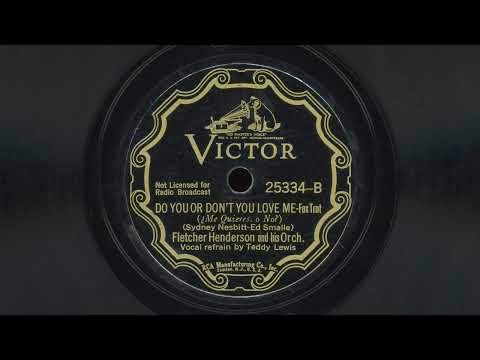
  • “Do You Or Don’t You Love Me” – Fletcher Henderson and his Orchestra (1936)

    “Do You Or Don’t You Love Me” – Fletcher Henderson and his Orchestra (1936)

    In May of 1936 the hugely popular Henderson band – fresh off their national hit “Christopher Columbus” a few weeks earlier – began another contract at the Grand Terrace in Chicago with a new bass player – a 17-year-old named Israel Crosby. They had also added Jerome Pasquall on sax.

    Metronome wrote: “His first Sunday night at the Terrace was the biggest they have had in a long time.” His performances were broadcast nationally on radio stations across the country.

    Here we hear a lighter – but no less swingin’ – number with vocals by Teddy Lewis – a Chicago singer who joined the band that April. Teddy can be seen with the band in a famous photo taken at this time featuring Fletcher in a white suit sitting at a piano while the band is gathered round.

    At this time, according to John Hammond, Grand Terrace Director Ed Fox apparently chose Fletcher’s tunes and vocalists. Later that year, poor Teddy Lewis would be fired by Ed Fox “in an abusive tirade before a large group of onlookers.” Consequently, this is the only Henderson record he appears on. You deserved better, Teddy.

    Following Teddy’s vocals, Chu Berry and Roy Eldridge each take solos – with Eldridge’s the more daring of the two, giving this sweet tune a bit of a bite.

    0:00 Intro
    0:58 Vocals (Teddy Lewis)
    1:48 Tenor sax solo (Chu Berry)
    2:12 Trumpet solo (Roy Eldridge)
    2:36 Outro

    Recorded in Chicago, Illinois on May 23, 1936.
    Released as Victor 25334

    Credits
    Teddy Lewis – vocals
    Fletcher Henderson – piano, director
    Roy Eldridge, Dick Vance, Joe Thomas – trumpet
    Fernando Arbello, Ed Cuffee – trombone
    Buster Bailey, Jerome Pasquall – clarinet, alto sax
    Chu Berry, Elmer Williams – tenor sax
    Horace Henderson – arrangement
    Bob Lessey – guitar
    Israel Crosby – string bass
    Sidney Catlett – drums

    Sources:
    Hendersonia by Walter C. Allen, pp. 337-339, 363

  • “Henderson Stomp” – Fletcher Henderson and his Orchestra (1926)

    “Henderson Stomp” – Fletcher Henderson and his Orchestra (1926)

    You’ve no doubt heard of the Moten Stomp, the Whiteman Stomp, and the Casa Loma Stomp. Well before those compositions came into being, there was the Henderson Stomp!

    This original tune was first recorded in 1926 – and Henderson later recorded it with the Benny Goodman Orchestra in November of 1940 when he was working as an arranger.

    Originally titled “Top and Bottom”, it was arranged by Don Redman and had what some have called tricky and difficult passages.

    This recording session was also the first in which Fats Waller performed with the Henderson band – and he takes a jaunty solo in mid-tune.

    0:00 Intro (Clarinets)
    0:42 Chorus (Brass)
    0:58 Piano solo (Fats Waller)
    1:15 Trumpet solo (Joe Smith)
    1:51 Clarinets
    2:20 Coda

    Recorded in New York City on November 3, 1926.
    Released as Columbia 817-D

    Credits:
    Fletcher Henderson – director
    Russell Smith, Joe Smith, Tommy Ladnier – trumpet
    Benny Morton – trombone
    Buster Bailey – clarinet, soprano sax, alto sax
    Don Redman – clarinet, alto sax, arranger
    Coleman Hawkins – clarinet, tenor sax
    Fats Waller – piano
    Charlie Dixon – banjo
    June Cole – tuba
    Kaiser Marshall – drums

  • “Sing, Sing, Sing” – Fletcher Henderson and his Orchestra (1936)

    “Sing, Sing, Sing” – Fletcher Henderson and his Orchestra (1936)

    Fletcher Henderson’s band recorded this iconic anthem of jazz nearly a year before Benny Goodman’s popular hit version of the Louis Prima classic.

    Recorded in Chicago, Illinois on August 4, 1936.

    Credits:
    Arthur Lee “Georgia Boy” Simpkins – vocals
    Fletcher Henderson – piano, director
    Dick Vance, Joe Thomas, Roy Eldridge – trumpet
    Fernando Arbello, Ed Cuffee – trombone
    Buster Bailey, Jerome Pasquall – clarinet, alto sax
    Elmer Williams, Chu Berry – tenor sax
    Horace Henderson – piano, arranger
    Bob Lessey – guitar
    John Kirby – string bass
    Sidney Catlett – drums