After the Original Dixieland Jazz Band (ODJB) recorded what is considered the first jazz record with Victor in late February of 1917, they began playing at Reisenweber’s Cafe in New York to growing crowds interested in this new music.
Earl Fuller led his DeLuxe Orchestra at Rector’s Restaurant. After hearing ODJB, Fuller formed an impromptu small combo jazz act to compete with the upstart New Orleans band at the competing venue.
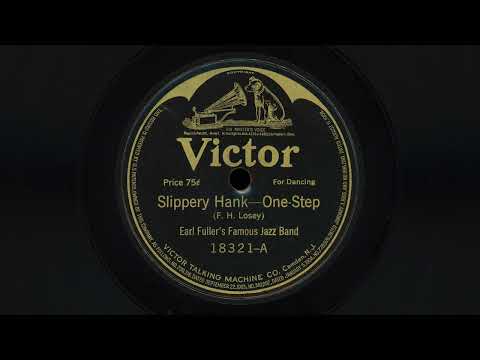
While many jazz historians write off Fuller’s band as a crude attempt to imitate jazz, I’d like to suggest perhaps it had a more expansive role. I’ve loved this record since I first heard it – and can’t imagine what the reaction to this wild spastic noise-fest must have been in 1917!
To me, the beauty of Earl Fuller’s Famous Jazz Band was that at base, it was a fun chaotic romp. The unbridled cacophony of “Slippery Hank” may have used jazz as cover – but this was music that was not trying to cloyingly ingratiate itself to the general public – rather, it beat the audience over the head with thundering spastic snare drums, howling warbling clarinet lines, and a dive-bombing trombone that sends the listener running for cover without warning.
This was all by design – Victor Records in its promotional materials described the sound of Ted Lewis’ clarinet as “a dog in his dying anguish.” The punk rocker in me adores this no-holds-barred assault on musical sensibilities. This was music that I find as culturally relevant to the time as the Dadaists performing at the Cabaret Voltaire in Zürich.
Fuller’s band recorded several more records for Victor, Emerson, Gennett, and Edison from 1917-1918 before members went their separate ways. Ted Lewis poached Kahn, Raderman, and Lucas to start his own band at the end of 1918 – and they released their first record in September of 1919.
Recorded in New York City on June 4, 1917.
Released as Victor 18321.
Credits:
Earl Fuller – piano, director
Walter Kahn – cornet
Harry Raderman – trombone
Ted Lewis – clarinet
John Lucas – drums
Leave a Reply