
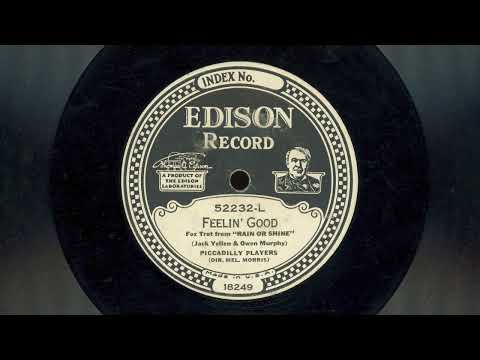
A real pick-me-up tune by Mel Morris’ Piccadilly Players which was electrically recorded for the Edison label. Please forgive that my copy has some slight warps in the laminate – and as a result, a slight “whooshing” can be heard for the first 30 seconds or so.
While Rust’s discographies do not list performers for Piccadilly Players outside of Director Mel Morris, cornetist Irving Peskin kept detailed records of the recording sessions he worked on and has been confirmed as the cornetist on the Piccadilly Players’ Edison records.
In a 2003 interview on the WFMU show “Thomas Edison’s Attic”, the 95-year-old Peskin was interviewed by telephone after listening to this very tune sent to him on CD.
Peskin says: “That is a good recording – You hear that the style is there – the refined jazz style! The saxophone solo – that style is about as forward-looking as existed at that time. It wasn’t wild the way they are these days. It stuck with a refined pattern.”
Peskin was asked if he knew who the sax player was and said that he did not. “No – sorry. I can only say this – I never took the time – I was so busy trying to do a good job that I wasn’t much on socialization.”
When asked what it felt like to hear the song 75 years after it was recorded, Peskin said: “I listen to this and I hear… the precision and quality of the instruments and playing – no mistakes – just about as top as you can get in precision playing wherever that is required… I call it articulation – there’s no flubs – no dubs – no ragged ends.”
Of his solo on this record, Peskin says “I was playing in the style of Bix, my idol of all the best jazz players in the world! Bix was a composer of absolutely fascinating beautiful music – [his playing] was so clear.”
Peskin had glowing words for director Mel Morris who he said he got along very well with.
Peskin also discussed the logistics and mechanics of how recording sessions worked at the time. He said he would get a call 1-2 days before the recording session to book him for the date – or would be asked in person at the musician’s union. He would travel to the recording session by subway alone. The musicians would sit down, run through the music once – and then do the recording. The money came after five days by post. The average pay was $20 for a three-hour session. However – the big money was playing what Peskin called “the society jobs” – where he could make $100 for a couple sets over the course of an evening.
Recorded in New York City on February 20, 1928.
Released as Edison 52232.
Directed by Mel Morris.
Irving Peskin – cornet
Don Murray – clarinet, alto sax, tenor sax
Jimmy Dorsey (?) – clarinet
Leave a Reply