
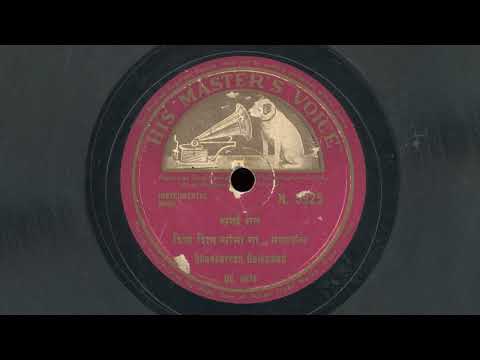
The first time I heard the Shehnai played I was struck by its raw beauty. Its tone can be described to Western listeners as similar to a slightly nasal-sounding oboe.
Its name translates to “King of the Flutes” and the instrument has a long history. It was, until the 20th century, primarily known as a folk instrument. It was common to hear playing in temples during religious ceremonies or at weddings or festivals.
In the early 1900s, shehnai players began to study with classical vocalists to learn to integrate this instrument into the classical tradition. This resulted in early masters such as Talim Hussein, Bismillah Khan, and Shankarrao Gaikawad, who plays masterfully on this wonderful record from 1933.
In Indian music, there is a concept that sounds are made of two types of vibrations – vibrations of air (sound waves that can be heard) and vibrations of ether – the “basis of all substance.” This unstruck sound is called anahata, and as I understand it, a type of spirit that master musicians can infuse into their playing in order to connect listeners with deeper divine vibrations.
In the first moments of this recording, I felt the shock of an immediate connection. The beautiful and mournful melody seemed to reach out across time to reveal itself. A wonder to experience. I hope you enjoy this digital transfer.
Amazingly, Namrata Gaikawad, the great-granddaughter of Shankarro Gaikawad, is still carrying on the family tradition of playing the Shehnai, an instrument so demanding to learn that it is said to take 15-20 years of training to master.
https://www.youtube.com/watch?v=6f-e5c2nxQc
Unfortunately, some Shehnai players are not optimistic about the future of this incredible instrument. Writing in 2007, Ramakant Sant (grandson of Shankarrao Gaikawad), laments that most opportunities to play shehnai professionally are for weddings and festivals, rather than classical concerts. Shehnai players must master other instruments to make a living. As Indian weddings begin to incorporate more recorded music, the demand for players has fallen.
He sadly writes:
“The Shehnai can now survive only as a classical instrument, and with the encouragement of international audiences. By the time the support gathers momentum, there will be no decent Shehnai players left either to perform or to teach. You need at least a hundred serious Shehnai players to produce another Bismillah Khan. It is too late now. You can forget about the Shehnai’s future.”
https://swaratala.blogspot.com/2007/11/ramakant-sant-you-can-forget-about.html
Let us hope it is not too late – the beauty of the Shehnai should be celebrated and venerated for centuries to come.
“शिव शिव सांमा गा” – शंकरराव गायकवाड
“Shiv Shiv Sahsha Ga” – Shankarrao Gaikawad
Shehnai Gat recorded circa 1933
Released as HMV N.5925.
From the collection of Suresh Chandvankar.
Leave a Reply