Jazz Crazy Records

An Archive of Early Jazz on 78 RPM

Category: Indian

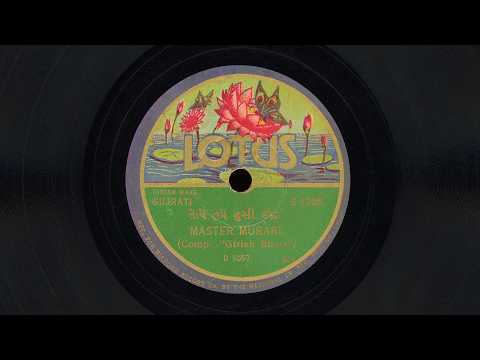
  • “તોયે તમી હસી લ્યો / સહન કંધ કરતાં લીજો” – Master Murari (1937)

    “તોયે તમી હસી લ્યો / સહન કંધ કરતાં લીજો” – Master Murari (1937)

    Probably one of the most beautiful label designs in my collection – here we have a recording on the Lotus label, short-lived Indian label on the The Diamond Record Company of Bombay. Records on this label were manufactured by the National Gramophone Record Manufacturing Co., Ltd.

    Recordings for this label were made electrically, so the sound quality is quite good. Pressing and shellac also appear to be very good quality. The label ceased operations in 1942.

    The title on the A side “તોયે તમી હસી લ્યો” seems to be an encouragement to laugh/smile, despite something bittersweet that may have occurred.

    The title on the B side “સહન કંધ કરતાં લીજો” seems to be a kindly request to please continue to carry a burden and endure a weight on your shoulders.

    At 78 rpm, the disc sounded slightly sped up and did not cleanly correspond to a key that a harmonium of the time would have reproduced. At a little under 76 rpm, the disc centered on a Sa corresponding to Eb, which seemed to sound most natural and made the most sense. The slightly slower tempo also seemed to complement the nature of the meditative performance and poetic lyrical themes.

    You can compare this transfer to a faster tempo transfer at
    https://archive.org/details/a_20210718_202107/LOTUS+S+1005+D+1057+-+TOYE+TAMEN+-+MASTER+MURARI.mp3

    Let me know what you think.

    Likely recorded in Bombay, India circa 1937.
    Released as Lotus S.1005

    Credits:
    Master Murari – vocals
    Unknown Artists – harmonium (?), unknown instrument, tabla
  • “పట్టివిడువరాదు / అబిమానమెన్నడు” – Mr. Palladam Sanjeeva Rao (1932)

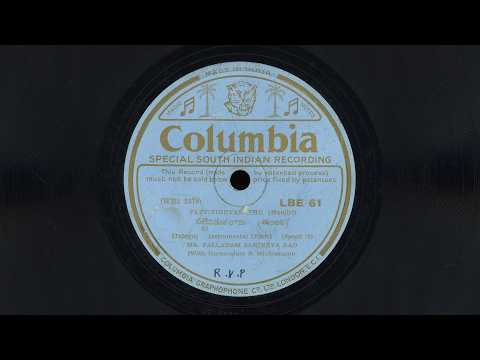
    “పట్టివిడువరాదు / అబిమానమెన్నడు” – Mr. Palladam Sanjeeva Rao (1932)

    These devotional Carnatic ragas are the perfect start to a Sunday morning

    A – Pattividuvarathu (Manjiri)
    B – Abhimana Menadu (Byagada)

    Recorded in India circa 1932.
    Released as Columbia LBE 61.
    Matrices WEI 2378 / WEI 2380

    Credits:
    Mr. Palladam Sanjeeva Rao – flute
    Unknown Artists – Harmonium, Mirdhangam

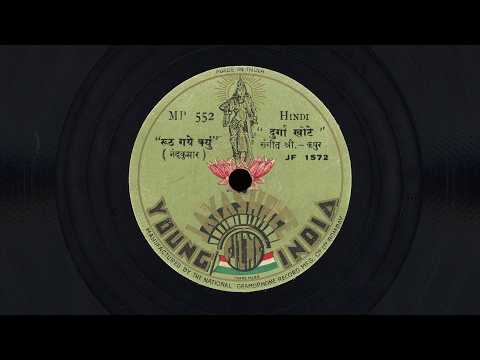
  • “रुठ गये क्युं / सुत है जगमें सबसे प्यारा” – दुर्गाबाई खोटे Durgā Khoṭe (1938) 🇮🇳

    “रुठ गये क्युं / सुत है जगमें सबसे प्यारा” – दुर्गाबाई खोटे Durgā Khoṭe (1938) 🇮🇳

    Today I fulfill a request from a friend of the channel – a disc from my collection of 78 rpm records on the Young India label – this series featuring songs from early Parbhat Film Company movies.

    The films produced by Parbhat are from the very early era of Indian cinema. Parbhat was founded in Kolhapur in 1929, and made 45 films in its run through the 30s and 40s. In 1960, the Indian government acquired the defunct Parbhat studio and transformed it into the Film and Television Institute of India (FTII).

    This record features songs from the Parbhat’s film Nandkumar = नंदकुमार​, released in 1938. The film recounts the birth, childhood, and early antics of Lord Krishna.

    The film was directed by Keshav Rao Dhaibar, produced by Jayashree Films. Both songs in this video were sung by Durgābāī Khoṭe ( दुर्गाबाई खोटे ) – better known as Durga Khote – an actress with a long prolific career in Hindi and Marathi cinema who performed in over 200 films – the last produced in 1983.

    Warning: You will hear a small baby crying on side one. That is Krishna, being comforted by a maternal figure played by Durga Khote, who then sings to him. This first side, रुठ गये क्युं , seems to translate as “Why are you displeased?”

    The second side, सुत है जगमें सबसे प्यारा , translates to “The Son – dearest in all the world.” Some very beautiful instrumentation and arrangement on this side, which features Durga Khote singing to “the world’s most beloved son.”

    I think this may be one of the more beautiful labels of records in my collection – and is somewhat unique, as later discs in the MP series had a different design that featured a small photo of the primary vocalist on the label with the recognizable graphic from Prabhat’s title sequence featuring a dramatic silhouetted figure holding a large curved horn. I think perhaps only the discs featuring songs from Nandkumar had this exquisite design.

    Recorded in India circa 1938.
    Released as Young India MP 552.
    Mx JF 1572 and JF 1573.

    Credits:
    Durga Khote – vocals

    Sources:
    https://www.imdb.com/title/tt0213922/
    https://scroll.in/reel/679099/the-story-of-how-prabhat-studios-made-india-s-biggest-hits-of-the-1930s
    https://www.youtube.com/watch?v=HRRGzC_n-l4
    https://www.youtube.com/watch?v=RqtKe63Y-FM
    https://www.linkedin.com/pulse/brands-lost-time-prabhat-film-company-dr-mohan-dewan-qs4rf/

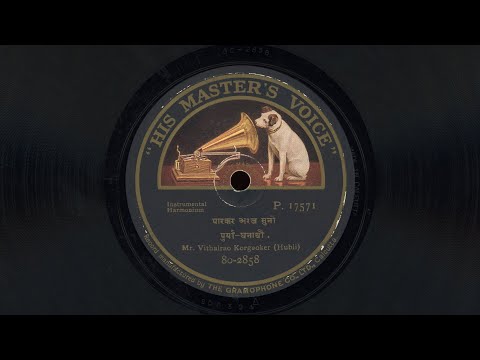
  • “पारकर अरज सुनो / लागे ह्रुदयी हुर हुर” – Mr. Vithal Rao Korgaokar Of Hubli (1925) Indian Harmonium

    “पारकर अरज सुनो / लागे ह्रुदयी हुर हुर” – Mr. Vithal Rao Korgaokar Of Hubli (1925) Indian Harmonium

    Mr. Vithal Rao Korgaokar of Hubli is one of many of prominent harmonium artists who recorded in India during the 20s and 30s.

    Side A, Pārkar Arj Suno, is a dusk raga (Puriya‑Dhanashree) that is serious and emotionally introspective.

    Side B, Lāge Hridayī Hur‑Hur, translates loosely to “My heart flutters”, with the phrase “Hur‑Hur” (हुर हुर) expressing romantic longing and emotional agitation. Here, we have an evening raga (Yaman) that expresses devotion, purity, longing, and calm.

    Believed to have been recorded circa 1925.
    Released as His Master’s Voice P.17571

    Credits:
    Mr. Vithal Rao Korgaokar Of Hubli – Harmonium
    Unknown Artist – Tabla

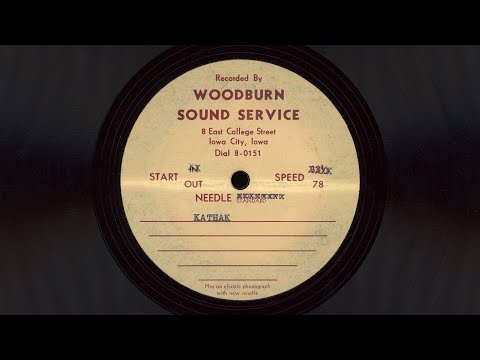
  • Live Sarangi Recording – Iowa City (1950s?)

    Live Sarangi Recording – Iowa City (1950s?)

    This home-recorded 78 rpm appears to feature Indian musicians playing what one knowledgeable commenter describes as “a very nice performance of a tintal gat in Raag Tilak Kamod on the sarangi, accompanied by tabla.”

    It is labeled “Kathak” so I initially guessed it was the musical accompaniment to a Kathak dance. Not sure what the label refers to.

    Recorded in Iowa City, Iowa – my guess at some point in the early-to-mid 1950s but perhaps later?

    Transferred this for a pal. Kind of curious to know more about this one.

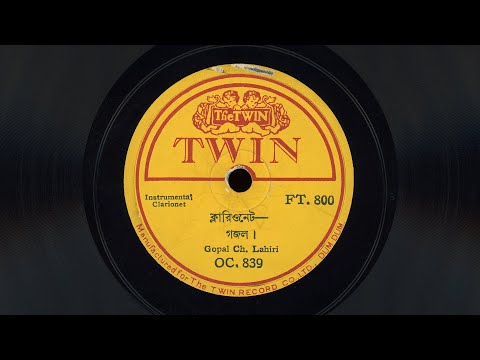
  • “সিন্ধু ভৈরবী / গজল” – Gopal Chand Lahiri (~1930)

    “সিন্ধু ভৈরবী / গজল” – Gopal Chand Lahiri (~1930)

    A digital transfer of both sides of a nice clarionet recording session by Gopal Chand Lahiri, about whom not much is known. The Bengali text on the label and production in Dum Dum, India indicates perhaps an artist from east India.

    Side A (Mx. OC.838) is a Carnatic raag called Sindhu Bhairavi. This raag is “suited for lighter pieces” and expresses separation, sorrow, compassion, and devotion.

    Side B (Mx. OC.839) is a ghazal (a type of love song originating in Arabic poetry). “The ghazal is always written from the point of view of the unrequited lover whose beloved is portrayed as unattainable.”

    Recorded in India circa 1930.
    Released as Twin FT.800

    Credits:
    Gopal Ch. Lahiri – Clarionet
    Unknown Artists – harmonium, tabla

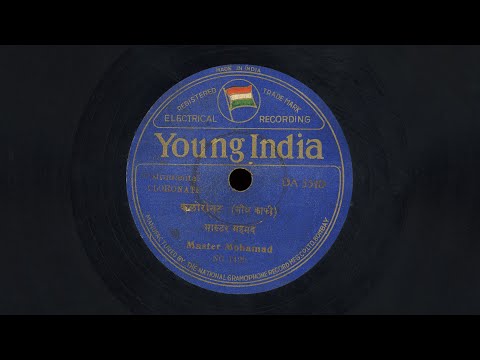
  • “मिश्र काफी / तिलंग” – Master Mohamad (1940)

    “मिश्र काफी / तिलंग” – Master Mohamad (1940)

    I was feeling a bit melancholic this week and steeping myself in the beauty of Indian music helped me process.

    Here we have two raags from an Indian clarionet player from the early 1940s recorded on the indigenous Young India label – which released hundreds, if not thousands, of records in India from 1935 to 1955.

    The first is labeled as “mixed” Kafi – meaning a variant of Raag Kafi that includes notes or phrases from other ragas. Raag Kafi is associated with the spring season and themes of love and longing.

    Secondly we have Raag Tilang, which has a light and sweet nature that can evoke a lively or romantic mood.

    Released as Young India DA 5510.

    Credits:
    Master Mohamad – clarionet
    Unknown Artists – harmonium, tabla

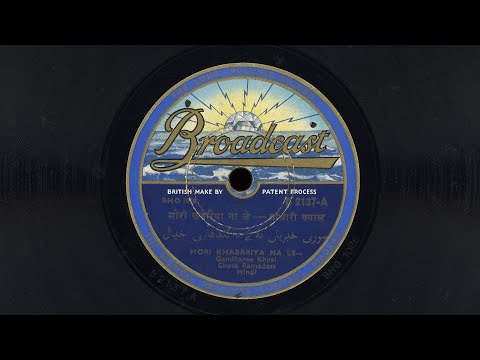
  • “मोरी खेदरिया ना ले / मग में श्याम छुओ ना” – Chota Ramadass (~1937)

    “मोरी खेदरिया ना ले / मग में श्याम छुओ ना” – Chota Ramadass (~1937)

    A – मोरी खेदरिया ना ले = Mori Khabariya Na Le = “Don’t Take My Sorrows Away”
    गांधारी ख्याल = Gandharee Khyal

    B – मग में श्याम छुओ ना = Mag Me Sham Chhhuo Na = “Don’t touch me, Shyam, as I walk along the path.”
    राग सोहिनी = Raga Sohini

    The artist, Chhota Ram Das, can be seen on the sleeve shown in the upper left quadrant of Side A.

    This is the only record on the Broadcast label I have in my collection. It is from the collection of renowned Indian music archivist and friend Suresh Chandvankar.

    Released as Broadcast B 2137

    Credits:
    Chota Ramadass – vocals
    Unknown Artists – harmonium and tabla

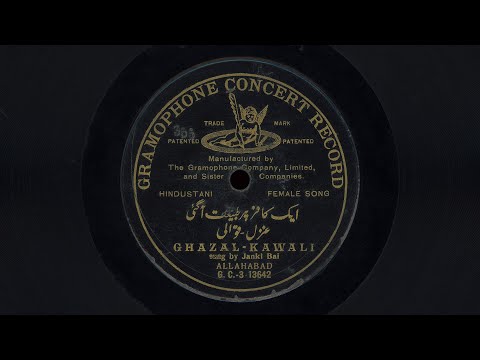
  • ایک کافر پر طبیعت آگئی – Janki Bai (1907)

    ایک کافر پر طبیعت آگئی – Janki Bai (1907)

    Janki Bai of Allahabad was born in Benares in 1875. At some point after becoming a courtesan, an attacker slashed her face with fifty-six wounds – earning her the nickname “chappan chhuri” which means fifty-six daggers. She was trained in Indian classical music by Ustad Hassu Khan.

    This disc was from her very first recording session. The selection, a ghazal, is a love poem set to music. It is also labeled as a kawali, a devotional singing style of the Sufi Islamic tradition. The title loosely translates to: “My heart has been drawn towards an infidel”.

    “As far as is known at present, Janki Bai made her first recordings for The Gramophone and Typewriter, Ltd., at Delhi in March, 1907 during the sessions conducted by William Conrad Gaisberg, assisted by George Walter Dillnutt. Janki Bai gave 22 recordings in this recording session, although she was paid Rs 250 for 20 titles… Delhi recording sessions were reissued as double sided discs and these double sided Gramophone Concert Record labelled releases had achieved sales of 12,825 pieces by February 1911, the sales of the 1907 titles accounting for 3,746 discs.”
    – Michael Kinnear, Discography of Janki Bai of Allahabad

    At the end of the recording, you can hear her clearly say: ‘Mera naam Janki bai Allahabad.’

    Recorded in Delhi in March, 1907.
    Released as Gramophone Concert Record G.C.-3-13642 (E 5383e) in January 1909.
    Later reissued as HMV P.234 (Jan 1916) and Twin FT.531 (Jun 1931).

    Credits:
    Janki Bai – vocals
    Unknown accompanists – harmonium (?), tabla

    Sources:
    The Record News: Journal of the Society of Indian Record Collectors, Vol 14, April 1994. https://archive.org/details/trn_14

    “Janki Bai, singer disfigured by 56 stab wounds sold more records than her contemporaries”, Vikram Sampath, June 2, 2019, The Print. https://theprint.in/opinion/treasured-tunes/janki-bai-singer-disfigured-by-56-stab-wounds-sold-more-records-than-her-contemporaries/243124/

    The Untold Story of Janki Bai “CHHAPPAN CHHURI”
    https://www.youtube.com/watch?v=0yaLbiAKfoQ

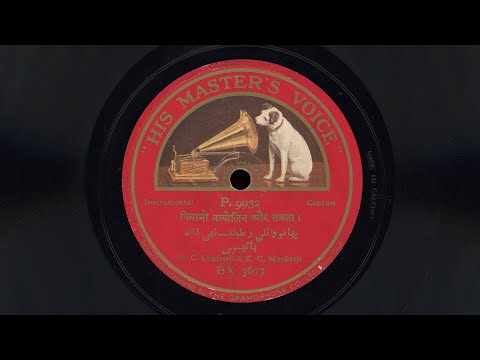
  • पियानो वायोलिन और तबला – G. C. Chatterjee & K. C. Mookerjee – Piano, violin, and tabla

    पियानो वायोलिन और तबला – G. C. Chatterjee & K. C. Mookerjee – Piano, violin, and tabla

    G. C. Chatterjee was a North Indian classical violin in the gatkari style who often recorded with pianist K. C. Mookerjee and an unknown accompanist on tabla.

    The result is a delightful collaboration that to my ears is many years ahead of its time.

    It is believed this recording was made in the late 1920s – and here is recorded from a later HMV reissue circa 1940.

    Released in India as His Master’s Voice P.9932
    (HMV mx. BX.3677 and BX.3678)
    (Gramophone mx 8-15367 and 8-15368)

    Credits:
    Gagan Chandra Chatterjee – violin
    K. C. Mookerjee – piano
    Unknown accompanist – tabla