Jazz Crazy Records

An Archive of Early Jazz on 78 RPM

Category: Indian

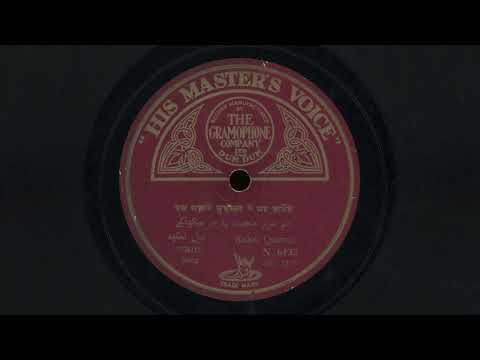
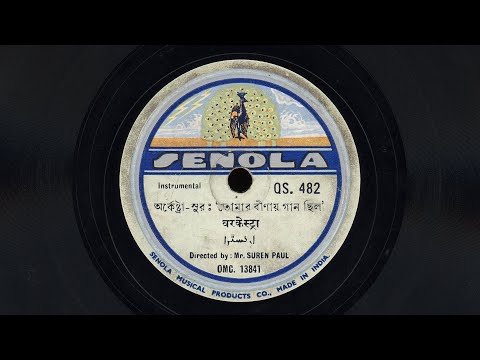
  • “তোমার বীণায় গান ছিল / পিয়া মিলন কো যানা” – Orchestra Directed by Mr. Suren Paul (1930s)

    “তোমার বীণায় গান ছিল / পিয়া মিলন কো যানা” – Orchestra Directed by Mr. Suren Paul (1930s)

    There is an interesting pocket of Indian music on 78 rpm where Indian musicians were integrating Western concepts and instruments such as the violin and piano into traditional Indian ensembles.

    I don’t know anything about Mr. Suren Paul or the orchestra he directs here in the early 1930s – but listening to the music, I feel this music is 40 years ahead of its time.

    It reminds me of a time in Western music where Indian concepts and instruments such as the sitar and tabla were being widely integrated into Western ensembles. Think of a group such as Ralph Towner’s Oregon from the early 1970s. “Music from Another Present Era” could have been Mr. Suren Paul’s grandchild.

    In the late 1930s, Western music and instruments began to be seen as damaging to traditional Indian music. For example, the harmonium began to be seen as an “un-Indian” instrument not suitable for Indian classical music and in 1940 was banned outright from appearing on All India Radio.

    An excellent article on this topic appears at:
    https://www.heritagetimes.in/when-harmonium-was-banned-at-all-india-radio

    I’m wondering if such orchestras also were discouraged from pursuing integrative music with Indian and Western instruments. I need to learn more about this.

    Released as Senola QS 482
    I believe this recording was made in Calcutta, India circa 1933.
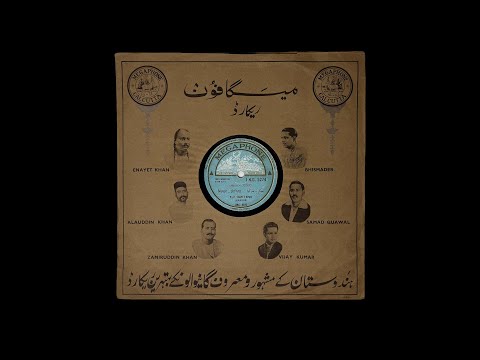
  • “सितार – जोगिया / सितार – भैरवी गत​ ” – Prof. Enayet Khan & Mr. Vilayet Hossain (1938) Indian Sitar

    “सितार – जोगिया / सितार – भैरवी गत​ ” – Prof. Enayet Khan & Mr. Vilayet Hossain (1938) Indian Sitar

    Both sides of a scarce Indian sitar recording of the legendary master, Enayat Khan, and his son, Ustad Vilayat Khan on the Calcutta-based Megaphone label. The original Megaphone sleeve is also featured – one side showing a photo of Ustad Enayat Khan.

    Enayat Khan passed away at age 43 in 1938, so this recording was likely made shortly before his death. Vilayat Khan, on the other hand, was only ten years old at the time of this recording! This pairing shows the passing of the torch from one master to the next.

    Matrix OMC. 8699
    Bhairavi Gat (the queen of morning Ragas)
    Prof. Enayet Khan – sitar

    Matrix OMC. 8698
    Jogiya (a morning Raga based on Bhairavi Thaat)
    Mr. Vilayet Hossain (Son of Prof. Enayet Khan) – sitar

    Released as Megaphone J.N.G. 5274.
    Recorded circa 1938.

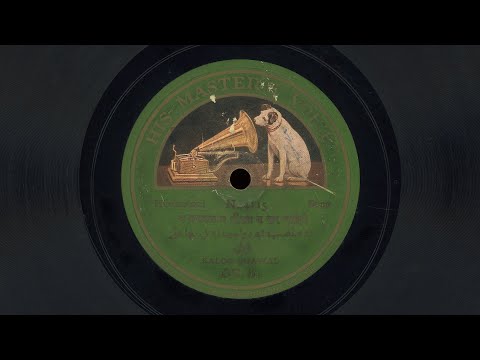
  • न मनसब न दौलत न जुर चाहिए – Kaloo Quawal (c. 1933)

    न मनसब न दौलत न जुर चाहिए – Kaloo Quawal (c. 1933)

    This transfer is by request from a patient viewer in Pakistan. 🙏 Peace to you my friend. I hope you enjoy this record.

    Kaloo Qawwal was an early Indian qawwali – a singer of Islamic devotional music in the mystical Sufic tradition. He recorded extensively in the 1930s and also performed on Indian radio stations and in large live concerts.

    My technology-assisted translation of the title is “Neither position nor wealth nor power is needed.” If a native speaker has a better translation, please comment below.

    Released as His Master’s Voice N.4115 (Matrix OE. 80)

  • “ఎవరనినిర్ణయింఛదూ” – Nagaraja Rao (1912) Indian Carnatic Flute Instrumental

    “ఎవరనినిర్ణయింఛదూ” – Nagaraja Rao (1912) Indian Carnatic Flute Instrumental

    This is the other side of the Nagaraja Rao record of Carnatic flute I posted earlier today.

    The title (if I have it correctly) ఎవరనినిర్ణయింఛదూ translates to “Who Can Decide?” or “Who Can Judge?”

    This side features the Nadachintamani rāgam – which is said to be similar to the Hungarian minor scale in Western music.

    Recorded in Bangalore, India, c. September 1912 by engineer Max Hampe.
    Originally released as Gramophone Concert Record G.C.-8-18916 (Matrix H 11268 R)
    Reissued as His Master’s Voice P. 2312 in the 1920s.

    Credits:
    Nagaraja Rao – flute
    Unknown accompanists – mridangam

    Thanks to Jonathan Ward of Excavated Shellac for his help dating this recording.

    The flip side of this record can be heard at:
    https://youtu.be/wDAeHAsEqys

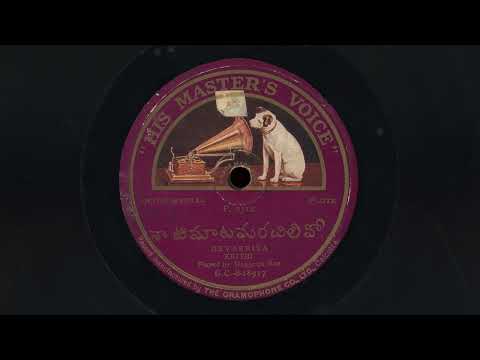
  • “నాటిమాటమరచిలివో” – Nagaraja Rao (1912) Carnatic Flute Instrumental

    “నాటిమాటమరచిలివో” – Nagaraja Rao (1912) Carnatic Flute Instrumental

    Let’s all take a breath together. Tomorrow is election day in the U.S. and this soothing and melodious Devakriya raag recorded over a century ago seems just the right music to center ourselves after a long and divisive year in American politics.

    The flute of Nagaraja Rao is played beautifully – evoking serenity – in this Krithi composition of the Carnatic musical tradition of Southern India. It is not know which section of the Krithi we are hearing.

    The title (if I have it correctly) నాటిమాటమరచిలివో translates to “Forget the Words of the Past” or “Let Go of Past Words.”

    The Devakriya raag is also known as Shuddha Saveri, comprised of five notes (swaras). It is curious to Western ears (and particularly to jazz ears) as there is no minor or major third or minor or major seventh in the scale – only a second, a fourth, a fifth, and a sixth – so it has a kind of suspended 4th or sixth chord sound. As a guitarist who is learning jazz, the 3rd and the 7th are everything in jazz harmony. A scale that omits these notes is introduces a kind of harmonic uncertainty that is refreshing to hear as your ears adapt to its tonal language.

    Recorded in Bangalore, India, c. September 1912 by engineer Max Hampe.
    Originally released as Gramophone Concert Record G.C.-8-18917 (Matrix H 11268 R)
    Reissued as His Master’s Voice P. 2312 in the 1920s.

    Credits:
    Nagaraja Rao – flute
    Unknown accompanists – mridangam

    Thanks to Jonathan Ward of Excavated Shellac for his help dating this recording.

    The flip side of this record can be heard at:
    https://youtu.be/DDjGPc19wrE

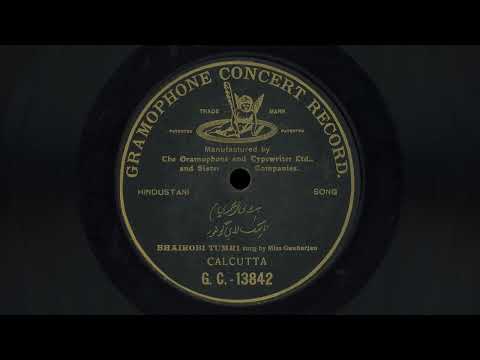
  • Bhairobi Tumri – Miss Gauharjan (1904) – Very Early Recording of Legendary Indian Vocalist

    Bhairobi Tumri – Miss Gauharjan (1904) – Very Early Recording of Legendary Indian Vocalist

    Legendary classical vocalist Gauhar Jan was born in Azamgarh, India in 1870. She could sing in over 20 languages and recorded over 600 records.

    This was from a very early session from 1904. It was reissued as HMV P-17 which I also have a copy of, but believe it or not, the older GCR made for a slightly better transfer!

    This early acoustic recording made for a very tricky transfer – and it really took a lot to minimize noise without sacrificing the performance. Hopefully it is enjoyable!

    If you stick around until the very end, you’ll hear the voice of Gauhar Jan herself announcing her name as was the custom of many early recordings.

    Recorded by William Sinkler Darby in Calcutta, India in December 1904.
    Released as Gramophone Concert Record G. C. – 13842 (mx. E2585h)

    Miss Gauhar Jan is accompanied by unknown artists on harmonium and tabla.

    Notes from Michael Kinnear “Discography of Miss Gauhar Jan of Calcutta”, The Record News, Vol. 9, Jan. 1993.

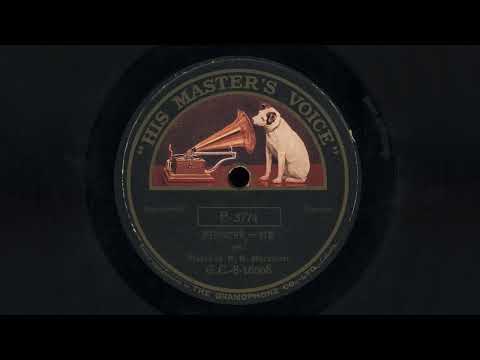
  • “ক্লারিওনেট বাদ্য – দেশ। / কীর্তন সুরা।” – N. Mazumdar (1917) – Indian Clarionet

    “ক্লারিওনেট বাদ্য – দেশ। / কীর্তন সুরা।” – N. Mazumdar (1917) – Indian Clarionet

    These two sides of instrumental clarionet are performed by N. Mazumdar (amateur).

    Mr. Mazumdar recorded a number of sides for the Gramophone Concert Record label in the 16000 block series of clarionet recordings. He also is credited on a few Columbia releases from much later in the 1930s.

    I find that his playing is a delight to listen to. In study of Indian music, I have learned about the concept of meend which refers to the practice within certain raags to slide between certain notes, creating a glissando. What is interesting about this performance is hearing the meend interpreted on this reeded instrument – which creates such flowing melodies.

    Recorded by George Dillnutt in Calcutta, India on January 20, 1917.
    Released as His Masters Voice P. 3774.
    Originally released as Gramophone Concert Record G.C. – 8-16008.

    Matrix 4738AK দেশ। is accompanied by tabla.
    Matrix 4739AK কীর্তন সুরা। is accompanied by tabla and harmonium.

    Thank you to Jonathan Ward of Excavated Shellac for providing more information on the date and recording of this record!

  • “हम अल्लाके मुहम्मद के घर जायेंगे” – Kaloo Qawwal कालू कव्वाल (1935)

    “हम अल्लाके मुहम्मद के घर जायेंगे” – Kaloo Qawwal कालू कव्वाल (1935)

    Kaloo Qawwal was an early Indian qawwali – a singer of Islamic devotional music in the mystical Sufic tradition. He recorded extensively in the 1930s and also performed on Indian radio stations and in large live concerts.

    Kaloo Qawwal here is heard beautifully singing accompanied by a harmonium, tabla, and an unidentified string instrument.

    My technology-assisted translation of the title is “We will go to the house of Allah and Muhammad”. If a native Hindi speaker has a better translation, please comment below.

    It is believed this record was recorded and released between 1933 and 1935.
    Released as His Master’s Voice 6133
    Matrix OE. 3177

    Credits:
    कालू कव्वाल (Kaloo Qawwal) – vocals
    Unknown artists – harmonium, tabla, unidentified string instrument

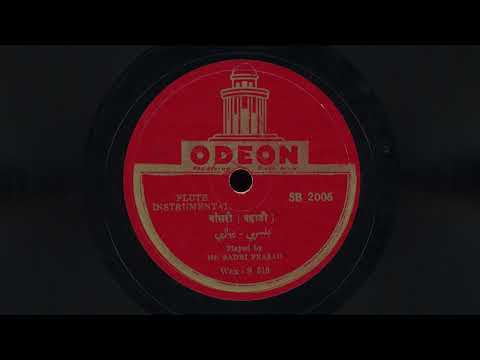
  • “बांसरी – पहाडी / भैरवी” – Mr. Badri Prasad – Bansuri Instrumental (1937)

    “बांसरी – पहाडी / भैरवी” – Mr. Badri Prasad – Bansuri Instrumental (1937)

    A beautiful bansuri (bamboo flute) instrumental by Mr. Badri Prasad from the mid 1930s on the Odeon label from the collection of the late Dr. Suresh Chandvankar, who I was thinking about today.

    I met Suresh in 2021 on Discogs – and started corresponding with him about Indian music and 78 rpm records. He pointed me to many fantastic resources to learn about Indian musicians and labels of the 78 rpm era such as the back issues of the magazine he edited for many years, “The Record News”, which are generously available for free online:
    https://dsal.uchicago.edu/books/trn/

    He also talked at length about his long relationship with discographer and author Michael Kinnear, who wrote many books and articles about Indian music – which can be found at:
    https://bajakhana.com.au/

    When I would describe artists or music that I liked, he would recommend records based on my interests. I ended up purchasing quite a few records from Suresh – which he shipped from India. If you think shipping records is a risky endeavor, know that Suresh would ship boxes of 25, 30 or even 35 records internationally. I never had one arrive broken or even cracked!

    In one of his last emails he told me “I am really glad to learn that these discs are finding homes and users – rather than lying in archival vaults.” He was glad to know that I was digitizing them and sharing them on YouTube (though he often encouraged me to use archive.org instead). In that spirit, I share it with all of you – in hopes that it will bring you joy.

    A (Mx S 619) – बांसरी (पहाडी) Bansuri (Pahadi)
    B (Mx S 620) – बांसरी (भैरवी) Bansuri (Bhairvi)

    Released as Odeon SB 2005 (Mx S 619 + S 620)

    Credits
    Mr. Badri Prasad = Flute
    Unknown Artists – Harmonium (?), Tabla

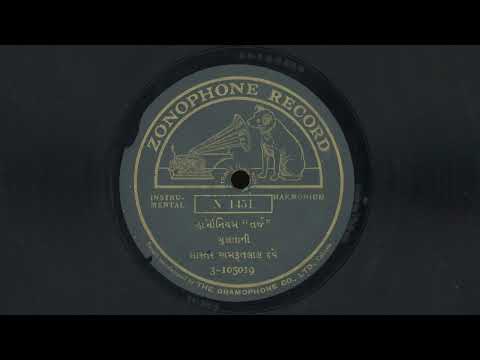
  • હારમોનિયમ તર્ઝ – માલકૌંસ / મુલતાની – માસ્તર અમરૂતલાલ દવે (1928)

    હારમોનિયમ તર્ઝ – માલકૌંસ / મુલતાની – માસ્તર અમરૂતલાલ દવે (1928)

    Today I learned that my friend and fellow 78 rpm collector Dr. Suresh Chandvankar passed away. Suresh was a founding member of the Society of Indian Record Collectors and a tireless proponent, archiver, and preserver of Indian music of the 78 rpm era.

    I first ran across Suresh on Discogs when I stumbled across some 78s he had for sale. I wrote him and we began talking about Indian music. He steered me toward the treasure trove of back issues of The Record News, available online, which contain a wealth of information on Indian music, record labels, and artists of the 78 rpm era.

    I really was astounded by the amount of dedication and effort Suresh put into the preservation of the important records he collected. He had started uploading them to Discogs and archive.org to help more people have access to them. He had started selling his collection and told me he was glad that other collectors were interested in them – as he much preferred them to have an active life of being listened to and enjoyed rather than sitting in an archive. The last sentence from his last email to me simply read: “Enjoy the music.”

    Rest in peace, my friend.

    This record of solo Harmonium Tarz by Master Amarutlal Dave was in the last shipment of records I received from Suresh last year. I hope you, too, dear listeners, will enjoy the music.

    Suresh estimated release date as 1928 – could be earlier.
    Released as Zonophone N.1451