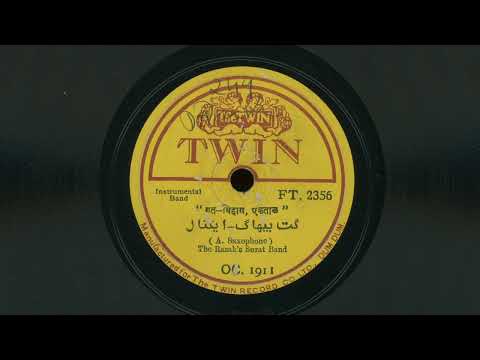
Long before Kadri Gopalnath popularized the use of the saxophone in Indian music in the late 1970s and 80s, Mr. Razak’s Surat Band recorded a number of records on the Twin label featuring saxophone solos.
Such bands, associated with municipalities, are often hired to perform at cultural events and marriages in India. I do not have a lot of information on this band – though there is a band still performing in India today that traces its lineage to the year 1900 when it was founded by Mr. Abdul Razak Abdul Rahim in the city of Surat (hence the name Razak’s Surat Band).
I always find it thrilling to hear how Indian musicians approach an instrument such as the saxophone, piano, or violin, and completely reinterpret and adapt its sound.
Released as The Twin FT. 2356 circa 1932
This video includes both sides of the release as follows: A गत बिहाग, त्रिताल (Gat – Raga Bihag – Tritaal) B गत बिहाग, एकताल (Gat – Raga Bihag – Ektaal)
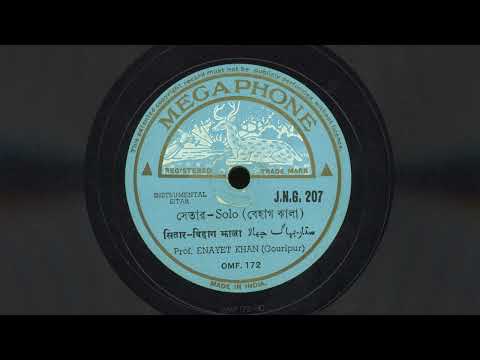
Enayet Khan, the son of Imdad Khan and father of Vilayat Khan, performs a beautiful Bihag raag on the sitar. Here, we hear the fast-paced Jhala, or conclusion of the raag.
It is believed this recording dates from 1935.
Sitar – Solo. Released in India as Megaphone J.N.G. 207 (Matrix OMF 172).
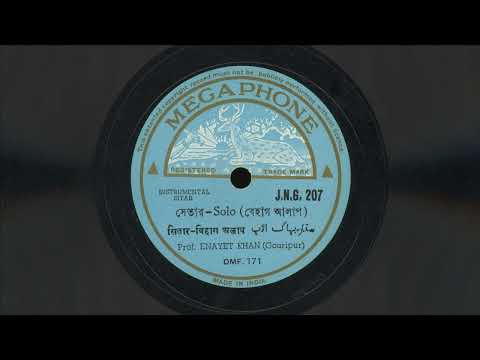
Enayet Khan, the son of Imdad Khan and father of Vilayat Khan, performs a beautiful Bihag raag on the sitar. Here, we hear the opening section of the raag, known as the Alap, which introduces the mode and mood of the composition’s form.
It is believed this recording dates from 1935.
Sitar – Solo. Released in India as Megaphone J.N.G. 207 (Matrix OMF 171).
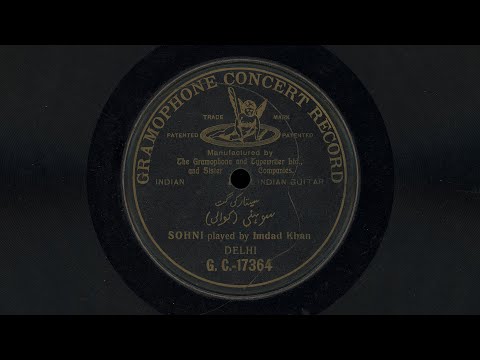
Ustad Imdad Khan (1848-1920) was a sitar player in India in the early 20th century. He is said to be the first sitar player ever recorded. In this example, we can hear the beauty of his playing.
His father, born Sahib Singhet, was rejected as a student of khyal vocalist Haddu Khan – so spent seven years secretly listening to Haddu’s practice sessions trying to learn despite the rejection. When he was finally discovered, his determination and love for music won him a place as a disciple (student). He converted to Islam and became Sahabdad Khan.
He taught his son, Imdad Khan, to play sitar over the course of twelve years. He was also taught by Ustad Bande Ali Khan. Imdad Khan
Khan’s playing and success became so influential that he became the patriarch of a musical lineage that includes his son Ustad Enayat Khan, his grandson Ustad Vilayat Khan, and his great-grandsons Ustad Shahid Parvez, Ustad Nishat Khan, Ustad Irshad Khan, and Ustad Shujaat Khan – all masters of the sitar or subahar.
I have tried to faithfully transfer this early acoustic recording, from a somewhat worn copy, with minimal treatment to improve sound quality without compromising the music itself.
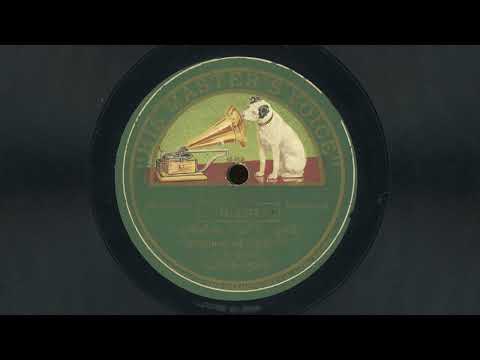
This one-sided record with etched Gramophone backplate (seen in video) is believed to have been recorded in 1904.
The first time I heard the Shehnai played I was struck by its raw beauty. Its tone can be described to Western listeners as similar to a slightly nasal-sounding oboe.
Its name translates to “King of the Flutes” and the instrument has a long history. It was, until the 20th century, primarily known as a folk instrument. It was common to hear playing in temples during religious ceremonies or at weddings or festivals.
In the early 1900s, shehnai players began to study with classical vocalists to learn to integrate this instrument into the classical tradition. This resulted in early masters such as Talim Hussein, Bismillah Khan, and Shankarrao Gaikawad, who plays masterfully on this wonderful record from 1933.
In Indian music, there is a concept that sounds are made of two types of vibrations – vibrations of air (sound waves that can be heard) and vibrations of ether – the “basis of all substance.” This unstruck sound is called anahata, and as I understand it, a type of spirit that master musicians can infuse into their playing in order to connect listeners with deeper divine vibrations.
In the first moments of this recording, I felt the shock of an immediate connection. The beautiful and mournful melody seemed to reach out across time to reveal itself. A wonder to experience. I hope you enjoy this digital transfer.
Amazingly, Namrata Gaikawad, the great-granddaughter of Shankarro Gaikawad, is still carrying on the family tradition of playing the Shehnai, an instrument so demanding to learn that it is said to take 15-20 years of training to master.
Unfortunately, some Shehnai players are not optimistic about the future of this incredible instrument. Writing in 2007, Ramakant Sant (grandson of Shankarrao Gaikawad), laments that most opportunities to play shehnai professionally are for weddings and festivals, rather than classical concerts. Shehnai players must master other instruments to make a living. As Indian weddings begin to incorporate more recorded music, the demand for players has fallen.
He sadly writes: “The Shehnai can now survive only as a classical instrument, and with the encouragement of international audiences. By the time the support gathers momentum, there will be no decent Shehnai players left either to perform or to teach. You need at least a hundred serious Shehnai players to produce another Bismillah Khan. It is too late now. You can forget about the Shehnai’s future.”
Let us hope it is not too late – the beauty of the Shehnai should be celebrated and venerated for centuries to come.
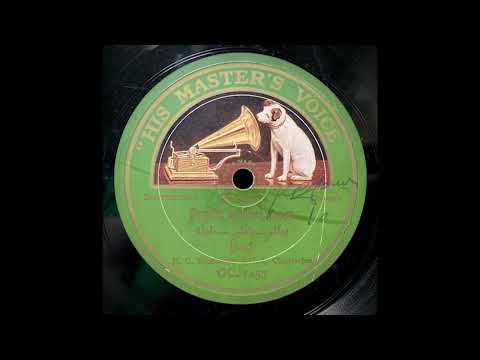
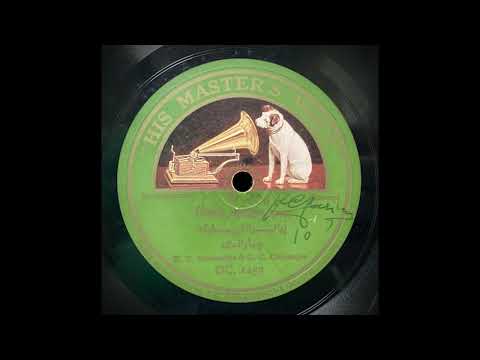
“शिव शिव सांमा गा” – शंकरराव गायकवाड “Shiv Shiv Sahsha Ga” – Shankarrao Gaikawad Shehnai Gat recorded circa 1933 Released as HMV N.5925. From the collection of Suresh Chandvankar.
The second side of this wonderful record gives each instrument more room to expand – for the first 45 seconds, we hear the piano taking the lead on melody. Then the violin comes to the forefront, accompanied beautifully by the piano. Finally, all three instruments come together energetically.
A wonderful hybrid of Indian musical sensibilities and Western instrumentation. The first time I heard this I was absolutely delighted. Perhaps you will be too.
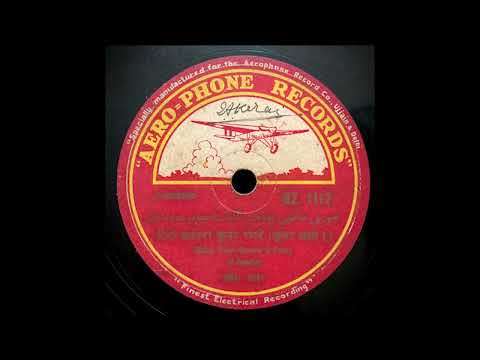
I don’t know a lot about this wonderful record from India – perhaps one of my viewers can tell me more about this artist or this beautiful devotional Qawwali?
Released as Aero-Phone Records NZ.1112
Other than the credited lead vocalist Mohd. Yasin Quawal, the other vocalists and musicians are unknown to me.
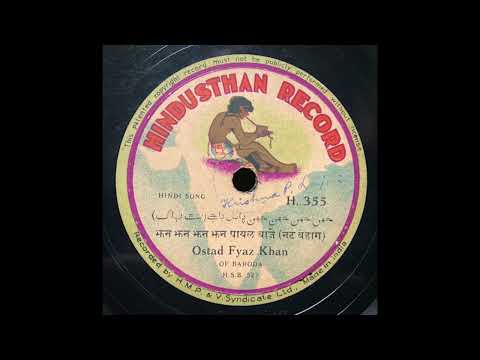
Born on February 8, 1881, Indian vocalist and composer Ustad Faiyaz Khan learned to sing from his grandfather Ghulam Abbas Khan, a great musician who was reputed to live to the age of 125.
In 1915, Faiyaz was employed by the Maharaja of Baroda, thus beginning a lifetime residence in the Baroda state (in present-day Gujarat).
His strong voice was said to move listeners to tears with the beauty of his vocal renderings.
Though I am not well-versed in the various genres and styles of Indian classical music, the first time I heard Ustad Faiyaz Khan sing, I also was moved.
Recorded in 1936. Released as Hindusthan H. 355 (Matrix H.S.B. 527/528).
Notes from “Ustad Faiyazkhan: A Living Legend in his Life Time” by Professor S. R. Mehta, The Record News, Vol 12, Oct. 1993.

![“शिव शिव सांमा गा” – शंकरराव गायकवाड (1930) – “Shiv Shiv Sambha Ga” by Shankarrao Gaikawad [Shehnai]](https://www.jazzcrazy.org/wp-content/uploads/2026/03/3948_thumbnail.jpg)