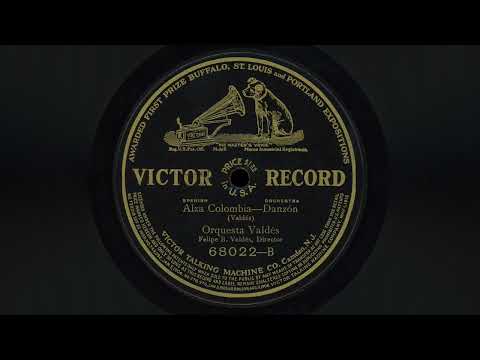
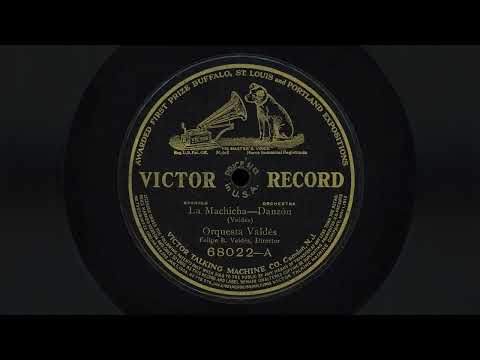
Something quite interesting that I pulled out of the non-jazz deep freeze archive over the weekend – a 12″ Victor containing some early Cuban Danzón from the Orquesta de Felipe Valdés.
Valdés, a cornetist, formed the orchestra in 1899. According to Cuban music historian Cristobal Diaz-Ayala, Valdés “recorded more danzons than any other típica in the twentieth century.” He recorded over 300 sides in total.
In his doctoral thesis on Valdés and the role of the Cornet, Gerardo Garcia Mata goes into detail on the structure and sound of danzón at the time – which showcased a violin and clarinet as the “prominent melodic voices”.
Starting in 1907, Valdés began to integrate the cornet to a larger degree into his compositions and arrangements. In this 1907 recording, the cornet begins by playing with the ensemble, then lays out for the B section and returning A section. It is only at 1:10 at the start of the C section that we hear the cornet take the melodic spotlight, which it moves in and out of for the remainder of the tune.
Dr. Mata writes that this formative period marked a growing confidence by Valdés in his abilities – and that subsequent works see the “increased presence” of his cornet.
Recorded in Havana, Cuba on March 6, 1907. Released as Victor 68022.
Credits: Felipe Valdés – bandleader, cornet Unknown Artists – violins (3), clarinets (2), trombone, contrabajo, saxophone, guiro, and timbales.
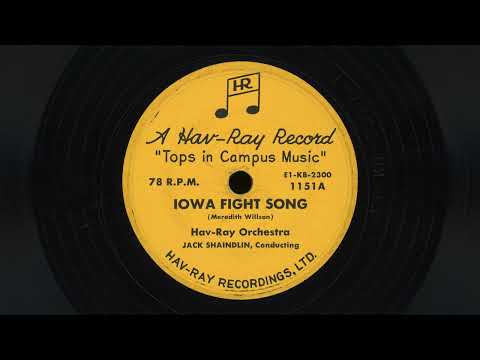
In tribute to Caitlyn Clark, Hannah Stuelke, Kate Martin, Gabbie Marshall, Sydney Affolter, and the entire 2023-24 Iowa Hawkeyes Women’s Basketball team as they play the national championship game against South Carolina today. Best of luck!
Go Hawks!
Recorded by the Hav-Ray Orchestra. Conductor: Jack Shaindlin. Released as Hav-Ray 1151.
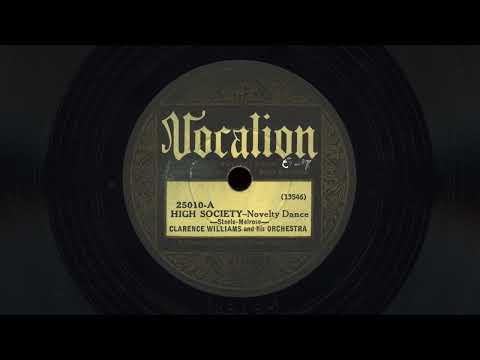
Our final stop on the “High Society” express is a deep depression cut from 1933.
This version is played in Eb/Bb and has a different arrangement from the 1929 recordings.
Once again, the identity of the clarinetist is shrouded in mystery and guesses – and we also have a mystery percussionist keeping a steady beat on a bass drum or tom throughout!
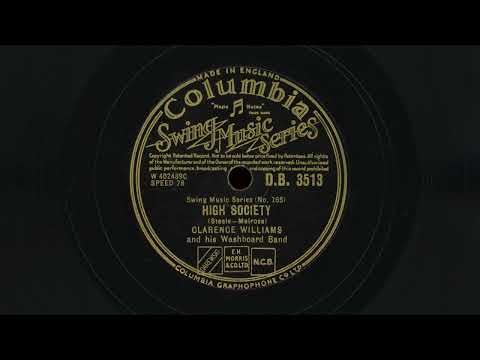
We also notice a curious songwriter credit: “Steele-Melrose” on this composition – which was credited on the 1929 version to A.J. Piron. Record Research #124 contains a history of this song – which was *originally* composed and copyrighted by Porter Steele in 1901. In 1929 Steele neglected to renew his copyright on the work, and it passed into the public domain. A.J. Piron and Clarence Williams – who at the time had a music publishing business – filed copyright on the work on May 13, 1929. Melrose publishing in Chicago created a new arrangement of the work by George Leaman and filed a separate copyright in 1931. Piron and Williams filed an additional copyright on an arrangement of the tune with words on August 13, 1933 – a month after this recording session and ostensibly just before the record was released. Why then, Vocalion chose to credit the song to Steele-Melrose is another mystery.
Continuing our romp through Clarence Williams’ recordings of “High Society”, here we have take C from the same 1929 session that I posted yesterday.
Note that this record is credited to “Steele-Melrose” rather than A.J. Piron, as the OKeh release was credited. This is due to a very interesting history of copyright shenanigans that I will get into tomorrow when I post yet another later version of this tune recorded by Williams.
I was surprised to hear this take also had what sounds like a “clam” by Ed Allen around the 0:47 mark. Just serves as a reminder that these tunes were recorded live in one or two takes – sometimes after only one brief rehearsal – and what you got was what you got. I’ve also noticed that while I’ve seen certain classical artists or symphonies recording on Victor Red Seal could get 10 or even 15+ takes during a session, jazz and blues artists were often given just one – and three at best.
Two issued takes were recorded and released – this is take C. Yesterday I posted take A. Both takes were pressed as Okeh 8706 – and I’m not sure which take is more common – but take C was the only one master pressed for this later U.K. reissue.
Recorded in New York City on July 2, 1929. Released in the U.K. as Columbia D.B. 3513 (take C) on their Swing Music Series.
Credits: Ed Allen – cornet Unknown Artist – clarinet, alto sax Clarence Williams – piano Floyd Casey – washboard
Clarence Williams recorded the Porter Steele composition “High Society” a few times during his long career – and today and tomorrow I’ll be sharing a few of my favorite versions of this tune.
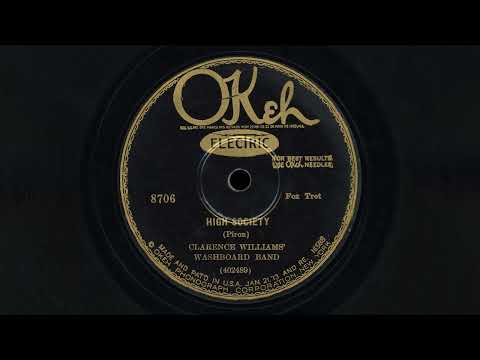
First up we have a version recorded during the summer of 1929 for the OKeh label. Curiously, it is played in a higher key (C/F) than the one it is normally played in (Bb/Eb) – and also does not include the turnaround section after the first 32 bars.
The identity of the reed player has been hotly debated – with many educated guesses from Ben Whittet or Arville Harris to Cecil Scott.
While “High Society” was originally composed by Porter Steele in 1901, he let the copyright lapse in 1929, leading A.J. Piron + Clarence Williams’ music publishing company to file a copyright under A.J. Piron’s name on his arrangement of the composition in May of 1929 – a few months before this recording was made. Hence the credit to Piron on this record.
Also – is it me or does sound like Ed Allen flubbed a note at 1:04?
Two issued takes were recorded and released – this is take A.
Recorded in New York City on July 2, 1929. Released as OKeh 8706 (take A).
Credits: Ed Allen – cornet Unknown Artist – clarinet, alto sax Clarence Williams – piano Floyd Casey – washboard
Working at the Kansas City Art Institute as a student in the late 1980s, my supervisor in the photo-video checkout area was Rev. Dwight Frizzell, who also employed a delightful curmugeon named Morris Martin. Reverend Dwight was constantly playing jazz music while we worked and Martin saw that I was interested in learning more. He made me a mix tape of Fletcher Henderson and Lucky Millinder that he recorded from his vinyl collection.
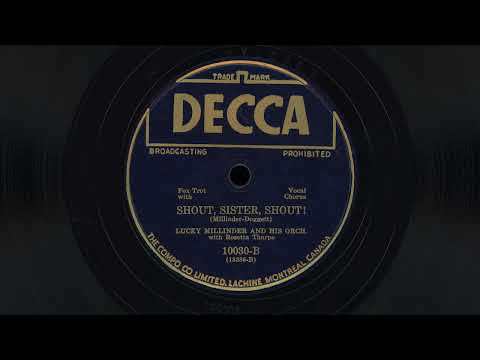
This tune was one that I really loved from that tape. Fast forward 30 years and I have this very nice Canadian Decca pressing on 78 rpm.
While Millinder got his start in the world of jazz and swing leading the Mills Blue Rhythm Band in the 1930s, his own orchestra that started in 1941 leaned more into rhythm and blues. Here we have an expressive anthem written by Millinder and pianist Bill Doggett – joyfully sung by the up-and-coming gospel singer Rosetta Tharpe.
Recorded in New York City on September 5, 1941. Released in the U.S. as Decca 18386. Here we have the Canadian issue – Decca 10030.
Credits: Lucky Millinder, vocals, director William Scott, Archie Johnson, Nelson Bryant – trumpet George Stevenson, Floyd Brady, Edward Morant – trombone Ted Barnett, George James – alto sax Stafford Simon – tenor sax Ernest Purce – baritone sax Bill Doggett – piano Trevor Bacon, Rosetta Tharpe – guitar, vocals Abe Bolar – bass Panama Francis – drums
The Georgians are one of those underrated acoustic-era jazz bands that often get overlooked – though Italian-born trumpeter Frank Guarente had been playing in New Orleans – the epicenter of early jazz – starting in 1914. It was said that he was friends with Joe Oliver – and that the two traded tips and techniques.
Guarente is a marvel on these early Georgians records, playing advanced hot solos for the time – and leading a very elegant group of ensemble players.
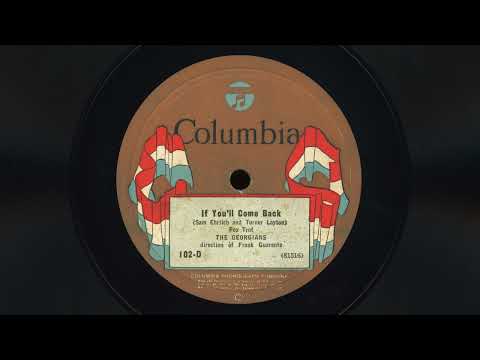
Here we have a fine tune on a record in excellent condition – “If You’ll Come Back”. At 1:15, the trumpet takes a solo, and we hear Guarente launch into an ornery muted melody that begins and ends with a growl.
Recorded in New York City on March 6, 1924. Released as Columbia 102-D
Credits Frank Guarente – trumpet, director Archie Jones – trombone Johnny O’Donnell – clarinet, bass clarinet, alto sax Dick Johnson – clarinet, alto sax, tenor sax Arthur Schutt – piano Russell Deppe – banjo Chauncey Morehouse – drums
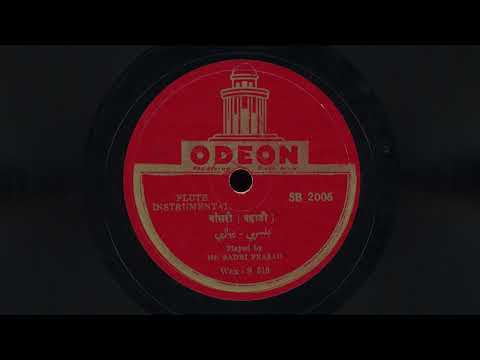
A beautiful bansuri (bamboo flute) instrumental by Mr. Badri Prasad from the mid 1930s on the Odeon label from the collection of the late Dr. Suresh Chandvankar, who I was thinking about today.
I met Suresh in 2021 on Discogs – and started corresponding with him about Indian music and 78 rpm records. He pointed me to many fantastic resources to learn about Indian musicians and labels of the 78 rpm era such as the back issues of the magazine he edited for many years, “The Record News”, which are generously available for free online: https://dsal.uchicago.edu/books/trn/
He also talked at length about his long relationship with discographer and author Michael Kinnear, who wrote many books and articles about Indian music – which can be found at: https://bajakhana.com.au/
When I would describe artists or music that I liked, he would recommend records based on my interests. I ended up purchasing quite a few records from Suresh – which he shipped from India. If you think shipping records is a risky endeavor, know that Suresh would ship boxes of 25, 30 or even 35 records internationally. I never had one arrive broken or even cracked!
In one of his last emails he told me “I am really glad to learn that these discs are finding homes and users – rather than lying in archival vaults.” He was glad to know that I was digitizing them and sharing them on YouTube (though he often encouraged me to use archive.org instead). In that spirit, I share it with all of you – in hopes that it will bring you joy.
A (Mx S 619) – बांसरी (पहाडी) Bansuri (Pahadi) B (Mx S 620) – बांसरी (भैरवी) Bansuri (Bhairvi)
Released as Odeon SB 2005 (Mx S 619 + S 620)
Credits Mr. Badri Prasad = Flute Unknown Artists – Harmonium (?), Tabla