Jazz Crazy Records

An Archive of Early Jazz on 78 RPM

Author: Professor M

  • How To Make Digital Transfers Of Your 78 RPM Records – Jazz Chat Episode 7

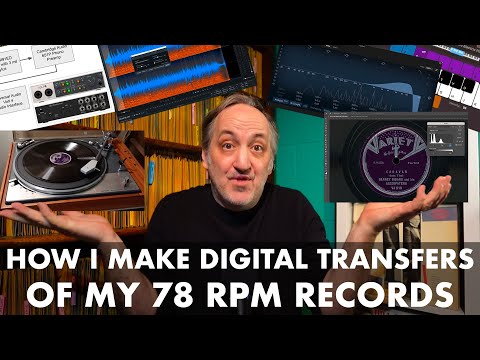
    How To Make Digital Transfers Of Your 78 RPM Records – Jazz Chat Episode 7

    If you’ve ever wanted to make digital transfers of 78 rpm records in your collection to listen to on modern devices (or make YouTube videos of your own), this video will walk you through my process so you can see what is involved.

    I’ll take you step-by-step as I demonstrate how I created a digital transfer of “Caravan” by Barney Bigard and his Jazzopaters released on the Variety label in 1937.

    If you have any suggestions, questions, or thoughts on my process – please leave a comment!

    0:00 Intro
    2:07 Step 1: Clean the Record
    3:04 My Signal Chain
    8:14 Step 2 – Digitize the Record
    10:09 My Philosophy on Digital Transfers
    11:35 Step 3 – De-clicking (RX Elements)
    19:26 Step 4 Trimming the Clip (Apple Logic)
    23:14 Step 5: Adjusting Play Speed
    29:29 Step 6: Audio Corrections (EQ, Gain, Summing to Mono)
    49:19 Step 7: Scanning the Label
    51:11 Step 8: Scan Corrections (tone, color, retouching)
    1:05:56 Step 9: Making the Video (Adobe Premiere)
    1:08:57 Comparison of Raw and Final Transfer
    1:10:21 Final Remarks

    The final transfer of this record:
    https://youtu.be/M17eZcf_hOw

    Link to the site I referenced with information on equalization and EQ curves:
    https://midimagic.sgc-hosting.com/mixphono.htm

    Software I Use:
    RX Elements
    https://www.izotope.com/en/shop/rx-elements/

    Apple Logic Pro
    https://www.apple.com/logic-pro/

    Adobe Photoshop
    https://www.adobe.com/products/photoshop.html

    Adobe Premiere
    https://www.adobe.com/products/premiere.html

    Epson Perfection V600 Photo Scanner:
    https://epson.com/For-Home/Scanners/Photo-Scanners/Epson-Perfection-V600-Photo-Scanner/p/B11B198011

    USB Audio Interface
    Universal Audio Volt4
    https://www.uaudio.com/uad-plugins/volt-4-usb.html
  • “The Cannon Ball” – Guy Lombardo and his Royal Canadians (1928)

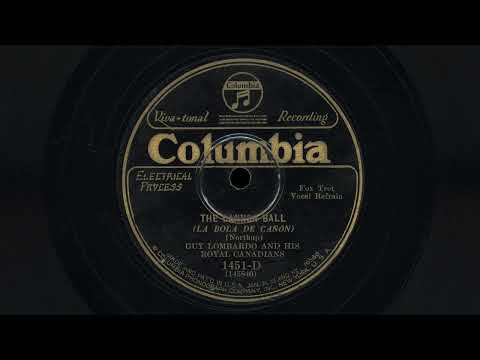
    “The Cannon Ball” – Guy Lombardo and his Royal Canadians (1928)

    While known for his sweet dance music, Guy Lombardo and his Royal Canadians had a number of hot jazzy sides on the Gennett and Columbia labels in the mid to late 1920s.

    Here we have “The Cannon Ball” – one of the harder of his early Columbias to find. Guy’s brother Lebert takes the lead on trumpet throughout this one – which also includes lots of reed section goodness, both piano and trombone solos, and a brief scatted vocal section.

    Recorded in Chicago, Illinois on March 26, 1928.
    Released as Columbia 1451-D.

    Credits:
    Guy Lombardo – director
    Lebert Lombardo – trumpet, vocals
    Jim Dillon – trombone
    Carmen Lombardo – clarinet, alto sax, vocals
    Larry Owen – clarinet, alto sax, vocals
    Fred Higman – tenor sax
    Victor Lombardo – baritone sax
    Bernard Davis – tuba
    Fred Kreitzer – piano
    Francis Henry – banjo
    George Gowans – drums

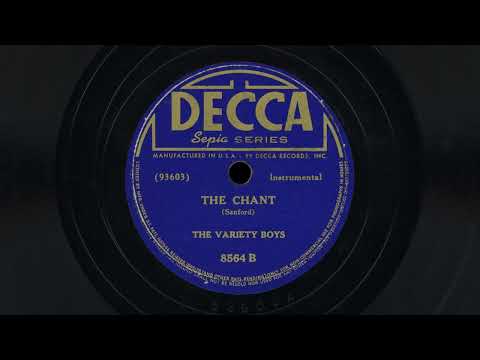
  • “The Chant” – The Variety Boys (1941)

    “The Chant” – The Variety Boys (1941)

    One of the reasons I love 78 rpm records is that sometimes you stumble across something brilliant when you weren’t expecting to. This 1941 recording must have flipped some lids upon its release – sounding inspired by a minimalist version of Django and Grappelli filtered through a film noir nightmare sequence. I love this twisted avant garde jam!

    I couldn’t find much out about The Variety Boys from this time period – though it seems to be led by tenor saxophonist George Oldham.

    From 1943 onwards, they added vocalist Ethelene Dinsmore and were known as a lounge act at cocktail clubs such as A1 Simmon’s Brown Derby in Washington, the Sky Club in Chicago, Flame Club in Duluth, Beachcomber in Omaha, Black and Tan in Seattle, and the Club Royal in San Diego.

    Recorded in Chicago, Illinois on March 15, 1941.
    Released as Decca 8564.

    Credits:
    George Oldham – tenor sax
    Bill Sanford – bass
    Clarence Black – violin
    Kenneth Henderson – guitar
    (as per “History of Jazz Tenor Saxophone Black Artists” by Jan Evensmo)

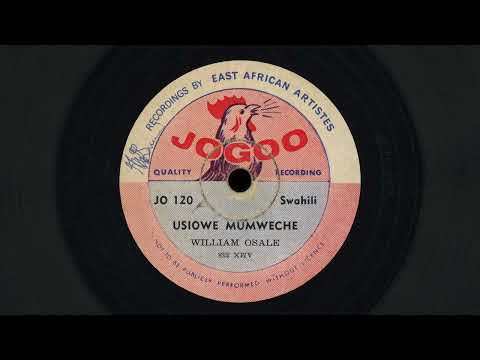
  • “Usiowe Mumweche” – William Osale (Kenya) – African Guitarist – Jogoo 120

    “Usiowe Mumweche” – William Osale (Kenya) – African Guitarist – Jogoo 120

    William Osale was a fingerstyle guitarist who performed and recorded in Kenya during the 1950s and 60s. Osale was a rural musician who played in the ‘sukuti’ style – a rhythmic style of finger-style playing invented by George Mukabi that results in a light, ‘bouncy’ sound.

    In his “A History of Kenyan Guitar Music: 1945-1980”, John Low writes, “Some rural finger-stylists like George Mukabi and William Osale also had success in the towns, providing Swahili versions of songs that they might sing in local languages back home. The appeal of their songs lay in the fact that many town dwellers had (and still have) strong links with the land, and the themes of these songs, often conservative and sometimes nostalgic, reminded them of the old values.”

    The title of this tune, “Usiowe Mumweche” seems difficult to translate. If any Swahili speakers can help translate the title or lyrics, please leave a comment!

    I do not have a recording date for this record – but will add one if I find a definitive source. My best guess is sometime in the late 1950s.

    Released as Jogoo 120.

    The flip side of this record is very good and can be found at:
    https://youtu.be/RYVzRr8Fz8M

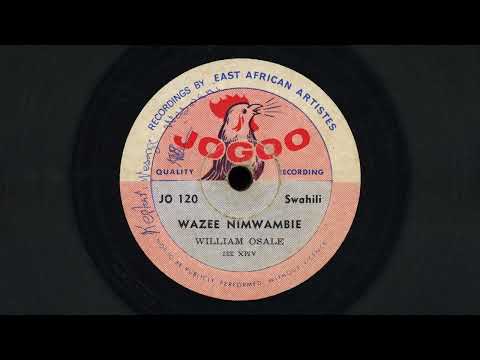
  • “Wazee Nimwambie” – William Osale (Kenya) – African Guitarist – Jogoo 120

    “Wazee Nimwambie” – William Osale (Kenya) – African Guitarist – Jogoo 120

    William Osale was a fingerstyle guitarist who performed and recorded in Kenya during the 1950s and 60s. Osale was a rural musician who played in the ‘sukuti’ style – a rhythmic style of finger-style playing invented by George Mukabi that results in a light, ‘bouncy’ sound.

    In his “A History of Kenyan Guitar Music: 1945-1980”, John Low writes, “Some rural finger-stylists like George Mukabi and William Osale also had success in the towns, providing Swahili versions of songs that they might sing in local languages back home. The appeal of their songs lay in the fact that many town dwellers had (and still have) strong links with the land, and the themes of these songs, often conservative and sometimes nostalgic, reminded them of the old values.”

    The title of this tune, “Wazee Nimwambie” seems to be a plea for the elders to speak or to share their knowledge. If any Swahili speakers can help translate the lyrics, please leave a comment!

    I find this record absolutely mesmerizing and hauntingly beautiful.

    I do not have a recording date for this record – but will add one if I find a definitive source. My best guess is sometime in the late 1950s.

    Released as Jogoo 120.

    The flip side of this record can be heard at:
    https://youtu.be/Hu8TPwOVkoI

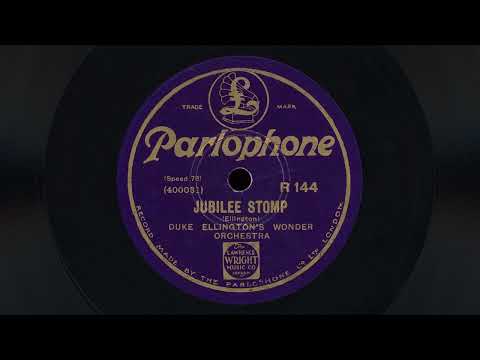
  • “Jubilee Stomp” – Duke Ellington’s Wonder Orchestra (1928)

    “Jubilee Stomp” – Duke Ellington’s Wonder Orchestra (1928)

    A while back I posted a transfer of “Jubilee Stomp” from a Brunswick session:
    https://youtu.be/25cyz9mkF_A

    This earlier version is from an Okeh session recorded two months earlier in January. A third session for Victor yielded another version that was recorded at the end of March, 1928.

    This very clean Parlophone master pressing presented the Ellington band as “Duke Ellington’s Wonder Orchestra” – one of only a very small number of releases to give the band that particular pseudonym. Great performances all around on this version – including hot trumpet, clarinet, trombone, and piano solos.

    Recorded in New York City on January 19, 1928.
    Originally released as Okeh 41013.
    Released in the U.K. as Parlophone R-144 (master pressing).

    Credits:
    Duke Ellington- piano, arranger, director
    Bubber Miley, Louis Metcalf – trumpet
    Joe Nanton – trombone
    Otto Hardwick – soprano sax, alto sax, baritone sax
    Harry Carney – clarinet, alto sax, baritone sax
    Barney Bigard – clarinet, tenor sax
    Fred Guy – banjo
    Wellman Brand – string bass
    Sonny Greer – drums

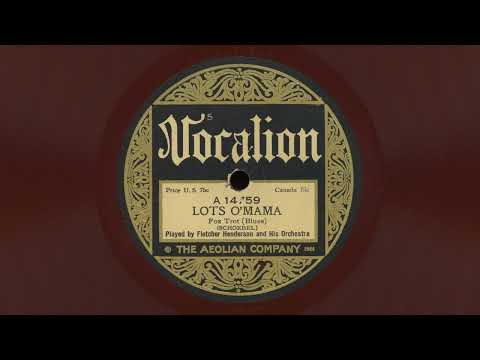
  • “Lots O’ Mama” – Fletcher Henderson and his Orchestra (1924)

    “Lots O’ Mama” – Fletcher Henderson and his Orchestra (1924)

    These early Fletcher Henderson Red Vocalions are gorgeous and always contain great music.

    Hendersonia by Walter C. Allen recounts a curious episode from around this time:
    “Don Redman has recalled that he and Coleman Hawkins were once surreptitiously approached by a young man who had a pair of clarinets for sale. They were all apart, in a sack, and had to be put together. A deal was concluded: ten dollars for the two. Don thought it best not to ask any questions, but he and Hawk always referred to them as their ‘hot’ clarinets! These ‘hot clarinets’ are heard jointly on a number of Henderson records, one of the first being Vocalion 14759.”

    So enjoy the “hot” clarinets on this record – along with cornet and trombone solos in this jaunty arrangement of an Elmer Schoebel tune “Lots O’Mama” – which was also recorded the very same month by the California Ramblers, Ladd’s Black Aces, and the Original Memphis Jazz Band.

    0:00 Intro
    0:28 Cornet solo (Howard Scott)
    1:05 Trombone solo (Teddy Nixon)
    1:42 Clarinet solo (Redman? or Hawkins?)
    2:00 Clarinet solo (Don Redman)
    2:18 Outro

    Recorded in New York City on January 29, 1924.
    Released as Vocalion 14759.

    Fletcher Henderson – piano, arranger, director
    Elmer Chambers, Howard Scott – cornet
    Teddy Nixon – trombone
    Don Redman – clarinet, alto sax
    Charlie Dixon – banjo
    Ralph Escudero – tuba
    Kaiser Marshall – drums

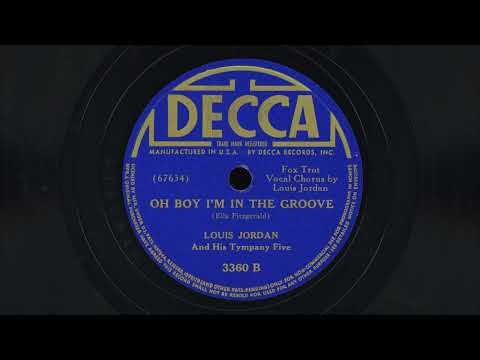
  • “Oh Boy I’m In the Groove” –  Louis Jordan and his Tympany Five (1940)

    “Oh Boy I’m In the Groove” – Louis Jordan and his Tympany Five (1940)

    An early Ella Fitzgerald tune recorded by Louis Jordan early in his career – before his widespread popularity which came later in the decade. Jordan had played with Fitzgerald as part of Chick Webb’s band in 1937.

    A swingin’ toe-tapper with vocals by Jordan – followed by sax and trumpet solos – and a final vocal chorus. A perfect tune to get yourself “in the groove” this Monday morning.

    Recorded in New York City on April 29, 1940.
    Released as Decca 3360.

    Credits
    Louis Jordan – alto sax, vocals, director
    Courtney Williams – trumpet
    Kenneth Hollon – tenor sax
    Arnold Thomas – piano
    Charlie Drayton – string bass
    Walter Martin – drums

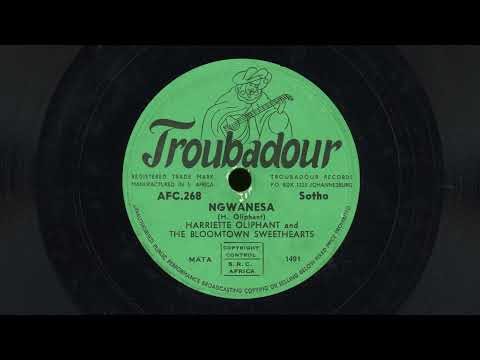
  • “Ngwanesa” – Harriette Oliphant and the Bloomtown Sweethearts (c. 1956)

    “Ngwanesa” – Harriette Oliphant and the Bloomtown Sweethearts (c. 1956)

    Great music on the South African Troubadour label.

    Recorded circa 1955-56
    Released as Troubadour AFC.268
    Matrix: MATA 1491

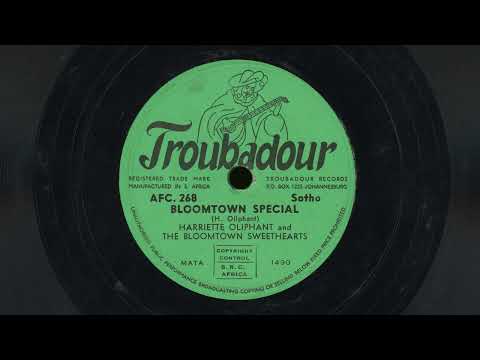
  • “Bloomtown Special” – Harriette Oliphant and the Bloomtown Sweethearts (c. 1956)

    “Bloomtown Special” – Harriette Oliphant and the Bloomtown Sweethearts (c. 1956)

    Great music on the South African Troubadour label.

    Recorded circa 1955-56
    Released as Troubador AFC.268
    Matrix: MATA 1490