Jazz Crazy Records

An Archive of Early Jazz on 78 RPM

Author: Professor M

  • What To Do With 78 rpm Records You Don’t Want? – Jazz Chat Episode 6

    What To Do With 78 rpm Records You Don’t Want? – Jazz Chat Episode 6

    Jazz Chat Episode 6
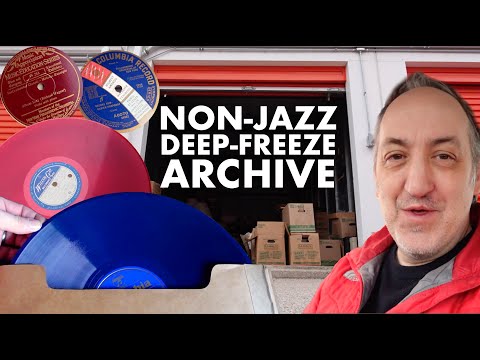
    Field Trip to the Non-Jazz Deep-Freeze 78 rpm Record Archive!

    Nearly every 78 rpm record collector I know has a stack – or several stacks – or a few crates – or a garage – full of shellac records they don’t want and that do not have much resale value individually. This can happen as you acquire large job lots or have records given to you.

    A collecting mentor once told me: “If you pick up every record that comes your way, you are not a collector – you’re a hoarder.” And that is why I have focused my collection on jazz (with some notable excursions into music that interests me). But I have ended up with a lot of stuff outside of my area of focus.

    A sort of Hippocratic oath among 78 collectors is that you “do no harm” to old records – even the ones you don’t personally enjoy. This creates a responsibility as the record’s new caretaker to find good homes for them. However, as 78s are quite bulk and heavy and fragile – this responsibility can be daunting.

    These are not the kind of records that fly off the shelf. It could take several lifetimes or more to sell or find homes for each record individually. They are also difficult to sell as a group – as so many thousands of 78s weigh a lot and take a lot of effort to safely move. I have had luck with giving away some records – but often the people who claim free records are not collectors and I sometimes worry about their fate.

    In any case, join me as I visit my own personal “Lonely Mountain” hoard of unwanted records – the Non-Jazz Deep-Freeze Archive – and see what lies inside.

    Along the way, if you see anything you are interested in – let me know in the comments.

    I’ll be working on organizing most these for sale this summer when I have more time to devote to it.
  • “Slue Foot” – Doc Cook and his 14 Doctors of Syncopation (1927)

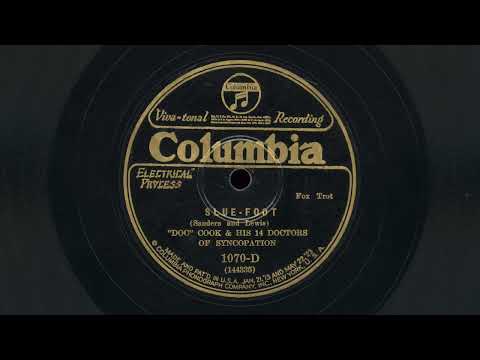
    “Slue Foot” – Doc Cook and his 14 Doctors of Syncopation (1927)

    Kentucky-born Charles “Doc” Cook led his first band at age 15 in Louisville. He moved to Chicago in 1922 and formed “Cook’s Dreamland Orchestra” which featured cornetist Freddie Keppard and recorded many excellent sides at a recording session for Gennett in 1924.

    While “Doc” was a common nickname for The nickname was legit: as Cook earned his Doctor of Music degree from the Chicago College of Music in 1926.

    He led this Chicago band full of New Orleans musicians during the late 1920s that played a dance hall at the White City amusement park. After the entire orchestra’s instruments were stolen off the bandstand after a dance marathon, the band broke up and Cook moved to New York City, where he worked as an arranger for Radio City Music Hall and RKO.

    This tune is a jaunty toe-tapper, with lots of syncopated moments (as advertised) to keep dancers on their feet. At a key moment in the composition, the band enthusiastically shouts out “Slue Foot! Do That Step!”

    Recorded in Chicago on June 15, 1927.
    Released as Columbia 1070-D.

    Credits:
    Doc Cook (Charles L. Cooke) – director
    George Mitchell, Elwood Graham – cornet
    Bill Dawson, Fayette Williams – trombone
    Jimmie Noone – clarinet
    Joe Poston – alto sax
    Billy Butler – alto sax, violin
    Clarence Owens – tenor sax
    Jerome Carrington – piano
    Johnny St. Cyr – banjo
    Bill Newton – tuba
    Andrew Hilaire – drums

  • “Charleston” – Ben Selvin and his Orchestra (1925)

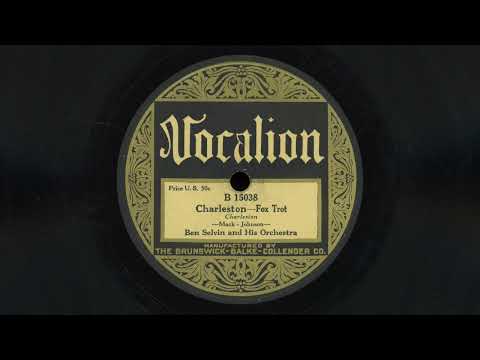
    “Charleston” – Ben Selvin and his Orchestra (1925)

    “Charleston” was composed by James P. Johnson for the production of “Runnin’ Wild”, a musical that opened in October of 1923 at the New Colonial Theatre at 1887 Broadway at 62nd St in New York City. The first published version of the tune was recorded that same month by Arthur Gibbs and his Gang.

    Fast forward a year and a half – To this excellent early recording of “Charleston” by Ben Selvin and his Orchestra. The band had recorded “The Original Charleston” under the pseudonym “The Knickerbockers” for the Columbia label on April 10 – and came into the studio to record a second version for Vocalion under the Ben Selvin name.

    This second recorded version has tighter orchestration and a more elegant feel to my ears – and some of that comes from the lively arrangement by William Covington Perry (The Perry in Perry’s Hot Dogs), who “doctored up the stock arrangement by Walter Paul Duzet.”

    Quite an enjoyable dance tune! Lots of energetic playing by Earl Oliver on trumpet throughout with some hot clarinet and trombone solos to boot. A real treat to listen to!

    Recorded in New York City on May 13, 1925.
    Released as Vocalion 15038.
    Released in the U.K. as Duotone B-5076.

    Credits:
    Ben Selvin – violin, director
    Earl Oliver, Tommy Gott – trumpet
    Sammy Lewis – trombone
    Larry Abbott, Lucien Smith – clarinet, alto sax, soprano sax
    Jimmy Johnston – bass sax
    Harry Reser – banjo
    Lew Cobey – piano
    Milton Sands – drums
    William Covington “Bill” Perry – arranger

    Thank you to @jslas2-590 for the additions and corrections to the original description!

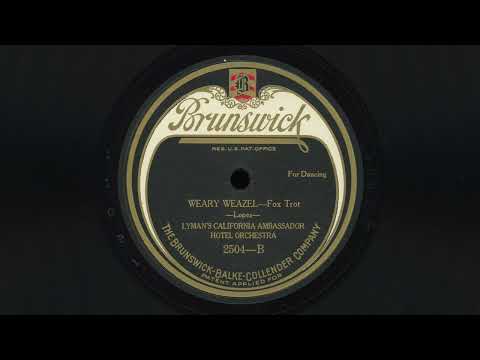
  • “Weary Weazel” – Abe Lyman’s California Ambassador Hotel Orchestra (1923)

    “Weary Weazel” – Abe Lyman’s California Ambassador Hotel Orchestra (1923)

    In the summer of 1923, Brunswick sent a recording crew to Los Angeles where, over the course of two weeks, they recorded 15 tracks by a popular local orchestra that had made a name for itself at the Cocoanut Grove ballroom in the Ambassador Hotel. They were led by drummer Abe Lyman, originally from Chicago, who had been playing out west for a number of years.

    “Weary Weazel” composed by trumpeter Ray Lopez, sounds to my ears like a loose homage to “Tiger Rag” by the Original Dixieland Jazz Band, which Lopez, being a New Orleans native, was no doubt familiar with. Interesting also because Lopez was sued by ODJB after he copyrighted “Livery Stable Blues”, which ODJB had recorded but failed to secure a copyright for. Nick LaRocca is reported to have admitted in court that “Livery Stable Blues” was based on a Ray Lopez song called “More Power Blues” and the suit was dismissed.

    This was only the second recording the band made – and captures the influence, vis-à-vis Ray Lopez, of early New Orleans “jass” in this Los Angeles ballroom orchestra.

    Recorded in Los Angeles, California on July 27, 1923.
    Released as Brunswick 2504.

    Credits
    Abe Lyman – drums, director
    Ray Lopez, Howard Fenimore – trumpet
    Orlando “Slim” Martin (or possibly Vic Smith on some of the earlier sides) – trombone
    Jim Welton, Al Baker (or possibly Gus Mueller on some titles) – clarinet, alto sax
    Horace “Zip” Keyes – clarinet, tenor sax
    John Schonberger, Charles Kaley – violin
    Gus Arnheim – piano
    Charlie Pierce – banjo
    Jake Garcia – tuba

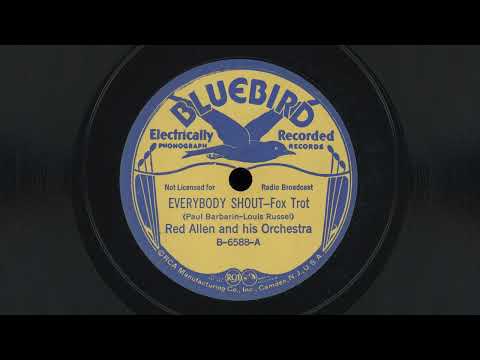
  • “Everybody Shout” – Red Allen and his Orchestra (1930)

    “Everybody Shout” – Red Allen and his Orchestra (1930)

    The outstanding orchestra of Henry “Red” Allen master pressed and reissued on the Bluebird label. What a sound!

    Originally released on the Victor V-38000 series in the early 1930s – this big swingin’ sound certainly must have still sounded fresh and crisp even when it was reissued on Bluebird in 1937. If you’re “feeling drowsy”, this oughta wake you right up!

    Features an all-star cast of great performances and the legendary rhythm section of Pops Foster and Paul Barbarin.

    Recorded in New York on February 18, 1930.
    Originally released on Victor V-38121 (as Henry Allen Jr. and his New York Orchestra).
    Reissued as Bluebird B-6588 in 1937.

    Credits
    Henry Allen – trumpet, director
    Otis Johnson – trumpet
    J. C. Higginbotham – trombone
    William Thornton Blue – clarinet, alto sax
    Charlie Holmes – clarinet, soprano sax, alto sax
    Teddy Hill – clarinet, tenor sax, baritone sax
    Luis Russell – piano
    Will Johnson – banjo
    Pops Foster – bass
    Paul Barbarin – drums

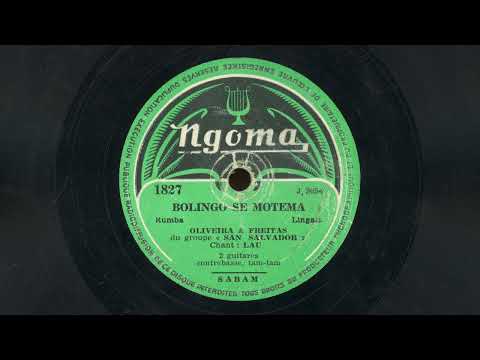
  • “Bolingo Se Motema” – Oliveira & Freitas du groupe San Salvador (c. 1957) – Ngoma 1827

    “Bolingo Se Motema” – Oliveira & Freitas du groupe San Salvador (c. 1957) – Ngoma 1827

    Congolese rumba in Lingala.

    Released as Ngoma 1827.

    The other side of this 78 rpm record can be found at:
    https://youtu.be/CJ8cdRGecJU

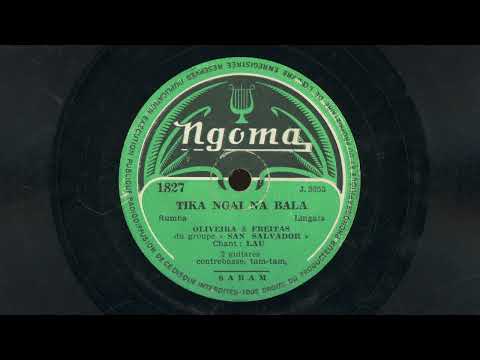
  • “Tika Ngai Na Bala” – Oliveira & Freitas du groupe San Salvador (1957) – Ngoma 1827

    “Tika Ngai Na Bala” – Oliveira & Freitas du groupe San Salvador (1957) – Ngoma 1827

    Released as Ngoma 1827.

    The other side of this 78 rpm record can be heard at:
    https://youtu.be/KCSfPBsQWxk

    Credits:
    Manuel Oliveira – guitar, vocals
    Henri Freitas – guitar, vocals
    Lau – vocals
    unknown performers – contrebasse, tam-tam

    Lingala. Rumba.

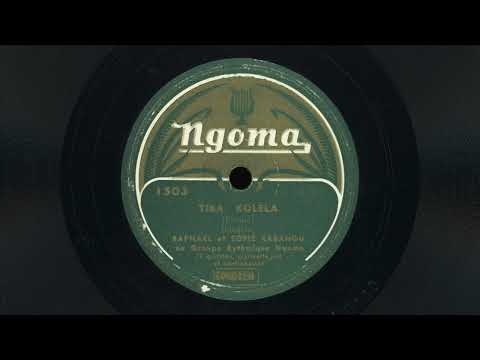
  • “Tika Kolela” – Raphael et Sofie Kabangu (1954) – Ngoma 1503

    “Tika Kolela” – Raphael et Sofie Kabangu (1954) – Ngoma 1503

    Recorded in Léopoldville (Kinshasa), Congo on May 19, 1954.
    Released as Ngoma 1503.
    Matrix J. 3009.

    Credits:
    Unknown performers – 3 guitares, clarinette, jazz & contrebasse

    The other side of this record can be heard at:
    https://youtu.be/We5MvJBwtYU

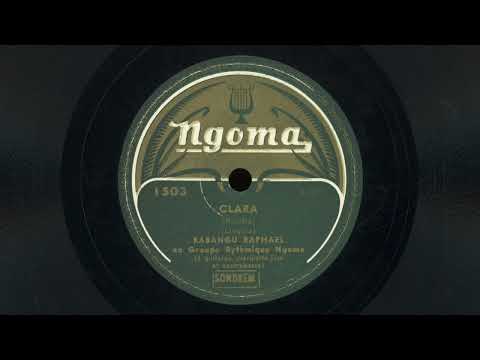
  • “Clara” – Kabangu Raphael na Groupe Rythmique Ngoma (1954) – Ngoma 1503

    “Clara” – Kabangu Raphael na Groupe Rythmique Ngoma (1954) – Ngoma 1503

    Recorded in Léopoldville (Kinshasa), Congo on May 19, 1954.
    Released as Ngoma 1503.
    Matrix J. 3010.

    Credits:
    Unknown performers – 3 guitares, clarinette, jazz & contrebasse

    The other side of this record can be heard at:
    https://youtu.be/tMWoPeoDyB8

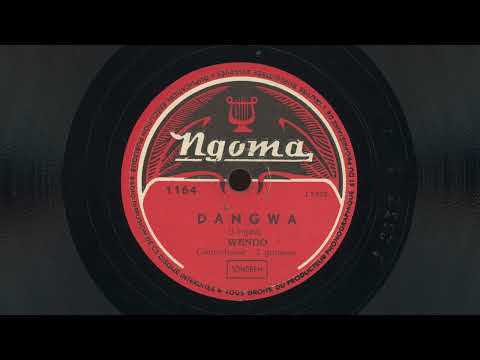
  • “Dangwa” – Wendo (c. 1951-52) – Ngoma 1164

    “Dangwa” – Wendo (c. 1951-52) – Ngoma 1164

    Wendo (Antoine Kolosoyi) sings and plays guitar on this Ngoma record from the early 1950s.

    Released as Ngoma 1164.
    Matrix J 2332

    The other side of this 78 rpm record can be found at:
    https://youtu.be/y5mVga4jNS4

    If you enjoyed this music, please check out my interview with Alastair Johnston, producer of the 3CD/3LP set “The Soul of Congo: Treasures of the Ngoma Label”:
    https://youtu.be/2BSsWpb49AA