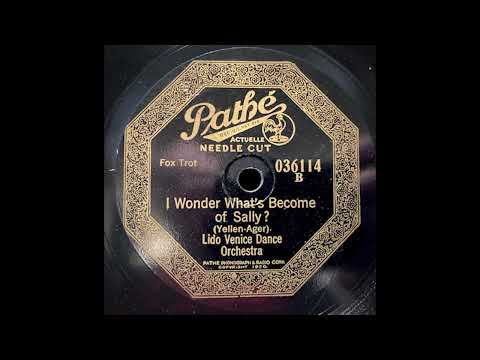
Sometimes you take a chance on a random dance orchestra – and it turns out to be a great number! Some snazzy piano and banjo breaks lead to a peppy hot trombone solo by Barney Russell starting at 1:47.
Recorded in New York on June 18, 1924. Released as Pathé Actuelle 036114
Credits Harl Smith – director, drums Henry Nathan – trumpet, clarinet, violin Barney Russell – trombone, bass sax? Davie Davidson – clarinet, banjo Fred Morrow – alto sax Bill Haid – piano, tuba
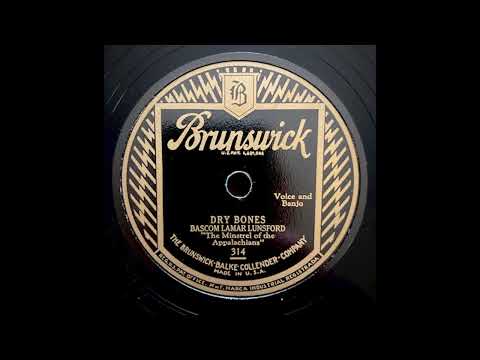
I first heard “Dry Bones” by Bascom Lamar Lunsford on Harry Smith’s Anthology of American Folk Music when I borrowed a vinyl copy from Rod Library at UNI in the summer of 1989 and made a cassette mix from it.
While I mainly focus on collecting jazz records, I agree with Duke Ellington that there are only two kinds of music – good music and the other kind. One inevitably winds up discovering all sorts of good music when digging through crates of records in musty basements, unheated storage sheds, dirty garages, and dusty attics.
A few years ago I had a “my hands were shaking” moment when I pulled this pristine copy of Brunswick 314 out of a crate from a large bargain lot of 78s I had just purchased and hauled home from a rural garage two hours away.
A truly beautiful song – One of the gems of the collection – enjoy!
Recorded in Ashland, Kentucky on February 6, 1928. Originally released as Brunswick 231. Reissued as Brunswick 314.
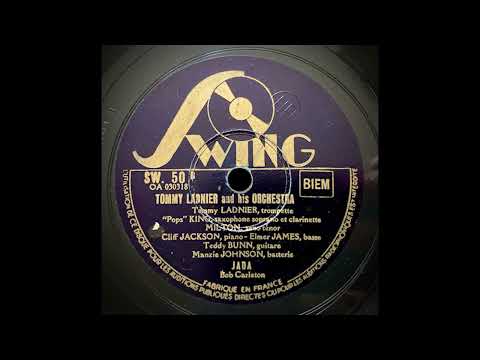
Tommy Ladnier was widely recorded in the 1920s and early 30s playing cornet and trumpet with Ma Rainey, Ida Cox, Lovie Austin, Fletcher Henderson, and Noble Sissle. He also spent a good amount of time on European tours with the Sam Wooding Orchestra.
During the depression, he worked in a tailor shop with clarinetist Sidney Bechet in Harlem. In 1938, French jazz enthusiast Hugues Panassié (who was one of the founding members of the Hot Club de France and an acquaintance of Ladnier from his time in Paris) came to NYC and arranged a recording session for Ladnier that took place on November 28, 1938.
In addition to Bechet (as “Pops” King), the session included Mezz Mezzrow on clarinet/tenor sax, Cliff Jackson on piano, Teddy Bunn on guitar, Elmer James on bass, and Manzie Johnson on drums.
This lively tune, “Jada” included wonderful solos and ensemble playing. It was issued domestically on the Bluebird label as B-10086 and in France on Swing as SW 50.
Tragically, Ladnier died of a heart attack just six months after this recording was made.
Apart from director and pianist Charles Matson, little is known about the performers of the Creole Serenaders. They recorded two sides for Edison in 1923 – one of the very few black jazz bands to record on the Edison label.
German website grammophon-platten.de did some sleuthing and discovered newspaper clippings from early 1923 that list band personnel as follows: Thomas E. “Petey” Hillery – cornet Levi Bush – trombone Carlos Daugherty – clarinet/sax Charles O. Moseley – sax/clarinet Julian Arthur – violin (?) or sax (?) Leroy Parker – violin William ‘Splif’ Escoffery – banjo William “Bill” Benford – tuba Curtis Moseley – drums Source: https://grammophon-platten.de/page.php?579
They recorded two sides for Edison in New York on July 30, 1923 – about a month after King Oliver’s Creole Jazz Band released “Chime’s Blues” on Gennett.
Three takes (A, B, C) were recorded and all were released. This digital transfer is from an Edison Diamond Disc containing take C.
Recorded in New York on July 30, 1923. Released as Edison 51224.
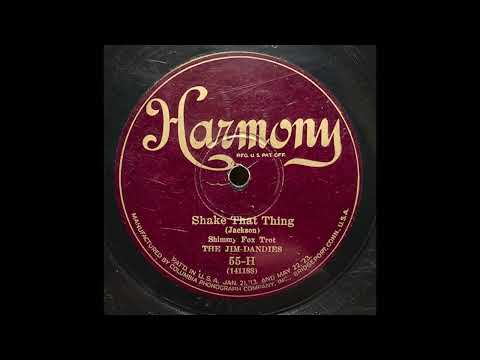
“Shake that Thing” – the only recorded output of the Lem Fowler quartet The Jim-Dandies – was released on the Harmony label in late 1925.
This exuberant jam, driven on by a rather insistent drum beat, starts as Irick and Glascoe each take solos – then begin to read one another’s minds as they complete one another’s phrases without skipping a beat.
Great fun to listen to.
Released as Harmony 55-H. Recorded in New York on October 24, 1925.
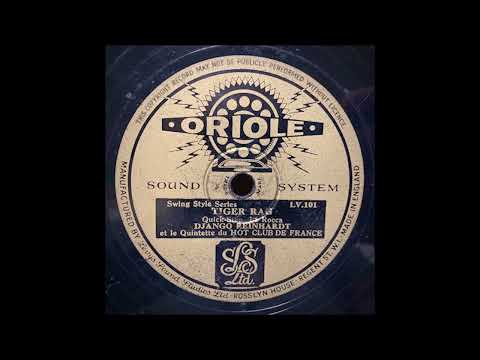
Django Reinhardt was 24 when he and violinist Stéphane Grappelli formed the legendary Quintet of the Hot Club of France. This record was from their very first recording session as the Quintet in Paris on December 28, 1934.
The quintet gives the standard “Tiger Rag”, originally recorded by the Original Dixieland Jazz Band in 1918, a wild rollicking ride from the very start. The guitars, violin, and bass all trade joyfully frantic solos until the very end, when it sounds as if the air had finally been let out of the balloon and the tune deflates as it approaches the last note.
Released in the U.K. as Oriole LV.101. Original release in France was as Ultraphon AP-1423.
Credits Stéphane Grappelli – violin Django Reinhardt, Roger Chaput, Joseph Reinhardt – guitar Louis Vola – string bass
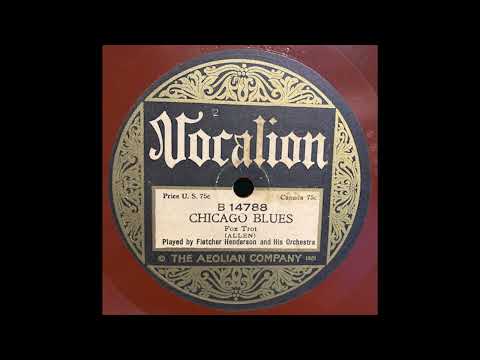
This gorgeous “Vocalion Red” record features a great early side by Fletcher Henderson and his Orchestra: “Chicago Blues”. The tune begins with an ensemble theme led by violinist Allie Ross.
After an insistent train whistle reminds us the ride is about to begin, we hear Elmer Chambers take the first solo at the 0:40 mark supported by Henderson’s strideful playing as accompaniment.
While Howard Scott was known as the band’s “primary hot soloist” in this incarnation of the band, Chambers does take a number of solos on record that Hendersonia author Walter C. Allen characterizes as recognizable due to his buzz tone. Scott’s tone was more often muted with growling vocal effects.
Chambers is followed by a fine Don Redman alto sax solo. Percussionist Kaiser Marshall even gets a moment to shine with a brief breakdown featuring a “sandpaper effect” that is perhaps the first “scratch DJ” sound in recorded history. Howard Scott takes us out with a solo, which is recognizable by his characteristic muted tone and use of growling and talking effects. Train whistles and chimes indicate the ride is over and our stop has arrived.
Recorded in New York City on March 25, 1924. Released in the U.S. as Vocalion 14788 and in the U.K. as Homochord H-670. Later reissued as Silvertone 3023.
Credits: Fletcher Henderson – piano, director, arranger Elmer Chambers – cornet Howard Scott – cornet Coleman Hawkins – clarinet, tenor sax Teddy Nixon – trombone Don Redman – clarinet, alto sax, chimes Lonnie Brown – alto sax Allie Ross – violin Charlie Dixon – banjo Ralph Escudero – baritone brass (tuba) Kaiser Marshall – drums
![“I Just Want A Daddy (I Can Call My Own)” [Take C] – Chas. A. Matson’s Creole Serenaders](https://www.jazzcrazy.org/wp-content/uploads/2026/03/4239_thumbnail.jpg)