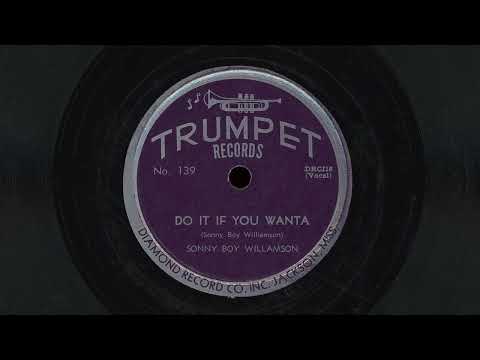
Not to be confused with John Lee Curtis “Sonny Boy” Williamson, who recorded for Bluebird and RCA Victor in the late 30s and 40s and passed away in 1948, *this* Sonny Boy Williamson was born in Mississippi as Alex Ford.
He performed in Mississippi and Arkansas in the 30s, consorting with Robert Johnson, Big Joe Williams, and Elmore James. Radio station KFFA in Arkansas hired him as a performer and starting promoting him as Sonny Boy Williamson (while the original Sonny Boy was still alive).
Willard and Lillian McMurry started Trumpet records in Mississippi from the makeshift recording studio in the back room of the Record Mart, their little record store in Jackson.
This rockin’ tune was recorded when Bill Haley was still playing western swing with the Saddlemen and Elvis was still a high school student. It’s a reminder of how influential, important, and prescient blues players like Williamson were in the history of rock and roll.
Not a record I usually go out of my way to look for, but this one showed up at a garage sale at a price I couldn’t say no to.
Recorded in Jackson, Mississippi on August 5, 1951. Released as Trumpet 139.
Credits: Sonny Boy Williamson – harmonica Willie Love or David Cambell – piano Elmore James, Joe Willie Wilkins – guitar Leonard Ware – bass Unknown Artist – drums
One last video to celebrate Pride Month, though I’m late posting it.
Bessie Smith, one of the most popular and prolific of the early blues singers of the 1920s, was known, like her mentor Ma Rainey, to be bisexual.
She was also reportedly “quite religious” and would often attend Sunday morning services while on tour. Drummer Zutty Singleton once said that Bessie “was real close to God, Very religious.”
Her music often took on the characteristic of preaching, and here, in her original composition, “Preachin’ the Blues”, Ms. Smith lays down a sermon for her flock of faithful:
“I will learn you something if you listen to this song. I ain’t here to try to save your soul Just want to teach you how to save your good jelly roll.”
Angela Davis argues, in her excellent book, Blues Legacies and Black Feminism, that this song “juxtaposes the spriit of religion and the spirit of the blues, and contests the idea of the incontrovertible separateness of these two spheres.”
Smith’s song combines the evangelical spirit of her religious upbringing with the worldly pleasures of the blues lifestyle. The song “advises women to take control of their sexuality and implicitly challenges the church’s condemnation of sexuality.”
This open celebration and affirmation of sexuality, given in the context of blasphemously “preaching” a “sermon”, was quite radical and progressive for this time period. It was, as a teenage friend of mine in the 80s would have called it, “totally punk rock”.
We owe Bessie Smith and other bisexual female blues singers of the 1920s a debt of gratitude for their courage to sing their authentic truth to the world.
Once more: Happy Pride Month! 🏳️🌈🏳️⚧️ I didn’t get to explore as many artists as I had planned – but as the month progressed, I found myself out celebrating Pride and neglecting the channel. That’s ok – that leaves more artists to feature next year!
Recorded in New York City on February 17, 1927. Released as Columbia 14195-D
Credits: Bessie Smith – vocals James P. Johnson – piano
Sources: Bessie, Chris Albertson, Yale University Press, 2003 Blues Legacies and Black Feminism, Angela Y. Davis, Pantheon, 1998
In celebration of Pride month 🏳️🌈 all of my posts this month will feature the music of LGBTQ+ artists of the 78 rpm era!
This week we will focus on the amazing black women who were among the first to freely express their lesbian sexuality and bisexuality on record. These artists were 50+ years ahead of their time and ahead of the world when it comes to embracing alternative sexualities and gender norms. We all owe them so much for their artistry and empowered advocacy.
While the guitar-based male artists of the following decade often get the lion’s share of credit for pioneering the blues, it is critically important to note that black women were the first to popularize the blues – and their success allowed them an empowering level of self-expression in the songs they recorded.
Ma Rainey’s “Prove It On Me Blues” is an assertive and proud anthem that celebrates lesbian sexuality and gender nonconformity – while daring the world to try and prove what happens behind closed doors. Rainey, who wrote the lyrics, openly declares her preference for women, wearing male-coded clothing, and behaving in male-coded ways.
“Went out last night, had a great big fight, Everything seemed to go on wrong. I looked up, to my surprise, The gal I was with was gone.
Where she went, I don’t know, I mean to follow everywhere she goes. Folks said I’m crooked, I didn’t know where she took it, I want the whole world to know.
They say I do it, ain’t nobody caught me, Sure got to prove it on me. Went out last night with a crowd of my friends, They must’ve been women, ’cause I don’t like no men.
It’s true I wear a collar and a tie, Make the wind blow all the while. They say I do it, ain’t nobody caught me, They sure got to prove it on me.
Say I do it, ain’t nobody caught me, Sure got to prove it on me. I went out last night with a crowd of my friends, They must’ve been women, ’cause I don’t like no men.
Wear my clothes just like a fan, Talk to the gals just like any old man. ‘Cause they say I do it, ain’t nobody caught me, Sure got to prove it on me.”
The song had some direct biographical inspiration from an incident in 1925 when Rainey was drinking with a group of young women. “They made so much noise that a neighbor summoned the police. The impromptu party was getting intimate, and as bad luck would have it, the law showed up just as everyone began to let their hair down” [Albertson, p. 116]. Rainey was arrested and spent the night in jail. Bessie Smith bailed her out the next morning.
The advertisement in the Chicago Defender promoting this record shows Rainey wearing a collared shirt, tie, vest, suit jacket, and fedora. She openly flirts with two lithe young ladies while a police officer espies the situation from across the street. The ad states: “What’s all this? Scandal? Maybe so, but you wouldn’t have thought it of ‘Ma’ Rainey – But look at that cop watching her! What does it all mean?”
In her book “Blues Legacies and Black Feminism”, Angela Davis writes: “The blues women openly challenged the gender politics implicit in traditional cultural representations of marriage and heterosexual love relationships. Refusing, in the blues tradition of raw realism, to romanticize romantic relationships, they instead exposed the stereotypes and explored the contradictions of those relationships. By doing so, they redefined women’s ‘place.’ They forged and memorialized images of tough, resilient, and independent women who were afraid neither of their own vulnerability nor of defending their right to be respected as autonomous human beings.”
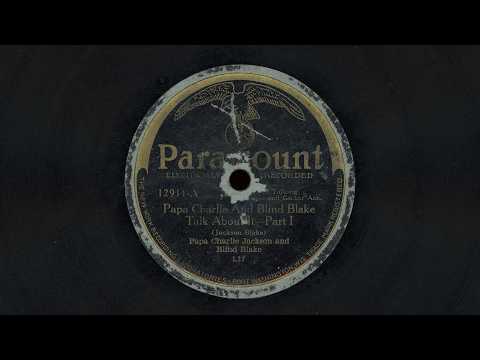
Though this disc has been a holy grail of mine ever since I first heard it, the original Paramount release is quite rare, and the few copies I’ve seen available at auction often go for several hundreds of dollars.
Luckily, I do have this bootleg reissue on the Ristic label was made by the young jazz musician and audio engineer John R. T. Davies sometime around 1949-50. He released an edition of 100 copies – and as you can see from the label, I have #57.
I’m so thankful for the beautiful, authentic, and empowered black women of the 78 rpm era!
Happy Pride Month! 🏳️🌈🏳️⚧️
Recorded in Chicago, Illinois on Tuesday, June 12, 1928. Originally released as Paramount 12668. This U.K. unofficial reissue dub was released as Ristic 6.
Credits: Ma Rainey – vocals Carl Reid – jug Georgia Tom Dorsey – piano Martell Pettiford – banjo Herman Brown – kazoo, washboard, tub drum
Sources: Mother of the Blues: A Study of Ma Rainey, Sandra R. Lieb, University of Massachusetts Press, 1981 Blues Legacies and Black Feminism, Angela Y. Davis, Pantheon Books, 1998 Bessie, Chris Albertson, Yale University Press, 2003 Blues & Gospel Records 1890-1943, Robert M. W. Dixon, John Godrich, and Howard Rye, 4th Ed., Clarendon Press Oxford, 1997
Chillax mid-week with Barney Bigard and crew. Everyone’s sounding mellow and chill on this side. I was gonna post the flip side “Sweet Marijuana Brown” on 4/20 but then listened to this and felt that, novelty of the former aside, it may be the better side.
Recorded in New York City on January 5, 1945. Released as Black & White 13.
Credits: Joe Thomas – trumpet, tenor sax Barney Bigard – clarinet Art Tatum – piano Billy Taylor – bass Stan Levey – drums
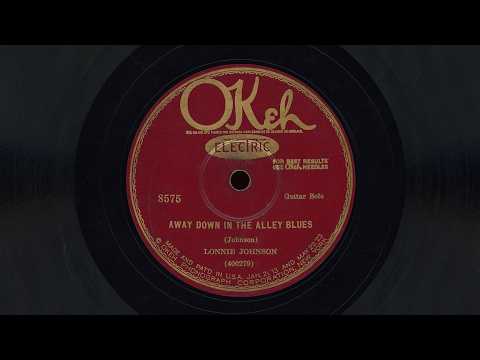
One of my favorite guitarists of the 20s and 30s was Lonnie Johnson. I always thought his playing style was so crisp and fresh that he’s one of the few blues artists I go out of my way to collect.
Of course, Johnson considered himself a jazz guitarist and indeed appears on many jazz records in the 1920s, including with Louis Armstrong’s Hot Five, Jimmy Blythe, Wilton Crawley, Chas. Creath’s Jazz-o-maniacs, Duke Ellington, and Clarence Williams (and yes, I just did a search of Rust’s “Jazz and Ragtime Records to come up with that list) – along with providing guitar accompaniment to a number of blues singers. Of course, his most famous collaborations are with guitarist Eddie Lang.
But often he recorded blues after winning a contest in St. Louis in 1925 and being awarded a recording contract with Okeh Records. Many of his records featured a blues number with Johnson on vocals. Here we have an instrumental composition that could be said to represent a bridge between his jazz and blues roots.
Recorded in Memphis, Tennessee on Tuesday, February 21, 1928. Released as Okeh 8575.
I’ll be honest – I was reticent to even post this one, as the disc is so totally beat that the sound quality is almost unlistenable. But it’s a super rare one and the transfers that are available are only marginally better.
It’s a great example of how sometimes even 78s in the worst shape sometimes are so special and important, as there just may not be too many other copies out there.
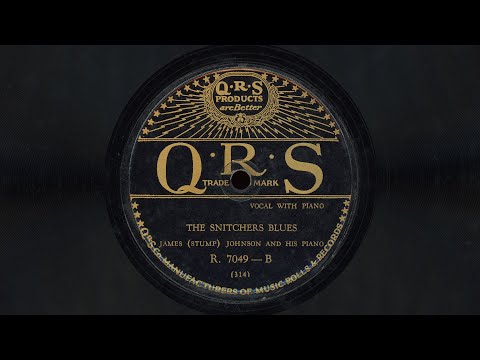
From James “Stump” Johnson’s first recording session in Long Island City, New York in early 1929, we have an original tune called The Snitchers Blues.
Johnson sometimes performed under the stage name Snitcher Roberts, so the title of the tune is self-referential.
A percussive effect is heard throughout the song – perhaps this is Mr. Johnson tapping his foot on the floor to keep time?
The song ends abruptly at 2:50 with Johnson exclaiming “What? Well Give me another drink, then – that’s all right then.” The session engineers wisely kept this informal interjection in the released recording.
The flip side, “The Duck Yas-Yas-Yas” is the more well-known side – and I couldn’t find another transfer of this B-side anywhere on YouTube, so I figured I’d get this one out there to enjoy. If there is interest, I’ll transfer the A-side as well.
Recently won this rare QRS disc on eBay for $13 – as the record has a well-repaired crack and I guess that scared other bidders off. Otherwise in great shape – and my de-clicking filter took the tick right out.
Recorded in New York City circa January 1929. Released as QRS R.7049 and Paramount 12842.
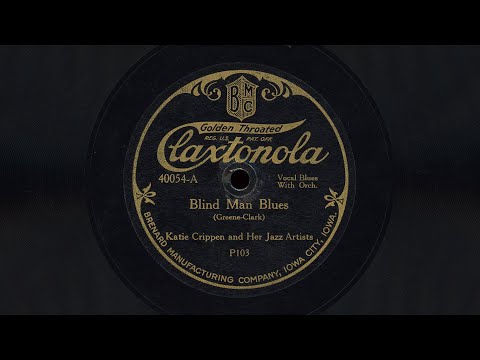
In 1921, Philadelphia-born vocalist Katie Crippen recorded four sides for Black Swan Records – a Harlem-based label founded by Harry Pace.
This song, “Blind Man Blues”, according to Walter Allen in Hendersonia, was “one of the first 12-bar blues recorded.” It features a couple of classic lines, such as “I ain’t gonna marry, I ain’t gonna settle down” – later sung in 1926 by Bessie Smith’s “Young Woman’s Blues” and in 1928 by Jimmie Rodgers’ “Blue Yodel #2”. Lines such as this expressed a gendered independence and were a challenge to the social order of the time – only a year after women in the U.S. won the right to vote.
Additionally, here we have one of Fletcher Henderson’s very early recorded sessions for Black Swan and his second commercially-released recording. He had moved to NYC in 1920 to study science after graduating from Atlanta University, where he played organ for the mandatory chapel services at the university.
After working as a song plugger for the Pace and Handy Music Company, he took a job with Harry Pace at his newly formed Black Swan label as a pianist in 1920. The label strove for “cultural respectibility” in its choice of artists and repertoire, and Henderson’s first commercially-released record was providing accompaniment to classical vocalist C. Carroll Clark.
Though he was a classically-trained pianist, this recording with Kate Crippen was the first of many he would go on to record with many early blues vocalists – as Mamie Smith’s hit “Crazy Blues” in 1920 had started a surge of interest in blues recordings. This style of playing did not come naturally to Henderson, and Ethel Waters, who played and recorded with him often from 1921-23 was quoted as saying:
“Fletcher wouldn’t give me what I call ‘the damn-it-to-hell bass,’ that chump-chump stuff that real jazz needs… I kept nagging him – I said he couldn’t play as I wanted him to. When we reached Chicago I got some piano rolls that Jimmy Johnson had made and pounded out each passage to Henderson. To prove to me he could do it, Fletch began to practice. He got so perfect, listening to James P. Johnson play on the player piano, that he could press down the keys as the roll played, never missing a note. Naturally, he began to be identified with that kind of music, which isn’t his kind at all.”
Crippen continued to perform with artists such as Fats Waller and Count Basie throughout the 1920s. She tragically died of cancer in November of 1929.
Here we have an issue on the Iowa-based Claxtonola label – of my favorite labels to collect from the 78 rpm era. The label was made by the Brenard Manufacturing Company in Iowa City, which manufactured phonographs. They licensed masters from Paramount, Black Swan, and Gennett and issued them under their own labels, Claxtonola and National.
Enjoy this scarce early blues recording!
Recorded in New York City in February – March, 1921. Originally released as Black Swan 2003. Reissued as Paramount 12126, Puritan 11054, Famous 3048 and Claxtonola 40054.
Credits: Katie Crippen – vocals Unknown artist – trumpet Chink Johnson (?) – trombone Edgar Campbell – clarinet Cordy Williams (?) – violin Fletcher Henderson – piano
Sources: Hendersonia, Walter C. Allen His Eye is on the Sparrow, Ethel Waters & Charles Samuels Fletcher Henderson and Big Band Jazz, Jeffrey Magee
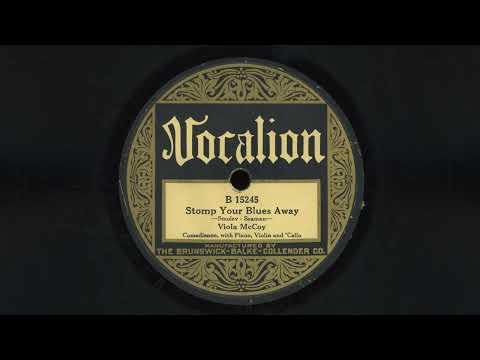
A lovely tune (penned by Marvin Smolev and Bernie Seaman) performed by blues singer Viola McCoy who is accompanied by a very young Rex Stewart on cornet and an unidentified pianist and violinist. The pianist has been suggested to be Porter Grainger – but there is disagreement on this.
Like Ethel Waters, Viola McCoy had a theatrical voice that was clear and crisp, making it a pleasure to listen to. The three accompanists expertly weave around one another, creating a kind of musical bouquet in which McCoy is the centerpiece.
Of note: Smolev later co-wrote a few songs for Cliff Jackson and his Krazy Kats (“Horse Feathers” and “The Terror”).
Recorded in New York City on January 6, 1926. Released as Vocalion 15245.
Credits: Viola McCoy – vocals Rex Stewart – cornet Unknown Artists – piano, violin (Despite the label attribution, no cello is heard on this record)
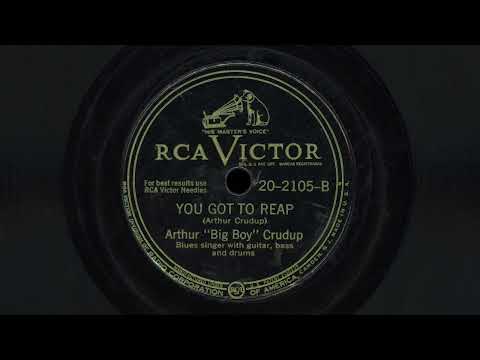
It was my birthday yesterday and after some reflecting – I realized that it was about seven years ago that I started collecting 78 rpm records. I had just repaired an old Airline console for a friend and wanted to try the 78 rpm turntable. I went to an estate sale at a rural home about fifteen miles north and thumbed through a pile of 78s that sat unsold. In that stack I found this beat up Arthur Crudup record.
Arthur “Big Boy” Crudup was an artist I had never heard of – and after listening to this track I immediately wanted to know all about him and hear more of his music.
This one record led me down an endless rabbit hole of fascinating history and amazing music that continues to this day.
Finding this record so close to home convinced me that maybe it was possible to find other good 78s in this area. It started the obsession.
It’s in rough shape and the music is a bit distorted but it will always be a special record to me.
What was your first record?
Recorded in Chicago, Illinois on September 6, 1946. Released as RCA Victor 20-2105.