In celebration of Pride month 🏳️🌈 all of my posts this month will feature the music of LGBTQ+ artists of the 78 rpm era!
Starting us off with week two of our Pride month celebration, we introduce the work of composer and arranger Billy Strayhorn.
William “Billy” Strayhorn was born in Ohio in 1915 to working class parents and grew up in Pittsburgh. Encouraged by his grandmother, a church organist, he saved his money working at a drug store to buy a used piano and began taking piano lessons in the classical tradition. He was a fast learner and wrote his first composition, Concerto for Piano and Percussion, in 1934.
That same year, he saw the Duke Ellington orchestra perform in Pittsburgh and became fixated on a particular chord played during one of their numbers. He soon became enamored with jazz and began composing and arranging tunes in a small jazz combo. He wrote timeworn jazz classics like “Lush Life” when he was barely 21.
His fortunes changed after meeting Duke Ellington in 1938 during an engagement at the Stanley Theatre in Pittsburgh. Strayhorn was still working as a soda jerk at a drug store at the time. Strayhorn played a few of his original tunes and before you know it, Ellington was giving him arrangement assignments.
For the next twenty five years, Strayhorn would work with Ellington as an arranger while also collaborating with the Duke on works and composing his own pieces. Ellington said of Strayhorn: “Billy Strayhorn was my right arm, my left arm, all the eyes in the back of my head, my brain waves in his head, and his in mine.”
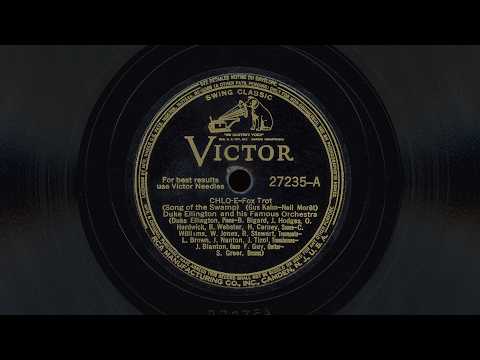
Here we find Strayhorn’s vibrant arrangement of the melancholic “Chlo-e (Song of the Swamp)” an old show tune from the late 20s revived in 1937 with new interpretations by Benny Goodman and Art Tatum, among others.
What is most striking about this arrangement is how elegantly Strayhorn had internalized the sound of the Ellington band.
“On first hearing, the piece sounds like a genuine Ellington arrangement, with Joe Nanton’s ‘jungle style’ talking trombone and Blanton’s bass breaks mirroring the earlier Jack the Bear… to the careful listener the overall structure of the score by means of an imitated melody fragment, followed by another caesura-less modulation to Bb after the tenor solo, and the short but integrated coda that rounded out the piece, were not Ellingtonian.”
While here we hear subtle glimpses of Strayhorn’s arrangement prowess and musical sensibility, it would not be long before his musical vision would more fully reveal itself with original compositions, including one of the most popular jazz standards in history.
Happy Pride! 🏳️🌈 🏳️⚧️
Recorded in Chicago, Illinois on October 28, 1940.
Released as Victor 27235.
Credits:
Duke Ellington – piano, director
Billy Strayhorn – arranger
Wardell Jones, Cootie Williams – trumpet
Rex Stewart – cornet
Joe Nanton, Lawrence Brown – trombone
Juan Tizol – valve trombone
Barney Bigard – clarinet
Johnny Hodges – clarinet, soprano sax, alto sax
Harry Carney – alto sax, bass sax
Ben Webster – tenor sax
Fred Guy – guitar
Jimmy Blanton – string bass
Sonny Greer – drums
Sources:
“Something to Live For: The Music of Billy Strayhorn”, Walter Van De Leur, Oxford University Press, 2002
“Music Is My Mistress”, Duke Ellington, Doubleday, 1973
Leave a Reply