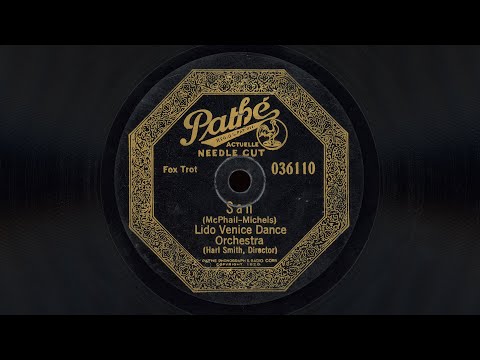
Few early jazz standards get the dance floor hoppin’ more than Lindsay McPhail and Walter Michels’ “San” – and this fine 1924 version by Harl Smith’s Lido Venice Dance Orchestra is no exception.
Recorded in New York City c. June 18, 1924. Released as Pathé 036110.
Credits: Harl Smith – drums, director Henry Nathan – trumpet, clarinet, violin Barney Russell – trombone Davie Davidson – clarinet, banjo Fred Morrow – alto sax Bill Haid – piano Unknown Artist – tuba
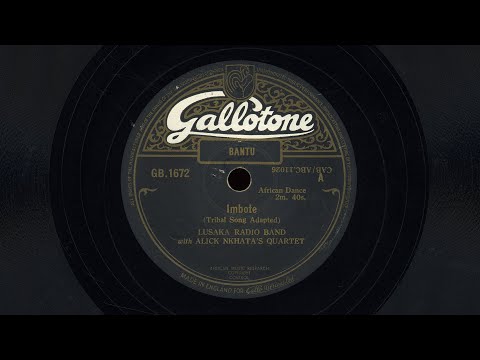
This record featuring Zambian artist Alick Nkhata has been waiting in the “to transfer” queue for a while – and with the release of “Radio Lusaka” on Mississippi Records, I thought it a good time to help their effort to promote Nkhata’s music.
If you like this number, please check out the recent release produced by friend of the channel Cyrus Moussavi and Jamal Khadar:
Radio Lusaka by Alick Nkhata “Vocalist, guitarist, and bandleader Alick Nkhata moved effortlessly between lonesome country slide, big band pop, and air-tight vocal harmonies, all with roots in Bemba and other African traditional songs and rhythms. It’s a dizzying, inclusive, expansive blend from an artist and music archivist who became the voice of his nation’s fight for freedom.”
1936 saw the Henderson band at the height of its popularity – with the massive hit “Christopher Columbus” and an active association with the Benny Goodman band. They spent much of the fall touring the midwest, playing to large crowds at college campuses and hotels in St. Paul, St. Louis, Indianapolis, Kansas City, Evanston, Lawrence, and Chicago.
Despite the popularity the band enjoyed, some were quite critical of the band. John Hammond wrote in Downbeat (March 1937) that “The rhythm section has gone to pot” and “the trumpets have thin forced tones”. He harshly concluded: “How is it that Fletcher can never imbue a band with proper discipline, for this band, which has some of the finest musicians in the city, is just as ragged as the lowliest dance relief band.”
Hammond called Henderson “the greatest arranger in the country” but questioned his ability as bandleader. He said of his group that they “possessed not an atom of swing, personality, or vitality.”
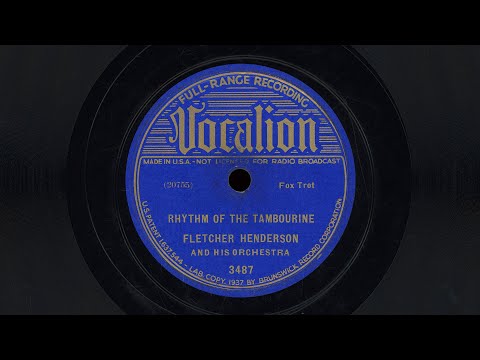
Hmmm. What do you think? My take on this recording of “Rhythm of the Tambourine” is that it’s snappy, swingin’ and has a good mix of interesting ensemble passages and soloists, such as Emmett Berry’s trumpet solo at 1:05, Chu Berry’s tenor solo at 1:34, and Jerry Blake’s short but fiery clarinet solo at 2:22.
Recorded in New York City on March 2, 1937. Released as Vocalion 3487
Credits: Fletcher Henderson – piano, director Dick Vance, Russell Smith, Emmett Berry – trumpet George Washington, Ed Cuffee, J. C. Higginbotham – trombone Jerry Blake – clarinet, alto sax Elmer Williams, Chu Berry – tenor sax Lawrence Lucie – guitar Israel Crosby – bass Walter Johnson – drums Benny Carter – arranger
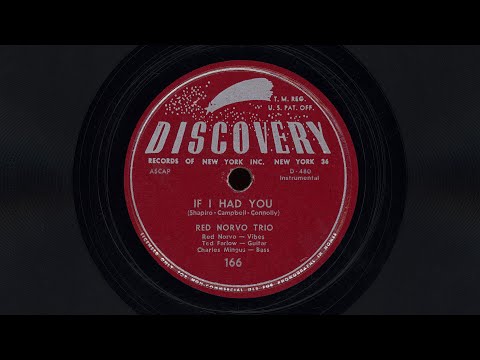
One of my favorite jazz trios was formed by vibraphonist Red Norvo in the late 1940s. The trio featured the soon-to-be-legendary bassist Charles Mingus and guitar monster Tal Farlow early in their careers.
I’ve written about them and posted one of their records, “Move”, from this same period before: https://youtu.be/VawKm0UkKbg
Here we find the trio a bit more relaxed and charming as they revive “If I Had You”, an old tune first published in 1928. Recorded on the West Coast, it has a cool jazz vibe and it’s a rewarding record to put on when you just want to relax and watch the world go by.
“The thing that made me want to record Red’s music was the fact that it was so delicate. The flavor was so unbelievably easy to listen to, and jazz at the same time. Everyone then seemed to feel that jazz had to be strong and macho. This was a group that did it all beautifully, but you had to pay attention.” – Albert Marx, Founder, Discovery Records
Recorded in Los Angeles, California on April 13, 1951. Released as Discovery 166. Later included on the 10″ ep “Red Norvo Trio, Volume Two”, Discovery DL 3018 and the 12″ lp “Move!”, Savoy MG 12088.
Credits: Red Norvo – vibes Tal Farlow – guitar Charles Mingus – bass
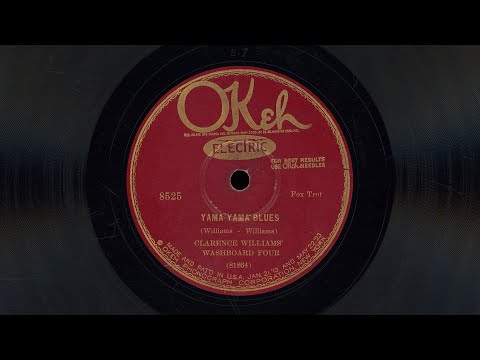
“Yama Yama Blues” was an early composition credited to Spencer Williams and Clarence Williams. It was recorded in 1919 by both Louisiana Five and Jocker’s Dance Orchestra. Eight years later, it was recorded by a Clarence Williams washboard quartet for Okeh.
Ed Allen and Buster Bailey effortlessly dance around one another on cornet and clarinet throughout the first minute, then Bailey breaks off into a hot and occasionally florid clarinet solo and is then rejoined by Allen for the remainder. Floyd Casey gets in a few hot washboard breaks before the tune is over.
The song title comes from an interesting line from the original lyrics: “Anything you really need, just tell sweet mama. She’s just simply wild about her yama yama.”
Recorded in New York City on November 25, 1927. Released as Okeh 8525.
Credits: Ed Allen – cornet Buster Bailey – clarinet, alto sax Clarence Williams – piano Floyd Casey – washboard
The first published recordings of the Louisiana Five were made for the Emerson Phonograph Company in New York City and were released on non-standard 7″ and 9″ formats. These are not terribly common to find out there – and almost always in rough shape – so one has to wonder how large the original press runs of these discs were.
The Emerson 9 inch Universal Cut record series included releases of “quick selling, popular, dance, vocal, and patriotic selections” and retailed for only 65 cents. Jazz was still an emerging musical art form in 1919, and only a few jazz artists made it onto this series.
Besides Louisiana Five (who also appeared on Emerson 9150, 9158, 9165, and 9178), the series featured mostly popular vocalists and military bands. A few other releases in this series showcased dance and novelty bands such as Van Eps Banta Trio, Emerson Xylo-Phiends, and Emerson Dance Orchestra.
I think I was able to coax some decent sound out of this well-loved acoustically-recorded disc that suffered from a bit of warpage on the outer grooves.
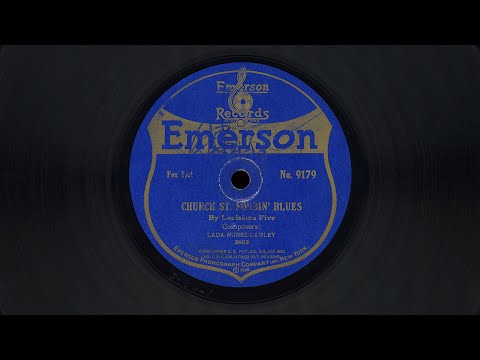
As with side A of this record, Alcide Nuñez again makes the biggest impression – with the clear melodies of his clarinet shining the brightest – but this side makes Joe Cawley’s piano and Anton Lada’s percussion more audible.
In 1927, Clarence Williams recorded the exact pairing of songs that appears on this record, and it is my working theory that he must have had a copy of this record in his personal collection.
I posted a transfer of this tune as performed by Williams back in January and put the word out that I was very interested in hearing this record. VERY thankful to @Desdemona202 (Colin Hancock), who found a copy and sent it to the jazz bunker at no charge! Thank you, sir! 🎺
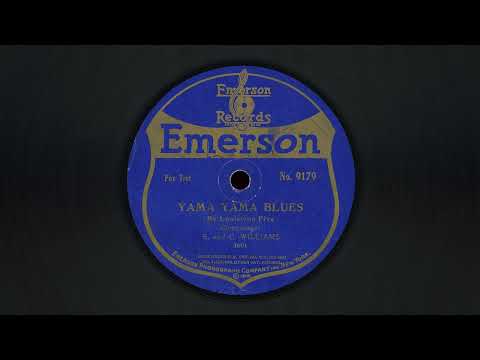
Recorded in New York City in March 1919. Released as Emerson 9179 in June of 1919. Side A: Matrix 3601-1
Credits: Charlie Panelli – trombone Alcide Nuñez – clarinet Joe Cawley – piano Karl Berger – banjo Anton Lada – drums
Sources: Emerson Records: The Complete Discography (1915-1928), 2nd Edition, by Allan Sutton (Mainspring Press) Jazz and Ragtime Records, 1897-1942, 6th Ed, Brian Rust (Mainspring Press)
The first published recordings of the Louisiana Five were made for the Emerson Phonograph Company in New York City and were released on non-standard 7″ and 9″ formats. These are not terribly common to find out there – and almost always in rough shape – so one has to wonder how large the original press runs of these discs were.
The Emerson 9 inch Universal Cut record series included releases of “quick selling, popular, dance, vocal, and patriotic selections” and retailed for only 65 cents. Jazz was still an emerging musical art form in 1919, and only a few jazz artists made it onto this series.
Besides Louisiana Five (who also appeared on Emerson 9150, 9158, 9165, and 9178), the series featured mostly popular vocalists and military bands. A few other releases in this series showcased dance and novelty bands such as Van Eps Banta Trio, Emerson Xylo-Phiends, and Emerson Dance Orchestra.
I think I was able to coax some decent sound out of this well-loved acoustically-recorded disc that suffered from some warpage.
Alcide Nuñez is the real star of this record – his clarinet sounding loud and clear – and his optimistic playing making one wonder if one is truly listening to a sobbin’ blues or if this could instead represent a celebratory revelry.
Louisiana Five famously eschewed the trumpet/cornet and made the clarinet the melodic centerpiece of the band. One wonders if Nuñez’ experience with firecracker Nick LaRocca during his stint with the Original Dixieland Jazz Band had anything to do with that decision.
In 1927, Clarence Williams recorded the exact pairing of songs that appears on this record, and it is my working theory that he must have had a copy of this record in his personal collection.
I posted a transfer of this tune as performed by Williams back in January and put the word out that I was very interested in hearing this record. VERY thankful to @Desdemona202 (Colin Hancock), who found a copy and sent it to the jazz bunker at no charge! Thank you, sir! 🎺
Recorded in New York City in March 1919. Released as Emerson 9179 in June of 1919. Side A: Matrix 3601-1
Credits: Charlie Panelli – trombone Alcide Nuñez – clarinet Joe Cawley – piano Karl Berger – banjo Anton Lada – drums
Sources: Emerson Records: The Complete Discography (1915-1928), 2nd Edition, by Allan Sutton (Mainspring Press) Jazz and Ragtime Records, 1897-1942, 6th Ed, Brian Rust (Mainspring Press)
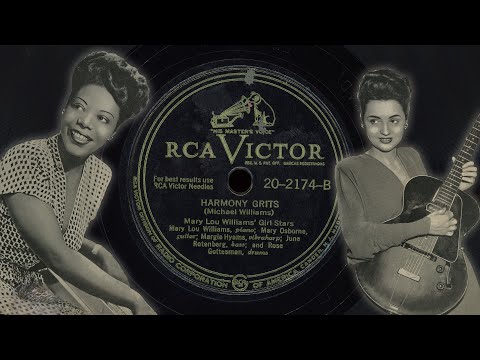
This boppin’ side showcases some strong jazz talent at the crossroads between swing and bebop. Fans of the channel know how much I admire Mary Lou Williams – and what a treat to hear her with the lively guitarist Mary Osborne at the beginning of her career and the talented Margie Hyams on vibes.
Mary Lou Williams is best known to early jazz fans for her role as a pianist and composer in Andy Kirk’s Twelve Clouds of Joy in Kansas City. When she finally left the Clouds in 1942, she briefly formed a small group in Pittsburgh that featured a young Art Blakey. The group played an engagement in New York before disbanding. In 1943 she moved to New York City – where she stayed for the rest of her life. There, she met and played with many artists who would go on to form the bebop vanguard such as Bud Powell, Miles Davis, and Fats Navarro.
In her book on women’s bands in America (which is fascinating—and which explores many intersectional aspects of this story—and which I will quote from quite a bit below), Jill Sullivan writes about “an exceptional moment in Mary Lou William’s career”:
“From 1945 to 1947, Williams went into the studio four times to record fifteen sides with an all-female combo, the Girl Stars… These Girl Stars recordings, along with surrounding documentation, serve as an extraordinarily rich source for understanding how emergent changes in jazz intersected with emergent changes in U.S. gender and race norms.”
“…these recordings, first, confirm Williams’ ability as a leader—as the primary creative presence in a jazz combo—in a variety of settings (trio, quartet, and quintet) during the first few years of her solo career. Second, they reveal Williams’ early bebop piano style and her versatility, as exemplified by her ready ability to switch back and forth among stride, boogie, and bebop.”
Guitarist Mary Osborne was just hitting her stride in the NYC jazz scene while vibraphonist Margie Hyams had just spent almost a year playing with Woody Herman. Bassist June Rotenberg was classically trained but had played with a USO band during the war and had sat in with Art Tatum uptown.
Recorded in New York, July 24, 1946. Released as RCA Victor 20-2174
Credits: Mary Lou Williams – piano Mary Osborne – guitar Margie Hyams – vibraphone June Rotenberg – bass Rose Gottesman – drums
Sources: Women’s Bands in America : Performing Music and Gender by Jill M. Sullivan, Rowman & Littlefield, 2016
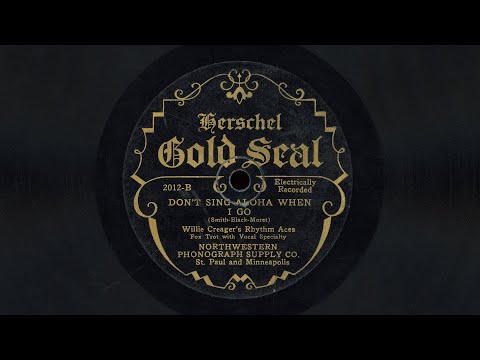
Willie Creager was a prolific dance band leader in the 1920s who recorded for Gennett, Pathé-Perfect, and Plaza Music Company labels such as Banner, Regal, Domino, Oriole, and Jewel.
In the October 1926 issue of Variety, Willie Creager had placed an ad billing himself as a “Guest Conductor Extraordinary for the Picture Houses” and offering a “unique attraction” of comedy, novelty, and entertainment.
The Keller sisters (Nan and Taddy) handle vocal harmonies with sibling Frank Lynch. Fun fact: Taddy later married bandleader Jack Pettis.
The records on the Herschel Gold Seal label were pressed by Gennett for Harry Bernstein’s Northwestern Phonograph Supply Company based in St. Paul & Minneapolis – as the label indicates. Bernstein owned ten record stores in the twin cities and sold a LOT of Gennett titles. Gennett created this private label for Bernstein. But this very short-lived label only issued 21 releases in total.
Second fun fact: according to Kurt Gegenhuber, Harry Bernstein grew up in Des Moines, Iowa.
Recorded at Herbert Berliner’s Recording Labs in New York’s Hilton Building located at 69 West 90th Street on October 19, 1926. Released as Herschel Gold Seal 2012. Also released as Gennett 3404, Challenge 15182, Challenge 210, Herwin 55002, Silvertone 3841, Canadian Starr 23083, and British Vocalion X-9939.
Credits: Keller Sisters and Lynch – vocals Willie Creager – director, arranger Earl Oliver – trumpet Red Nichols – cornet Chuck Campbell – trombone Nathan Glantz – alto sax, soprano sax, clarinet, bass clarinet) Larry Abbott – clarinet, alto sax, soprano sax, oboe Herman “Hymie” Wolfson – clarinet, tenor sax, soprano sax Kel Murray, Ben Poberesky – violin Phil Romano ? – piano Harry Reser – banjo Hank Stern – tuba Ken Whitmer – drums, sound effects
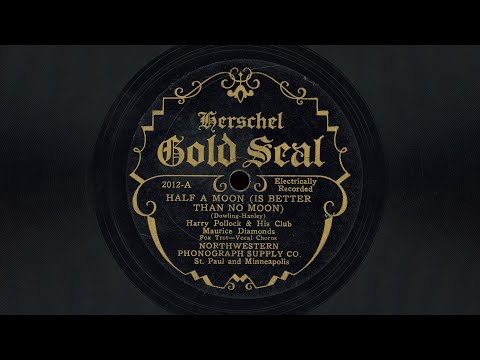
Harry Pollock was a violinist who led bands under a few different names (Harry Pollock and his Diamonds, Harry Pollock’s Blue Diamonds, Harry Pollock and his Orchestra) who recorded primarily for the Gennett label from 1926-1929.
This sweet side is a sprightly dance number with some excellent banjo playing, percussion, and a violin solo by Pollock.
The records on the Herschel Gold Seal label were pressed by Gennett for Harry Bernstein’s Northwestern Phonograph Supply Company based in St. Paul & Minneapolis – as the label indicates. Bernstein owned ten record stores in the twin cities and sold a LOT of Gennett titles. Gennett created this private label for Bernstein. But this very short-lived label only issued 21 releases in total.
Fun fact: according to Kurt Gegenhuber, Bernstein grew up in Des Moines, Iowa.
Found this in the wild – which is quite exciting as releases on this label are quite scarce. Side A starts off with a lot of “sizzling bacon” noise and this is the first video I’ve ever made where I’ve judiciously applied some noise reduction. Fortunately, the noise naturally subsides a bit by the time Pollock starts his violin solo around 1:12.
Recorded in New York City on October 1, 1926. Released as Herschel Gold Seal 2012. Also released as Gennett 3401.
Credits: Harry Pollock – violin, director Charles Forsythe – vocals Unknown performers – 2 trumpets / trombone / clarinet, soprano sax, alto sax / clarinet, alto sax / clarinet, tenor sax / piano / banjo / tuba / drums