Jazz Crazy Records

An Archive of Early Jazz on 78 RPM

Author: Professor M

  • “Altitude” – Vivien Garry Trio (1945)

    “Altitude” – Vivien Garry Trio (1945)

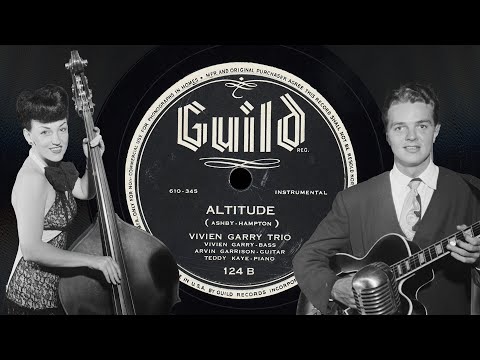
    From an early recording session of the Vivien Garry Trio featuring the iconic Vivien Garry on bass and rising star Arv Garrison (who later went on to record with Dizzy Gillespie, Charlie Parker, and Howard McGhee for the Dial label) on guitar.

    Arv and Viv met when Arv was playing with the Bud Ziegler Trio in Toledo, Ohio in 1941. In a 1989 interview with Bob Dietsche for Toledo magazine, Viv stated:

    “I was so crazy about Arv when I first met him that I used to follow him around to all of his rehearsals. I noticed that his bass player was having trouble getting the chords right, and I said to myself, ‘Hell, I can do better than that’, so I went out and bought a bass from a guy who informed me that ladies did not play the bass fiddle. I took it home and put it in the middle of the front room. When Arv came over that night, I said, ‘Teach me to play this, and we’ll become famous.’ I learned fast, so in a few weeks I was already better than Arv’s regular bass player.”

    They soon got married and formed their own trio and headed to NYC, where they landed a contract at Kelly’s Stable on 52nd Street. This venue gained them exposure, and soon after, this session for the Guild label was arranged.

    “Altitude” – a proto-bop tune by Lionel Hampton and guitarist Irving Ashby from 1941 – demonstrates the trio’s articulate timing and delightful ensemble interplay.

    Recorded at Decca Studios in New York City circa 1945.
    Released as Guild 124.

    Credits:
    Vivien Garry – bass
    Arvin Garrison – guitar
    Teddy Kaye – piano

    Sources:
    https://jazzresearch.com/arv-garrison/
    https://jazzresearch.com/vivien-garry-on-record/
  • “In a Jam” – Duke Ellington and his Orchestra (1936)

    “In a Jam” – Duke Ellington and his Orchestra (1936)

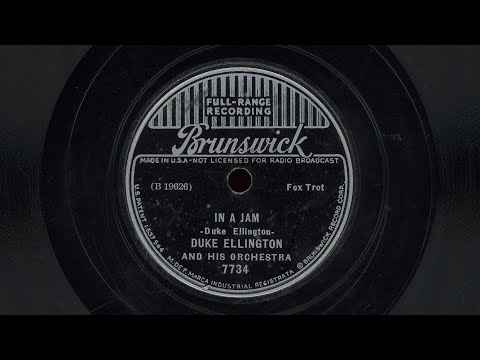
    It’s been called one of Ellington’s “most exuberant records” – which is a high bar – and indeed, “In a Jam” from July of 1936 does not disappoint. The head begins with a simple but insistent swing riff, which serves as a recurring chorus that appears between solos.

    Recorded in New York City on July 29, 1936.
    Released as Brunswick 7734.

    Duke Ellington – piano, arranger, director
    Arthur Whetsel, Cootie Williams – trumpet
    Rex Stewart – cornet
    Joe Nanton, Lawrence Brown – trombone
    Juan Tizol – valve trombone
    Barney Bigard – clarinet
    Johnny Hodges – clarinet, soprano sax, alto sax
    Harry Carney – clarinet, alto sax, baritone sax
    Otto Hardwick – alto sax, bass sax
    Ben Webster – tenor sax
    Fred Guy – guitar
    Billy Taylor – bass
    Sonny Greer – drums

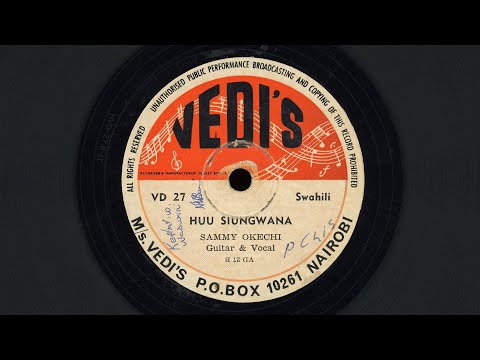
  • “Huu Siungwana” – Sammy Okechi – Kenyan Guitarist

    “Huu Siungwana” – Sammy Okechi – Kenyan Guitarist

    A virtually unknown Kenyan guitarist and singer recording for a small Nairobi label. Little information can be found on either the artist or the label.

    Guitarists like Okechi in Kenya were first inspired by Congolese fingerstyle guitarists such as Jean Mwenda Bosco. The Kenyan contribution to this style included the use of a second harmonizing vocal and glass bottle accompaniment. Fanta bottles were preferred due to their ribbed edging that could be scraped like a guiro.

    The title, Huu Siungwana, can be translated as “This Is Not Gentlemanly”, suggesting a critique of conduct seen as improper or impolite.

    The tuning of this one made it very difficult to pitch correctly – even more troublesome, the two different sides seem to have been recorded at different speeds.

    Recorded in Nairobi, Kenya – probably in the late 1950s or early 1960s.
    Released as Vedi’s VD 27.

    Sammy Okechi – guitar and vocal
    Unknown Artist – 2nd vocal, glass bottle

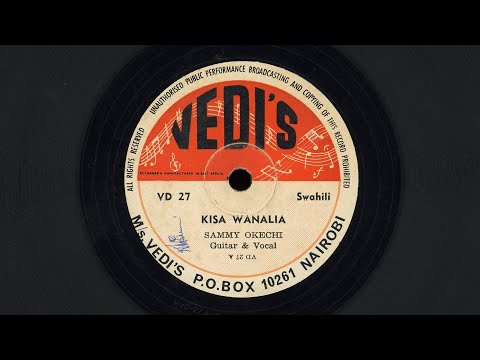
  • “Kisa Wanalia” – Sammy Okechi – Kenyan Guitarist

    “Kisa Wanalia” – Sammy Okechi – Kenyan Guitarist

    A virtually unknown Kenyan guitarist and singer recording for a small Nairobi label. Little information can be found on either the artist or the label.

    Guitarists like Okechi in Kenya were first inspired by Congolese fingerstyle guitarists such as Jean Mwenda Bosco. The Kenyan contribution to this style included the use of a second harmonizing vocal and glass bottle accompaniment. Fanta bottles were preferred due to their ribbed edging that could be scraped like a guiro.

    The title, Kisa Wanalia, can be translated as “The Story They Are Crying About.”

    The tuning of this one made it very difficult to pitch correctly – even more troublesome, the two different sides seem to have been recorded at different speeds.

    Recorded in Nairobi, Kenya – probably in the late 1950s or early 1960s.
    Released as Vedi’s VD 27.

    Sammy Okechi – guitar and vocal
    Unknown Artist – 2nd vocal, glass bottle

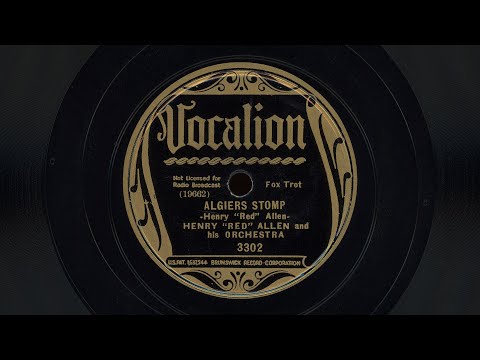
  • “Algiers Stomp” – Henry “Red” Allen and his Orchestra (1936)

    “Algiers Stomp” – Henry “Red” Allen and his Orchestra (1936)

    New Orleans born trumpeter Henry “Red” Allen and his orchestra recorded a large number of excellent sides for the American Record Corporation between 1934-37.

    “Throughout the series Red’s trumpet-playing covers the whole gamut of jazz expressiveness, creating many examples of superb small-band jazz. None of the 72 sides are less than good and many are superfine. Despite the various changes of personnel that took place over the three-year period, the recordings present an impressive level of consistency and feeling.”
    – John Chilton, Ride, Red Ride: The Life of Henry “Red” Allen

    “Algiers Stomp” is an homage to the Algiers neighborhood of New Orleans where Allen grew up. Lots of highlights, including a pair of proto-bop sax solos, a overdriven clarinet solo by Rudy Powell, and the main event: Allen’s confident and expressive trumpet solo.

    Recorded in New York City on August 5, 1936.
    Released as Vocalion 3302.

    Credits:
    Henry Allen – trumpet, vocals
    Rudy Powell – clarinet, alto sax
    Tab Smith – alto sax
    Cecil Scott – tenor sax
    Edgar Hayes – piano
    Lawrence Lucie – guitar
    Elmer James – bass
    Cozy Cole – drums

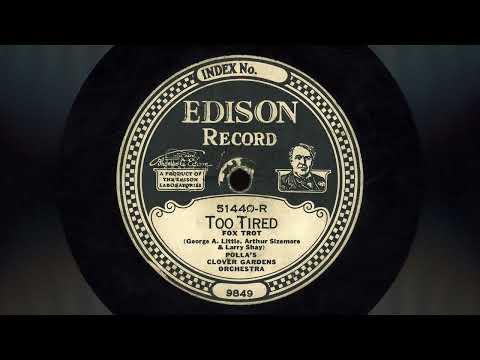
  • “Too Tired” – Polla’s Clover Gardens Orchestra (1924) 🔥 Edison!

    “Too Tired” – Polla’s Clover Gardens Orchestra (1924) 🔥 Edison!

    I’ve been looking through the excellent scholarship of Javier Soria Laso (JSLas2) on archive.org and came across his discography of William Conrad Polla’s Clover Gardens Orchestra. I immediately dug out some PCFO records and gave them a fresh listen!

    JSL – with prompting from a Dave Lomax comment from an old Storyville magazine – thinks that some of the players from the Georgia Melodians may be performing on this record.

    While the Clover Gardens Ballroom may seem like small potatoes compared to more popular and well-known venues, orchestras who took up residence there were well-paid. Ambrose’s Orchestra – led by British bandleader Benjamin Ambrose – an outfit with 25 performers – made $2,800 a week playing there in fall of 1922. That’s the equivalent of around $52K a week today.

    “Too Tired” is a peppy little number (thankfully with omitted lyrics in this instrumental version) featuring many hot solos and breaks.

    0:00 Intro
    0:47 trumpet solo
    1:05 sax solo
    1:40 banjo/trumpet duet
    2:17 muted trumpet solo
    2:33 trombone solo
    2:42 muted trumpet solo
    3:00 outro led by clarinet and trumpet

    Recorded in New York City on November 15, 1924
    Released as Edison 51440. This is take A.

    Credits:
    William Conrad Polla – piano, arranger, director
    Ernie Intelhouse (?), Unknown Artist – trumpet
    Unknown Artist – trombone
    Unknown Artist – clarinet, alto sax, soprano sax
    Unknown Artist – alto sax, soprano sax
    Unknown Artist – tenor sax
    Elmer Merry (?) – banjo
    Al Singmore (?) – tuba
    Carl Gerold (?) – drums
    Wm. Schulz, Louis Katzman – arranger

    Source:
    https://archive.org/details/the-recordings-of-william-conrad-pollas-clover-gardens-orchestra/

  • “Speckled Red’s Blues” – Speckled Red (1930)

    “Speckled Red’s Blues” – Speckled Red (1930)

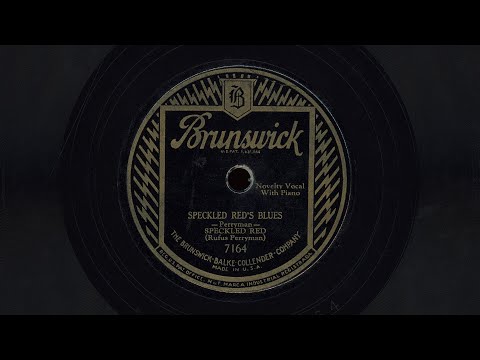
    Speckled Red (Rufus Perryman) was a self-taught piano player from Georgia who had his first recording session in Memphis Tennessee in 1929. One of the tunes he recorded there, “The Dirty Dozens”, became a bit of a hit – and he was invited back to another session in Chicago in the spring of 1930, where he recorded this tune.

    Amazing to listen to this and think about the deep roots of rock and roll in black American music. Here it is for all to hear, 20+ years ahead of its time.

    Recorded in Chicago on Tuesday, April 8, 1930.
    Released as Brunswick 7164.

    Credits:
    Speckled Red – piano, vocals

  • “Lots O’ Mama” – Midway Dance Orchestra (1923)

    “Lots O’ Mama” – Midway Dance Orchestra (1923)

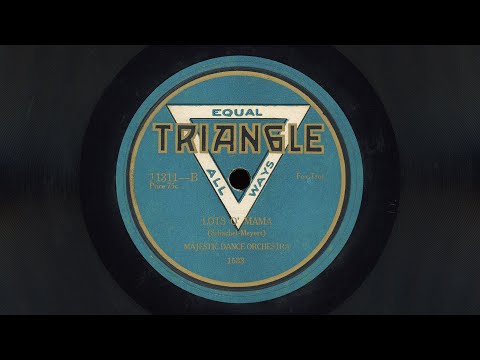
    Elmer Schoebel’s Midway Dance Orchestra (here under the alias Majestic Dance Orchestra). The band was so named for being a regular fixture at the Midway Gardens, a massive European-style concert garden in Chicago’s Hyde Park designed by Frank Lloyd Wright that opened in 1914.

    The band recorded this exact same tune for Columbia the day before this session that was released as Columbia 33-D. I’ll post that version later today. An interesting listen to compare how the band performed the same tune 24 hours apart – and a comparison of the two Chicago recording studios.

    Recorded in Chicago, Illinois on October 19, 1923.
    Released as Triangle 11311 (this is take 1).
    Originally released as Paramount 20273.

    Credits:
    Elmer Schoebel – piano, director, arranger
    Murphy Steinberg – cornet
    Jesse Barnes – trombone
    Art Kassel, Roy Kramer – clarinet
    Lou Black – banjo
    Steve Brown – tuba
    Bobby de Lys – drums

  • “C Jam Blues” – Billy Strayhorn Trio (1950)

    “C Jam Blues” – Billy Strayhorn Trio (1950)

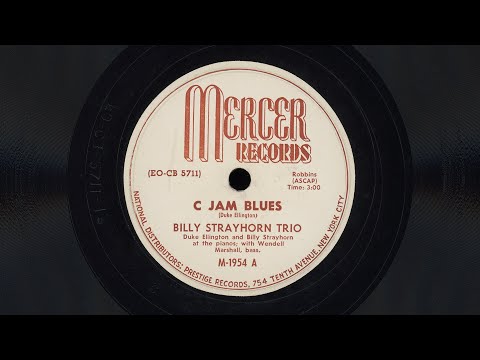
    A popular jazz standard with a melodic head that anyone who can locate a C and a G on a piano can play – and anyone who knows the 12-bar blues song form can play along with.

    While the tune was originally recorded by Barney Bigard with a small combo Ellington unit in 1941, it eventually became one of the Duke Ellington Orchestra’s most recorded and most played numbers. At that original session Billy Strayhorn helped arrange the number – and then added additional elements for Ellington’s full-orchestra version recorded at the end of that year.

    Over the years, it ranked among the twenty most-played tunes by the Ellington orchestra.

    Here we have Billy Strayhorn and Duke both at the piano, nearly ten years after the original recording was made. At times it is tricky to figure out who is playing what – a testament to their close musical connection.

    Recorded in New York City on October 3, 1950.
    Released as Mercer M-1954

    Credits:
    Billy Strayhorn, Duke Ellington – piano
    Wendell Marshall – bass

  • “Here Comes My Ball and Chain” – Bert Lown & His Loungers (1929)

    “Here Comes My Ball and Chain” – Bert Lown & His Loungers (1929)

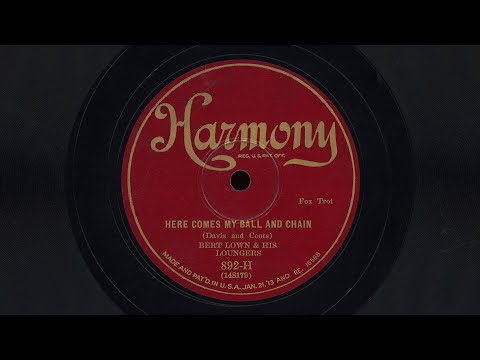
    Bert Lown was a violinist who played in Fred Hamm’s orchestra in Chicago in 1925 before leading his own orchestra in New York starting in the late 20s.

    While this tune gets fired up straightaway with dynamic interplay between Frank Cush and Miff Mole, the extended sax solo starting at 0:43 is quite tasty. Mole takes another solo at 1:39 followed by Cush’s trumpet and another sax encore.

    Recorded in New York City on April 5, 1929.
    Released as Harmony 892-H.

    Bert Lown – director
    Frank Cush – trumpet
    Miff Mole – trombone
    Rudolph Adler, Johnny Costello – clarinet, alto sax
    Paul Mason – clarinet, tenor sax
    Chauncey Gray – piano
    Tommy Felline – banjo
    Ward Lay or Al Weber – baritone brass
    Unknown Artist – drums