Jazz Crazy Records

An Archive of Early Jazz on 78 RPM

Author: Professor M

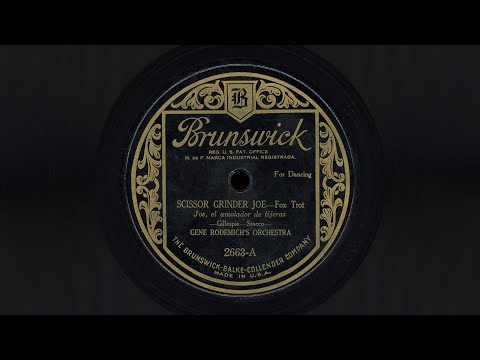
  • “Scissor Grinder Joe” – Gene Rodemich’s Orchestra (1924)

    “Scissor Grinder Joe” – Gene Rodemich’s Orchestra (1924)

    Eugene F. Rodemich was born in St. Louis in 1890 and studied violin and piano as a child. In 1904, he heard a group of ragtime pianists perform at the 1904 World’s Fair in St. Louis and was immediately hooked. He moved to NYC in 1913 and worked as an accompanist for vaudeville performer Elsie Janis – and later went on tour with her in France to entertain the troops during WWI. After returning to St. Louis in 1918, he started his own orchestra, which hired young saxophonist Frank Trumbauer in 1921.

    “Scissor Grinder Joe” was a novelty tune that begins with a melancholic arpeggiated piano line that is decidedly un-jazzy which reappears throughout the piece. The band comes in at a quick clip, artfully articulating the theme with stylistic aplomb. Soon we hear a piano solo followed by what sounds like a paper and comb solo. A sax and trumpet engage in a speedy melodic reparté. Then two muted trumpets battle to see whose wah-wah is most wooing. The whole thing comes to a close as artfully arranged as it began. The last thing we hear is the simple piano riff repeating and gently reminding us of its mournful state.

    The identity of the paper and comb / kazoo soloist is unknown. Curiously, Rust states that “the Mound City Blue Blowers are said to have appeared with this band, as they may have done on the stand, but not in the recording studio.” I wonder if Red McKenzie may be a contender here?

    Rust and a few others have attempted to provide personnel for this session – and they are quite different from one another. I’ve listed those that all sources agree upon plus a few suggestions (marked with a ?) on who else is playing.

    Recorded in New York City on June 11, 1924.
    Released as Brunswick 2663.

    Credits:
    Credits:
    Gene Rodemich – piano, director
    Clarence Foster or Jess Walton (?), Charles Werner – cornet
    Jules Blattner (?) – trumpet
    Julius Robb (?), Bill Bailey (?) – clarinet, alto sax
    Allister Wylie (?) – alto sax, 2nd piano
    Jules Silberberg – sax, violin
    Otto Reinert (violin)
    Unknown performer – paper and comb
    Larry Conley – trombone
    Eddie Storman – banjo
    John Bambridge (?) – tuba
    Paul Spoerloder – drums
  • ایک کافر پر طبیعت آگئی – Janki Bai (1907)

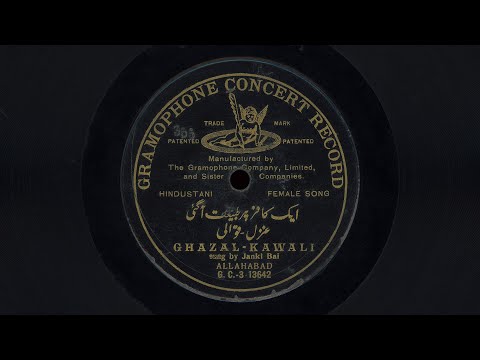
    ایک کافر پر طبیعت آگئی – Janki Bai (1907)

    Janki Bai of Allahabad was born in Benares in 1875. At some point after becoming a courtesan, an attacker slashed her face with fifty-six wounds – earning her the nickname “chappan chhuri” which means fifty-six daggers. She was trained in Indian classical music by Ustad Hassu Khan.

    This disc was from her very first recording session. The selection, a ghazal, is a love poem set to music. It is also labeled as a kawali, a devotional singing style of the Sufi Islamic tradition. The title loosely translates to: “My heart has been drawn towards an infidel”.

    “As far as is known at present, Janki Bai made her first recordings for The Gramophone and Typewriter, Ltd., at Delhi in March, 1907 during the sessions conducted by William Conrad Gaisberg, assisted by George Walter Dillnutt. Janki Bai gave 22 recordings in this recording session, although she was paid Rs 250 for 20 titles… Delhi recording sessions were reissued as double sided discs and these double sided Gramophone Concert Record labelled releases had achieved sales of 12,825 pieces by February 1911, the sales of the 1907 titles accounting for 3,746 discs.”
    – Michael Kinnear, Discography of Janki Bai of Allahabad

    At the end of the recording, you can hear her clearly say: ‘Mera naam Janki bai Allahabad.’

    Recorded in Delhi in March, 1907.
    Released as Gramophone Concert Record G.C.-3-13642 (E 5383e) in January 1909.
    Later reissued as HMV P.234 (Jan 1916) and Twin FT.531 (Jun 1931).

    Credits:
    Janki Bai – vocals
    Unknown accompanists – harmonium (?), tabla

    Sources:
    The Record News: Journal of the Society of Indian Record Collectors, Vol 14, April 1994. https://archive.org/details/trn_14

    “Janki Bai, singer disfigured by 56 stab wounds sold more records than her contemporaries”, Vikram Sampath, June 2, 2019, The Print. https://theprint.in/opinion/treasured-tunes/janki-bai-singer-disfigured-by-56-stab-wounds-sold-more-records-than-her-contemporaries/243124/

    The Untold Story of Janki Bai “CHHAPPAN CHHURI”
    https://www.youtube.com/watch?v=0yaLbiAKfoQ

  • “A Pane in the Glass” – Clarence Williams and his Jazz Kings (1929)

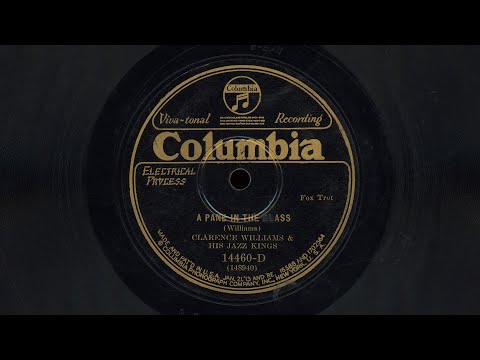
    “A Pane in the Glass” – Clarence Williams and his Jazz Kings (1929)

    Here is the third and final recording of the clever “A Pane in the Glass”, this time with Clarence accompanied by his Jazz Kings. The form is a 12 bar blues in Eb, with solos as follows:

    0:00 Intro
    0:25 Trumpet solo (Ed Anderson)
    0:52 Tenor sax solo
    1:17 Trombone solo (Geechie Fields)
    1:43 Clarinet solo
    2:08 Trumpet solo (Ed Allen)
    2:33 Ensemble

    There is (as always seems to be the case), some disagreement on the identities of the reedmen on this recording – and I give Rust’s personnel as a starting point for discussion. The other interesting player on this session seems to be Geechie Fields of Jelly Roll Morton’s Red Hot Peppers.

    You will note that the previous caretaker of this disc mischievously attempted to make the innuendo of the title a tad more explicit by attempting to cover up the “G” and “L” in the word “Glass” on the label.

    Recorded in New York City on August 26, 1929.
    Released as Columbia 14460-D.

    Credits:
    Ed Allen, Ed Anderson – cornet
    Geechie Fields – trombone
    Russell Procope (?) – clarinet, alto sax
    Arville Harris (?) – clarinet, tenor sax
    Clarence Williams – piano
    Leroy Harris – banjo
    Cyrus St. Clair – tuba

  • “A Pane in the Glass” – Clarence Williams (1929)

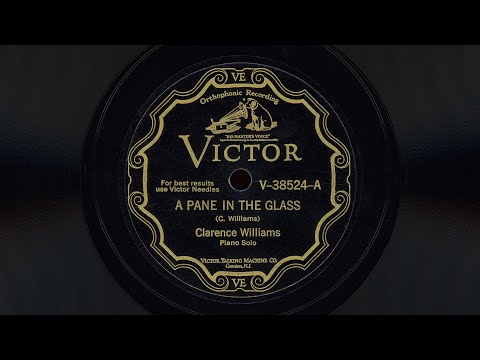
    “A Pane in the Glass” – Clarence Williams (1929)

    This session is Clarence Williams’ first for Victor involving a cleverly-named tune that he first recorded three months earlier for Paramount with King Oliver sitting in with his Blue Five. He would go on to record it one more time with his Jazz Kings for Columbia a few months later (a recording I will post later today!)

    In “Clarence Williams”, Tom Lord reports: “it was recorded in their 46th Street Studio between 10:45 and 12:45. Two takes were recorded of each performance. It’s hard to decide just why Victor decided to begin with two piano solos. I don’t imagine that piano solos were very big sellers in any market. Perhaps Victor decided on them for reasons of economy.”

    Also curious, as Williams was not known as a flashy stride player like James P. Johnson or a showman like Jelly Roll Morton. In fact, a good many jazz writers have described Williams as “only a fair pianist.” Yet one and all are quick to recognize his ability as a stylist and composer.

    In the book “New Orleans Style” by Bill Russell, Frank Walker at Columbia Recordings described Williams’ piano style:
    “Clarence [Williams] really wasn’t much of a pianist though, he’ll tell you that himself. When he was back home in New Orleans he played piano in one of those honky-tonks and could only play by ear-maybe knowing a half-dozen songs. Then some inebriate might come in and ask for a song he didn’t know, and Clarence would say, “Come back tomorrow night.” The next day he’d go down to the five-and-ten-cent store, to the sheet music counter, and pull out the song for the piano player to demonstrate. He would hear it once and know it. If that customer came back, Clarence would play the song and maybe pick up a dime tip.

    I find this solo work interesting as a lens into hearing a work as he likely originally composed it – and then listening to the other recorded versions arranged for small combos. It gives you a sense of his compositional style and a window into the aesthetics of his arrangement choices.

    This release was a part of the Victor V-38500 series, which mainly was full of recordings by jug band, blues and gospel artists such as Memphis Jug Band, Cannon’s Jug Stompers, Frank Stokes, and Victoria Spivey.

    Recorded in New York City on February 12, 1929.
    Released as Victor V-38524.

    Credits:
    Clarence Williams – piano

  • “Tampeekoe” – The Dixie Stompers (1926)

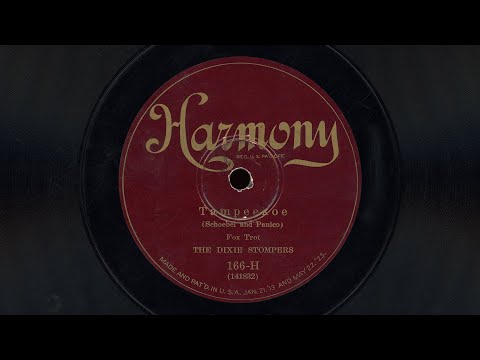
    “Tampeekoe” – The Dixie Stompers (1926)

    An interesting tune written by Elmer Schoebel and Louis Panico performed by Fletcher Henderson and his Orchestra for Harmony under the pseudonym “The Dixie Stompers”

    Recorded in New York City on January 6, 1926.
    Released as Harmony 166-H.

    Credits:
    Fletcher Henderson – piano, director
    Russell Smith, Joe Smith – trumpet
    Charlie Green – trombone
    Buster Bailey, Don Redman – clarinet, alto sax
    Coleman Hawkins – clarinet, tenor sax
    Charlie Dixon – banjo
    Kaiser Marshall – drums

  • “Happy Days and Lonely Nights” – Charlie Fry and his Million Dollar Pier Orchestra (1928)

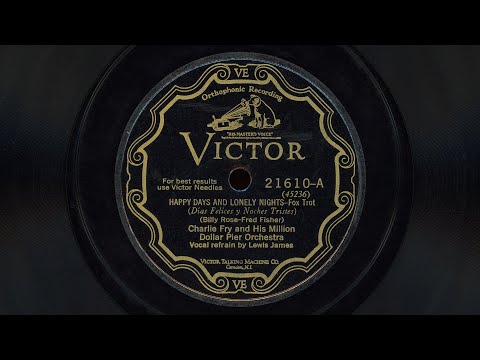
    “Happy Days and Lonely Nights” – Charlie Fry and his Million Dollar Pier Orchestra (1928)

    Recently dug this record out of the vault after reading an R. Crumb comic about 78 collecting in which he considers getting rid of his “whole damn collection” but then gets very sad thinking about parting with his beloved copy of “Happy Days and Lonely Nights” by Charlie Fry and his Million Dollar Pier Orchestra.

    Well folks, here it is in all its glory – and R. Crumb, if you’re listening – don’t be sad – now it’s always available for you here.

    This was from the second-to-last session the band ever recorded – and unfortunately, Rust’s Jazz and Ragtime records discography lists no personnel outside of Fry and vocalist Lewis James.

    Recorded in Camden, New Jersey on June 5, 1928.
    Released as Victor 21610.

    Credits:
    Charlie Fry – director
    Lewis James – vocals

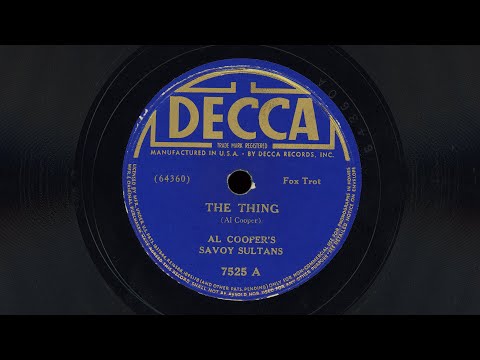
  • “The Thing” – Al Cooper’s Savoy Sultans (1938)

    “The Thing” – Al Cooper’s Savoy Sultans (1938)

    A swingin’ tune from the outstanding band known for its longtime residency at the Savoy Ballroom in Harlem starting in 1937. They recorded several records for Decca between 1938-1941, and this one is from their first session.

    In addition to a rock solid hook, this original tune by Al Cooper also features great solo work by Sam Massenberg on trumpet and an exciting bass solo that I mistook for Slam Stewart at first due to the vocalizations – but the honors here go to Cooper’s half brother Grachan Moncur.

    Recorded in New York City on July 29, 1938.
    Released as Decca 7525.

    Credits:
    Al Cooper – clarinet, alto sax, baritone sax, arranger, director
    Pat Jenkins, Sam Massenberg – trumpet
    Rudy Williams – alto sax
    Ed McNeil – tenor sax
    Oliver Richardson – piano
    Grachan Moncur – string bass
    Alex “Razz” Mitchell – drums

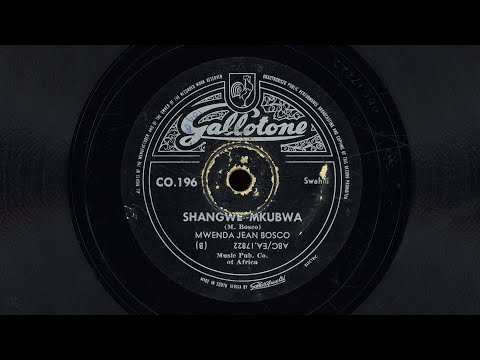
  • “Shangwe Mkubwa” – Jean-Bosco Mwenda (~1958)

    “Shangwe Mkubwa” – Jean-Bosco Mwenda (~1958)

    The great Congolese fingerstyle guitarist Jean-Bosco Mwenda.

    If you like this, I just discovered that Mwenda’s set at the 1969 Newport Folk Festival was recorded and is available online:
    https://www.wolfgangs.com/music/jean-bosco-mwenda/audio/20020427-50522.html

    Believed to have been recorded circa 1958.

    Released as Gallotone CO.196 (mx. ABC/EA.17822).

    Credits:
    Jean-Bosco Mwenda – guitar, vocals
    Unknown accompanist – glass bottle

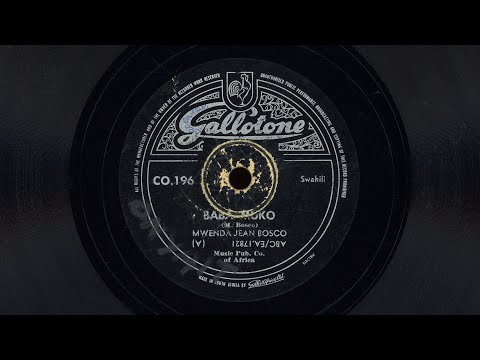
  • “Baba Moko” – Jean-Bosco Mwenda (~1958)

    “Baba Moko” – Jean-Bosco Mwenda (~1958)

    The great Congolese fingerstyle guitarist Jean-Bosco Mwenda.

    If you like this, I just discovered that Mwenda’s set at the 1969 Newport Folk Festival was recorded and is available online:
    https://www.wolfgangs.com/music/jean-bosco-mwenda/audio/20020427-50522.html

    Believed to have been recorded circa 1958.
    Released as Gallotone CO.196 (mx. ABC/EA.17821)

    Credits:
    Jean-Bosco Mwenda – guitar, vocals
    Unknown accompanist – glass bottle

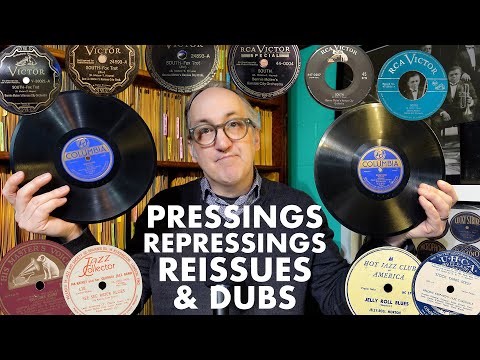
  • Pressings, Repressings, Reissues, & Dubs – A Guide for New Collectors of 78 rpm Records

    Pressings, Repressings, Reissues, & Dubs – A Guide for New Collectors of 78 rpm Records

    If you are new to collecting 78 rpm records, this video will help you learn about the different types of pressings of the 78 rpm era – which often confused me as a new collector when I first started.

    After I explain the differences between original pressings, repressings, foreign pressings, reissues, master pressings, dubbed pressings, and bootleg pirated dubs. Later in the video, we’ll do some comparative listening to hear the differences between different pressings of the same recording.

    Unfortunately, a planned comparison between the original pressing of “Bucktown Stomp” by Johnny Dodds’ Washboard Band on Victor with a British dub on His Master’s Voice had to be edited out due to copyright restrictions on that song. Maybe I’ll revisit this comparison in a few years when it enters the public domain.

    0:00 Intro
    0:40 A Duke Ellington Panorama
    2:27 Original Pressings
    6:22 Foreign Pressings
    7:28 Repressings
    10:23 Reissues
    11:51 Master Pressings
    13:04 Dubbed Copies
    14:39 Pirate Bootleg Dubs
    18:47 Confusing Outliers
    21:45 What about MY record? What type of pressing is it?
    23:22 Head-to-Head Comparisons
    24:13 East St. Louis Toodle-Oo – Duke Ellington (original v. master pressings)
    30:09 Brush Stomp – The Chicago Footwarmers (original pressing v. pirate dub)
    33:46 See See Rider Blues – Ma Rainey (dub v. dub)
    38:17 Summary

    Please let me know your thoughts in the comments – what’s your take on original pressings vs. reissues?

    Find Out More About Your 78 rpm Record
    https://youtu.be/4TkGJ1Yna1g