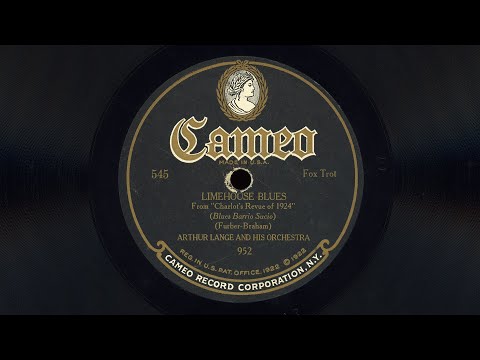
Ever since I heard Cannonball Adderley and John Coltrane play “Limehouse Blues” on “Cannonball Adderley Quintet in Chicago”, I’ve been intrigued by this tune, which was originally written for a revue performed in London in 1921.
Jack Hylton recorded an instrumental version in 1922 with the Queen’s Dance Orchestra, but it was not until the song hit Broadway in the U.S. that it became a breakout hit. Fortunately, most jazz versions of this tune are instrumental, omitting the original Orientalist lyrics that, to use a Gen Z colloquialism, are “cringe”.
Arthur Lange was a prolific bandleader and arranger, and his orchestra had already recorded nearly 100 sides for Cameo before this session. The arrangement here is very tight and nearly symphonic in its precise interactions between the band’s instrumentation. Lange would later write a book on dance band arrangement that is quite an interesting read.
The jazz interest here begins around 1:28 with a muted 16-bar doo wacka doo trumpet solo by Earl Oliver.
Recorded in New York City on April 22, 1924. Released as Cameo 545.
Credits: Arthur Lange – director, arranger Earl Oliver, Tommy Gott – trumpet Eph Hannaford – trombone William Tresize – alto sax, violin Morris Payes – clarinet, alto sax Owen Bartlett – tenor sax Licco Liggy – violin Ray Romano – piano Frank Reino – banjo Arthur Campbell – tuba Ken Whitmer – drums
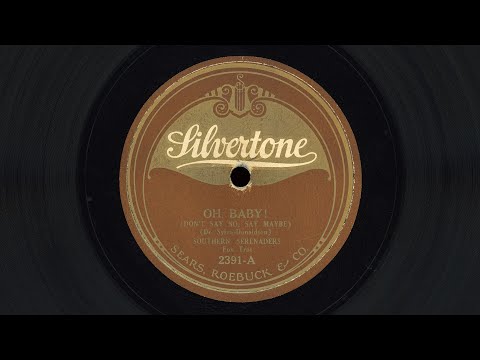
Here’s another Silvertone reissue of a Federal release that doesn’t appear in either of Brian Rust’s discographies covering Jazz and Dance Band records.
The sax that comes in 0:27 and 1:16 sounds familiarly like Nathan Glantz – who did record this tune twice in early 1924 for different labels – and indeed it is he. The highlight of this one for me is the xylophone (marimba?) at 1:33 and 1:58, which is noneother than George Hamilton Green.
According to astute friend of the channel @jslas2-590 (Javier Soria Laso), trumpeter Jules Levy Jr. (present throughout the entire recording) tragically died of pleurisy shortly after this recording was made on June 18 of 1924.
Thanks to Javier for his help with notes and credits on this one!
Believed to be recorded in early 1924. Reissued as Silvertone 2391 (mx. 2-2465). Originally released as Federal 5391 and Resona 75391.
Credits: Nathan Glantz – director, alto sax, tenor sax, soprano sax, clarinet, bass clarinet Jules Levy Jr., Mike Mosiello – trumpet Eph(riam) Hannaford – trombone Larry Briers – piano unknown artist – tuba George Hamilton Green – drums, xylophone, bells
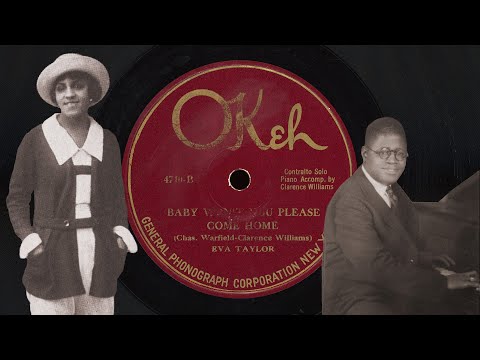
Of all of the songs credited to and published by Clarence Williams, “Baby Won’t You Please Come Home” is one of his best known. Here we have the first recorded version of that song from late 1922, featuring Clarence on piano and his wife Eva Taylor on vocals.
The song would go on to become a jazz standard, recorded by every big name one can think of: Bessie Smith, Louis Armstrong, Sidney Bechet, Count Basie, Benny Goodman, Billie Holiday, Ella Fitzgerald, Miles Davis… along with many of the top vocal performers such as Bing Crosby, Frank Sinatra, Dean Martin, and Julie London.
Eva Taylor (also known by her maiden name Irene Joy Gibbons) was a St. Louis vaudeville performer who met Williams in New York in 1920. They married a year later and recorded extensively together for Okeh and Columbia.
In addition to her collaborations with Williams, Eva would go on to sing with many other artists such as the Charleston Chasers and Ben Selvin’s orchestra.
If there ever was a first couple of early jazz, I think it would be Clarence Williams and Eva Taylor. Two married artists who collaborated and performed as equals.
Recorded in New York City on November 25, 1922. Released as Okeh 4740.
Credits: Eva Taylor – vocals Clarence Williams – piano
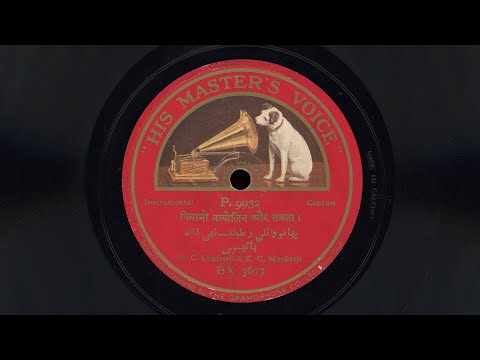
G. C. Chatterjee was a North Indian classical violin in the gatkari style who often recorded with pianist K. C. Mookerjee and an unknown accompanist on tabla.
The result is a delightful collaboration that to my ears is many years ahead of its time.
It is believed this recording was made in the late 1920s – and here is recorded from a later HMV reissue circa 1940.
Released in India as His Master’s Voice P.9932 (HMV mx. BX.3677 and BX.3678) (Gramophone mx 8-15367 and 8-15368)
Credits: Gagan Chandra Chatterjee – violin K. C. Mookerjee – piano Unknown accompanist – tabla
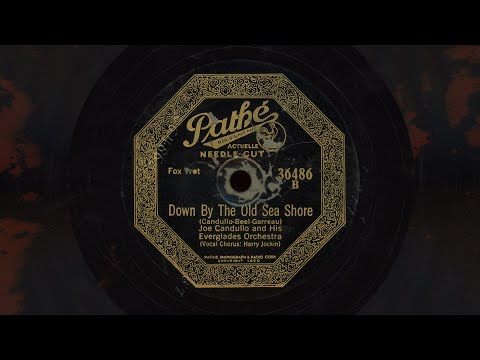
A nice “bowling ball” style Pathé Actuelle disc with a splatter of black and red shellac by Joe Candullo and his Everglades Orchestra.
This side did not look promising based on the title, and I put it on with low expectations. The first 90 seconds are a pleasant straightforward dance band number with vocal. However, at 1:28, my ears perked up at Goof Moyer’s warbling alto sax solo that then led to excellent subsequent trombone, sax, and trumpet solos. Not too shabby at all, gentlemen! 👏👏👏
Recorded in New York City circa July 1926. Released as Pathé Actuelle 36486
Credits: Joe Candullo – violin, director Leo McConville (?), Tommy Gott (?) – trumpet Goof Moyer – clarinet, alto sax Ray Stilwell – trombone Gerry Salisbury – clarinet, alto sax, tenor sax Frank de Carlo – piano John Montesanto – banjo Nick Farrara – tuba Ray Bauduc – drums
Mary Lou Williams left Andy Kirk and his Clouds of Joy in 1942 – and here we find her leading a trio on a session for Asch Recordings.
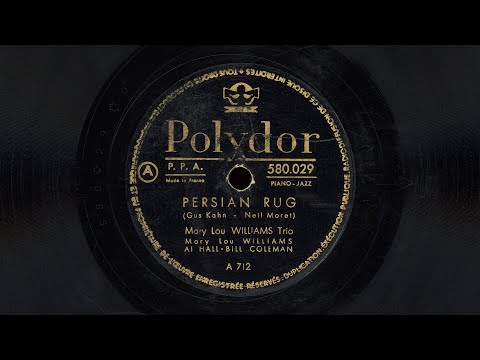
This old tune, “Persian Rug”, was a number published in 1927, written by Gus Kahn and Neil Moret. It was a song full of Eastern exoticism that had been recorded in the late 20s by artists such as Fats Waller, Louisiana Sugar Babes, the Dorsey Brothers, Eddie Harkness, and Charley Straight. It languished during the depression years and was revived in the late 30s by Jack Teagarden in a recording for Brunswick. More recently, it was recorded by guitarist Julian Lage for his 2016 album, Arclight.
This beautifully sparse version opens with bassist Al Hall bowing in the background in a way that resembles a lower-pitched slide whistle while a trumpet call by Bill Coleman seems to announce a somber occasion. Mary Lou then bursts onto the scene with a cheerful melodic line full of a joie de vivre. Williams, Hall, and Coleman trade ideas, often coming together between solos as though to check in with one another. I find it quite inventive and a real delight to listen to.
Unfortunately, Asch pressings are known to have a lot of surface noise – possibly because of the lower quality of scarce wartime shellac. This French Polydor pressing (which you wouldn’t necessarily expect to be much better, all things considered) seems a bit better – though my copy gets noisier toward the end. Probably the result of a steel needle junkie trying to get just one more play out of an used needle.
Recorded in New York City on August 10, 1944. Released as Polydor 580 029.
Credits: Mary Lou Williams – piano Al Hall – bass Bill Coleman – trumpet
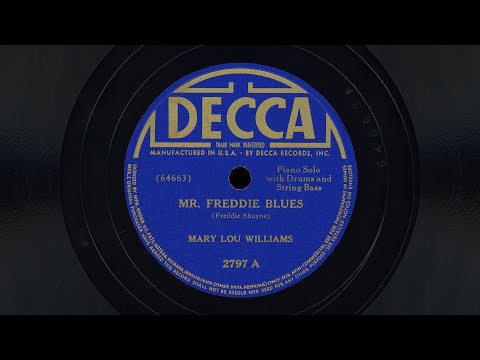
I am on a Mary Lou Williams kick this week – and have a few great sides to share.
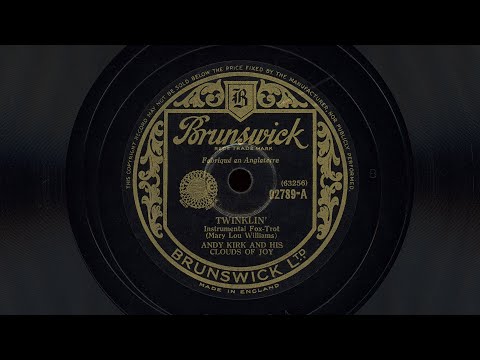
This first one is Twinklin’ – a delightful self-penned number with Andy Kirk and his Clouds of Joy that showcases Williams’ piano. She’s got this great unhurried tone – always quite elegant.
Recorded in New York City on February 8, 1938. Originally released in the U.S. as Decca 2483. Released in the U.K. as Brunswick 02789.
Credits: Andy Kirk – bass sax, director Mary Lou Williams – piano, arranger Harry Lawson, Clarence Trice, Earl Thomson – trumpet Ted Donnelly, Henry Wells – trombone John Harrington – clarinet, alto sax, baritone sax Earl Miller – alto sax John Williams – alto sax, baritone sax Dick Wilson – tenor sax Ted Robinson – guitar Booker Collins – string bass Ben Thigpen – drums
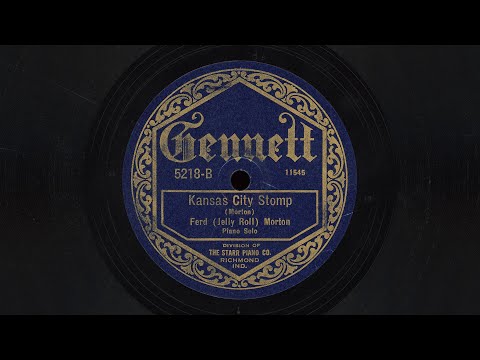
Oh, to be a fly on the wall in Gennett studios on July 17-18 during the summer of 1923 when Jelly Roll Morton went into the studio for his second recording session (the first was with Paramount a month earlier).
On the 17th, he spent the day alternating between recorded performances with the New Orleans Rhythm Kings and recording his own piano solos. 16 takes of 7 different tunes were recorded that day. On the 18th, Morton started with more solo piano recordings (including this one) and then finished the day recording London Blues, Milenberg Joys, and Mad (Cause You Treat Me This Way) with NORK.
For fun, also listen to the later 1928 recording of this same tune with the full Red Hot Peppers accompaniment: https://youtu.be/jdQsglyv-U8
Recorded in Richmond, Indiana on July 18, 1923. Released as Gennett 5218.
W. C. Handy first met J. Paul Wyer in Memphis in the early 1910s. He recounts:
“One evening when we were getting off the excursion steamer Pattona, a shy stranger approached me and said he had heard that I needed another good clarinetist. It was easy to see that he had been having his downs. He reminded me of myself back on the levee at St. Louis. He told me his name was J. Paul Wyer.”
Turns out Wyer’s father was a noted army bandsman who had led an orchestra in Pensacola, Florida that Handy was familiar with. Wyer had played in his father’s theatre orchestra and could sight read music.
“I took him on for the night and gave him a chance to play with our large group… under rather trying circumstances. He was asked to play second clarinet without a prepared part. But the young musician improvised a part better than if one had been written. I was deeply impressed and genuinely sorry when I had to tell him that I couldn’t see my way clear to hire a second clarinetist at the moment.
‘But I can play the violin, too,’ he suggested.
He gave us a demonstration. To my surprise, he could play any standard opera and many violin solos from memory. He left us all aghast.
‘You must have been tops in your daddy’s band,’ I said.
‘Oh, no,’ he answered promptly. ‘Not quite tops. My brother Ed has me beat.’ Naturally, I kept young Paul and lost no time sending for his brother Ed. From that time forward the boom was on where the Handy dance orchestra was concerned. Calls came from the towns and great houses down on the roads that crossed the Dog. Jim (Turner) knew every pig path in Mississippi and Alabama. He had also played the river and was favorably known in Louisiana and Arkansas. All this territory we took under control and made it our stamping ground.”
Turns out Wyer also was a close friend of Jelly Roll Morton, who he had met in 1906 while playing pool. Morton even had a nickname for him: “Pensacola Kid”.
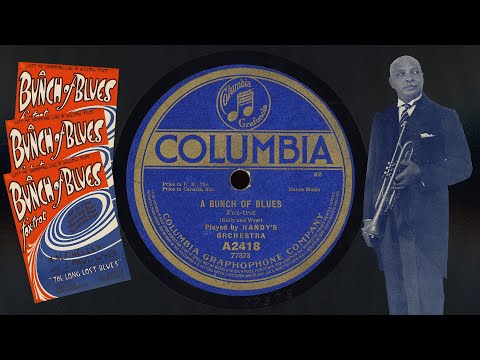
“Bunch of Blues” was a Wyer composition (with lyrics by H. Alf Kelly) that was a medley of “The Weary Blues”, “The String Beans Blues”, “Ship Wreck Blues”, and “The Long Lost Blues.” It was recorded by Handy for a marathon session for Columbia in NYC. Over a five day period, the band prolifically recorded 34 takes of 15 tunes that resulted in 10 released sides.
While J. Paul Wyer had left the band by this point, Ed Wyer was supposed to be in on this session, but he had moved to Chicago and the musician’s union there (Local 208) had told him he’d be fined up to $500 if he left town with Handy.
While J. Paul Wyer is not a well-known name in jazz and blues history – his story has a happy ending – in 1919 he joined the New York Syncopated Orchestra (NYSO) and traveled to Europe with them. In 1923 he travelled to Buenos Aires where he had a long and successful career as a bandleader. He died there in 1959.
Recorded in New York City on September 24, 1917. Released as Columbia A2418.
Credits: W. C. Handy – director, trumpet Sylvester Bevard, – trombone Wilson Townes, Alex Poole – clarinet, alto sax Charles Harris, Nelson Kincaid – clarinet, tenor sax Edward Alexander, William Tyler, Darnell Howard – violin Henry Graves – violincello Charles Hillman – piano Archie Walls – tuba Jasper Taylor – drums, xylophone
SOURCES: Father of the Blues: An Autobiography – W.C. Handy “Paul Wyer O La Metáfora Corporizada Del Atlántico Negro En La Argentina” by Berenice Corti