Jazz Crazy Records

An Archive of Early Jazz on 78 RPM

Author: Professor M

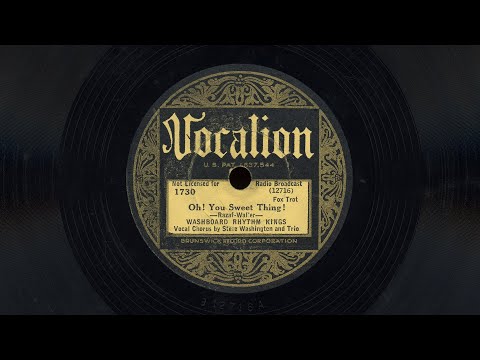
  • “Oh! You Sweet Thing!” – Washboard Rhythm Kings (1932)

    “Oh! You Sweet Thing!” – Washboard Rhythm Kings (1932)

    This deep depression cut featuring some lovely vocal harmonizing from the Washboard Rhythm Kings arrived courtesy of fellow WRK fanatic Ricky Hernandez (Wacko_Shellacko).

    Did WRK ever make a bad record? No, I think not. To paraphrase Vizzini, that would be quite inconceivable. Ever since I heard their absolutely ripping version of “Tiger Rag”, I’ve been a diehard fan. I could add a few more gushing remarks, but I’ll leave you to enjoy the rapturous “Oh! You Sweet Thing!”

    Recorded in New York City on December 14, 1932.
    Released as Vocalion 1730.

    Credits:
    Steve Washington – banjo, vocals
    Carl Wade – tenor sax
    Ghost Howell – bass
    Unknown Artist – trumpet
    Unknown Artist – clarinet, alto sax
    Unknown Artist – alto sax
    Unknown Artist – piano
    Unknown Artist – washboard

    The flip side, “Something’s Gotta Be Done” is excellent too – and I have already made a transfer of it from a British master pressing on the Decca label if you’d like to listen to it here:
    https://youtu.be/bMKrXRUP3qQ
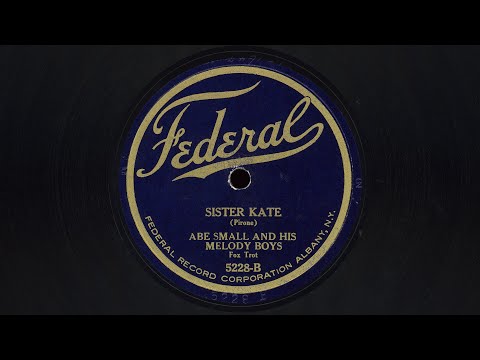
  • “Sister Kate” – Abe Small and his Melody Boys (1923)

    “Sister Kate” – Abe Small and his Melody Boys (1923)

    This one has been in my transfer queue for quite some time – and until recently I did not know much about Abe Small, the cornetist who led this small band. However, about six months ago jazz historian Colin Hancock (who is behind the excellent YouTube channel @Desdemona202 ) did a great writeup on Abe Small which you can read at the link below.

    A version of this tune appears in Colin’s video from a different session for the Strong label. This version with a different matrix is from a Federal session from the same month. I add it here since I don’t see it anywhere on YouTube yet. Had to pitch this one down a bit to around 75 rpm to get it in key.

    Recorded in New York City in January, 1923.
    Released as Federal 5228 (mx. 1-1647)

    If you’d like to hear the rest of Abe Small’s recorded output, be sure to watch @Desdemona202 ‘s excellent video “Abe Small–Brooklyn Cornetist (Gennett, Strong, and Federal Recordings: 1922-1923)” at:
    https://www.youtube.com/watch?v=4iWnpY5TQk4

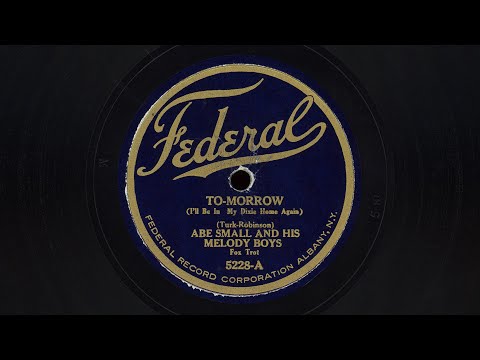
  • To-morrow (I’ll Be In My Dixie Home Again) – Abe Small and his Melody Boys (1923)

    To-morrow (I’ll Be In My Dixie Home Again) – Abe Small and his Melody Boys (1923)

    This one has been in my transfer queue for quite some time – and until recently I did not know much about Abe Small, the cornetist who led this small band. However, about six months ago jazz historian Colin Hancock (who is behind the excellent YouTube channel @Desdemona202) did a great writeup on Abe Small which you can read at the link below.

    This record did not appear in Colin’s video, so I add it here since I don’t see it anywhere on YouTube yet. Had to pitch this one down a bit to around 75 rpm to get it in key.

    Recorded in New York City in January, 1923.
    Released as Federal 5228 (mx. 1-1640)

    If you’d like to hear the rest of Abe Small’s recorded output, be sure to watch @Desdemona202’s excellent video “Abe Small–Brooklyn Cornetist (Gennett, Strong, and Federal Recordings: 1922-1923)” at:
    https://www.youtube.com/watch?v=4iWnpY5TQk4

  • “So Tired” – Jean Goldkette and his Orchestra f/ Hoagy Carmichael (1927)

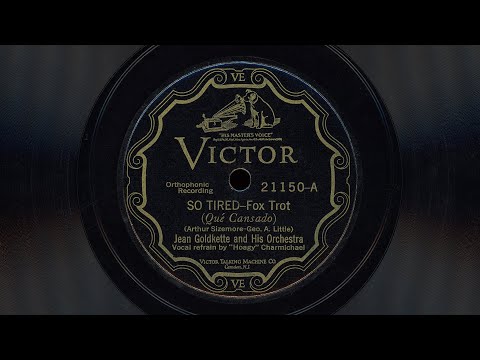
    “So Tired” – Jean Goldkette and his Orchestra f/ Hoagy Carmichael (1927)

    After Jean Goldkette and his Orchestra’s most famous configuration that featured Bix, Tram, Venuti, and Lang broke up in the autumn of 1927, Goldkette reconfigured the band in Kansas City with members of an Indianapolis band called the Royal Peacocks. Goldkette got an engagement with the lush Pla-Mor Ballroom.

    This recording was made during that time in Kansas City at a temporary studio Victor set up.

    This disc, while the grooves were in great condition, had some rippling warps emanating from the center of the record – possibly due to heat damage – that gave the stylus a wild ride. This made it necessary to transfer at a gentle 16 rpm and then correct the speed digitally.

    Recorded in Kansas City, Missouri on December 12, 1927.
    Released as Victor 21150.

    Credits:
    Myron Schulz – violin, director
    Nat Natoli, Andy Secrest, Sterling Bose – trumpet
    Lorin Schulz, Red Ginsler – trombone
    Larry Tice, Bob Hutsell – clarinet, alto sax
    Reggie Byleth (Severance), Ray Porter – clarinet, alto sax, tenor sax
    Harold Stokes – piano-accordion, arranger
    Harry Bason – piano
    Hoagy Carmichael – piano, vocals
    Joe Galbraith – banjo
    Harold George – tuba
    Mel Miller – drums

    Sources consulted:
    Jazz and Ragtime Records, Brian Rust, 6th Edition
    “Jean Goldkette’s Post-Bix Recordings: the Don Redman Arrangements – Part One”, Nick Dellow and Albert Haim, Vintage Jazz Mart

  • “I Need a Good Man Bad” – Miss Frankie (1926)

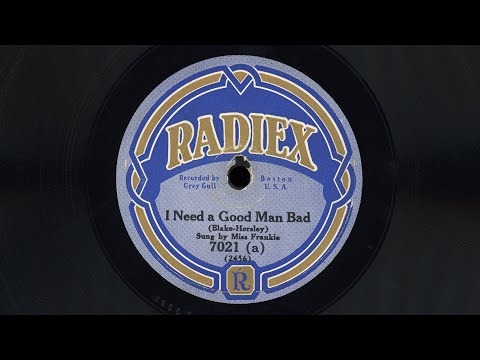
    “I Need a Good Man Bad” – Miss Frankie (1926)

    Early blues on Grey Gull? Yes, apparently so.

    The identity of Miss Frankie is unknown. While Jane Howard used the pseudonym on some labels, her participation in this release has not been fully confirmed – and Dixon & Godrich note that the cuts from this session “reportedly sounds very unlike Jane Howard.”

    So this is likely an unknown vocalist whose identity has completely disappeared – my guess from her crisp enunciation is that she was likely an actress in the vein of Ethel Waters.

    Eubie Blake has been listed as the accompanist, but in every source it was cited, there was a question mark as to whether it was definitively confirmed as Eubie.

    At normal running speed, this record was pitched in the key of B – which is an unusual key for a piano blues. Slowing to about 73-74 rpm delivered what I believe is the correct key of B flat.

    Recorded in New York City in December, 1926.
    Released as Radiex 7021.

    Credits:
    Miss Frankie – vocals
    Eubie Blake (?) – piano

  • “Just You Just Me” – Teddy Wilson Quintet (1945)

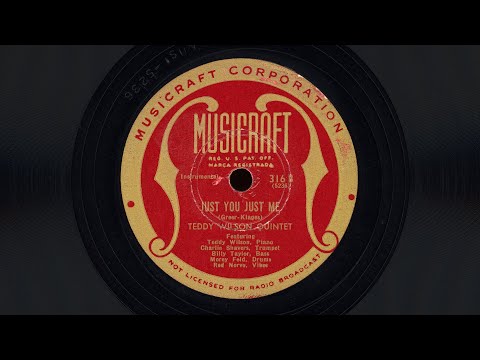
    “Just You Just Me” – Teddy Wilson Quintet (1945)

    Another version of the 1929 jazz standard “Just You, Just Me” by pianist Teddy Wilson and his Quintet from 1945.

    To quote Butterfly from Digable Planets, “The vibe here is very pleasant.”

    Recorded in New York City on January 8, 1945.
    Released as Musicraft 316.

    Credits:
    Teddy Wilson – piano
    Charlie Shavers – trumpet
    Billy Taylor – bass
    Morey Feld – drums
    Red Norvo – vibes

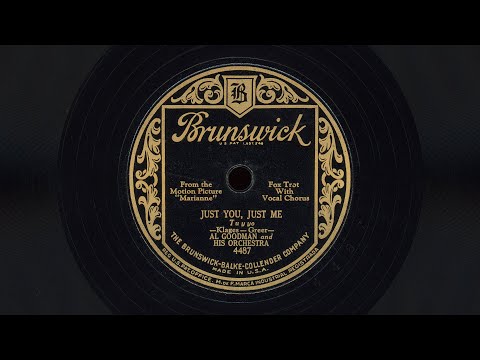
  • “Just You, Just Me” – Al Goodman and his Orchestra (1929)

    “Just You, Just Me” – Al Goodman and his Orchestra (1929)

    Ever since posting that Monk recording “Evidence”, I’ve been listening to versions of the tune its chord progression was based on: “Just You, Just Me”. I find it quite fascinating to trace how songs like this were originally played, and how jazz artists throughout the decades have reinterpreted and reimagined them.

    Here we have a recording very close to when the song was first published, by Ukranian-born bandleader Al Goodman – who at the time was quite busy conducting orchestras for Broadway productions. The tune was composed by Jesse Greer and Raymond Klages for the film “Marianne”, which was released in 1929. Who knew this minor song in a relatively minor film would go on to become known as a jazz standard – recorded by luminaries such as Ella, Sinatra, Bing, and Nat King Cole over 25-30 years later!

    This early version is a straightforward dance band arrangement without much “jazz interest” as Brian Rust might say. Yet the chord progression was of interest to later jazz players. I’ll post a jazzier version recorded about 15 years after this one later today.

    Recorded in New York City in August, 1929.
    Released as Brunswick 4487

    Credits:
    Al Goodman – director
    Vocals – Harold “Scrappy” Lambert
    Unknown Artists – trumpets (2-3), trombone (2), clarinet-alto sax (2-3), tenor sax, violin, cello, piano, banjo, tuba, drums

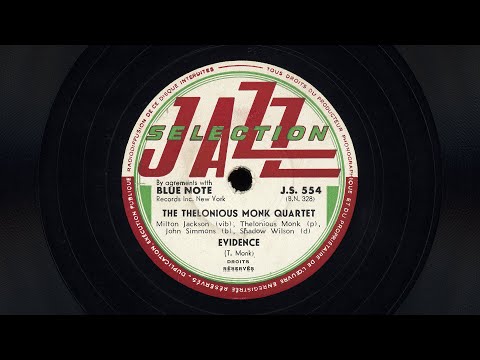
  • “Evidence” – The Thelonious Monk Quartet (1948)

    “Evidence” – The Thelonious Monk Quartet (1948)

    After sitting in as a sideman on recorded jam sessions quite a bit from 1941-1944 with luminaries like Charlie Christian, Kenny Clarke, Joe Guy, and Roy Eldridge, Thelonious Monk got his first session dates as leader in late 1947 for the then evolving Blue Note label. Blue Note had started in 1939 primarily as a label that featured stride pianists and hot jazz artists from the 20s and 30s like Sidney Bechet and Teddy Bunn. In the late 40s they began recording more modern jazz styles and new artists.

    “Evidence” was a contrafact of “Just You, Just Me”, a tune featured in a 1929 MGM film “Marianne” and was originally titled “Justice” (“just us”) in homage to the original composition. The original tune was recorded in the late 20s by Al Goodman, Ukulele Ike, Jack Hylton, and others. It was recorded later in the 30s by Artie Shaw and Red Norvo but really enjoyed a resurgence after the war when it seemed everyone was recording it again – including Lester Young, Teddy Wilson, and Eddie Heywood.

    From the first dyad octaves of Monk’s version, played in a rough and seemingly disjointed style, you can hear how Monk’s approach to jazz was markedly different than what came before. So simple – in some ways – just octaves played in unison – but following the harmony in an advanced manner – emphasizing the sevenths and tritones of the underlying chords. At once, off kilter and perfectly aligned.

    The soft vibes of Milt Jackson kick in to lull us back while Monk spends the rest of the track weaving around the harmony in that same abrupt yet intentional movement through the changes. While not as well known as the flip side, “Ruby My Dear”, I find this track quite compelling.

    Recorded at Apex Studios in New York City on July 2, 1948.
    Released in France as Jazz Selection J.S. 554.
    Originally released in the U.S. as Blue Note 549.

    Credits:
    Milt Jackson – vibes
    Thelonious Monk – piano
    John Simmons – bass
    Shadow Wilson – drums

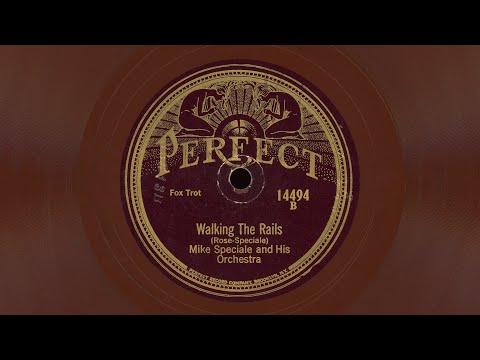
  • “Walking the Rails” – Mike Speciale and his Orchestra (1925)

    “Walking the Rails” – Mike Speciale and his Orchestra (1925)

    An excellent hot dance record by Mike Speciale and his Orchestra, sure to furnish followers of the terpischorean art with sufficient jazz to inject pep and make the dance worthwhile, to paraphrase a reviewer from 1929. Well, viewers, we’ve learned a new word: terpischorean – in homage to the muse Terpsichore, patron of dance – meaning those who enjoy dancing.

    Speciale and his band started their career playing at the Carlton Terrace Hotel at Broadway and 100th Street in New York City, where they assuredly kept the terpischorean population satisfied.

    This tune is one of their hotter numbers – an original composition by Speciale and his pianist, Sam Rose. If any of my learned viewers has an updated personnel list, I’d be most obliged – mine comes from Rust’s American Dance Band Discography.

    Other than that – not much else to do but follow one’s terpischorean impulses and get out there on the dance floor!

    Recorded in New York City on September 11, 1925.
    Released as Perfect 14494 and Pathé Actuelle 36313.

    Credits:
    Mike Speciale – violin, director
    Red Nichols, Earl Oliver (?) – trumpet
    Unknown Artist – trombone
    Jessie Berkman – clarinet, alto sax, soprano sax
    Unknown Artist – tenor sax, bass sax
    Sam Rose – piano
    Lou de Fabbia – banjo
    Tom Speciale – tuba
    Herman Berkin – drums

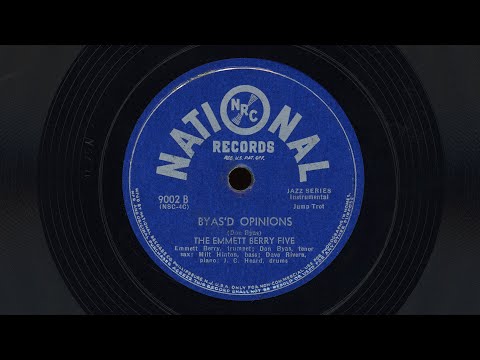
  • “Byas’d Opinions” – The Emmett Berry Five (1944)

    “Byas’d Opinions” – The Emmett Berry Five (1944)

    Some fine swingin’ proto-bop with an excellent title.

    Labeled not as a Jump Blues or a Fox Trot – but as “Jump Trot”!

    After a fun riffy head and brief solos by Rivera and Berry, Don Byas lays out his opinions and tells it like it is.

    0:00 Intro
    0:38 Piano (Rivera)
    0:54 Trumpet (Berry)
    1:08 Tenor Sax (Byas)
    2:09 Outro

    Recorded in New York City on August 31, 1944.
    Released as National 9002.

    Credits:
    Emmett Berry – trumpet
    Don Byas – tenor sax
    Milt Hinton – bass
    Dave Rivera – piano
    J. C. Heard – drums