Jazz Crazy Records

An Archive of Early Jazz on 78 RPM

Author: Professor M

  • “Church Street Sobbin’ Blues” – Plantation Dance Orchestra (1921)

    “Church Street Sobbin’ Blues” – Plantation Dance Orchestra (1921)

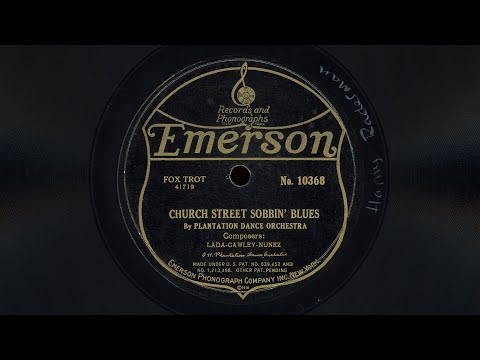
    “Church Street Sobbin’ Blues” was written by Alcide Nuñez, Joe Cawley, and Anton Lada of the Louisiana Five – and was originally recorded by that group in 1919. Here we find Harry Raderman’s Plantation Dance Orchestra performing the tune for Emerson in 1921.

    Very glad to find a clean copy of this one – the sound quality is quite good for an acoustic recording!

    The song was later recorded by Eva Taylor and Clarence Williams in 1923 and again by Clarence Williams Washboard Four in 1927. I wonder if Williams had a copy of Emerson 9179 – which featured the Louisiana Five performing both Church St. Sobbin’ Blues and Yama Yama Blues – both tunes he covered with his washboard band.

    Eddie Lang did a wonderful solo version accompanied by Frank Signorelli in 1928. I’ve been meaning to make a transfer of that one – will have to go dig that one out.

    Recorded in New York City on March 30, 1921. This is take 3.
    Released as Emerson 10368.
    Also released as Regal 952 (as Regal Jazz Syncopators).

    Credits:
    Harry Raderman – director, trombone
    Harry Glantz, Walter Kahn – trumpet
    Pincus Glantz – bass clarinet
    Nathan Glantz – C-melody sax
    Lou Raderman – violin
    Henry Scharf – piano
    Dave Raderman – drums

    Hear the flip side, “Rebecca”, from Lanin’s Roseland Orchestra at:
    https://youtu.be/aRcaeZzEKkA

    Hear the Clarence Williams 1927 version at:
    https://youtu.be/vaAKFcS1kAM
  • “Hot Lips” – Harry Barth’s Mississippi Six (1922)

    “Hot Lips” – Harry Barth’s Mississippi Six (1922)

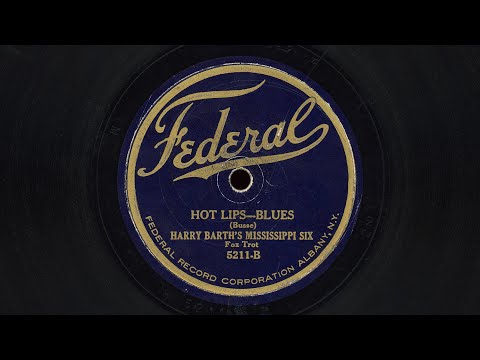
    The B side to “I Love Sweet Angeline” also features some great soprano sax work by Doc Berendsohn throughout. Starting at 1:08 he really gets to spread out between the starts and stops of the syncopated rhythms. At 1:50 he switches to clarinet and keeps the vibe going! A really fun listen.

    Recorded in New York City circa June-July 1922.
    Released as Federal 5211. This is take 2 (mx. 2-1538).

    Credits:
    Harry Barth – director, tuba
    Dave Klein, cornet
    Bernhard ‘Doc’ Berendsohn, clarinet & soprano saxophone
    Harry Raderman, trombone
    Lou Raderman, violin
    Dick Reynolds, piano

    If you enjoyed this one, be sure to watch Colin Hancock’s excellent curated playlist of other tunes by Harry Barth’s Mississippians:
    https://youtu.be/SROAGc_Op8M

    Hear the flip side, “I Love Sweet Angeline” at:
    https://youtu.be/1XKl3yfF-TY

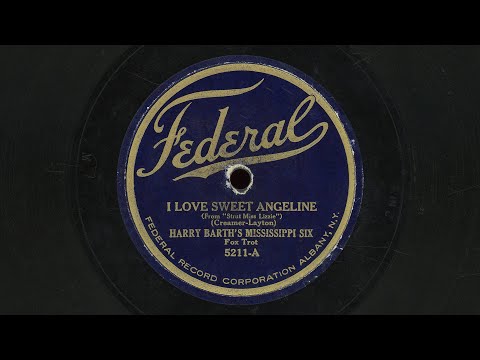
  • “I Love Sweet Angeline” – Harry Barth’s Mississippi Six (1922)

    “I Love Sweet Angeline” – Harry Barth’s Mississippi Six (1922)

    A few weeks ago I was enjoying a video Colin Hancock posted on his excellent channel of Harry Barth records and remembered I had one in the transfer queue that I’d been meaning to get to.

    I couldn’t find a transfer of this one online – and it doesn’t appear in either of Brian Rust’s discographies (Jazz and Ragtime Records or American Dance Band Discography), so I offer it to you, dear viewer, to enjoy.

    The tune, “I Love Sweet Angeline”, penned by the songwriting team of J. Turner Layton and Henry Creamer, appeared in the all-black Broadway production “Strut Miss Lizzie”, which had a nine-week run at the Times Square and Earl Carroll Theaters during the summer of 1922.

    The musical featured the duo’s hit song of 1921 (“Strut Miss Lizzie”), along with several others, including one destined to become a classic: “Way Down Yonder in New Orleans”.

    Here we have another tune from the show, “I Love Sweet Angeline”. Love the sax, clarinet, and piano on this one.

    Quite interesting to see this secondary tune from the show recorded around the same time the production opened. It was also recorded by Ted Lewis for Columbia and Kaplan’s Melodists for Edison in late July 1922.

    Recorded in New York City circa June-July 1922.
    Released as Federal 5211.
    This is take 3 (mx. 3-1542).

    Credits:
    Harry Barth – director, tuba
    Dave Klein, cornet
    Bernhard ‘Doc’ Berendsohn – clarinet, alto saxophone
    Harry Raderman, trombone
    Lou Raderman, violin
    Dick Reynolds, piano

    If you enjoyed this one, be sure to watch Colin Hancock’s excellent curated playlist of Harry Barth’s Mississippians tunes:
    https://youtu.be/SROAGc_Op8M

    Hear a nice piano version of this tune played from the original sheet music:
    https://youtu.be/lyJ0c8qTncM

    Hear the flip side, “Hot Lips” at:
    https://youtu.be/xtsws7-g9iY

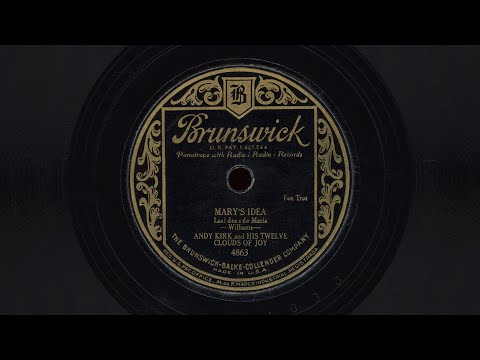
  • “Mary’s Idea” – Andy Kirk and his Twelve Clouds of Joy (1930)

    “Mary’s Idea” – Andy Kirk and his Twelve Clouds of Joy (1930)

    “Mary’s Idea” is an invigorating Mary Lou Williams composition performed by the Kansas City-based Andy Kirk and his Twelve Clouds of Joy. This session finds the band coming off a long series of engagements out East at the Roseland Ballroom. Savoy Ballroom and Apollo Theater. They sound super tight and they fly through this unique proto-swing arrangement like a well-oiled machine.

    Lots of brief beautiful moments of inspired solos throughout – though curiously, the composer herself does not take a piano solo.

    Recorded in Chicago, Illinois on May 1, 1930.
    Released as Brunswick 4863.

    Credits:
    Andy Kirk – director, bass sax, tuba
    Edgar Battle, Harry Lawson – trumpet
    Allen Durham – trombone
    John Harrington – clarinet, alto sax
    John Williams – alto sax, baritone sax
    Lawrence Freeman – tenor sax
    Claude Williams – violin
    Mary Lou Williams – piano, arranger
    William Dirvin – guitar
    Edward McNeil – drums

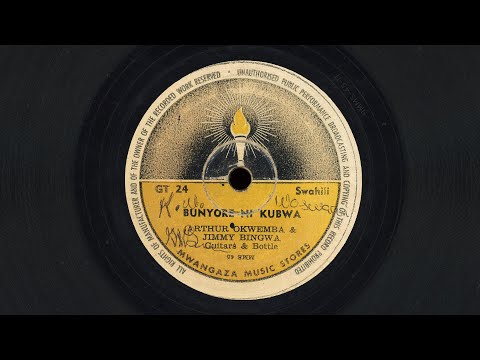
  • “Bunyore Ni Kubwa” – Arthur Okwemba & Jimmy Bingwa

    “Bunyore Ni Kubwa” – Arthur Okwemba & Jimmy Bingwa

    Kenyan musicians Arthur Okwemba and Jimmy Bingwa perform “Bunyore Ni Kubwa”.

    Bunyore is a region in Western Kenya and “kubwa” is a Swahili word meaning “great” or “big”, so the title literally translates to “Bunyore is Great”.

    Two harmonizing vocals accompanied by fingerstyle guitar and glass bottle – a classic combination.

    Mwangaza was an independent Kenyan label launched by David Amunga in 1965. While Western record labels had stopped producing 78 rpm records in the late 1950s in favor of the smaller lighter vinyl 45 rpm format, 78s were still produced in other parts of the world, including Kenya, through the mid-1960s.

    Recorded in Nairobi, Kenya circa 1966.
    Released as Mwangaza Music Stores GT 24 (mx. MMS 45).

    The flip side, “Taabu Za Vijana”, can be heard at:
    https://youtu.be/-m2tw2_00DA

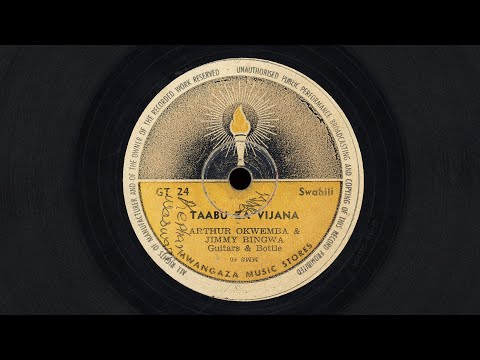
  • “Taabu Za Vijana” – Arthur Okwemba & Jimmy Bingwa (c. 1966) Kenyan Guitar

    “Taabu Za Vijana” – Arthur Okwemba & Jimmy Bingwa (c. 1966) Kenyan Guitar

    Kenyan musicians Arthur Okwemba and Jimmy Bingwa perform “Taabu Za Vijana”, roughly translated as “Troubles of the Youth” or “Problems of the Young People”.

    Two harmonizing vocals accompanied by fingerstyle guitar and glass bottle – a classic combination.

    Mwangaza was an independent Kenyan label launched by David Amunga in 1965. While Western record labels had stopped producing 78 rpm records in the late 1950s in favor of the smaller lighter vinyl 45 rpm format, 78s were still produced in other parts of the world, including Kenya, through the mid-1960s.

    Recorded in Nairobi, Kenya circa 1966.
    Released as Mwangaza Music Stores GT 24 (mx. MMS 46).

    The flip side, “Bunyore Ni Kubwa”, can be heard at:
    https://youtu.be/xpWoE2QEnBg

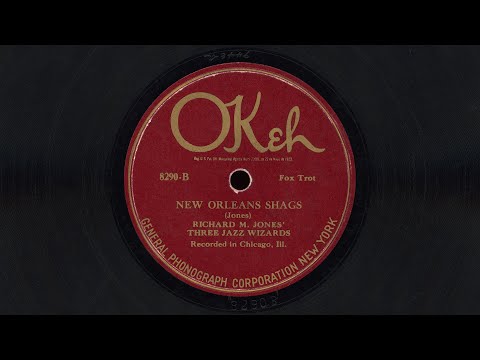
  • “New Orleans Shags” – Richard M. Jones’ Three Jazz Wizards (1925)

    “New Orleans Shags” – Richard M. Jones’ Three Jazz Wizards (1925)

    One of Richard M. Jones’ first group outings under his own name, this early Okeh is a lovely small combo blues number featuring clarinetist Albert Nicholas and banjo player Johnny St. Cyr.

    Recorded in Chicago, Illinois on November 6, 1925.
    Released as Okeh 8290

    Credits:
    Albert Nicholas – clarinet
    Richard M. Jones – piano
    Johnny St. Cyr – banjo

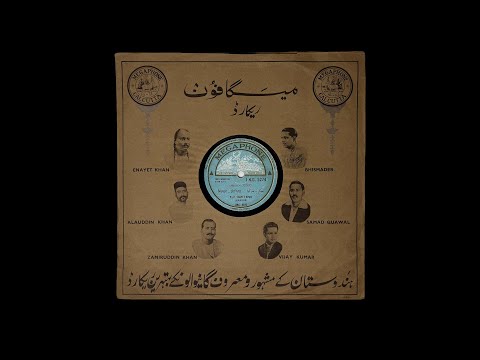
  • “सितार – जोगिया / सितार – भैरवी गत​ ” – Prof. Enayet Khan & Mr. Vilayet Hossain (1938) Indian Sitar

    “सितार – जोगिया / सितार – भैरवी गत​ ” – Prof. Enayet Khan & Mr. Vilayet Hossain (1938) Indian Sitar

    Both sides of a scarce Indian sitar recording of the legendary master, Enayat Khan, and his son, Ustad Vilayat Khan on the Calcutta-based Megaphone label. The original Megaphone sleeve is also featured – one side showing a photo of Ustad Enayat Khan.

    Enayat Khan passed away at age 43 in 1938, so this recording was likely made shortly before his death. Vilayat Khan, on the other hand, was only ten years old at the time of this recording! This pairing shows the passing of the torch from one master to the next.

    Matrix OMC. 8699
    Bhairavi Gat (the queen of morning Ragas)
    Prof. Enayet Khan – sitar

    Matrix OMC. 8698
    Jogiya (a morning Raga based on Bhairavi Thaat)
    Mr. Vilayet Hossain (Son of Prof. Enayet Khan) – sitar

    Released as Megaphone J.N.G. 5274.
    Recorded circa 1938.

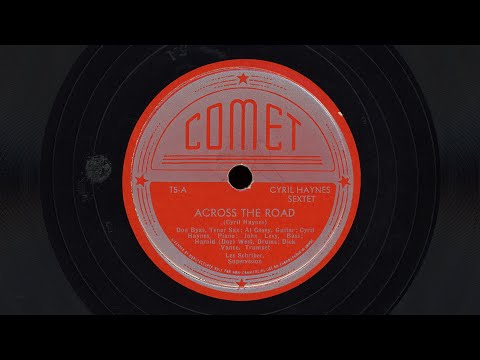
  • “Across the Road” – Cyril Haynes Sextet (1944)

    “Across the Road” – Cyril Haynes Sextet (1944)

    Cyril Haynes was a New York pianist who played with Billy Hicks, Al Cooper’s Savoy Sultans, Sidney and Wilbur De Paris, and Roy Eldridge in the late 30s and early 40s before recording four 12″ sides for Comet under his own name as bandleader.

    This self-penned tune, “Across the Road” has a catchy head and peppy vibe. Haynes gets some time to showcase his piano chops at the 0:34 mark, followed by an extensive 64 bar solo by tenor sax player Don Byas. Byas – who in 1944 head been playing extensively with the bebop crowd – showcases some of his bop-infused credentials without ever losing the swingin’ feel of this tune.

    The extra playing time of a 12″ 78 gives the soloists a chance to spread out – and they take full advantage. Dick Vance takes 32 bars on trumpet, followed by 32 bars of Al Casey on guitar – who was voted best guitarist in Esquire magazine that same year.

    All told, it’s a great record full of unsung heroes who deserve to be heard again. Take a listen and see what you think.

    Though you can hear the typical Comet graininess due to lower quality WWII-era shellac composition, this copy is in good enough shape that after a while you forget about it.

    Recorded in New York City in late 1944.
    Released in July, 1945 as Comet T5.

    Credits:
    Cyril Haynes – director, piano
    Don Byas – tenor sax
    Dick Vance – trumpet
    Al Casey – guitar
    John Levy – bass
    Harold (Doc) West – drums

    Les Schriber – Supervision

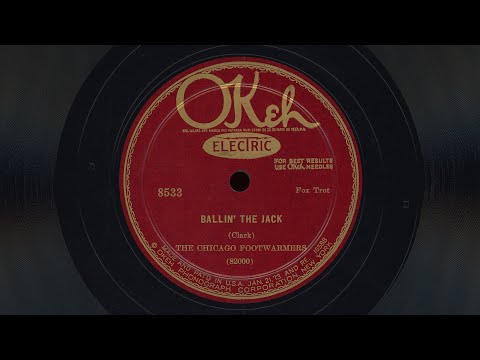
  • “Ballin’ The Jack” – The Chicago Footwarmers f/Johnny Dodds (1927) 🔥🔥🔥

    “Ballin’ The Jack” – The Chicago Footwarmers f/Johnny Dodds (1927) 🔥🔥🔥

    Ain’t no jazz as immediately gratifying as washboard jazz. From the first washboard skritches in the intro, you’ll find your toes tapping and body instinctually responding to the infectious rhythms and melodies.

    “Folks in Georgia’s ’bout to go insane
    Since that new dance down in Georgia came.”

    This hot lil’ instrumental number features great solo and ensemble performances in a small combo setting made up of members who would later become Johnny Dodd’s Washboard Band. Let’s not spoil the fun by talking about it – just listen and enjoy!

    Ballin’ The Jack is an older song – first published in 1913. It was composed by Chris Smith and James Reece Europe, with lyrics by songwriter James Henry Burris. The tune was first recorded by Prince’s Band (for Columbia), National Promenade Band (for Edison) and the Victor Military Band (for Victor) in 1914. I even have an abbreviated version on the Little Wonder label from 1915!

    Oddly, while Europe was credited on the Victor label in 1914 – he was not credited on the Columbia release or in the sheet music published in 1913 by Smith Burris Music Company. Here, the Okeh label misattributes songwriting credits to “Clark” – perhaps a reference to Tin Pan Alley composer Grant Clarke?

    The phrase comes from the railroad industry. The Jack is a locomotive, and ballin’ the jack means running that locomotive at high speed. In the context of this song, Ballin’ the Jack is a new dance – said to be similar to the shimmy. The lyrics give us a clue as to how the dance was done:

    “First you put your two knees close up tight,
    Then you sway ’em to the left,
    Then you sway ’em to the right,
    Step around the floor kind of nice and light,
    Then you twist around
    and twist around with all your might,
    Stretch your lovin’ arms straight out in space,
    Then you do the Eagle Rock with style and grace.
    Swing your foot way ’round then bring it back,
    Now that’s what I call ‘Ballin’ the Jack’.”

    Recorded in Chicago, Illinois on December 3, 1927.
    Released as Okeh 8533.

    Credits:
    Natty Dominique – cornet
    Johnny Dodds – clarinet
    Jimmy Blythe – piano
    Baby Dodds – washboard