Jazz Crazy Records

An Archive of Early Jazz on 78 RPM

Author: Professor M

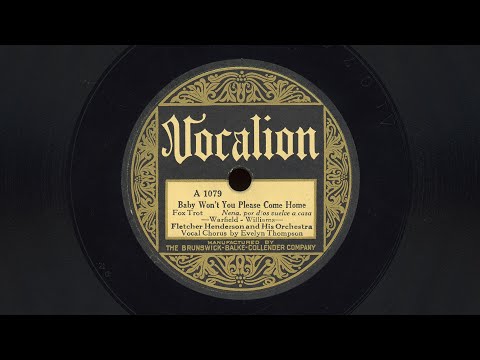
  • “Baby Won’t You Please Come Home” – Fletcher Henderson and his Orchestra f/ Evelyn Preer (1927)

    “Baby Won’t You Please Come Home” – Fletcher Henderson and his Orchestra f/ Evelyn Preer (1927)

    Here’s a scarce Henderson record on the Vocalion 1000 series.

    This session finds the band coming off a three month stint gigging in NYC – primarily at the Roseland Orchestra, playing with the Jean Goldkette band in October 0f 1926 and Jacques Green in November. These shows were apparently broadcast live on NYC radio station WHN – can you imagine!?!

    They also did shows at Small’s Paradise, Savoy Ballroom and on January 5, 1927, played with Cliff Jackson and his Krazy Kats at the short-lived Murray’s Roseland. Again – imagine going to THAT show!

    This record features vocalist Evelyn Preer – a well-known actress who developed her credentials appearing in the trailblazing silent films of black director Oscar Micheaux (who founded his film company in Sioux City, Iowa!).

    Preer does a fine job in an amazing Redman arrangement that features soloist after soloist popping in one after another at a galloping pace. Standouts to my ears are Tommy Ladnier, Hawkins and the excellent but brief trombone solo by Harrison right after the vocals.

    0:00 Intro
    0:38 Clarinet Trio
    0:52 Guitar (Dixon)
    1:05 Trumpet (Joe Smith)
    1:30 Trumpet (Ladnier)
    1:43 Tenor Sax (Hawkins)
    2:00 Vocals (Preer)
    2:28 Trombone (Harrison)
    2:42 Trumpet (Joe Smith)
    2:57 Coda

    They followed this outstanding session for Vocalion in short order with equally excellent sessions for Harmony (Jan. 20), Columbia (Jan. 21), and again for Vocalion (Jan 22) before setting off for Detroit on January 25 for two weeks at the Graystone Ballroom, followed by a short Midwestern tour with stops in Chicago, St. Louis, and Kansas City.

    This should give you a real sense of how busy the band was during this period and the high level of professionalism of its musicians – who could likely play these songs backwards in their sleep!

    Recorded in New York City on January 19, 1927.
    Released as Vocalion 1079.
    While some Vocalion pressings of this tune are known to have alternate takes, this one is the common take (mx. E-4394).

    Credits:
    Fletcher Henderson – director, piano
    Russell Smith, Joe Smith, Tommy Ladnier – trumpet
    Benny Morton, Jimmy Harrison – trombone
    Buster Bailey – clarinet, alto sax
    Don Redman – clarinet, alto sax, arranger
    Coleman Hawkins – clarinet, tenor sax
    Charlie Dixon – banjo, guitar
    June Cole – tuba
    Kaiser Marshall – drums
    Evelyn Preer Thompson – vocals
  • “Jazz A La Carte” – Barney Bigard and his Jazzopaters (1937)

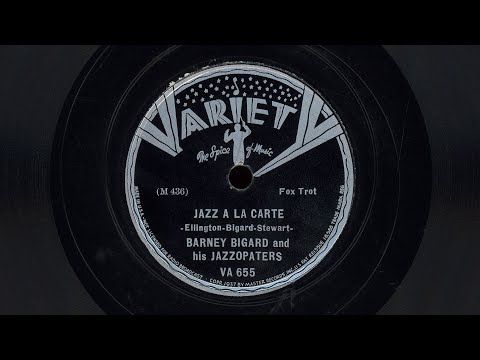
    “Jazz A La Carte” – Barney Bigard and his Jazzopaters (1937)

    A fun blues in Eb by the Duke’s men in small combo form on the excellent Variety label. Clarinetist Barney Bigard leads this session.

    Recorded in New York City on April 29, 1937.
    Released as Variety VA 655.

    Credits:
    Rex Stewart – cornet
    Juan Tizol – valve trombone
    Barney Bigard – clarinet
    Harry Carney – baritone sax
    Duke Ellington – piano
    Billy Taylor – string bass
    Sonny Greer – drums

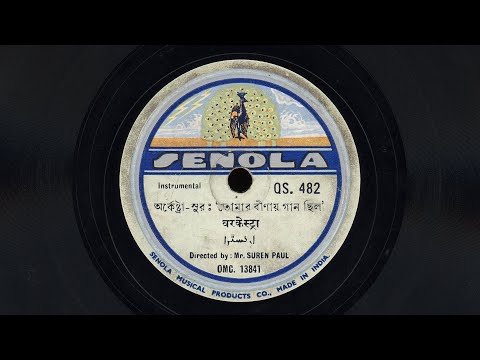
  • “তোমার বীণায় গান ছিল / পিয়া মিলন কো যানা” – Orchestra Directed by Mr. Suren Paul (1930s)

    “তোমার বীণায় গান ছিল / পিয়া মিলন কো যানা” – Orchestra Directed by Mr. Suren Paul (1930s)

    There is an interesting pocket of Indian music on 78 rpm where Indian musicians were integrating Western concepts and instruments such as the violin and piano into traditional Indian ensembles.

    I don’t know anything about Mr. Suren Paul or the orchestra he directs here in the early 1930s – but listening to the music, I feel this music is 40 years ahead of its time.

    It reminds me of a time in Western music where Indian concepts and instruments such as the sitar and tabla were being widely integrated into Western ensembles. Think of a group such as Ralph Towner’s Oregon from the early 1970s. “Music from Another Present Era” could have been Mr. Suren Paul’s grandchild.

    In the late 1930s, Western music and instruments began to be seen as damaging to traditional Indian music. For example, the harmonium began to be seen as an “un-Indian” instrument not suitable for Indian classical music and in 1940 was banned outright from appearing on All India Radio.

    An excellent article on this topic appears at:
    https://www.heritagetimes.in/when-harmonium-was-banned-at-all-india-radio

    I’m wondering if such orchestras also were discouraged from pursuing integrative music with Indian and Western instruments. I need to learn more about this.

    Released as Senola QS 482
    I believe this recording was made in Calcutta, India circa 1933.

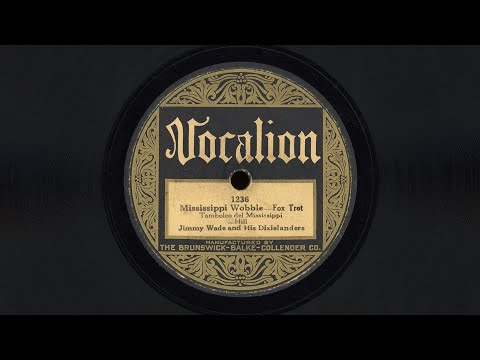
  • “Mississippi Wobble” – Jimmy Wade and His Dixielanders (1928) Test Pressing

    “Mississippi Wobble” – Jimmy Wade and His Dixielanders (1928) Test Pressing

    Here’s one you don’t hear every day – one of only seven Jimmy Wade sides – this one from the Vocalion 1000 series.

    Wade was based in Chicago and orchestras under his name recorded for Paramount in 1923-24 and Gennett in 1927 before closing with two sides for Vocalion in 1928.

    Best of all – this is a test pressing on vinyl which is dead quiet with great fidelity. Not sure if even an original Vocalion pressing would sound this good – and if I ever come across one I’ll let you know!

    The real highlights of this side are Alex Hill’s unique arrangement, Alex Hill on piano at 1:39, and Cliff Jones’ kazoo solo starting at 2:20.

    Recorded in Chicago, Illinois on October 10, 1928.
    Released as Vocalion 1236.
    Test Pressing

    Credits:
    Jimmy Wade – cornet, director
    Punch Miller – cornet
    Charles Lawson – trombone
    Arnett Nelson (?), Unknown Artist – clarinet, alto sax
    Unknown Artist – tenor sax
    Alex Hill – piano, arranger
    Charles Jackson or Stanley Wilson – banjo
    Unknown Artist – tuba
    Cliff Jones – drums, kazoo

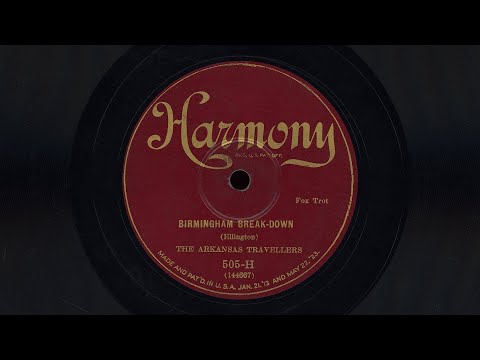
  • “Birmingham Breakdown” – The Arkansas Travelers (1927) f/ Red Nichols and Miff Mole

    “Birmingham Breakdown” – The Arkansas Travelers (1927) f/ Red Nichols and Miff Mole

    From the last Arkansas Travellers session, a real gem from Red and Miff – their take on the Duke Ellington composition, “Birmingham Break-Down”.

    Red and Miff worked together with many similar lineups for various labels alternately called “Red Nichols and his Five Pennies”, “Red and Miff’s Stompers”, “Miff Mole and his Molers”, “The Red Heads”, and “The Charleston Chasers”.

    Harmony was the low-budget label owned by Columbia – along with sister labels Velvet Tone and Diva. The surprising quality of the acoustic recording and the outstanding laminated pressings made this label hold its own against even the big labels of the time who were all recording electrically. One could argue that between the Harmony and Edison labels, acoustic recording techniques had reached the height of its sound quality and audio fidelity.

    Now, let’s break down the Break-Down: Red and Miff share the intro – playing the head melody in unison. Red takes a solo, followed by clarinet, trombone, and piano before the ensemble brings us back home.

    0:00 Intro
    0:40 Trumpet (Red Nichols)
    1:04 Clarinet (Fud Livingston)
    1:26 Trombone (Miff Mole)
    1:39 Piano (Rube Bloom)
    2:02 Ensemble
    2:26 Outro

    Recorded in New York City on September 14, 1927.
    Released as Harmony 505-H

    Credits:
    Red Nichols – trumpet
    Miff Mole – trombone
    Fud Livingston – clarinet
    Fred Morrow – alto sax
    Rube Bloom – piano
    Vic Berton – drums

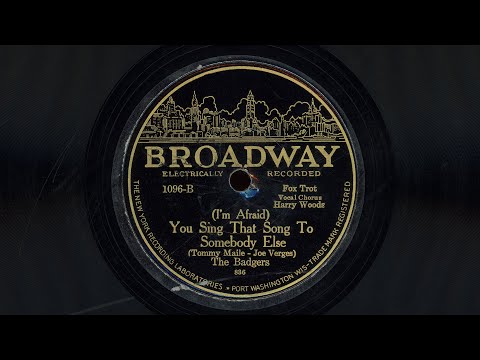
  • “(I’m Afraid) You Sing That Song To Somebody Else” – Harry Reser and his Orchestra (1927)

    “(I’m Afraid) You Sing That Song To Somebody Else” – Harry Reser and his Orchestra (1927)

    Gosh, you know this is the first Harry Reser record I’ve posted on the channel.

    With Reser, you know you’re going to get some energetic banjo playing, and at 1:13 we get the first hot banjo break – and at 1:51 we get a solo. At 2:08 a lively trumpet solo breaks through and gives us a moment of what Brian Rust would call “jazz interest”.

    Not sure if that is Tommy Gott or Hymie Farberman or Bob Effros on trumpet, but those eight bars really give this record a big lift.

    Recorded in New York City on August 3, 1927.
    Released as Broadway 1096.

    Credits:
    Harry Reser – banjo, director
    Red Nichols (?) – cornet
    Tommy Gott, Hymie Farberman or Bob Effros (?) – trumpet
    Sam Lewis – trombone
    Larry Abbott – clarinet, alto sax
    Bill Wirges – piano
    Jimmy Johnston – bass sax
    Tom Stacks – drums, vocals (as “Harry Wood”)

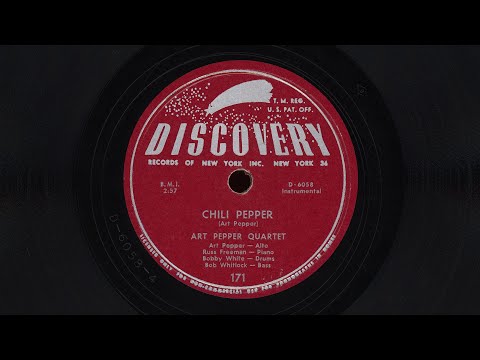
  • “Chili Pepper” – Art Pepper Quartet (1953) 🌶️🌶️🌶️

    “Chili Pepper” – Art Pepper Quartet (1953) 🌶️🌶️🌶️

    After a successful initial session with Discovery in 1952, the Art Pepper Quartet was called back in to record four more tunes, with plans to release as 78 rpm singles and a 10″ LP.

    On this original composition, Pepper comes in hot and is deftly accompanied by pianist Russ Freeman who dances eloquently around his lines. Hard to believe the amazing fidelity of this 1953 78 rpm disc! Really impressed by the sound stage of this mono disc and the warm liveliness of the recording.

    Recorded at Radio Recorders in Los Angeles, California on March 29, 1953.
    Released as Discovery 171.
    Also appears on the 1953 10″ self-titled LP (Discovery DL 3019) and the 1957 LP release Surf Ride (Savoy MG 12089).

    Credits:
    Art Pepper – alto sax
    Russ Freeman – piano
    Bob Whitlock – bass
    Bobby White – drums

    Some great info on the history of the Discovery label and Pepper’s sessions for Discovery at:
    https://jazzresearch.com/art-pepper-the-discovery-sessions/

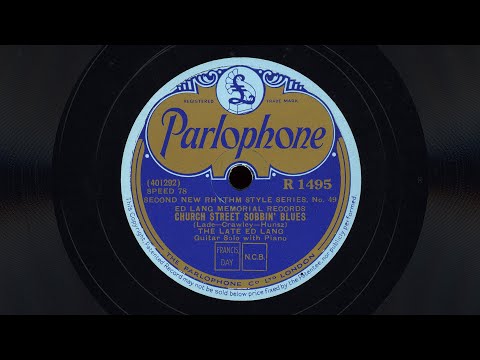
  • “Church Street Sobbin’ Blues” – Eddie Lang (1928)

    “Church Street Sobbin’ Blues” – Eddie Lang (1928)

    A Louisiana Five tune originally published and recorded in 1919, “Church Street Sobbin’ Blues” was recorded twice by Clarence Williams before this 1928 recording by jazz guitar godfather Eddie Lang.

    If you think you’re hearing bells and chimes throughout this song – you are. That’s Okeh studio regular Justin Ring. The first time I listened I was using headphones and thought that someone was ringing my doorbell.

    Lang here is charmingly languid – taking a relaxed swing at the tune that is both bluesy and folksy.

    Recorded in New York City, November 5, 1928.
    Released in the U.K. as Parlophone R-1495.
    Originally released as Okeh 8633 (As “Blind Willie Dunn”).

    Credits:
    Eddie Lang – guitar
    Frank Signorelli – piano
    Justin Ring – chimes

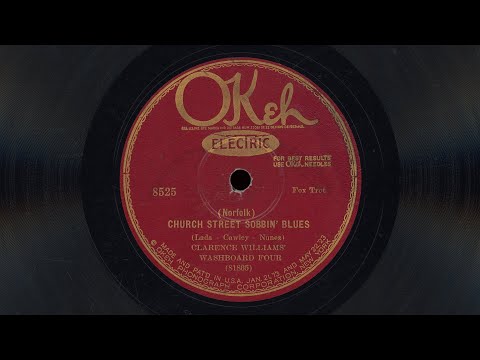
  • “(Norfolk) Church Street Sobbin’ Blues” – Clarence Williams’ Washboard Four (1927)

    “(Norfolk) Church Street Sobbin’ Blues” – Clarence Williams’ Washboard Four (1927)

    Here’s the Clarence Williams version of “Church Street Sobbin’ Blues” – a real toe tapper with some inspired solos by Ed Allen and Buster Bailey accompanied by Mr. Williams on piano and the no-nonsense rhythm section of Floyd Casey’s washboard.

    I have no notes on the performance other than I love it.

    The flip side of this one, “Yama Yama Blues”, matches exactly to the same pairing on an early 9″ Emerson record by the Louisiana Five (Emerson 9179). My perhaps unprovable theory is that Williams must have had (and quite liked?) this record himself. Not only did he record “Church Street Sobbin’ Blues” with his wife, Eva Taylor, in 1923 – but he recorded it again here – over eight years after these songs were first popular – paired with the exact same flip side as the Louisiana Five.

    These two songs were not popular jazz or dance standards of their day – outside of the 1919 recordings of Louisiana Five, Jockers Dance Orchestra, and the Plantation Dance Orchestra – and the later 1928 version by Eddie Lang (coming soon) – no other jazz or dance band seems to have performed either of these two songs – much less performed both together on the same record.

    Mr. Williams was at this time the A&R man at Okeh Records who supervised the 8000 series. The choice of these two particular songs would have come directly from him, I should think. What do you think of my theory?

    In the meantime, of course, it has ignited a strong desire to find that Louisiana Five record!

    Recorded in New York City on November 25, 1927.
    Released as Okeh 8525.

    Credits:
    Ed Allen – cornet
    Buster Bailey – clarinet, alto sax
    Clarence Williams – piano
    Floyd Casey – washboard

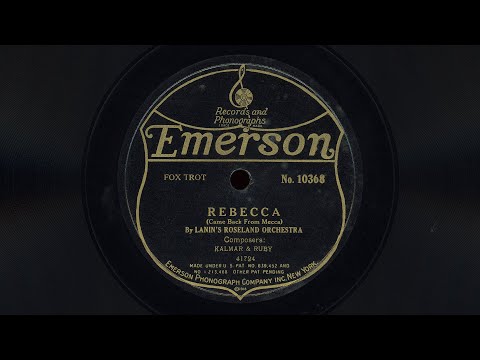
  • “Rebecca (Came Back From Mecca)” – Lanin’s Roseland Orchestra (1921)

    “Rebecca (Came Back From Mecca)” – Lanin’s Roseland Orchestra (1921)

    By request: The flip side of “Church Street Sobbin’ Blues” by Harry Raderman’s Plantation Orchestra: An early recording of Sam Lanin’s Roseland Orchestra performing “Rebecca (Came Back From Mecca)”.

    Recorded in New York City in April, 1921. This is take 3.
    Released as Emerson 10368.

    Credits:
    Sam Lanin – director, drums
    Hymie Farberman (?), Benny Bloom – trumpet
    Unknown Artists – trombone, alto sax, tenor sax, violin, piano, banjo, tuba

    Hear the flip side, “Church Street Sobbin’ Blues” by the Plantation Dance Orchestra at:
    https://youtu.be/2A40qFtNrmo