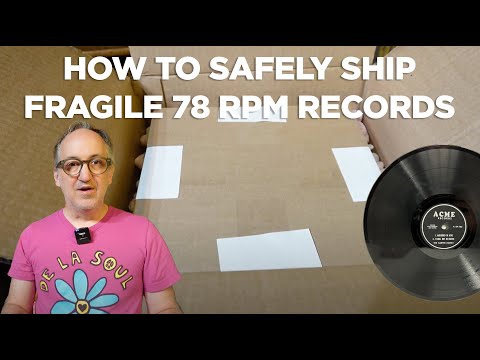
A short video showing the most widely accepted method of packing 78 rpm records for shipment. This method is nearly 100% guaranteed to result in a safe shipment of a fragile 78 rpm record. If you are a seller and are wondering how to ship 78 rpm records: PLEASE use this method! ^_^
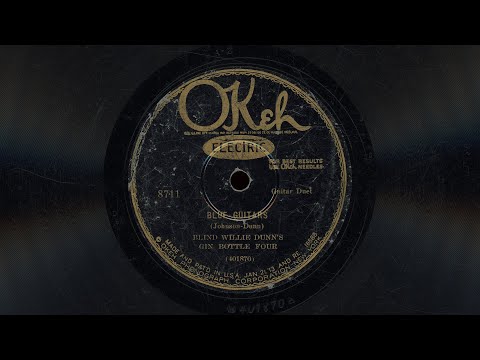
Two of my favorite guitarists playing together: Eddie Lang and Lonnie Johnson.
This Okeh has certainly seen better days – probably a V grade at best if you were grading visually. But those Okeh A stampers sure have some life left in ’em! I think it turned out right fine.
Recorded in New York City on May 8, 1929. Released as Okeh 8711.
Two of my favorite guitarists playing together: Eddie Lang and Lonnie Johnson.
This Okeh has certainly seen better days – probably a V grade at best if you were grading visually. But those Okeh A stampers sure have some life left in ’em! I think it turned out right fine.
Recorded in New York City on May 7, 1929. Released as Okeh 8711.
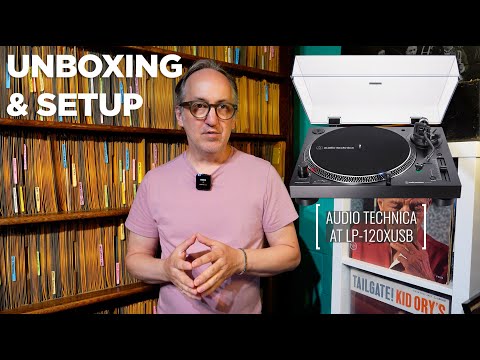
The Audio Technica AT-LP120XUSB turntable is one of the most widely recommended turntables to buy if you are interested in playing 78 rpm records on a modern setup.
Recently I helped a friend of mine overseas obtain one – and had it in the jazz bunker for a few days to test and play with. I decided to make a video to help him set it up correctly – and share it with you in case you’re thinking of buying an AT-LP120 and needed some help.
In this video, I unbox an AT-LP120XUSB turntable, go over how to set it up correctly, and how to hook it up to your computer via a USB cable to make digital copies of your 78 rpm records using the free software Audacity.
In part two of the video, I will demonstrate the digital transfer process and share samples made from a few different 78 rpm records using different sized stylii and different output methods.
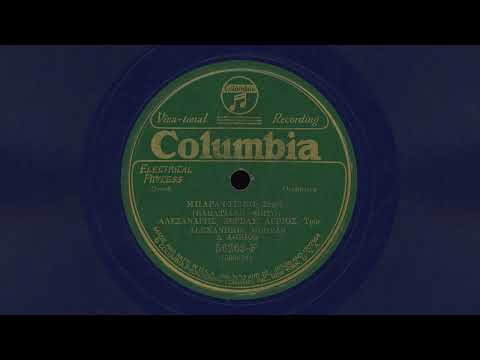
By request – another 12″ Greek disc from the collection. These beautiful royal blue laminated Columbia records were pressed in the middle of the Great Depression starting in late 1932 and continuing until 1935. The laminated shellac generally sounds excellent – even when slightly worn, like this one.
This release, by a group of three musicians called the Mouskas Trio recording in 1928 in New York City. The group recorded six sides that day – and does not appear to have recorded again. The longer playing surface of these 12″ discs means the two sides together deliver nearly nine minutes of recorded music.
Side A, “In Salona”, is a Τσάμικο (Tsamiko). The tsamiko Sta Salona is quite well known and especially popular in the early 20th century, there being dozens of recordings from both Greece and USA, both instrumental and sung. Salona is a village near Mt Parnassos in central Greece (Sterea Ellas or Roumeli) now called Amfissa as it was in ancient times. Salona was its medieval name up to and during the Greek War of Independence. The tune is also known as “Sta Salona Sfazun Arnia, Maria Pentayiotissa” (In Salona they are slaughtering lambs, Maria Pentayiotissa).*
Side B, “Baraïtiano”, is a Συρτό (Syrto). Baraitiano is also a well known tune but usually called Beratiano Μπερατιανό or Berati Μπεράτι The tune is also called Himariotiko Χειμαριώτικο, from the Greek inhabited town of Himara in southern Albania. The tune has traveled such that in the Peloponnese it is often called Peratiano and on the island of Kalymnos it is known as Thimariotiko Θυμαριώτικο where it is a specific dance for males.*
Recorded in New York City on Oct 16, 1928. Released as Columbia 56263-F. Originally released as Okeh 82521.
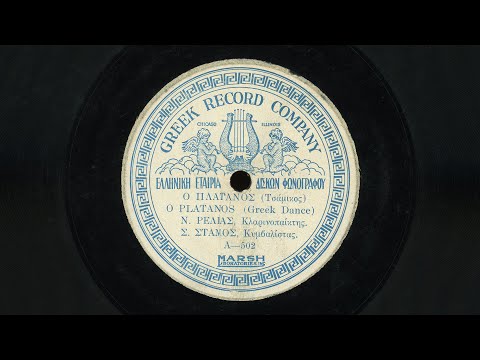
By request from a Discogs user: an early record on the Greek Record Company label recorded at Marsh Laboratories in Chicago, Illinois. Both sides of this 12″ disc are included in this video.
502 A – Ο Πλάτανος (The Plane Tree) 502 B – Μπαρμπουνάρα (Little Red Mullet)
Nikos Rellias was born in Goura, Corinth in 1892 and was a shepherd there until he emigrated to the U.S. in 1906, where he studied clarinet in New York City starting in 1909. He also performed with Marika Papagika and Kostas Papagikas around this same time.
Marsh Laboratories was founded by Orlando Marsh in Chicago in 1922. Marsh was a pioneer in electrical recordings with microphones – and a few years ahead of the big labels who were all recording acoustically (through an acoustic horn).
Recorded in Chicago circa 1923. Released as Greek Record Company 502
The Πλάτανος (Plane Tree – or as it is commonly known in the U.S., a Sycamore tree) refers to a type of long-lived revered tree that often stands at the center of a village square in Greece. They can symbolize community, wisdom, and longevity. They could also have spiritual importance in Greek mythology and ancient Greek religious practices.
“Μπαρμπουνάρα μου” (my little red mullet) is a playful, affectionate nickname. In Greek slang of the time, it could imply someone flashy, desirable, or stylish—like the prized red mullet fish. It might also carry a flirtatious or teasing tone, especially in a rebetiko or cabaret-style song such as this one. Μπαρμπουνάρα lyrics:
Εγώ με όλους παίζω κόρτε και γελούν κι έτσι περνάω τον ωραίο μου καιρό με μια ματιά μου μένουν όλοι σαν χαζοί ξοδεύουν χρήμα για ένα μόνο μου φιλί
Αχ, μπαρμπουνάρα μου, νέοι, γέροι ψιθυρίζουν τα μαύρα μάτια σου την καρδιά ραΐζουν
Έχω μανία να ανεβαίνω στα auto μα η τρέλα μου είναι το τιμόνι να κρατώ έτσι μ’ αρέσει να γλεντάω τη ζωή δεν δίνω δυάρα ο κοσμάκης τι θα ειπεί
Αχ, μπαρμπουνάρα μου, νέοι, γέροι ψιθυρίζουν τα μαύρα μάτια σου την καρδιά ραΐζουν
English Translation:
I flirt with everyone and they all laugh. That’s how I spend my lovely time. With just one glance, they all look like fools. they spend money for a single kiss of mine.
Ah, my little red mullet, young and old whisper. Your dark eyes shatter hearts.
I’ve got a craze for riding in cars, But my real thrill is holding the wheel. that’s how I like to party through life. I don’t give a damn what people say.
Ah, my little red mullet, young and old whisper. Your dark eyes shatter hearts.
NOTE: AI was used for translation. If you have suggestions to improve the translation, please let me know.
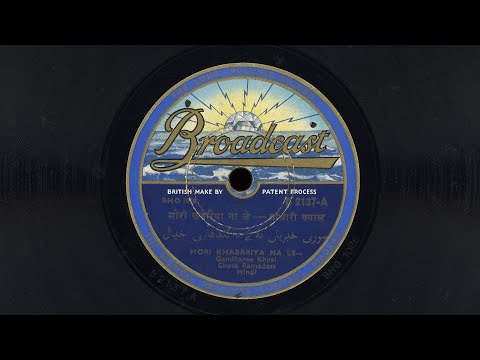
A – मोरी खेदरिया ना ले = Mori Khabariya Na Le = “Don’t Take My Sorrows Away” गांधारी ख्याल = Gandharee Khyal
B – मग में श्याम छुओ ना = Mag Me Sham Chhhuo Na = “Don’t touch me, Shyam, as I walk along the path.” राग सोहिनी = Raga Sohini
The artist, Chhota Ram Das, can be seen on the sleeve shown in the upper left quadrant of Side A.
This is the only record on the Broadcast label I have in my collection. It is from the collection of renowned Indian music archivist and friend Suresh Chandvankar.
Released as Broadcast B 2137
Credits: Chota Ramadass – vocals Unknown Artists – harmonium and tabla
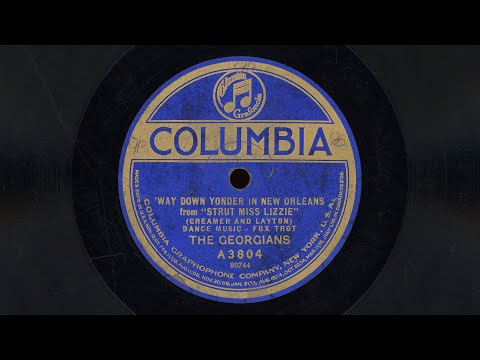
Continuing the Georgians marathon, this one is from their second recording session, where they added Joe Tarto and Frank Smith. All the players in the Georgians’ lineup also played together in the Paul Specht orchestra.
This lively recording of the Creamer and Layton tune “‘Way Down Yonder in New Orleans”, which had just finished its first run of over 80 performances at the Times Square Theatre (late June – late August) staged by Henry Creamer himself.
The black songwriting team subtitled the tune “A Southern Song, without A Mammy, A Mule, Or A Moon” as a critique of the common (and often racist) tropes of nostalgic songs about Southern life. These types of songs were popular during this era – and it is nice to see this subtle rejection of the mythology.
While this version is an early recording of the song – it is not even close to being the first recording. That honor appears to belong to Nathan Glantz, who recorded the tune for Pathé Actuelle in July/August of 1922. It was recorded by others in the ensuing months, including Peerless Quartet (August 14, 1922), the Dixie Daisies (October 1922), Bailey’s Lucky Seven (December 8, 1922), and Sam Lanin (early December 1922).
New York, December 21, 1922 Released as Columbia A3804.
Credits: Frank Guarente – trumpet, director Ray Stilwell – trombone Johnny O’Donnell – clarinet, bass clarinet, alto sax Harold Saliers – clarinet, alto sax, tenor sax Frank Smith – clarinet, soprano sax Joe Tarto – tuba Arthur Schutt – piano Russell Deppe – banjo Chauncey Morehouse – drums
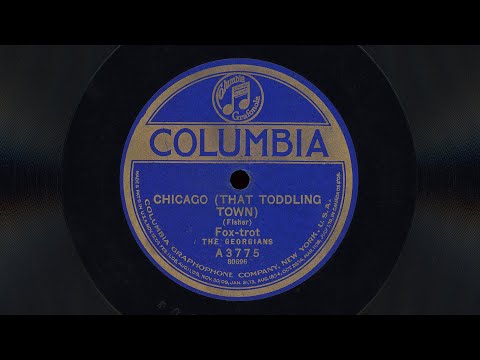
From the very first recording session as The Georgians, led by trumpeter Frank Guarente, we present “Chicago (That Toddling Town)”.
Recorded in New York City on November 29, 1922. Released as Columbia A3775.
Credits: Frank Guarente – trumpet, director Ray Stilwell – trombone Johnny O’Donnell – clarinet, bass clarinet, alto sax Harold Saliers – clarinet, alto sax, tenor sax Arthur Schutt – piano Russell Deppe – banjo Chauncey Morehouse – drums