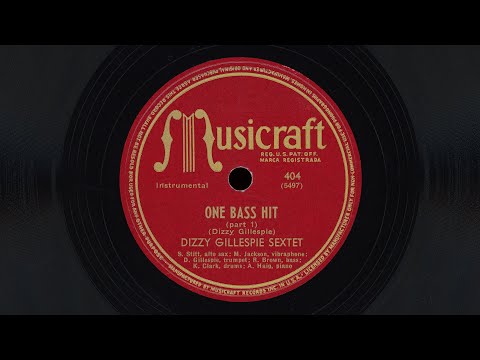
From the heady early days of bebop – here’s “One Bass Hit” from the Dizzy Gillespie Sextet featuring Sonny Stitt, Milt Jackson, and Klook on drums. But perhaps the real star of the number is bassist Ray Brown, who keeps things moving and grooving throughout.
We start out on a real understated groove led by Brown and Klook, punctuated by insistent horns. At 1:08 Dizzy takes us skyward. Jackson cools things down at 1:40 and Sonny Stitt follows at 1:53.
Recorded in New York City on May 15, 1946 Released as Musicraft 404.
Credits: Dizzy Gillespie – trumpet Sonny Stitt – alto sax Milt Jackson – vibes Al Haig – piano Ray Brown – bass Kenny Clarke – drums
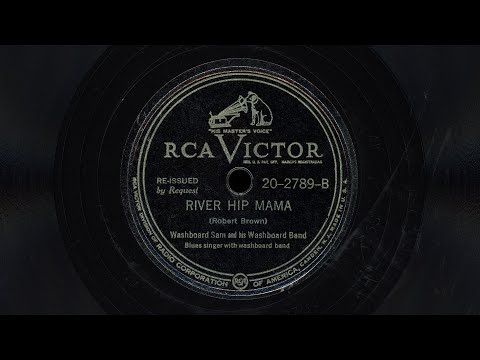
Here’s a fun Washboard Sam tune to take us into the weekend – and one that sounds ahead of its time in many ways.
“Men’s all crazy ’bout her She make them whine and cry She’s a river hip mama and they all wanna be baptized”.
Born as Robert Clifford Brown, Washboard Sam began performing in Memphis in the 1920s, before moving to Chicago in the 1930s, where he made many popular recordings. This session took place just a few months before the musician’s strike that began in August of 1942 and lasted over two years.
Recorded in Chicago, Illinois on February 10, 1942. Released as RCA Victor 20-2789 (“Re-Issued By Request”) Originally released as Bluebird B-9039.
Credits: Washboard Sam – washboard, vocals Big Bill Broonzy – guitar Roosevelt Sykes – piano Frank Owens – alto sax
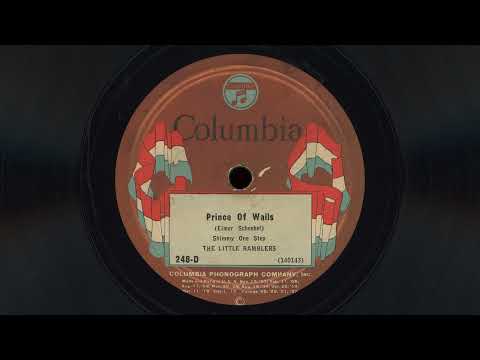
While working on the transfer of this Little Ramblers record, I noticed that it was recorded exactly 100 years ago today!
The Little Ramblers was a small combo made up of members of the California Ramblers. This “band within a band” was one of many that the Ramblers and manager Ed Kirkleby cooked up to record more records for more labels without breaking any contract agreements. The Little Ramblers, the Vagabonds, the Goofus Five, the Five Birmingham Babies and the Kentucky Blowers In the last six months of 1924 collectively made more records in total than the California Ramblers did!
The offshoot bands often played hotter and were jazzier. On this Elmer Schoebel tune, the gang lets loose with “wailing” solos – getting progressively more heated until the frantic ensemble-driven climax.
Recorded in New York City on November 14, 1924. Released as Columbia 248-D.
Credits: Bill Moore – trumpet Bobby Davis – clarinet, soprano sax, alto sax Adrian Rollini – bass sax Irving Brodsky – piano Tommy Felline – banjo Stan King – drums, kazoo
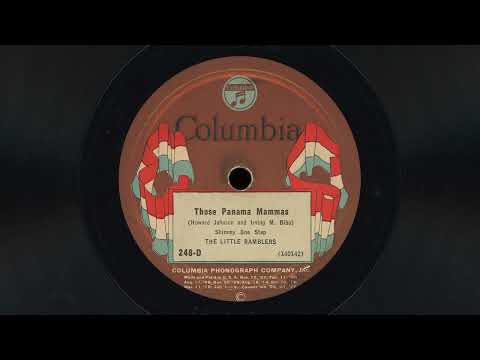
While working on the transfer of this Little Ramblers record, I noticed that it was recorded exactly 100 years ago today!
The Little Ramblers was a small combo made up of members of the California Ramblers. This “band within a band” was one of many that the Ramblers and manager Ed Kirkleby cooked up to record more records for more labels without breaking any contract agreements. The Little Ramblers, the Vagabonds, the Goofus Five, the Five Birmingham Babies and the Kentucky Blowers In the last six months of 1924 collectively made more records in total than the California Ramblers did!
The offshoot bands often played hotter and were jazzier. Of this recording, Ate Van Delden writes (in his biography of Adrian Rollini): “It shows that the group had fully mastered playing at breakneck speed and all the soloists had developed into jazz men.”
Recorded in New York City on November 14, 1924. Released as Columbia 248-D.
Credits: Bill Moore – trumpet Bobby Davis – clarinet, soprano sax, alto sax Adrian Rollini – bass sax Irving Brodsky – piano Tommy Felline – banjo Stan King – drums, kazoo
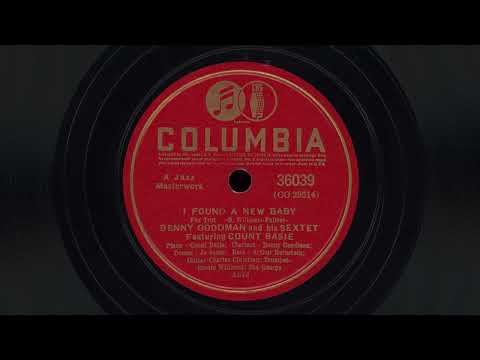
Here’s a fun challenge if you’re new to collecting 78s: Try to collect all the Benny Goodman records that feature Charlie Christian guitar solos. Goodman was so popular in the early 1940s, most of these records are not too hard to track down – and they are all outstanding!
This old standard also happens to be a tune I’m working on with my guitar instructor – so I am enjoying learning Charlie Christian’s solo.
This recording also features some other standout players: including Count Basie on piano and the great Cootie Williams (who had just left the Duke Ellington band a few months before) on trumpet.
Recorded in New York City on January 15, 1941. Released as Columbia 36039
Credits: Count Basie – piano Benny Goodman – clarinet Cootie Williams – trumpet George Auld – tenor sax Charlie Christian – guitar Arthur Bernstein – bass Jo Jones – drums
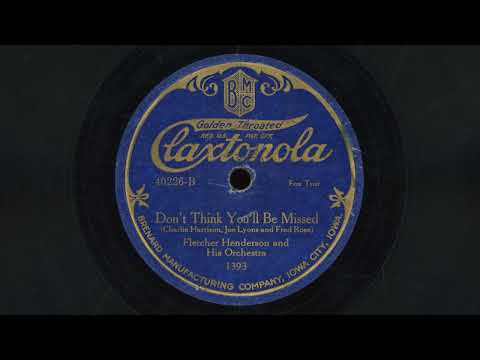
In March-April of 1923, Fletcher Henderson recorded his last session with the Black Swan label, which had given him his start as a recording artist in 1921. He began a short period in 1923 of recordings for the Paramount label, which were usually also pressed on the Puritan, Famous, and Claxtonola labels.
As a Iowan, the Claxtonola label has always been special to me because of its connection between early jazz and the state I call home. As valued as Paramount records are – I’d sooner have it on Clax.
This record has some great Don Redman playing both on alto sax and clarinet.
Recorded in New York City on May 1-2 ,1923. Released as Claxtonola 40226. Originally released as Paramount 20226.
Credits: Fletcher Henderson – piano, arranger, director Russell Smith, Elmer Chambers – trumpet George Brashear – trombone Don Redman – clarinet, alto sax Unknown artist – tenor sax Charlie Dixon – banjo
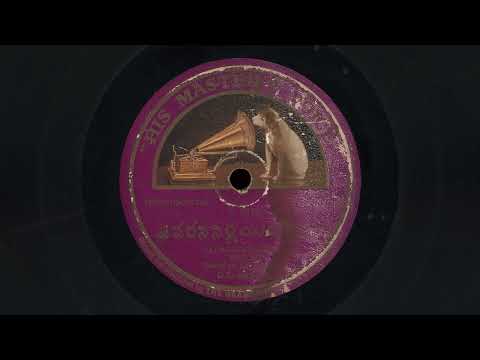
This is the other side of the Nagaraja Rao record of Carnatic flute I posted earlier today.
The title (if I have it correctly) ఎవరనినిర్ణయింఛదూ translates to “Who Can Decide?” or “Who Can Judge?”
This side features the Nadachintamani rāgam – which is said to be similar to the Hungarian minor scale in Western music.
Recorded in Bangalore, India, c. September 1912 by engineer Max Hampe. Originally released as Gramophone Concert Record G.C.-8-18916 (Matrix H 11268 R) Reissued as His Master’s Voice P. 2312 in the 1920s.
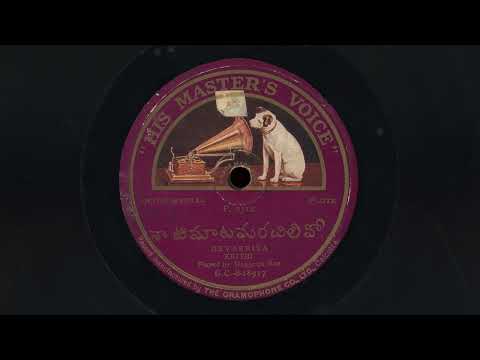
Let’s all take a breath together. Tomorrow is election day in the U.S. and this soothing and melodious Devakriya raag recorded over a century ago seems just the right music to center ourselves after a long and divisive year in American politics.
The flute of Nagaraja Rao is played beautifully – evoking serenity – in this Krithi composition of the Carnatic musical tradition of Southern India. It is not know which section of the Krithi we are hearing.
The title (if I have it correctly) నాటిమాటమరచిలివో translates to “Forget the Words of the Past” or “Let Go of Past Words.”
The Devakriya raag is also known as Shuddha Saveri, comprised of five notes (swaras). It is curious to Western ears (and particularly to jazz ears) as there is no minor or major third or minor or major seventh in the scale – only a second, a fourth, a fifth, and a sixth – so it has a kind of suspended 4th or sixth chord sound. As a guitarist who is learning jazz, the 3rd and the 7th are everything in jazz harmony. A scale that omits these notes is introduces a kind of harmonic uncertainty that is refreshing to hear as your ears adapt to its tonal language.
Recorded in Bangalore, India, c. September 1912 by engineer Max Hampe. Originally released as Gramophone Concert Record G.C.-8-18917 (Matrix H 11268 R) Reissued as His Master’s Voice P. 2312 in the 1920s.
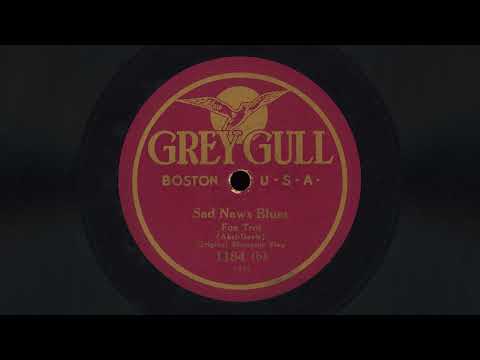
“Bad News Blues” was a tune published in 1923 composed by Harry Akst with lyrics by Benny Davis. It was recorded by Original Memphis Five (as Ladd’s Black Aces) in June of 1923 for Gennett, and also that same month for Pathé / Perfect (as “Sad News Blues”).
It is not clear why the song title was changed – but when they recorded it a third time, in September of 1923 for Plaza Music Company (who then likely licensed the master to Grey Gull), it was also released as “Sad News Blues”.
In any case, it’s a real treat – neither sad nor bad at all! Thankfully, even on dime store shellac, the sound quality is quite good.
Recorded in New York City on September 6, 1923. Released as Grey Gull 1184.
Credits Phil Napoleon – trumpet Miff Mole – trombone Jimmy Lytell – clarinet Frank Signorelli – piano Jack Roth – drums
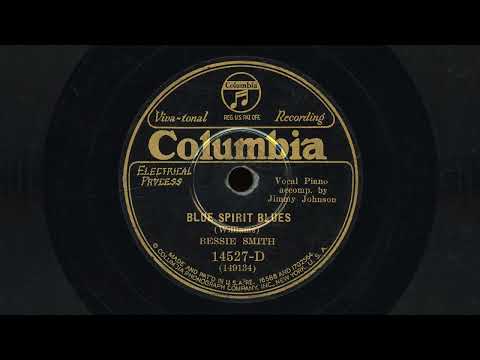
Because today is Dia De Los Muertos (Day of the Dead), I’m sharing a record with an appropriate theme: the amazing “Blue Spirit Blues” by Bessie Smith with piano accompaniment by James P. Johnson.
A real slow burn, Bessie paints a scene worthy of Dante’s Inferno:
“Had a dream last night that I was dead Evil spirits all around my bed The devil came and grabbed my hand Took me way down to that red hot land Mean blue spirits stuck their forks in me Made me moan and groan in misery Fairies and dragons spitting out blue flame Showin’ their teeth – for they was glad I came Demons with their eyelash dripping blood Draggin’ sinners through that brimstone flood This is hell I cried, cried with all my might Oh my soul, I can’t bear the sight Start runnin’ ’cause it is my cup Run so fast ’til someone woke me up.”
These later electrical recordings of Bessie Smith really sound fantastic! Her commanding voice just projects right out of the speaker through the years and confronts you with its real presence!
Recorded in New York City on October 11, 1929. Released as Columbia 14527-D.
Credits: Bessie Smith – vocals James P. Johnson – piano