Jazz Crazy Records

An Archive of Early Jazz on 78 RPM

Author: Professor M

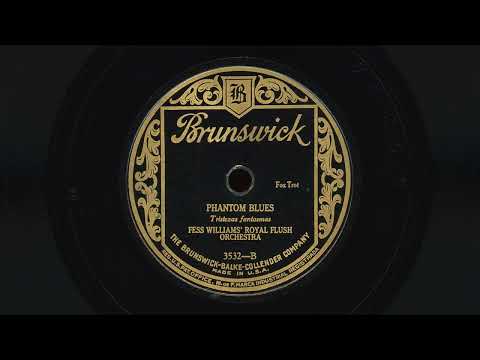
  • “Phantom Blues” – Fess Williams’ Royal Flush Orchestra (1927)

    “Phantom Blues” – Fess Williams’ Royal Flush Orchestra (1927)

    Today on Halloween, we have Fess Williams’s Royal Flush Orchestra performing the excellent “Phantom Blues”.

    Williams himself arranged this composition by Al Handler and Len Riley – and it is full of great playing. If this is what phantoms are listening to, well, maybe we have some fun to look forward to in the afterlife!

    The Royal Flush Orchestra had opened at the Savoy Ballroom in Harlem a year earlier and was the veritable house band there until 1928.

    Williams himself was originally from Kentucky – and studied at the Tuskegee Institute in Cincinnati. He moved to New York in 1924 and formed the Royal Flush Orchestra a year later.

    His birth name was Stanley Rudolph Williams, but when he taught students in Winchester, OH, after he graduated from Tuskegee, his pupils called him “Fess” – short for Professor.

    Recorded in New York City on March 28, 1927.
    Released as Brunswick 3532.

    Credits:
    Fess Williams – clarinet, alto sax, director, arranger
    George Temple, Kenneth Roane – trumpet
    David “Jelly” James – trombone
    Otto Mikell – alto sax
    Perry Smith – clarinet, tenor sax
    Henry Duncan – piano
    Ollie Blackwell – banjo
    Clinton Walker – baritone brass
    Ralph Bedell – drums
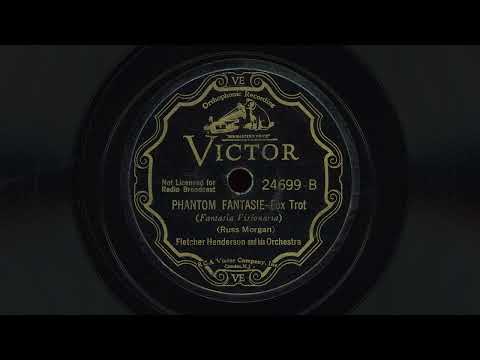
  • “Phantom Fantasie” – Fletcher Henderson and his Orchestra (1934)

    “Phantom Fantasie” – Fletcher Henderson and his Orchestra (1934)

    During the winter of 1933, Fletcher Henderson was negotiating via John Hammond with British bandleader Jack Hylton to bring his orchestra to London for a series of engagements there and in Europe. Plans were made for Hylton to hear the band at the Roseland – but he didn’t show up. A new date was set and he arrived two hours late – but left promising to make arrangements to bring the whole outfit to Europe. Henderson’s band had been through some lean depression years, so this was a big morale booster.

    Unfortunately, Hylton never made good on his promise. He did, however, negotiate a personal contract with Coleman Hawkins – and this Victor session was his last with the band – after eleven years with Henderson. Hawkins sailed for Europe right after this recording session, where he stayed for five years.

    This European let-down – coupled with accusations of non-payment by band members – gradually led to the breakup of the band. By November of 1934, all but three had quit the Henderson band to play with Benny Carter’s orchestra. He didn’t record another session until March of 1936.

    This Victor session included some of my favorite late-period Henderson works: This tune, Hocus Pocus, Harlem Madness, and Tidal Wave. “Phantom Fantasie” is a quasi-symphonic composition by Russ Morgan played with a chill groove by the Henderson band.

    In it, we are serenaded by a piano solo from Mr. Henderson himself, as well as a tenor solo from the Hawk. Two takes were recorded – the first was unissued, though it is said to exist as a test pressing.

    Recorded in New York City on March 6, 1934.
    Released as Victor 24699.

    Fletcher Henderson – piano, director
    Russell Smith, Joe Thomas, Henry Allen – trumpet
    Claude Jones, Keg Johnson – trombone
    Buster Bailey – clarinet
    Russell Procope, Hilton Jefferson – clarinet, alto sax
    Coleman Hawkins – tenor sax
    Bernard Addison – guitar
    John Kirby – string bass
    Vic Engle – drums
    Russ Morgan – arranger

    Sources:
    Hendersonia, Walter C. Allen
    Jazz and Ragtime Records, Brian Rust, 6th Ed.

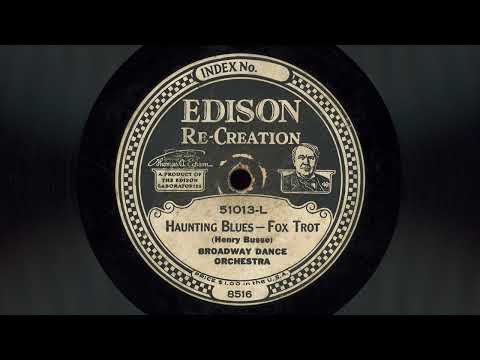
  • “Haunting Blues” – Broadway Dance Orchestra (1922)

    “Haunting Blues” – Broadway Dance Orchestra (1922)

    The Halloween playlist continues with a haunting number by Vincent Lopez and his Hotel Pennsylvania Orchestra, performing as Broadway Dance Orchestra on the Edison label.

    Recorded in New York City on June 30, 1922.
    Released as Edison 51013.

    Credits:
    Vincent Lopez – director, piano
    Bob Biers, Bob Effros – trumpet, flugelhorn, mellophone
    Harold Geiser – trombone, euphonium
    Billy Hamilton – clarinet, alto saxophone, oboe, sarrusophone
    Harry Brown – tenor saxophone
    Ernest Holst – violin
    Dave Berend – banjo
    Hank Waak – tuba
    Eddie Shearer – drums

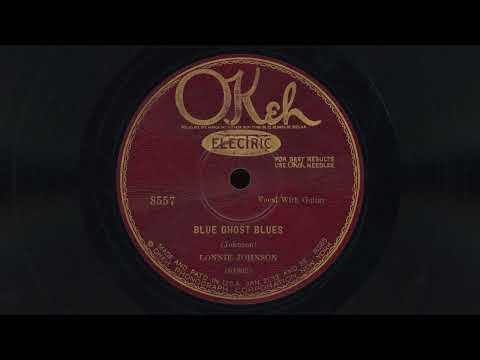
  • “Blue Ghost Blues” – Lonnie Johnson (1927)

    “Blue Ghost Blues” – Lonnie Johnson (1927)

    Continuing on the Halloween theme this week… we have the excellent “Blue Ghost Blues” by Lonnie Johnson.

    From the first line, you can tell it’s gonna be a scary tale:

    “MMmmm – I feel myself sinkin’ down.
    My body is freezin’ I feel something cold creepin’ around.
    My windows is rattlin’, my doorknob turnin’ round and round.
    This haunted house blues is killin’ me – I feel myself sinkin’ down.”

    A later verse seems to possibly indicate that the “blue ghost” perhaps has a more material presence:

    “The blue ghost is got the house surrounded – Lord! And I can’t get away
    They got shotguns and pistols standin’ all around my door.
    They haunt me all night long so I can’t sleep no more.
    The blue ghost haunts me all night, the nightmare rides me all night long.
    They worry me so in this haunted house, I wish’d I were dead and gone.”

    Johnson was a New Orleans jazzman who worked the riverboats with Charlie Creath out of St. Louis in the early 20s. In 1925 he won a blues contest and the prize was a contract with Okeh records – so he followed destiny and became a blues guitarist. His singing and playing made him one of the most popular Okeh artists of the late 20s.

    Thankfully, he continued to also also play jazz guitar, recording with Louis Armstrong and his Hot Five, Duke Ellington, and Eddie Lang, among others.

    This was one of my first big wantlist records – which eluded me for years. Funny story – when I was new to 78 collecting, I bought a copy of this tune on the Decca label, only to find out that Lonnie had re-recorded this tune in the late 30s with piano and bass accompaniment. Same tune but something was missing. It took me a while longer to find this original Okeh recording.

    Recorded on November 9, 1927.
    Released as Okeh 8557

    Credits:
    Lonnie Johnson – guitar, vocals

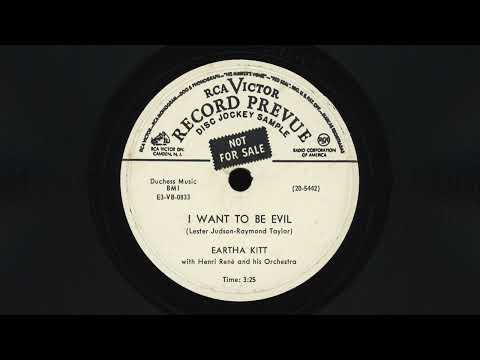
  • “I Want to be Evil” – Eartha Kitt (1953)

    “I Want to be Evil” – Eartha Kitt (1953)

    Starting off the week leading up to Halloween with a record by the great Eartha Kitt – who happens to be one of a handful artists of the 78 rpm era that I have seen perform live (some of the others include Bo Diddley and Ravi Shankar).

    I saw her at one of her many performances at the legendary Café Carlyle in NYC. She was a phenomenal performer and had the whole room in the palm of her hand. Her crisp delivery of lyrics, coming from her background in theatre, seemed as sharp as ever.

    This single came out in the spring of 1953 and hit #22 on the charts and Billboard reviewed it as a “finely produced side bringing together an unusual piece of material and an uncommonly fine performer in Eartha Kitt.” Later that year she would get to #4 with her most successful song, “Santa Baby”.

    I’m wondering if this record had an influence over her casting as Cat Woman in the 60s.

    These RCA Victor promo discs are dead quiet – there is almost no surface noise at all.

    Recorded on March 12, 1953.
    Released as RCA Victor 20-5442.

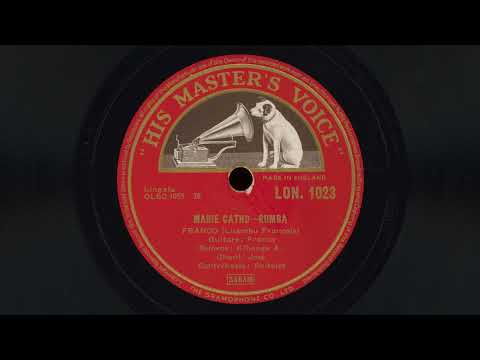
  • “Marie Catho” – Franco (1955) Rumba Congolaise

    “Marie Catho” – Franco (1955) Rumba Congolaise

    By the time the 17-year-old Luambo Franco cut this record in 1955, he had already been playing professionally for three years – both with Ebengo de Wayon in Group Watam and as a solo recording artist for the Loningisa label.

    Upon hearing him play at a Loningisa recording session in 1953, Loningisa owner Basile Papadimitriou gave him a nice guitar and signed a 10 year contract with the young guitarist, remarking, « Mon petit bon- homme, tu es appelé à un grand avenir ».

    By 1955, he had become a national sensation – and was performing frequently to packed bars. His band would “borrow” equipment from the Loningisa studio to play these gigs, then return it before morning. When Papadimitriou discovered this, he was angry at first – but quickly realized that supporting his stars should be his priority and he allowed the band to continue their nightly withdrawals of instruments and equipment.

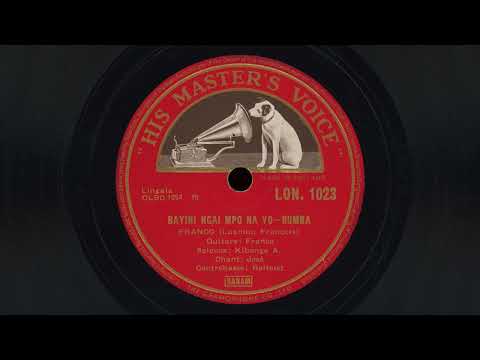
    This record was originally released on the Loningisa label for distribution within Belgian Congo. These LON series discs on the HMV label were then made for distribution outside of Congo. I believe they are master pressings and sound great!

    Recorded in Léopoldville (now Kinshasa), Belgian Congo (now Democratic Republic of the Congo) on October 14, 1955.
    Released as His Master’s Voice LON. 1023.
    Originally released as Loningisa No. 129

    Credits:
    Franco (Luambu François) – guitar
    Antoine Kibongué – organ (Hammond Solovox)
    Augustin Moniania “Roitelet”- bass
    José – vocals

    The flip side, “Bayini Ngai Mpo Na Yo” can be heard at:
    https://youtu.be/S7W2rJ3Gfq8

    Source:
    Dictionnaire Des Immortels De La Musique Congolaise Moderne
    by Jean-Pierre François Nimy Nzonga
    https://www.editions-harmattan.fr/catalogue/livre/dictionnaire-des-immortels-de-la-musique-congolaise-moderne/37369

  • “Bayini Ngai Mpo Na Yo” – Franco (1955) Rumba Congolaise

    “Bayini Ngai Mpo Na Yo” – Franco (1955) Rumba Congolaise

    By the time the 17-year-old Luambo Franco cut this record in 1955, he had already been playing professionally for three years – both with Ebengo de Wayon in Group Watam and as a solo recording artist for the Loningisa label.

    Upon hearing him play at a Loningisa recording session in 1953, Loningisa owner Basile Papadimitriou gave him a nice guitar and signed a 10 year contract with the young guitarist, remarking, « Mon petit bon- homme, tu es appelé à un grand avenir ».

    By 1955, he had become a national sensation – and was performing frequently to packed bars. His band would “borrow” equipment from the Loningisa studio to play these gigs, then return it before morning. When Papadimitriou discovered this, he was angry at first – but quickly realized that supporting his stars should be his priority and he allowed the band to continue their nightly withdrawals of instruments and equipment.

    The song title translates as “They hate me because of you.”

    This record was originally released on the Loningisa label for distribution within Belgian Congo. These LON series discs on the HMV label were then made for distribution outside of Congo. I believe they are master pressings and sound great!

    Recorded in Léopoldville (now Kinshasa), Belgian Congo (now Democratic Republic of the Congo) on October 14, 1955.
    Released as His Master’s Voice LON. 1023.
    Originally released as Loningisa No. 129

    Credits:
    Franco (Luambu François) – guitar
    Antoine Kibongué – organ (Hammond Solovox)
    Augustin Moniania “Roitelet”- bass
    José – vocals

    The flip side, “Marie Catho” can be heard at:
    https://youtu.be/hhyvFBcYP6U

    Source:
    Dictionnaire Des Immortels De La Musique Congolaise Moderne
    by Jean-Pierre François Nimy Nzonga
    https://www.editions-harmattan.fr/catalogue/livre/dictionnaire-des-immortels-de-la-musique-congolaise-moderne/37369

  • “Mary’s Special” – Mary Lou Williams (1936) Celesta and Piano Jazz!

    “Mary’s Special” – Mary Lou Williams (1936) Celesta and Piano Jazz!

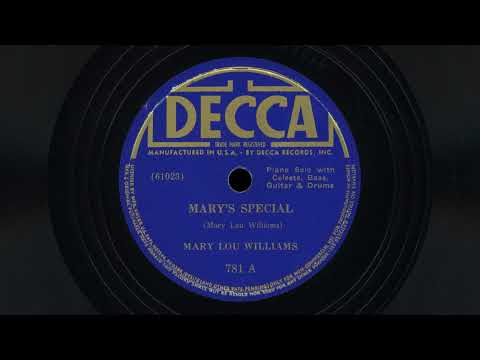
    Longtime viewers of the channel know that I love Mary Lou Williams and her work with Andy Kirk and his Twelve Clouds of Joy – and that I love it when jazzers play the celesta. This record has both in copious amounts!

    A small combo of guitar, bass, and drums (all compatriots of Mary’s in the Kirk band) accompanies Mary Lou on her composition “Mary’s Special”. While she starts off on piano, At 0:46 she switches to celesta – and switches back-and-forth throughout the rest of the song!

    An absolutely delightful number!

    Recorded in New York City on April 9, 1936.
    Released as Decca 781.

    Credits:
    Mary Lou Williams – piano, celesta
    Ted Robinson (?) – guitar
    Booker Collins – string bass
    Ben Thigpen – drums

  • “Long Lost Mamma (Daddy Misses You)” – California Ramblers (1923)

    “Long Lost Mamma (Daddy Misses You)” – California Ramblers (1923)

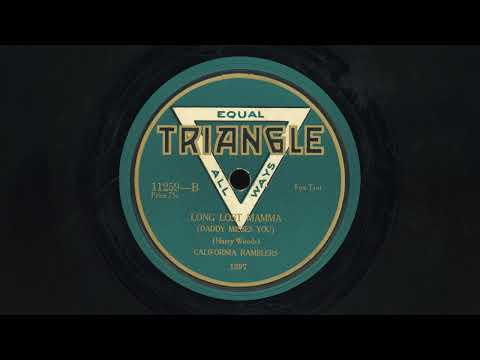
    A fun early record by the California Ramblers, who seemed to record on virtually every label in the 1920s under one of 1,000 pseudonyms. This one was from a Paramount session that also was released on Puritan, Broadway, Triangle, and Famous labels.

    A muted trumpet solo with some light growling and wah effects starting at 0:50 is followed by hot breaks featuring Lloyd Olsen on trombone and Rollini on bass sax. A second trumpet solo begins at 2:04 and leads us to the ensemble close.

    Recorded in New York City on May 3, 1923.
    Released as Triangle 11259.
    Original released as Paramount 20232.

    Arthur Hand – violin, director
    Frank Cush, Bill Moore – trumpet
    Lloyd “Ole” Olsen – trombone
    Jimmy Duff – clarinet, alto sax
    Freddy Cusick – tenor sax
    Adrian Rollini – bass sax
    Irving Brodsky – piano, arranger
    Ray Kitchingman – banjo
    Fred Henry – drums

  • “The Gouge of Armour Avenue” – Fletcher Henderson and his Orchestra (1924) f/ Big Charlie Green

    “The Gouge of Armour Avenue” – Fletcher Henderson and his Orchestra (1924) f/ Big Charlie Green

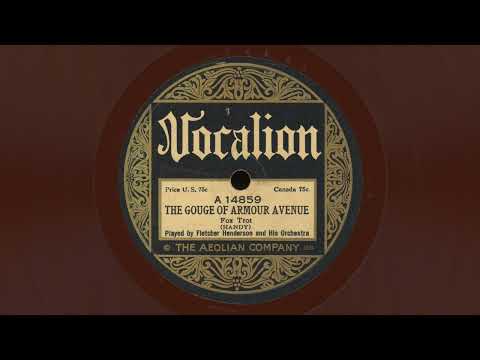
    One of my favorite of Henderson’s Red Vocalions: the first recording of W. C. Handy’s “The Gouge of Armour Avenue” that features one of the most inspired and legendary trombone solos of early jazz by Big Charlie Green.

    Jazz Scholar Phil Schaap wrote a wonderful essay delving into the esoterica of mysteries surrounding this tune – and I link to it below:
    https://www.philschaapjazz.com/essays/the-gouge-of-armour-avenue-a-legendary-trombone-solo-and-a-pronunciation

    In it, we learn that “gouge” is pronounced as in “price gouging” – not “googe” as in “Scrooge” – and that Green’s solo was likely not an improvisation at all but was pre-composed. By who, we may never know.

    In any case, it is massive, epic, and sounds fresh every time I hear it.

    Recorded in New York City on July 31, 1924.
    Released as Vocalion 14859

    Credits:
    Fletcher Henderson – piano, arranger, director
    Elmer Chambers Howard Scott – cornet
    Charlie Green – trombone
    Don Redman – clarinet, alto sax
    Coleman Hawkins – clarinet, tenor sax, baritone sax
    Charlie Dixon – banjo
    Ralph Escudero – tuba
    Kaiser Marshall – drums