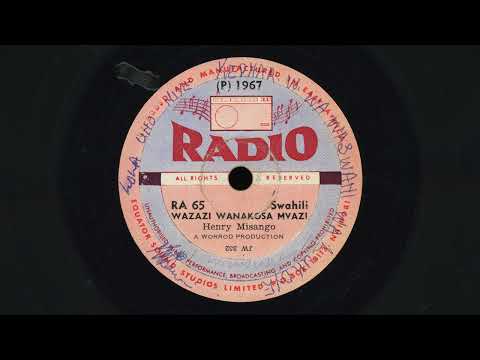
The Radio label seems to be a sublabel of Charles Worrod’s Equator Records, launched in 1960 from the acquired remains of East African Records – which owned the Jambo label.
I bought this record “as is” from a seller who warned me that the disc was cracked from the edge to the label. I stabilized and repaired the crack (you can see some of my glue to the upper left of the label) well enough that I was able to get a decent transfer from it.
Henry Misango was a fingerstyle guitarist who played in the Omutibo style popularized by George Mukabi. After Mukabi’s untimely death in 1963, several Kenyan guitarists continued to play in this style – including Henry Misango, Herbert Misango, William Osale, Humphrey Eshitool, Peter Opwaka and Fanuel Ami- mo.
The title of this song translates as: “Parents Lack Clothing”
Recorded in Nairobi, Kenya circa 1967. Released as Radio RA 65.
Credits Henry Misango – guitar, vocals Unknown artist – percussion, vocals
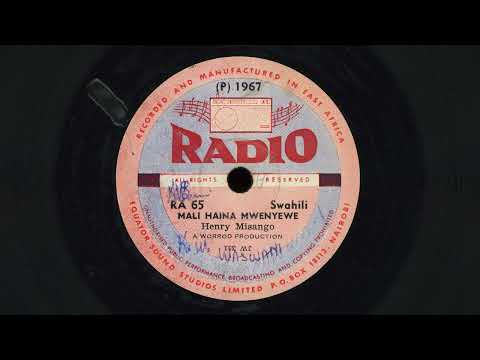
The Radio label seems to be a sublabel of Charles Worrod’s Equator Records, launched in 1960 from the acquired remains of East African Records – which owned the Jambo label.
I bought this record “as is” from a seller who warned me that the disc was cracked from the edge to the label. I stabilized and repaired the crack (you can see some of my glue to the upper left of the label) well enough that I was able to get a decent transfer from it.
Henry Misango was a fingerstyle guitarist who played in the Omutibo style popularized by George Mukabi. After Mukabi’s untimely death in 1963, several Kenyan guitarists continued to play in this style – including Henry Misango, Herbert Misango, William Osale, Humphrey Eshitool, Peter Opwaka and Fanuel Ami- mo.
The title of this song translates as “Wealth Has No Owner”.
Recorded in Nairobi, Kenya circa 1967. Released as Radio RA 65.
Credits Henry Misango – guitar, vocals Unknown artist – percussion, vocals
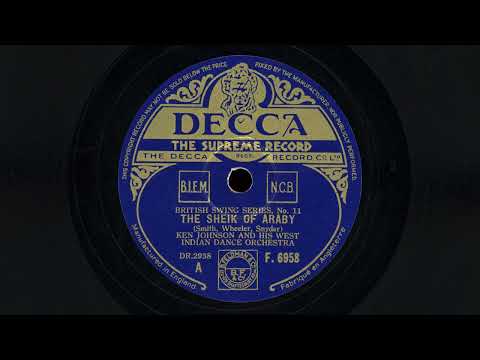
Kenrick Reginald Hijmans Johnson was a unique figure in the British jazz scene in the 1930s. He was born in Guyana and educated in the U.K. After leaving law school to pursue a career in dancing, Johnson spent time in New York City studying tap dancing styles and Harlem jazz.
Back in London in 1936, encouraged by Fletcher Henderson and inspired by Cab Calloway, Johnson began to recruit an all-black jazz band who could swing like the American big bands popular at the time.
Johnson was not a musician – so teamed up with trumpeter Leslie Thompson to help lead the band. The band’s name came from the fact that it was made up of members who were or were descendants from many parts of the British Commonwealth in the Caribbean – with members representing Guyana, Trinidad, and Jamaica. Interestingly – they had trouble finding black trombonists and ended up using white trombonists – who sometimes performed in blackface to maintain the band’s identity.
The band became very popular and influential due to a run of BBC broadcasts starting in 1938 and regular club appearances at Willerby’s and Café de Paris in London. The band made a number of recordings for Decca and HMV from 1938-1940 and the British Library Sound Archive has a sizeable collection of radio transcription discs from their BBC performances.
Johnson tragically was killed *during a performance* at the Café de Paris by a bomb dropped during a WWII London air raid by the German Luftwaffe. Thirty-four other jazz fans died in the bombing that night – and dozens more were injured.
Recorded in London, U.K. on September 22, 1938. Released as Decca F.6958.
Credits Ken Johnson – director Dave Wilkins, Leslie “Jiver” Hutchinson, Wally Bowen – trumpet Lad Busby – trombone Carl Barriteau, Bertie King – clarinet, alto sax George Roberts, David Williams – alto sax, tenor sax Errol Barrow – piano Joe Deniz – guitar Pops Clare – bass Tom Wilson – drums
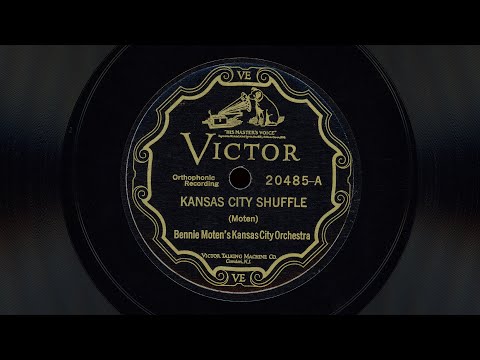
After recording extensively and exclusively for the Okeh label from 1923-25, Bennie Moten’s Kansas City Orchestra switched to Victor in 1926. This popular side is from their first session with Victor in Chicago – recording ten sides over a two day period.
Victor talent scout Ralph Peer (who had initially worked for Okeh) was a big proponent of Moten’s band, writing in early 1927 that these first sides for Victor “the best [they] ever made.” He offered Moten an exclusive contract with Victor and signed the band. Moten and his band were featured in Victor catalogs next to white bands such as Kansas City’s own Coon-Sanders Orchestra.
Side note – after these records were released in early 1927, Moten and trombonist Thamon Hayes went into business together and opened a music store on 18th St. in downtown Kansas City that sold phonographs, sheet music, and records from the Victor, Columbia, Okeh, and Paramount labels. Now there’s a record store I would love to have been able to experience!
Aside from “South” (which continued to be pressed on 78 rpm and 45 rpm until the mid 1950s), this is probably the most plentiful Moten disc that one can find on the market today. Due to its popularity there were a lot of copies of this one pressed.
The tune features an extended banjo solo by Sam Tall accompanied by Moten on piano.
Recorded in Chicago Illinois on December 13, 1926. Released as Victor 20485.
Credits: Bennie Moten – piano, director Lammar Wright – cornet Thamon Hayes – trombone Harlan Leonard – clarinet, alto sax LaForest Dent – alto sax, baritone sax Woody Walder – clarinet, tenor sax Sam Tall – banjo Vernon Page – tuba Willie McWashington – drums
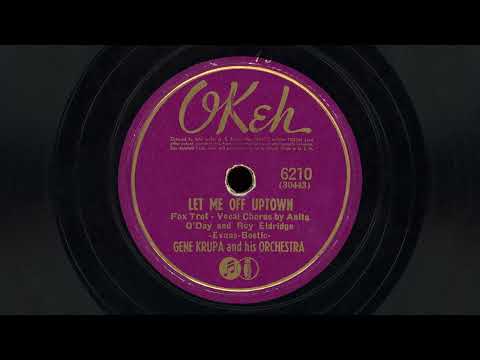
Some of my favorite Gene Krupa records feature singer Anita O’Day and trumpet virtuoso Roy Eldridge – and this one showcases them both to maximum effect. It was a huge hit and put O’Day on the map – by 1942 she was vote fourth most popular female jazz vocalist in the annual poll by Downbeat magazine.
Recorded in New York City on May 8, 1941 Released as Okeh 6210.
Credits: Gene Krupa – drums, director Anita O’Day – vocals Roy Eldridge – trumpet, vocals Graham Young, Torg Halten, Norman Murphy – trumpet Babe Wagner, Jay Kelliher, John Grassi – trombone Mascagni Ruffo, Clint Neagley – alto sax Sam Musiker, Walter Bates – tenor sax Bob Kitsis – piano Ray Biondi – guitar Biddy Bastien – bass
Imagine you’re the sixteen year old son of a millionaire who just caught the jazz bug in New York City circa 1923. What do you do? You buy an orchestra! Not just any orchestra, but the Arthur Lange Orchestra, a hot dance band that played at the Cinderella Ballroom on Broadway and featured Earl Oliver and Tommy Gott.
Kahn’s orchestra rehearsed in the family mansion on 5th Avenue and began playing gigs in 1924. His first recordings for Victor took place in 1925. In late 1925, Kahn brought on hot trombonist Miff Mole, drummer Vic Berton, and violinist Joe Venuti, who was occasionally joined by guitarist Eddie Lang. The addition of these all-star performers made for a supergroup.
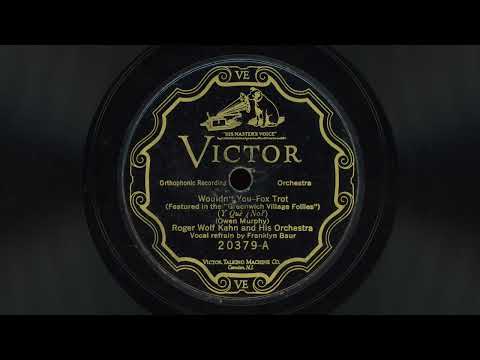
This recording of the tune “Wouldn’t You” coincided with Kahn’s opening of a night club, Le Perroquet de Paris, in New York City – which featured his orchestra as regular performers. The tune starts as a straightforward dance band number, but at 0:53, Miff Mole begins takes the temperature up with a trombone solo. After the vocals delivered by Franklyn Baur (accompanied by Eddie Lang), Joe Venuti and Lang perform a real gem of a hot duet starting at 2:35. All in all, an ornate affair, with just enough jazz interest for Brian Rust to concede they had a place in his famous Jazz and Ragtime Records discography.
Recorded in New York City on November 24, 1926. Released as Victor 20379
Credits: Roger Wolfe Kahn – director Tommy Gott, Leo McConville – trumpet Miff Mole – trombone Arnold Brilhart – clarinet, alto sax Alfie Evans – clarinet, alto sax, baritone sax Harold Sturr – clarinet, tenor sax Joe Venuti, Joe Raymond – violin Abe Borodkin – cello Irving Brodsky – piano Eddie Lang – guitar Arthur Campbell – tuba Vic Berton – drums Franklyn Baur – vocals
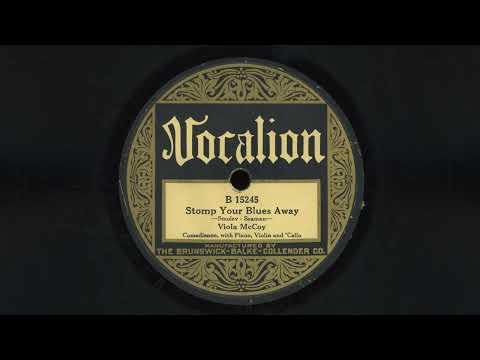
A lovely tune (penned by Marvin Smolev and Bernie Seaman) performed by blues singer Viola McCoy who is accompanied by a very young Rex Stewart on cornet and an unidentified pianist and violinist. The pianist has been suggested to be Porter Grainger – but there is disagreement on this.
Like Ethel Waters, Viola McCoy had a theatrical voice that was clear and crisp, making it a pleasure to listen to. The three accompanists expertly weave around one another, creating a kind of musical bouquet in which McCoy is the centerpiece.
Of note: Smolev later co-wrote a few songs for Cliff Jackson and his Krazy Kats (“Horse Feathers” and “The Terror”).
Recorded in New York City on January 6, 1926. Released as Vocalion 15245.
Credits: Viola McCoy – vocals Rex Stewart – cornet Unknown Artists – piano, violin (Despite the label attribution, no cello is heard on this record)
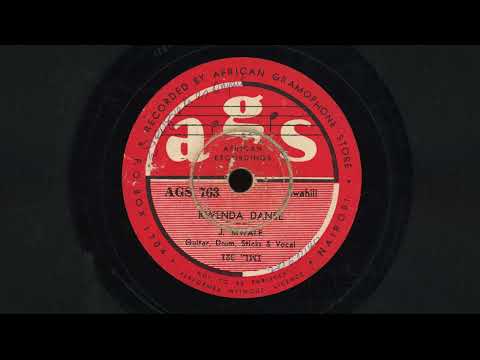
John Mwale was a Kenyan guitarist highly influenced by George Mukabi. He was born in 1925 in Western Kenya and was recording for the Nairobi-based Capitol Music Stores (CMS) label in the 1950s. The two business partners who owned CMS had a falling out and one then set up the competing label African Gramophone Store (AGS), which we see here.
AGS was producing 78 rpm records well into the 1960s – and this record is likely from the early 1960s, but unfortunately I have no exact recording date.
This disc was quite beat and has a particularly rough start – the noise floor seems to get progressively worse as the song progresses. Despite that – I hope you enjoy this lovely performance that stands out despite the shortcomings of the medium it is preserved into.
Released as AGS 763 Recorded in Nairobi, Kenya in the 1960s.
I recently acquired a large number of Storyville magazine issues – a London-based jazz publication that began in the mid 1960s. I’m reading them in order, one at a time, and it’s quite fun! In issue 6 from August 1966, a writer named Sandy Brown writes on the Isham Jones Orchestra:
“Isham Jones was one of the leading musical figures in the 1920s, as composer, bandleader, musician, and A&R man. As a composer he was most prolific, having something over two hundred of his numbers published, no mean feat when we consider that he also played in and lead one of the most successful dance bands of all time – in itself a time consuming occupation.”
He goes on to note that “All of Jones’ best tunes were written by 1924; three of them (‘The one I love belongs to somebody else’, ‘Spain’, and ‘It had to be you’) in one night!”
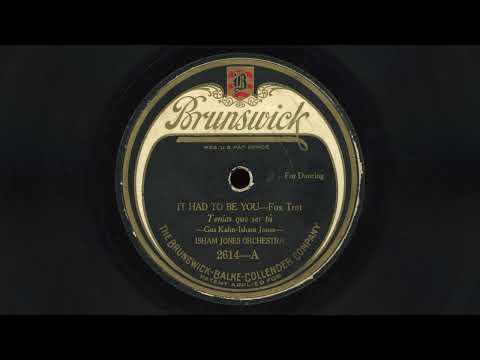
After reading that, I had to go pull a few Isham Jones records out while this fact was fresh in my mind. The one that struck me as most interesting musically was “It Had To Be You”, as we can hear cornetist Louis Panico blowing along with the main melody starting at 0:25, getting in one of his trademark “laughing” effects along with some wah wah effects (well before Clyde McCoy).
At 1:30, a sax states the main melody while trombonist Carroll Martin improvises along. At 2:14, Panico joins back in – and at 2:36, we hear a series of unique call and responses between Panico’s cornet and the rest of the band.
Throughout, the music just flows – and you can easily imagine a ballroom full of dancers effortlessly enjoying themselves.
It wasn’t the first recording of this tune – Marion Harris had recorded a vocal version a month earlier in March of 1924.
At the time of its publication, this popular tune was covered by many popular dance bands such as Paul Whiteman, California Ramblers, Bailey’s Lucky Seven, Ben Selvin, and Sam Lanin, among others. It rapidly became a standard in the great American songbook and has since been covered by a wide range of performers in jazz and popular music from Django Reinhardt to Frank Sinatra.
In August of 1924 Isham Jones wrote an article for Etude magazine’s infamous “The Jazz Problem” issue entitled “American Dance Music Is Not Jazz”, in which he declared “Because a song is successful and played by practically every dance orchestra, it is called jazz; but that is not my idea of jazz… I believe the term of jazz would only be applied to its rightful type of music, and that the dance music as played today would be known as American Dance Music.”
So perhaps Mr. Jones would find himself mischaracterized by having his records appear on my jazz-obsessed YouTube channel. Or perhaps our understanding of jazz and how it influenced American music has evolved. From my perspective, Isham Jones, like many early dance band leaders, certainly did play a role in the history and development of jazz.
So Isham – let’s be real – It had to be you.
🎺💃🕺🎶
Recorded in Chicago, Illinois on April 24, 1924. Released as Brunswick 2614
Credits: Isham Jones – tenor sax, leader Louis Panico – cornet Carroll Martin – trombone Al Mauling – clarinet, alto sax Artie Vanasec – soprano sax, violin Leo Murphy – violin Roy Bargy – piano Charles McNeill – banjo John Kuhn – tuba Joe Frank – drums