Jazz Crazy Records

An Archive of Early Jazz on 78 RPM

Author: Professor M

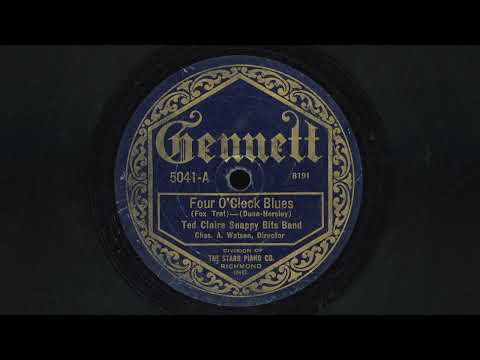
  • “Four O’Clock Blues” – Ted Claire Snappy Bits Band (1923) f/ Charles A. Matson

    “Four O’Clock Blues” – Ted Claire Snappy Bits Band (1923) f/ Charles A. Matson

    Imagine the exasperation of Charles Matson – his recorded output as a leader can be counted on two hands – and on both of his major Gennett sides they misspell his name as “Watson”!

    I feel for you, Chas. They done you wrong.

    The name “Ted Claire”, however, is correctly spelled – and is from a vaudeville performer whose relationship to Matson is unclear. Claire died in Chicago on December 9, 1960 and in his New York Times obituary, it notes he was a “former Broadway song-and-dance man” who was “a veteran of the Florenz Ziegfeld and Earl Carroll productions of the Nineteen Twenties and Thirties. He did comedy specialties in musicals and composed several show songs.”

    So perhaps the Ted Claire Snappy Bits Band moniker was a lark – much like Sgt. Pepper’s Lonely Hearts Club Band or Mellon Collie and the Infinite Sadness. Or perhaps Claire worked with Matson on aspects of his live show and the name was a tribute to him. I suppose we may never have an answer to that, and it’s just left to our imagination.

    I’m also a little miffed that the Times gave Claire an obit – but not Matson. Seems like he is a good candidate for their “Overlooked” series of obituaries about remarkable people whose deaths went unreported in The Times.

    In any case, “Four O’Clock Blues” begins with the tolling of a bell. Thankfully, the bell helped me get this track in tune, as it chimes in B flat throughout the tune. The clarinet and alto sax seem to be having the most fun on this one – and the ensemble playing is lively.

    This one comes from the collection of Christopher from HeyPally – so I’ll give his excellent website a shoutout and link to his original post about this record in 2016:
    http://www.heypally78rpms.com/2016/07/charles-matson-on-gennett-edison.html

    Recorded in New York City on January 31, 1923.
    Released as Gennett 5041.

    Credits:
    Charles A. Matson – piano, director
    Unknown artists – cornet, trombone, clarinet, alto sax, banjo, drums, bell
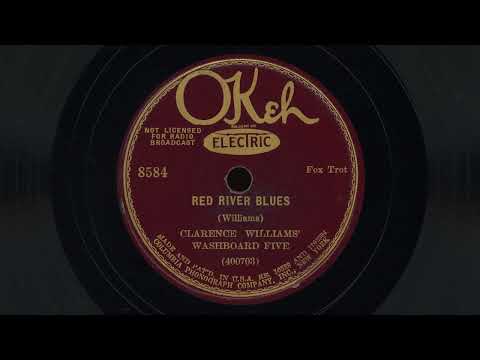
  • “Red River Blues” – Clarence Williams’ Washboard Five (1928) f/ King Oliver! 🎺

    “Red River Blues” – Clarence Williams’ Washboard Five (1928) f/ King Oliver! 🎺

    “Red River Blues” is a downtempo blues by Williams’ Washboard Five – a lineup that includes the legendary King Oliver on cornet.

    The tune was penned by Williams himself – and features a lengthy clarinet solo by Arville Harris starting at 1:06 followed by a cornet solo by the King starting at 1:41.

    Recorded in New York City on May 23, 1928.
    Issued as Okeh 8584 on July 5, 1928.

    Credits
    Ed Allen, King Oliver – cornet
    Arville Harris – clarinet
    Clarence Williams – piano
    Floyd Casey – washboard

    The flip side – “Red River Blues” – can be heard at:
    https://youtu.be/kbQVj3qcmN4

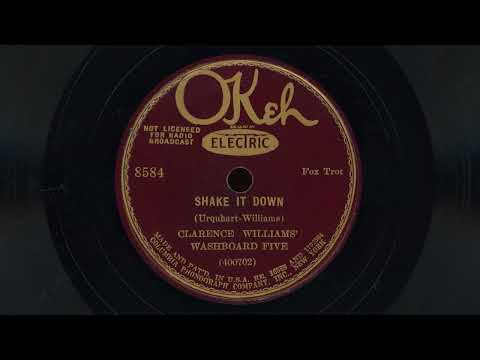
  • “Shake it Down” – Clarence Williams’ Washboard Five (1928) f/ King Oliver! 🎺

    “Shake it Down” – Clarence Williams’ Washboard Five (1928) f/ King Oliver! 🎺

    The first of many collaborations in 1928 between Clarence Williams and Joe Oliver, who had been playing out east in the summer of 1927. In July Oliver headed for NYC, after his group broke up. He had turned down a long-term contract at the Cotton Club (which instead went to Duke Ellington) earlier in the year and now found himself without a band. Instead, he collaborated with others as a featured sideman.

    On “Shake it Down”, Oliver doesn’t get a full solo – but contributes several two-bar hot breaks. He went on to play on many other Clarence Williams sessions that year. Williams even directed a session released under Oliver’s name to fulfill part of his contract with Brunswick (released as Vocalion 1189 and 1190). In late 1928, Oliver signed a contract with Victor and began the last phase of his recording career.

    This happens to be the first Clarence Williams record I ever heard – and from the first skritch of Floyd Casey’s washboard I was hooked. Since then I’ve really become a huge fan of his music – and learned a lot about his role in promoting and publishing jazz in the 20s. I posted an Instagram video of this record playing years ago – but never made a proper transfer.

    Williams’ washboard band repertoire is always full of joy and is loads of fun – this track is no different. While other bands at this time aimed for a more ‘sophisticated’ modernistic sound, Williams’ use of the washboard showed a more informal and warmly rustic approach. It always sounds immediately accessible to my ears – and never disappoints.

    Recorded in New York City on May 23, 1928.
    Issued as Okeh 8584 on July 5, 1928.

    Credits
    Ed Allen, King Oliver – cornet
    Arville Harris – clarinet
    Clarence Williams – piano
    Floyd Casey – washboard

    The flip side can be heard at:
    https://youtu.be/xM6L63FI_4Y

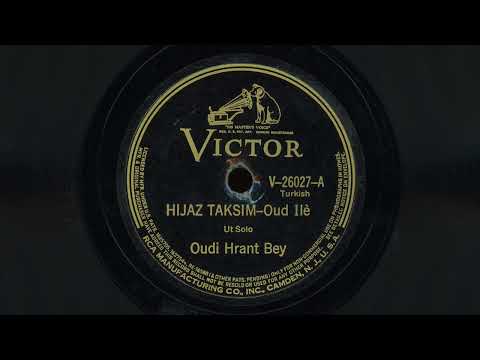
  • “Hijaz Taksim” – Oudi Hrant Bey (1936)

    “Hijaz Taksim” – Oudi Hrant Bey (1936)

    Udi Hrant Kenkulian (Հրանդ Քենքուլեան) was an innovative Armenian oud player who was a citizen of Turkey. Udi Hrant was also blind since birth. This was one of his early recordings which first brought him attention and acclaim as an artist.

    Recorded in Turkey before June 9, 1936.
    Released as Victor V-26027.
    Original release: Gramophone AX-1828.

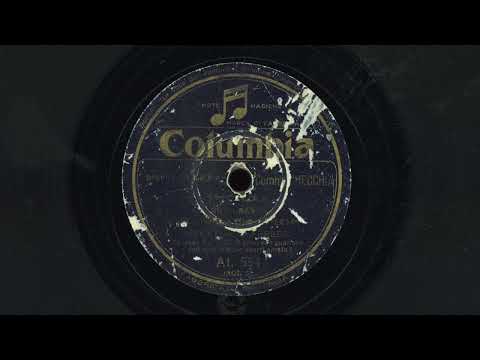
  • “Chi È Colui Che Guarisce Dell’amore Dopo Averti Amato?” – Negatua & Ferede (1939-40) 🇪🇹 Ethiopia

    “Chi È Colui Che Guarisce Dell’amore Dopo Averti Amato?” – Negatua & Ferede (1939-40) 🇪🇹 Ethiopia

    Records in the very scarce Columbia AI series were released during the Italian occupation of Ethiopia after the 1935 invasion. They were pressed in Italy and sponsored by Eritrean business man Saleh Ahmed Checchia – whose last name can be seen on the right side of the label.

    The song title can be translated as: “Who is the one who heals from love after loving you?” I have no information on the azmaris (troubadours) Negatua & Ferede or the specific instrumentation used as accompaniment. There is just not a lot of available information on this series and very few examples out there.

    The seal of the Italian East Africa government can be seen in the runout at the bottom of the record.

    This came to me in very bad shape – with many deep scratches and heavy scuffing on both sides. Because of its rarity I decided to make a transfer regardless. Better to preserve and share this, as I’m not likely to run across another copy.

    Released as Columbia AI. 554 (matrix AOI.3)
    Recorded circa 1939-1940.

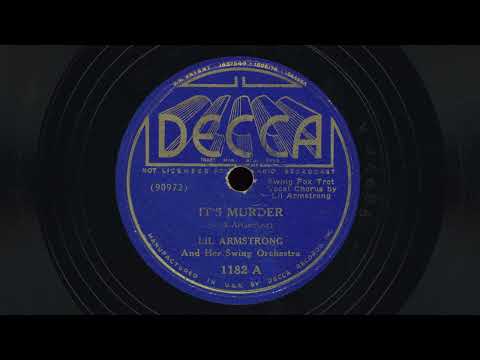
  • “It’s Murder” – Lil Armstrong and her Swing Orchestra (1936)

    “It’s Murder” – Lil Armstrong and her Swing Orchestra (1936)

    Even before Lil Hardin Armstrong made jazz history by co-founding the Hot Five with husband Louis Armstrong, she was playing with King Oliver’s Creole Jazz Band in Chicago and San Francisco. Her work with the Hot Five and Hot Seven is the stuff made of legends – but equally impressive was her work to help Louis Armstrong grow more confident as a performer and more astute as a manager of his own destiny. They parted ways in 1929.

    In the late 1930s, Armstrong recorded over 25 sides for Decca as a bandleader and vocalist – and this recording, “It’s Murder” is from her first session for Decca in 1936. It’s a swingin’ tune and it’s hard to imagine another song so bright and upbeat whose title contains the word “murder”. Murder ballad this is not. Armstrong is strong and seasoned as a vocalist – with real stage presence that can be sensed just from listening. It’s nice to see her in the spotlight – she’s a natural.

    Teddy Cole takes a solo on piano, followed by Chu Berry on tenor sax. Buster Bailey turns in a lively clarinet solo, followed by a short one by Joe Thomas on trumpet. Armstrong wraps things up with a scatted outro.

    Recorded in Chicago, Illinois on October 27, 1936.
    Released as Decca 1182.

    Credits:
    Joe Thomas – trumpet
    Buster Bailey – clarinet
    Chu Berry – tenor sax
    Teddy Cole – piano
    Huey Long – guitar
    John Frazier – string bass
    Lil Armstrong – vocals

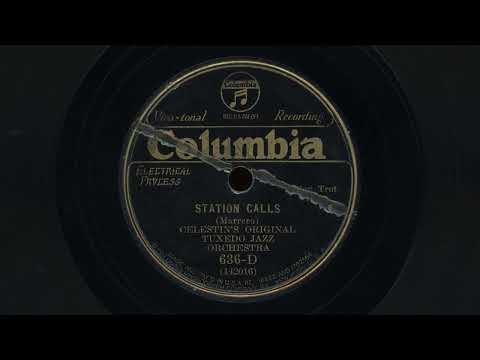
  • “Station Calls” – Celestin’s Original Tuxedo Jazz Orchestra (1926)

    “Station Calls” – Celestin’s Original Tuxedo Jazz Orchestra (1926)

    Louisiana-born cornetist Oscar Phillip Celestin moved to New Orleans in 1904 and by 1910 was leading a band at the Tuxedo Dance Hall in Storyville. Their first recording session did not take place for a full 15 years – until an Okeh session in 1925. Can you imagine if they had been recorded earlier? When I think of all the lost jazz of the “unrecorded period” before 1917, it is quite depressing indeed.

    This record is from their second recording session for Columbia in 1926 – and it almost didn’t make it to its upcoming 100th birthday. As you can see, it suffered the same fate as the Grey Gull I posted earlier this week – a near-fatal crack across the entire record due to recklessly inadequate packing job by a seller. Luckily it did not break completely and with some stabilization (and the help of de-clicking software to remove the tics) I was able to coax a decent transfer from it.

    Whenever you buy from a seller new to shipping 78s, you take a gamble. Though there is a tried-and-true method to ship these fragile discs with near 100% success, some new sellers decide it is best to ignore entreaties to ship safely and throw caution to the wind with a thin pizza box and a few sheets of bubble wrap. Let us not dwell on this – suffice to say it was injured and has convalesced to a point where it can still have a useful life.

    This tune, composed by banjo player John Marrero, has a languorous spirit throughout that is simultaneously calming and invigorating. A lengthy mid-section features a duet between Marrero and the talented female pianist Jeanette Salvant (who became Jeanette Kimball after marrying banjoist Narvin Kimball in 1929). She played on all of Celestin’s subsequent recordings in the 1920s and again with him in the 1950s when his career was revived.

    Celestin’s cornet brings us back to the ensemble – and he takes an extended solo that brings us home – the piercing tone of his muted trumpet offers a sharp contrast with the relaxed mood established.

    Recorded in New Orleans, Louisiana on April 13, 1926.
    Released as Columbia 636-D.

    Credits
    Oscar Celestin – cornet, director
    August Rousseau – trombone
    Paul Barnes – clarinet, alto sax
    Earl Pierson – tenor sax
    Jeanette Salvant – piano
    John Marrero – banjo
    Abby Foster – drums

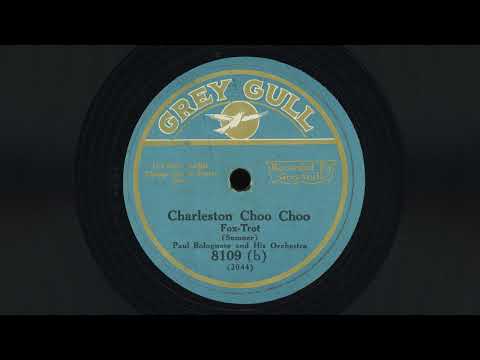
  • “Charleston Choo Choo” – Paul Bolognese and his Orchestra (1926)

    “Charleston Choo Choo” – Paul Bolognese and his Orchestra (1926)

    Releases by the Grey Gull label were low-priced records sold from job racks from newsstands, cigar stores, and drug stores. Along with their associated labels (Madison, Radiex, Globe, etc) these labels are often called “dime store” labels by collectors.

    Their cheap prices were attractive to consumers but the pressing quality of these labels is often inferior – and surface noise with some degree of graininess is common.

    There is a seemingly wide variety of different bands and orchestras recording for these labels, however many recordings were performed by their in-house orchestra featuring Mike Mosiello and Andy Sannella under a varied number of pseudonyms.

    Paul Bolognese was the musical director and house conductor for Emerson Records starting in 1922 – and he moved to Grey Gull in January 1926. This change coincided with Grey Gull moving its offices to New York City from Boston this same year.

    This release does not appear in either of Brian Rust’s comprehensive discographies that cover Jazz and Dance Band records.

    The record starts out with a peppy – but straightforward – sound. Things get hot once the trumpet solo kicks in around 0:57. This is followed by some highly arranged passages punctuated by hot banjo breaks – which lead to a xylophone solo at 1:49 by who I believe to be is George Hamilton Green.

    This 98-year-old record nearly met an ignoble end, as it was shipped to me by a seller who felt that loosely wrapping 10 fragile shellac records with bubble wrap in a thin “pizza box” would suffice for a cross-country journey. All records arrived cracked or broken. Luckily, I was able to repair and stabilize most of the cracked records to at least get transfers from them.

    “Charleston Choo Choo” – Paul Bolognese and his Orchestra
    Recorded in New York City circa May 1926.
    Released as Grey Gull 8109.
    Also released under the same catalog number on the Supertone and Radiex labels.

    Credits (no definitive source here – pretty much guesses):
    Paul Bolognese – director
    Mike Mosiello (?) – trumpet
    Andy Sannella (?) – clarinet, alto sax
    George Hamilton Green (?) – xylophone
    Unknown Artists – banjo, tuba, drums

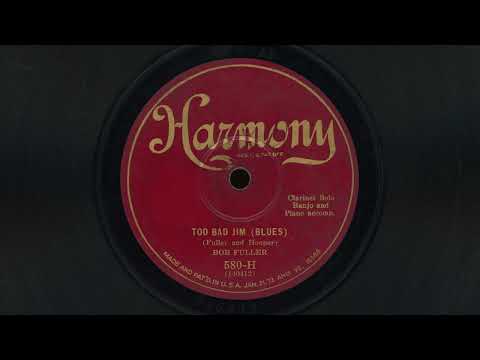
  • “Too Bad Jim” – Bob Fuller (1925)

    “Too Bad Jim” – Bob Fuller (1925)

    A bluesy number from a trio led by Bob Fuller on clarinet. Love the slow drawling pacing of this plaintive blues.

    This tune – co-written by Fuller and pianist Louis Hooper – was later re-recorded for Vocalion in June 1925 (under the name Three Jolly Miners) and for Pathé / Perfect in July 1925 (under the name Three Hot Eskimos).

    Recorded in New York City on March 4, 1925.
    Released as Harmony 580-H.

    Credits
    Bob Fuller – clarinet
    Louis Hooper – piano
    Elmer Snowden – banjo

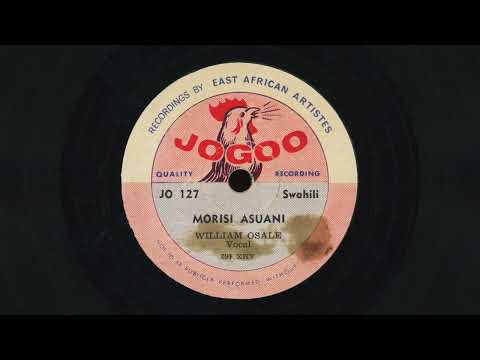
  • “Morisi Asuani” – William Osale (Kenya) – African Guitarist – Jogoo JO 127

    “Morisi Asuani” – William Osale (Kenya) – African Guitarist – Jogoo JO 127

    William Osale was a fingerstyle guitarist who performed and recorded in Kenya during the 1950s and 60s. Osale was a rural musician who played in the ‘sukuti’ style – a rhythmic style of finger-style playing invented by George Mukabi that results in a light, ‘bouncy’ sound.

    In his “A History of Kenyan Guitar Music: 1945-1980”, John Low writes, “Some rural finger-stylists like George Mukabi and William Osale also had success in the towns, providing Swahili versions of songs that they might sing in local languages back home. The appeal of their songs lay in the fact that many town dwellers had (and still have) strong links with the land, and the themes of these songs, often conservative and sometimes nostalgic, reminded them of the old values.”

    Released as Jogoo JO 127.

    The flip side can be heard at:
    https://youtu.be/L6bM18-Zpdo