Jazz Crazy Records

An Archive of Early Jazz on 78 RPM

Author: Professor M

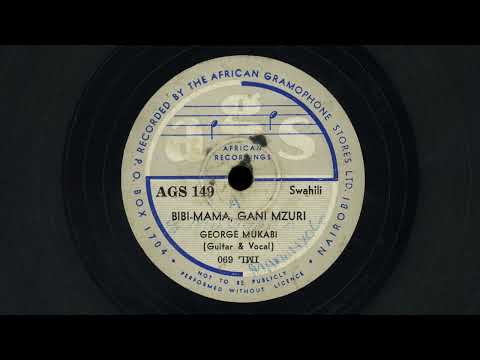
  • “Bibi Mamma, Gani Mzuri” – George Mukabi – Legendary Kenyan Guitarist

    “Bibi Mamma, Gani Mzuri” – George Mukabi – Legendary Kenyan Guitarist

    George Mukabi was a guitarist from western Kenya credited with inventing the Sukuti – or Omutibo – guitar style – a syncopated fingerstyle technique that combines rhythm and lead parts in a way that rhythmically imitates the sound of sukuti drums used in traditional Luhya music. His music was often accompanied by a glass bottle (or two) and sometimes by Jack Malenya, a second vocalist who harmonized in a higher register.

    This seemingly wistful tune is instead a full-throated celebration of mothers – reminding men that their mothers carried them in her womb for nine months and gave birth to them.

    This record is not in the best shape but I was quite thrilled to get a copy.

    Released as AGS 149 on the African Gramophone Stores label.

    To hear more of Mukabi’s work, check out Mississippi Records’s excellent release “Furaha Wenye Gita” produced by Cyrus Moussavi:
    https://mississippirecords.bandcamp.com/album/furaha-wenye-gita

  • New Arrivals at the Jazz Bunker – Jazz Chat Episode 8 – African 78 rpm records and exciting jazz!

    New Arrivals at the Jazz Bunker – Jazz Chat Episode 8 – African 78 rpm records and exciting jazz!

    The last six months have been a fruitful time for finding 78 rpm records – and I wanted to take a moment to share some of the incoming arrivals in two categories: 1) African 78 rpm records and 2) Jazz 78s.

    I also wanted to address the question of where to find African 78s by giving you some backstory on how I acquired these latest few – along with some of the jazz records you’ll be hearing in the coming weeks!

    0:00 Welcome
    0:34 Thank you to all the Jazz-Bos
    1:08 What precipitated this video
    2:01 Where does one find African 78s?
    2:53 Diaspora Records (diasporarecords.com)
    3:23 Intro to New Arrivals
    4:02 The Story of how I got a copy of Ngoma 202
    8:19 The Story of how I got a copy of Ngoma 1787 (& others)
    16:43 eBay finds: Ngoma 1165 and Loningisa 112
    20:07 The secret to finding Loningisa releases: the HMV LON series
    21:55 Other records that came directly from Africa
    26:57 Fantastic Kenyan records in rougher shape
    34:55 There are JAZZ records too! Some new Jazz arrivals
    50:02 Upcoming plans for special videos!
    51:37 Goodbye!

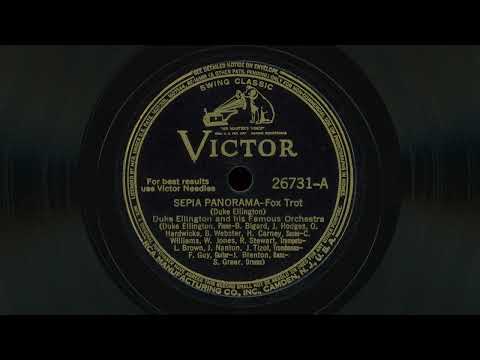
  • “Sepia Panorama” – Duke Ellington and his Famous Orchestra (1940)

    “Sepia Panorama” – Duke Ellington and his Famous Orchestra (1940)

    The first jazz CD I ever bought was Duke Ellington’s “The Blanton-Webster Band” – a 3 disc set of one of Duke’s most polished and innovative bands. I listened to it countless times at work where my supervisor, jazz musician and artist Reverend Dwight Frizzell, would play it – often commenting on the tracks as they played. Noting a performer or a particularly interesting solo.

    For a 19 year old whose taste in music was firmly in 70s and 80s punk and art rock, this music was a revelation. It was not at all predictable. The performances were absolutely perfect. Most importantly, it effortlessly and authentically expressed joy. To this day, the Ellington recordings from 1940-1942 on Victor remain favorites that I return to often.

    Here we have one of the more interesting compositions to fit on a 78 rpm record: an ABCDDCBA song form.

    0:00 A section (12 bars)
    0:26 B section (16 bars)
    1:01 C section (8 bars)
    1:18 D section (12 bars)
    1:45 D section (12 bars)
    2:12 C section (8 bars)
    2:29 B section (8 bars)
    2:46 A section (12 bars)

    The D section is the inner core of the tune – a 12 bar blues that features Ellington and Blanton in the first go round and a quiet lush Ben Webster in the second. The rest of the sections seem to arc us first toward and then away from that beautiful moment in the middle.

    Recorded in New York City on July 24, 1940.
    Released as Victor 26731

    Credits
    Duke Ellington – piano, arranger, director
    Wardell Jones, Cootie Williams – trumpet
    Rex Stewart – cornet
    Joe Nanton, Lawrence Brown – trombone
    Juan Tizol – valve trombone
    Barney Bigard – clarinet
    Johnny Hodges – clarinet, soprano sax, alto sax
    Harry Carney – alto sax, bass sax
    Ben Webster – tenor sax
    Fred Guy – guitar
    Jimmy Blanton – string bass
    Sonny Greer – drums

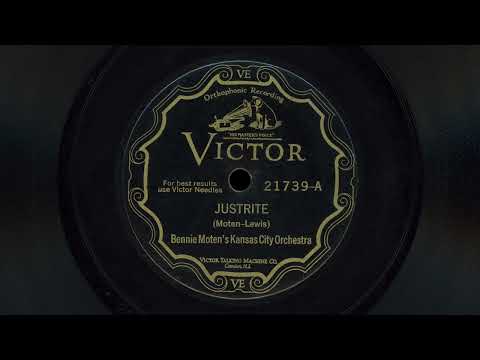
  • “Justrite” – Bennie Moten’s Kansas City Orchestra (1928)

    “Justrite” – Bennie Moten’s Kansas City Orchestra (1928)

    Some excellent Kansas City jazz from Bennie Moten on Victor.

    September 6-7 1928 saw Bennie Moten’s Kansas City Orchestra in the Victor studios in Camden, New Jersey for an epic two day session that yielded eleven released sides – including “South” – the last song to be recorded on the 7th and the band’s most popular and enduring hit. “South” stayed in print in the RCA Victor catalog until the late 1950s and was also released on 45pm.

    Here, we have the first song recorded on Sept 6th: “Justrite”, with songwriting credits split between Moten and cornetist Ed Lewis.

    I’m not sure if my ears are full of stuffing, but a few other versions of this tune out there (like the version on Spotify) sound a tad sharp. This one sounds in tune to my ears when I play along with it – but you’ll have to tell me what you think. If I’m wrong please let me know and I’ll schedule a cerumenectomy post haste. ^_^

    The tune starts off with an insistent tension, but soon falls into a driving groove with some nice ensemble playing before Ed Lewis finally hits a solo around the minute mark. He is followed by what sound like a vocal effect similar to Cliff Edwards’ “Effin’”. A baritone sax solo follows, then a banjo solo. A second distant-sounding cornet takes us back to a rousing conclusion.

    Recorded in Camden, New Jersey on September 6, 1928.
    Released as Victor 21739.

    Credits
    Bennie Moten – piano, director
    Ed Lewis, Booker Washington – cornet
    Thamon Hayes – trombone
    Harlan Leonard – clarinet, soprano sax, alto sax
    Jack Washington – clarinet, alto sax, baritone sax
    Woody Walder – clarinet, tenor sax
    Leroy Berry – banjo
    Vernon Page – tuba
    Willie McWashington – drums

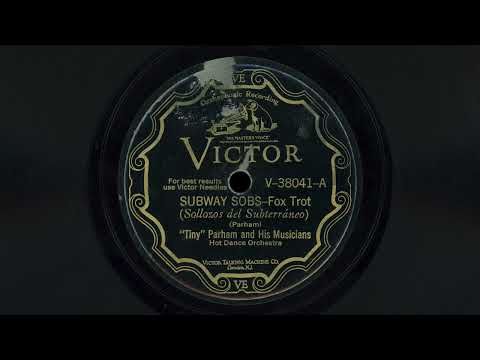
  • “Subway Sobs” – Tiny Parham and his Musicians (1929)

    “Subway Sobs” – Tiny Parham and his Musicians (1929)

    Thanks to the watchful eye of @atertiary78 for spotting this on Discogs right after it was listed and messaging me about it.

    It nearly did not make it to me, as the seller did not want to pack it using tried-and-true methods of safely shipping 78s. When I protested that using LP mailers or pizza boxes were very risky, he insisted that he would be using a “method passed down from his grandfather” to pack it. It arrived in a glorified pizza box with some bubble wrap. Perhaps pizza boxes were made of oak crates back in Grandpa’s day. In any case, somehow it survived the trip. The 78 gods truly do work in mysterious ways.

    This copy has some surface noise – but every time Quinn Wilson’s tuba starts this one off, I can’t help but listen to the whole thing despite the sizzle of that Victor shellac in the background. The performances are so wonderful on this one – from the clarinet to the violin to the trombone to the guitar to the tuba! One of those 20s jazz bands that definitely merits more spotlight!

    Recorded in Chicago, Illinois on February 2, 1929.
    Released as Victor V-38041. Later reissued as Bluebird B-6031.

    Credits
    Tiny Parham – piano, director
    Roy Hobson – cornet
    Charles Lawson – trombone
    Charles Johnson – clarinet, alto sax
    Elliott Washington – violin
    Mike McKendrick – guitar
    Quinn Wilson – tuba
    Ernie Marrero – drums

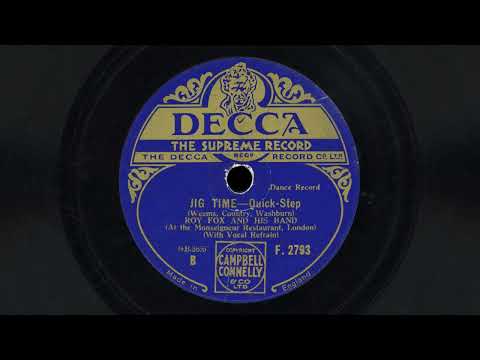
  • “Jig Time” – Roy Fox and his Band (1932) featuring Al Bowlly

    “Jig Time” – Roy Fox and his Band (1932) featuring Al Bowlly

    I know very little about British jazz and dance bands, so last year I asked a friend in the U.K. to pick out a few discs out for me.

    From what I’ve learned about Roy Fox – he was born in Denver, Colorado, grew up in Los Angeles, and lived in the U.S. until 1929, when he moved to London to lead a band there.

    1932 finds Fox leading a band at the Monseigneur restaurant in London featuring rising musical stars such as Al Bowlly, Nat Gonella, and Lew Stone.

    This tune is a fun hot dance tune – and you may certainly feel like doing a jig of your own once the band fires up.

    Bowlly opines: “You heard a lot of talk about rhythm, and how it affects the mind. Some folks like a dreamy waltz, some like another kind!”

    Recorded in London UK on January 21, 1932 at the Monseigneur Restaurant.
    Released as Decca F.2793.

    Credits
    Roy Fox – cornet, director
    Nat Gonella, Sid Buckman – trumpet
    Joe Ferrie – trombone
    Jim Easton, Ernest Ritte, clarinet, alto sax, baritone sax
    Harry Berly – tenor sax
    Lew Stone, piano
    Al Bowlly, guitar, vocals
    Don Stuteley – string bass
    Bill Harty – drums

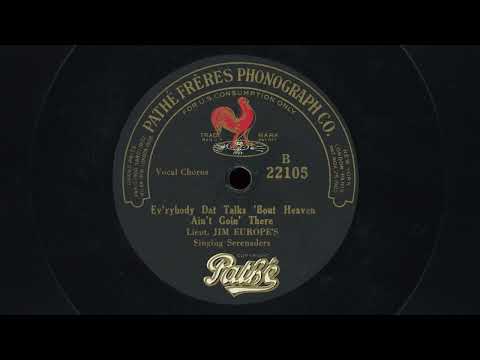
  • “Ev’rybody Dat Talks ‘Bout Heaven Ain’t Goin’ There” – Lt. Jim Europe’s Singing Serenaders (1919)

    “Ev’rybody Dat Talks ‘Bout Heaven Ain’t Goin’ There” – Lt. Jim Europe’s Singing Serenaders (1919)

    Lt. James Reece Europe’s 369th U.S. Infantry “Hell Fighters” Band is well known in jazz circles. Lesser known are the small handful of vocal quartet recordings made during his prolific recording sessions for Pathé in March of 1919.

    Here we have an acapella vocal quartet singing a variation of a traditional African-American gospel song “All God’s Chillun Got Shoes” – with the addition of a wonderful line that was made the title of the song: Ev’rybody Dat Talks ‘Bout Heaven Ain’t Goin’ There. I find this apt social commentary to be quite interesting.

    Recorded in New York City in March 1919.
    Released as Pathé 22105.

    Credits:
    Unknown artists (perhaps Creighton Thompson and Noble Sissle?)

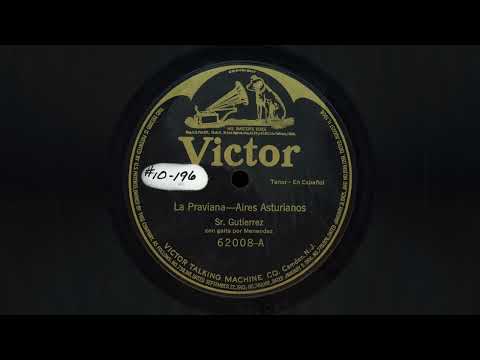
  • “La Praviana – Aires Asturianos” – Ramón Gutiérrez (1909) con gaita

    “La Praviana – Aires Asturianos” – Ramón Gutiérrez (1909) con gaita

    Here’s a really interesting recording: a Spanish vocalist singing an Asturian popular tune (taken from a play of the same name that premiered in Madrid in 1896) with gaita (bagpipes) accompaniment.

    A reminder that although we tend to think of bagpipes as a Scottish instrument, it came through Europe via North Africa nearly 1,000 years before it reached Scotland.

    The song begins “Soy de Pravia” (I am from Pravia) and its title indicates it refers to the Asturian town of Pravia in northern Spain.

    I am from Pravia
    I am from Pravia
    and my mother is a Pravian
    and my mother is a Pravian
    and that is why there is no room
    for any bad game in me.

    Recorded in Havana, Cuba on February 7, 1909.
    Released as Victor 62008.

    This batwing repressing was dubbed (as noted in DAHR). You can actually hear the dubbing apparatus at the very end of the record as the gaita fades out – first you hear the surface noise of the original record, then the needle lifts and you hear the much quieter surface noise of the dubbed copy.

    Credits:
    Ramón Gutiérrez – vocals
    Menéndez – gaita

    The flip side of this record can be heard at:
    https://youtu.be/5dCjo-vmgHM

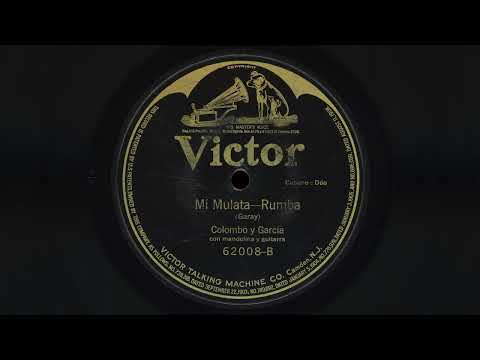
  • “Mi Mulata” – Colombo Y Garcia (1909) early recorded rumba from Havana, Cuba

    “Mi Mulata” – Colombo Y Garcia (1909) early recorded rumba from Havana, Cuba

    My interest in Congolese rumba of the 40s and 50s has led me to seek out early Cuban records that served as their inspiration. Here we have a very interesting early recording of a rumba made in Havana, Cuba in 1909 featuring two vocalists accompanied by a mandolin and guitar.

    It starts out pretty lively – and then the whistling kicks in at 0:24 and you get hooked pretty fast after that.

    Recorded in Havana, Cuba on February 8, 1909.
    Released as Victor 62008.

    This batwing repressing was dubbed from an original source – as noted in DAHR. You can hear the dubbing apparatus at the end of the track – the surface noise of the original comes to an abrupt halt as the stylus is lifted – then you hear a low mechanical noise as the tonearm is pulled back.

    Credits
    Adolfo Colombo – tenor vocals
    Claudio García – baritone vocals

    The flip side of this record can be heard at:
    https://youtu.be/9IMXKCIKqY4

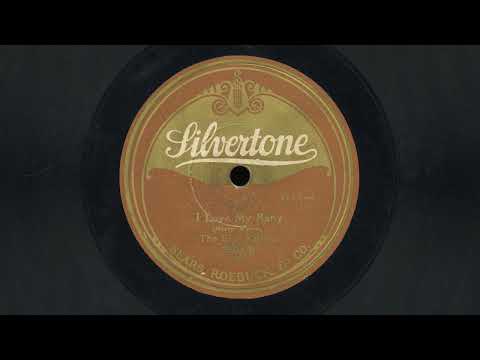
  • “I Love My Baby” – The Blue Kittens (1926)

    “I Love My Baby” – The Blue Kittens (1926)

    This one was a little beat, and I wondered if it was worth posting at all – but it was so invigorating that my enthusiasm got the best of me and here it is.

    This hot session is just a whole lot of fun. The band is tight and is trading solos so fast that one’s head starts to spin. It’s also always nice to hear a great bass sax player who is not Adrian Rollini or Coleman Hawkins. A delightful romp.

    0:00 intro
    0:24 sax solo
    0:40 muted trumpet solo
    0:38 sax solo
    0:56 trumpet solo
    1:12 bass sax solo
    1:21 trumpet lead
    1:35 clarinet solo
    1:51 trombone solo
    1:59 clarinet solo
    2:05 ensemble

    Erudite viewer @jslas2-590 has informed me that this is not a Harry Reser-led session as Rust reports but instead a session led by William Covington “Bill” Perry. I’ve updated the credits below as per his instruction.

    Recorded in New York City in January 1926.
    Released as Silvertone 3504 (mx. 2391).
    Original issue: Paramount 20434

    Credits:
    Andy Bossen (?) – trumpet
    Miff Mole (?) – trombone
    Ken “Goof” Moyer – clarinet, alto sax, baritone sax
    Jimmy Johnston – bass sax
    William Covington “Bill” Perry (?) – piano, leader, arranger
    Harry Reser – banjo
    Milton Sands (?) – drums