Jazz Crazy Records

An Archive of Early Jazz on 78 RPM

Author: Professor M

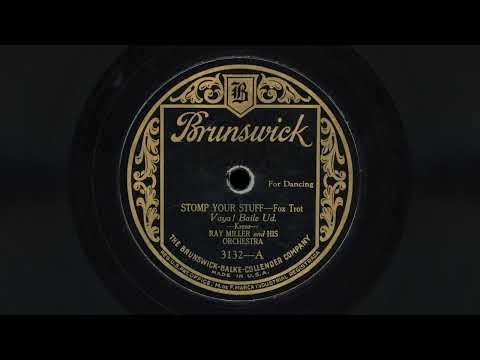
  • “Stomp Your Stuff” – Ray Miller and his Orchestra (1926)

    “Stomp Your Stuff” – Ray Miller and his Orchestra (1926)

    Was flipping through my Ray Miller records and came across this jazzy dance tune – Didn’t see a transfer of this one anywhere on YouTube yet so here it is!

    Vaya! Baile Ud.!

    Thanks to a comment by @henridelagardere264 I did some additional research on composer Bill Krenz – who was born in 1899 not far from me in Rock Island, Illinois. This was Krenz’ first composition – and he went on to write many more – including “Starlight Rendezvous” which was performed by Tommy Dorsey and a number of minor rags in the 1950s such as “Boogie Woogie Russian Rag”, “Poodle Rag”, and “Ramblin’ Rag”.

    Krenz played a solo piano set at the Bix Lives! Memorial Jazz Festival in Davenport in 1974 – so I wonder if he had moved back to the Quad Cities by that point?

    Recorded in New York City on March 9, 1926.
    Released as Brunswick 3132.

    Credits:
    Ray Miller – director
    Charlie Margulis, Bob Howard – trumpet
    Andy Sindelar, Mike Durso – trombone
    Volly de Faut – clarinet, alto sax
    Fred Crissey – alto sax
    Karl Spaeth – tenor sax
    Herman Kaplan – violin
    Bill Krenz, Joe Breitenbach – piano
    Happy Mansfield – tuba
    Tony Briglia – drums
  • “Old Man Blues” – Duke Ellington and his Orchestra (1930)

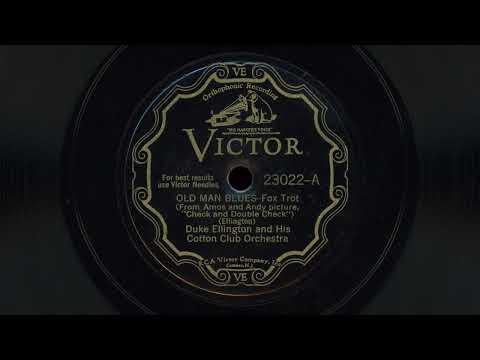
    “Old Man Blues” – Duke Ellington and his Orchestra (1930)

    “Old Man Blues” is an energized contrafact of “Old Man River” – the hit by Jerome Kern and Oscar Hammerstein from the Broadway play “Showboat”. Duke dials up the tempo and gives it an innovative arrangement full of engaging moments and showboating solos.

    Duke and the band were in Hollywood to appear in the Amos ‘n Andy film “Check and Double Check” and while there, recorded three songs: this one, “Ring Dem Bells” and “Three Little Words.”

    If you’d like to watch Duke and the band play this tune in the film, head over to:
    https://www.youtube.com/watch?v=RGb6fpS4Ais

    It’s a rare opportunity to see an early jazz band playing live, complete with the showmanship that they exhibited nightly at the Cotton Club.

    Recorded in Hollywood, California on August 26, 1930.
    Released as Victor 23022.

    Credits:
    Duke Ellington – piano, arranger, director
    Cootie Williams, Arthur Whetsel, Freddy Jenkins – trumpet
    Joe Nanton – trombone
    Juan Tizol – valve trombone
    Johnny Hodges – clarinet, soprano sax, alto sax
    Harry Carney – clarinet, alto sax, baritone sax
    Barney Bigard – clarinet, tenor sax
    Fred Guy – banjo
    Wellman Braud – bass
    Sonny Greer – drums

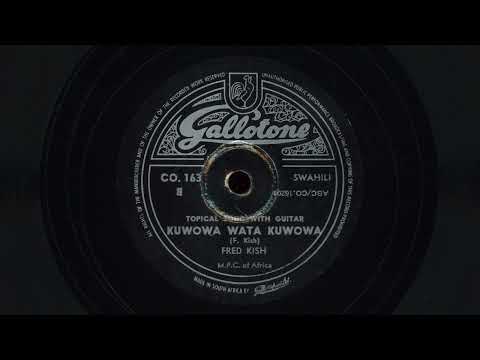
  • “Kuwowa Wata Kuwowa” – Fred Kish (1957) – Congolese guitarist with glass bottle accompaniment

    “Kuwowa Wata Kuwowa” – Fred Kish (1957) – Congolese guitarist with glass bottle accompaniment

    I know very little about this wonderful Congolese guitarist.

    The tune follows a familiar format: fingerstyle guitar, two harmonizing vocals, and a glass bottle accompaniment.

    Released as Gallotone CO.163.

    The flip side, “Alesi”, can be heard here:
    https://youtu.be/GnQgakuJC1A

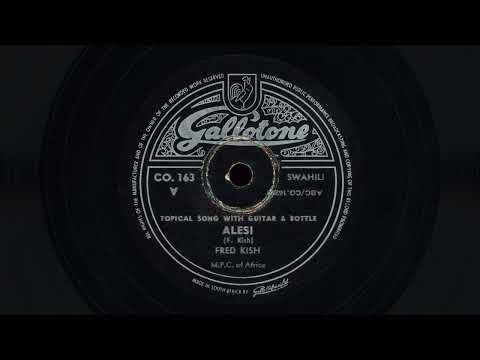
  • “Alesi” – Fred Kish (1957) – Congolese guitarist with glass bottle accompaniment

    “Alesi” – Fred Kish (1957) – Congolese guitarist with glass bottle accompaniment

    I know very little about this wonderful Congolese guitarist.

    The tune follows a familiar format: fingerstyle guitar, two harmonizing vocals, and a glass bottle accompaniment.

    Released as Gallotone CO.163.

    The flip side, “Kuwowa Wata Kuwowa”, can be heard here:
    https://youtu.be/ad65J30nR3U

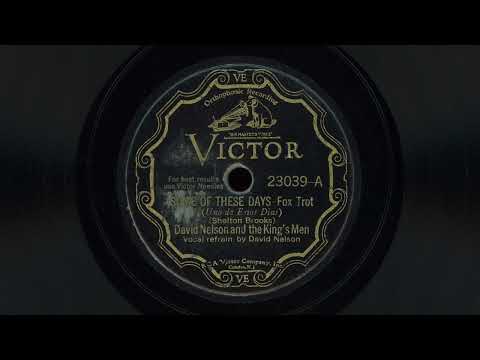
  • “Some of these Days” – David Nelson and the King’s Men (1931) – King Oliver’s Nephew!

    “Some of these Days” – David Nelson and the King’s Men (1931) – King Oliver’s Nephew!

    Dave Nelson was a Louisiana-born trumpet player (and nephew of jazz royalty King Oliver) who most famously played on the King Oliver Orchestra’s Victor sides from 1929 through 1931.

    He led two sessions with his own band in 1931 that resulted in seven released sides – three on Victor and four on the budget Timely Tunes label. His orchestra, comprised of many “borrowed” players from King Oliver’s Orchestra, were aptly named the “King’s Men”.

    I don’t suppose you could have picked a worse time to go out on your own as a bandleader as 1931 during the throes of the Great Depression. After 1931, the next time Dave Nelson appears on a record is 1937 when he played a session with Willie “The Lion” Smith and his Cubs for the Decca label.

    Recorded in New York City on January 14, 1931.
    Released as Victor 23039.

    DAHR reports only 5,976 copies were sold. To give some measure of comparison, Victor 23040 by the Doc Daugherty Orchestra sold well over 12,000 copies

    Credits:
    David Nelson – trumpet, vocals, director
    Melvin Herbert, Harry Brown – trumpet
    Wilbur de Paris – trombone
    Buster Bailey, Glyn Paque – clarinet, alto sax
    Charles Frazier – tenor sax
    Wayman Carver – tenor sax, flute
    Sam Allen – piano
    Arthur Taylor – guitar
    Simon Marrero – bass
    Gerald Hobson – drums

    If you like this tune, be sure to check out Dave Nelson’s “When Day is Done”:
    https://youtu.be/N9jyKbSEM-U

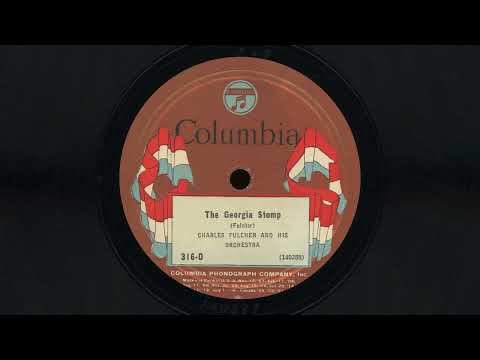
  • “Georgia Stomp” – Charles Fulcher and his Orchestra (1925) Atlanta Jazz

    “Georgia Stomp” – Charles Fulcher and his Orchestra (1925) Atlanta Jazz

    Recorded in Atlanta, Georgia on January 28, 1925.
    Released as Columbia 316-D.

    Credits:
    Charles Fulcher – clarinet, violin, director
    A. D. Barfield – trumpet
    Pop Miller – trombone
    Otis Haislip, Neely Plumb – alto sax
    Frank Crutcher – tenor sax
    Bo Norris – piano
    Gwynn Hester – banjo
    Chuck Jordan – tuba
    Sandy Jordan – drums

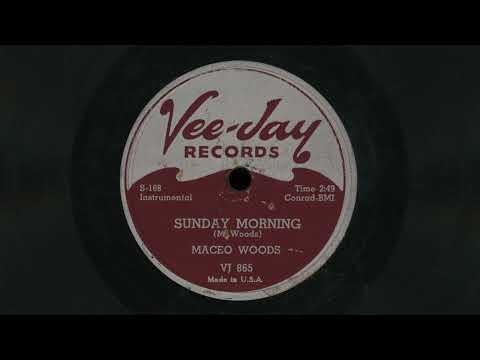
  • “Sunday Morning” – Maceo Woods (1955) – Amazing Gospel Organist

    “Sunday Morning” – Maceo Woods (1955) – Amazing Gospel Organist

    I got this record in a box of about 50 blues and gospel records that I traded a a few vinyl records for. They all looked beat and scratched up but I was pleasantly surprised that they played just fine.

    From the second I put it on the turntable, this record by Reverend Maceo Woods from Chicago reached out and spoke to me. While it’s an inside joke among many 78 collectors that organ records are among the least desirable records to find when you go on a dig – this was no joke.

    A massive Hammond B-3 sound that was in no hurry to get anywhere = yet continually reached higher and higher as though the sky had no limit. Woods was an amazing player. Every time the record would end I immediately wanted to hear it again.

    I learned that Rev. Woods played and preached at the Christian Tabernacle in Chicago – and only just passed away in 2020 at the age of 87. In his obituary in the Chicago Sun-Times, it notes that British musician Brian Eno had listed one of Rev. Woods’ albums in a list of his 13 favorite records.

    This record was recorded in1955 but not released until 1958 – right at the tail end of the 78 rpm era in the United States – as 7-inch 45 rpm singles began to phase out these older 10-inch records.

    Recorded in Chicago, Illinois on August 21, 1955.
    Released as Vee-Jay VJ-865.

    Credits:
    Reverend Maceo Woods – Organ

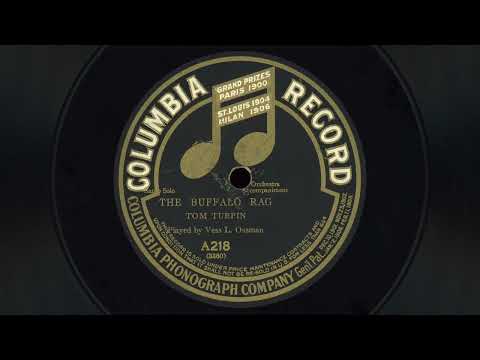
  • “Buffalo Rag”  – Vess L. Ossman (1905) – Ragtime Composition by Tom Turpin

    “Buffalo Rag” – Vess L. Ossman (1905) – Ragtime Composition by Tom Turpin

    Tom Turpin, the “Father of St. Louis Ragtime”, published seven compositions in his lifetime, including this one composed in 1904 and performed here on banjo by Vess L. Ossman with orchestra accompaniment.

    Some misalignment in the label design can be seen here – where the title and artist information seems to be off-center from where it usually appears. This seems to indicate that this information was printed separately from the rest of the label.

    Recorded in New York City circa 1905.
    Released as Coumbia A218.

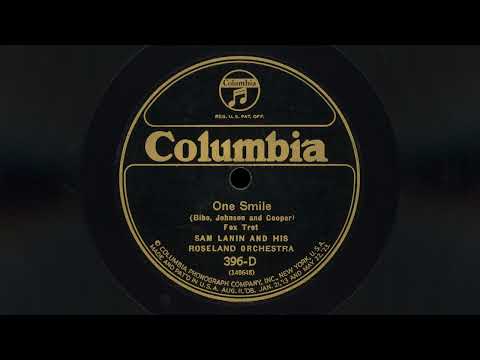
  • “One Smile” – Sam Lanin and his Roseland Orchestra (1925)

    “One Smile” – Sam Lanin and his Roseland Orchestra (1925)

    A lilting dance number by Lanin’s Roseland Orchestra featuring some nice trumpet work by Red Nichols starting at 2:21.

    Recorded in New York City on June 3, 1925.
    Released as Columbia 396-D.

    Credits:
    Red Nichols, Hymie Farberman – trumpet
    Herb Winfield – trombone
    Clarence Heidke, Alfie Evans – clarinet, alto sax
    George Slater – clarinet, tenor sax
    Eddie Sheasby – violin
    Bill Krenz – piano
    Tony Colucci – banjo
    Joe Tarto – tuba
    Vic Berton – drums

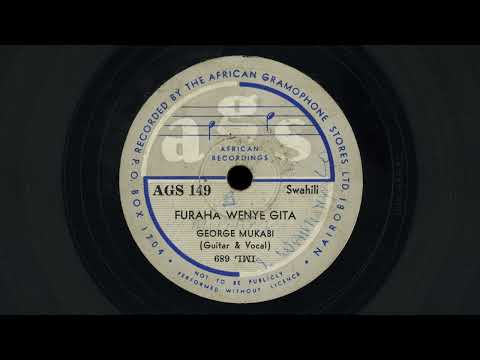
  • “Furaha Wenye Gita” – George Mukabi – Legendary Kenyan Guitarist

    “Furaha Wenye Gita” – George Mukabi – Legendary Kenyan Guitarist

    George Mukabi was a guitarist from western Kenya credited with inventing the sukuti guitar style – a syncopated fingerstyle technique that combines rhythm and lead parts in a way that rhythmically imitates the sound of sukuti drums used in traditional Luhya music. His music was often accompanied by a glass bottle (or two) and sometimes by Jack Malenya, a second vocalist who harmonized in a higher register.

    “Happiness with Guitar” seems an apt translation for this beautiful tune – but the lyrics discuss an apparent kidnapping of three girls and a subsequent death. The chorus somewhat ironically suggests “If you want to look for happiness – go and make friends with any guitarist” [translation from liner notes of Mississippi Records release noted below]

    This record is not in the best shape but I was quite thrilled to get a copy.

    Released as AGS 149 on the African Gramophone Stores (AGS) label.

    To hear more of Mukabi’s work, check out Mississippi Records’s excellent release “Furaha Wenye Gita” produced by Cyrus Moussavi:
    https://mississippirecords.bandcamp.com/album/furaha-wenye-gita