Jazz Crazy Records

An Archive of Early Jazz on 78 RPM

Author: Professor M

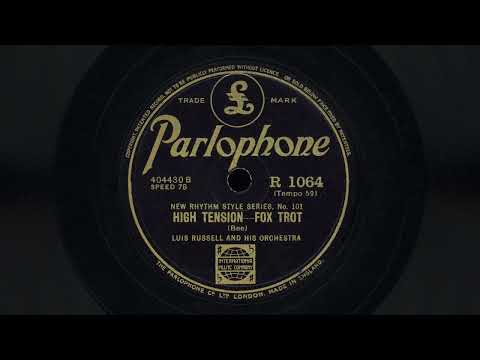
  • “High Tension” – Luis Russell and his Orchestra (1930)

    “High Tension” – Luis Russell and his Orchestra (1930)

    One of three recordings the great Luis Russell orchestra made during a fantastic 1930 session that I’ll be highlighting over the next week.

    This tune composed by Belgian David Bee has been called “hectic” and “quirky” – but seems to fit into a genre of jazz composition about strange mental states (think Arthur Schutt’s “Delirium” or Fletcher Henderson’s “Jangled Nerves” or “Queer Notions”), which are among my favorite compositions!

    In any case, there are many delightful moments to be enjoyed on this record – as solos begin after the first 54 seconds. We hear a rapid fire line of 8 bar solos with standout moments from Higginbotham and also from the trio of Russell, Foster, and Barbarin.

    Recorded in New York City on September 5, 1930.
    Released in the U.K. as Parlophone R 1064.
    (Original domestic release = Okeh 8849)

    Credits
    Luis Russell – piano, director
    Otis Johnson, Henry Red Allen – trumpet
    J.C. Higginbotham – trombone
    Charlie Holmes – alto sax
    Albert Nicholas – alto sax, clarinet
    Greely Walton – tenor sax
    Will Johnson – banjo, guitar
    George Pops Foster – string bass
    Paul Barbarin – drums

    The two other recordings from this same session:

    “Muggin’ Lightly”
    https://youtu.be/uezEjgzmt8E

    “Panama”
    https://youtu.be/WeryW5ri6yU
  • Bhairobi Tumri – Miss Gauharjan (1904) – Very Early Recording of Legendary Indian Vocalist

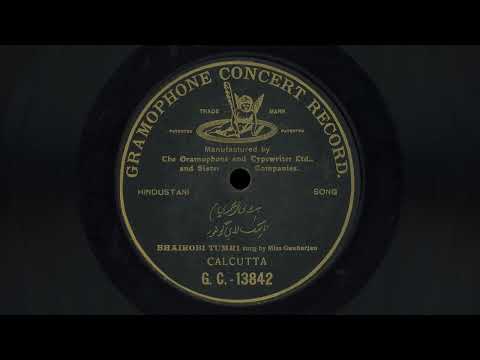
    Bhairobi Tumri – Miss Gauharjan (1904) – Very Early Recording of Legendary Indian Vocalist

    Legendary classical vocalist Gauhar Jan was born in Azamgarh, India in 1870. She could sing in over 20 languages and recorded over 600 records.

    This was from a very early session from 1904. It was reissued as HMV P-17 which I also have a copy of, but believe it or not, the older GCR made for a slightly better transfer!

    This early acoustic recording made for a very tricky transfer – and it really took a lot to minimize noise without sacrificing the performance. Hopefully it is enjoyable!

    If you stick around until the very end, you’ll hear the voice of Gauhar Jan herself announcing her name as was the custom of many early recordings.

    Recorded by William Sinkler Darby in Calcutta, India in December 1904.
    Released as Gramophone Concert Record G. C. – 13842 (mx. E2585h)

    Miss Gauhar Jan is accompanied by unknown artists on harmonium and tabla.

    Notes from Michael Kinnear “Discography of Miss Gauhar Jan of Calcutta”, The Record News, Vol. 9, Jan. 1993.

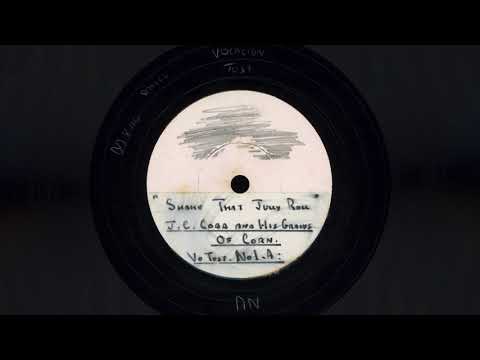
  • “Shake that Jelly Roll” – Junie C.  Cobb and his Grains of Corn (1929) Test Pressing!

    “Shake that Jelly Roll” – Junie C. Cobb and his Grains of Corn (1929) Test Pressing!

    If you really want to hear what music from the jazz age can sound like – take a listen to this amazing-sounding test pressing of Vocalion 1263! When the string bass takes a solo at 2:22 you’ll see what I mean!

    Probably one of the cleanest 78 rpm records I’ve ever heard! Apparently, U.K. audio engineer John R.T. Davies had gotten a hold of the metal masters and had this pressed up in vinyl. The surface noise is barely audible at all and the purity of sound on this transfer really delighted my ears!

    Junie Cobb was born in Hot Springs, Arkansas in 1896 who learned to play a variety of instruments. He moved to Chicago in the early 1920s and played with King Oliver and Jimmie Noone before putting together his own band with his brother, Jimmy, on trumpet.

    “Shake That Jelly Roll” is Cobb original – though a Lester Melrose credit appears on the record label – one of the Melrose brothers who owned a music publishing business in Chicago and would often write “lyrics” for instrumental tunes so that they would get part of the royalty.

    The tune starts off as though the band were about to play “Copenhagen” – but after a five second fake-out, the band launches into some hot fun, with hype man Junie Cobb braying out rejoinders such as “Oh Look at that Gal Shakin’ that Jelly Roll!” to keep the band fired up.

    Recorded in Chicago, Illinois on February 7, 1929.
    Originally released as Vocalion 1263.

    Credits:
    Jimmy Cobb – cornet
    Darnell Howard – clarinet, alto sax
    Junie Cobb – tenor sax, violin, clarinet, vocals
    Bob Waugh – violin
    Alex Hill – piano
    Eustern Woodfork – banjo
    Bill Johnson – string bass
    W. E. Burton – drums

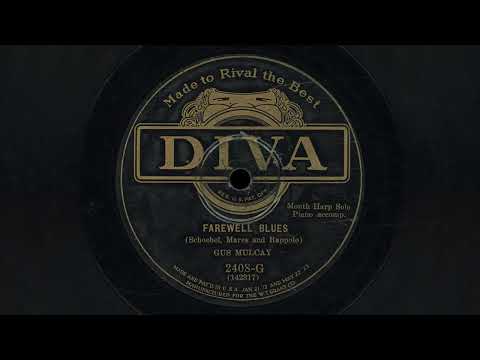
  • “Farewell Blues” – Gus Mulcay (1926) – Early Jazz Harmonica

    “Farewell Blues” – Gus Mulcay (1926) – Early Jazz Harmonica

    Recorded in New York City on June 18, 1926.
    Released as Diva 2408-G.

    Credits
    Gus Mulcay – mouth harp
    Irving Sherman – piano

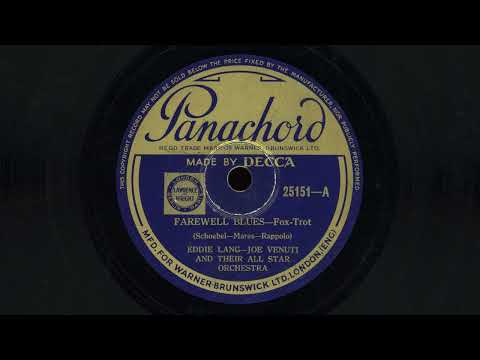
  • “Farewell Blues” – Eddie Lang – Joe Venuti and their All Star Orchestra (1931)

    “Farewell Blues” – Eddie Lang – Joe Venuti and their All Star Orchestra (1931)

    A rousing deep-depression cut from Lang and Venuti and friends. The boys take on the early standard “Farewell Blues”, written and recorded by members of the New Orleans Rhythm Kings almost a decade earlier.

    Lang and bassist Ward Lay keep a stompin’ rhythm throughout as we hear a rotating selection of outstanding soloists, including Benny Goodman on clarinet, Venuti on violin, Jack Teagarden on trombone, and Charlie Teagarden on trumpet.

    Recorded in New York City on October 22, 1931.
    Released as Panachord 25151

    Credits
    Charlie Teagarden – trumpet
    Jack Teagarden – trombone
    Benny Goodman – clarinet
    Joe Venuti – violin
    Frank Signorelli – piano
    Eddie Lang – guitar
    Ward Lay – string bass
    Neil Marshall – drums

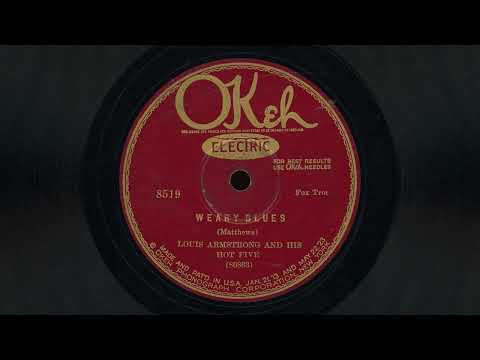
  • “Weary Blues” – Louis Armstrong and his Hot Seven (1927)

    “Weary Blues” – Louis Armstrong and his Hot Seven (1927)

    Clarinet Week on the channel wraps up today with one of my favorite players, the great Johnny Dodds, playing with Louis Armstrong and his Hot Seven – somehow mislabeled on this record as his Hot Five.

    Dodds comes storming out of the gate on this one – playing loop-de-loops around Armstrong as Satch states the rhythmic melody in the introductory section. A few hot banjo and tuba breaks later, Armstrong drives home an energetic solo which is abruptly taken over by Dodds playing a syncopated riff in a very low register – which he stays within throughout the rest of his solo.

    John Thomas follows with a trombone solo which is followed by Satch and his cornet leading us back to the ensemble for a rousing end.

    Recorded in Chicago, Illinois on May 11, 1927.
    Released as Okeh 8519.

    Credits:
    Louis Armstrong – cornet
    John Thomas – trombone
    Johnny Dodds – clarinet
    Lil Armstrong – piano
    Johnny St. Cyr – banjo
    Pete Briggs – tuba
    Baby Dodds – drums

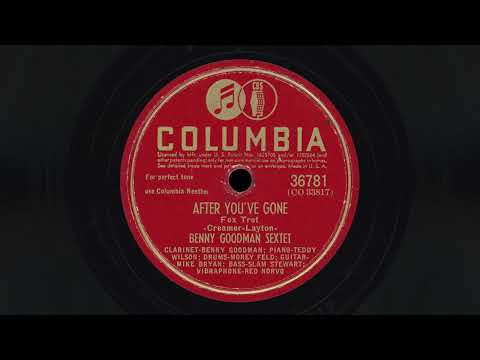
  • “After You’ve Gone” – Benny Goodman Sextet (1945)

    “After You’ve Gone” – Benny Goodman Sextet (1945)

    There are a couple of things that new collectors of 78s always hear – and some take as gospel: One is that prewar jazz is where it’s at and postwar jazz is not as interesting. The other is that there is no good music to be found on red label Columbia records.

    This record handily dispels both myths in one fell swoop – an astonishing version of the 20s classic “After You’ve Gone” by the Benny Goodman Sextet which is so loaded with musical ideas that by the end you feel a need to catch your breath!

    After Goodman states the theme, we get successive solos by Teddy Wilson on piano followed by Goodman on clarinet, Norvo on vibes, and Stewart on bass, complete with his characteristic melodic vocalizations.

    While Goodman is the obvious standout with his breakneck solos that seem to be racing so fast they risk leaping over the guard rails, Stewart really takes this number into the stratosphere – literally pushing Benny to the cusp of bop with his driving bass. Interestingly, this was his debut with the Goodman group – and what a showing!

    Don’t let anyone tell you there isn’t great music on these ole’ postwar red Columbias! If you follow your ears, you’ll find the good stuff.

    Recorded in New York City on February 4, 1945.
    Released as Columbia 36781

    Credits:
    Benny Goodman – clarinet, director
    Teddy Wilson – piano
    Red Norvo – Vibraphone
    Mike Bryan – guitar
    Slam Stewart – bass
    Morey Feld – drums

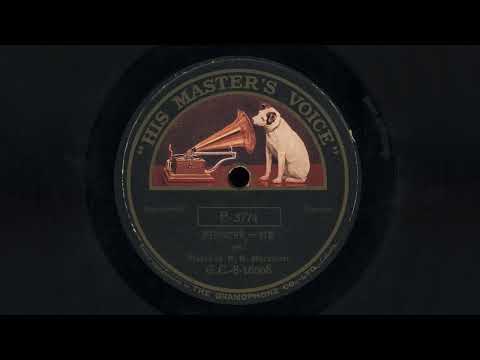
  • “ক্লারিওনেট বাদ্য – দেশ। / কীর্তন সুরা।” – N. Mazumdar (1917) – Indian Clarionet

    “ক্লারিওনেট বাদ্য – দেশ। / কীর্তন সুরা।” – N. Mazumdar (1917) – Indian Clarionet

    These two sides of instrumental clarionet are performed by N. Mazumdar (amateur).

    Mr. Mazumdar recorded a number of sides for the Gramophone Concert Record label in the 16000 block series of clarionet recordings. He also is credited on a few Columbia releases from much later in the 1930s.

    I find that his playing is a delight to listen to. In study of Indian music, I have learned about the concept of meend which refers to the practice within certain raags to slide between certain notes, creating a glissando. What is interesting about this performance is hearing the meend interpreted on this reeded instrument – which creates such flowing melodies.

    Recorded by George Dillnutt in Calcutta, India on January 20, 1917.
    Released as His Masters Voice P. 3774.
    Originally released as Gramophone Concert Record G.C. – 8-16008.

    Matrix 4738AK দেশ। is accompanied by tabla.
    Matrix 4739AK কীর্তন সুরা। is accompanied by tabla and harmonium.

    Thank you to Jonathan Ward of Excavated Shellac for providing more information on the date and recording of this record!

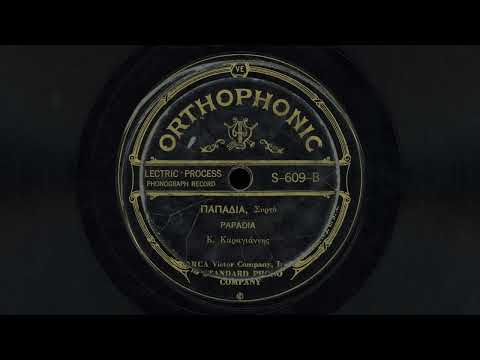
  • “Παπαδιά” – Κώστας Καραγιάννης (1931) – Greek Clarinet

    “Παπαδιά” – Κώστας Καραγιάννης (1931) – Greek Clarinet

    The Ted Lewis record I posted yesterday had me digging through the stacks to find interesting clarinet records – both in and outside the jazz tradition. I found a few that I wanted to share and this is one of them.

    I am very happy to have learned more about Kóstas Karagiánnis, the clarinetist on this record from viewer @henridelagardere264. He was born in the late 1880s to a family of folk artists and seems to have learned clarinet from a local master – perhaps from a Turkish-born musician named Ζεκύλ (Zekyll).

    I found his energetic playing on this record to be inspired and lively.

    The Orthophonic label is an interesting one – made by Victor and sold domestically, they reissued many imported Greek records from the late 1920s and early 1930s. DAHR said that this 12″ Orthophonic issue was “re-recorded” from a 10″ record – which I take to mean was dubbed. If so – it holds up quite well for a dubbed copy.

    Συρτο (Syrto)

    Recorded in Athens, Greece on May 13, 1931.
    Re-recorded (dubbed) from 10″ on December 3, 1931.
    Released as Orthophonic S-609.

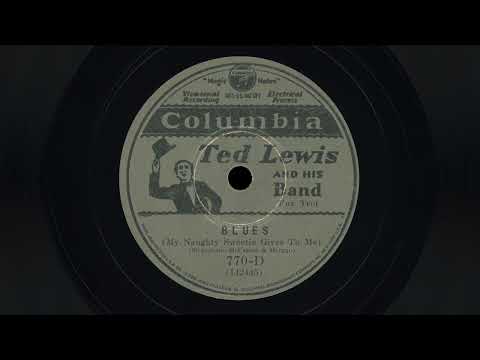
  • “Blues (My Naughty Sweetheart Gives To Me)” – Ted Lewis and his Band (1926)

    “Blues (My Naughty Sweetheart Gives To Me)” – Ted Lewis and his Band (1926)

    I can’t believe in the nearly two and a half years I’ve had this channel I’ve never posted a Ted Lewis record! To rectify this, here is the hilariously named “Blues (My Naughty Sweetheart Gives To Me)”.

    Lewis first recorded this song in 1919 at his first session for Columbia with a smaller band. Here we find a electric recording of Lewis seven years later giving the tune a fresh look. Lewis’ clarinet verges on a klezmer style throughout, and seems to constantly inspire the other instruments to join in as he stretches out.

    The original issue was a standard black Columbia Viva-tonal label – and this one is a repressing from 2-3 years later with Lewis’ custom Columbia label. These labels were originally a mirrored silver – but with age and time, the chrome finish dulled to a battleship grey.

    Recorded in Chicago, Illinois on July 16, 1926.
    Released as Columbia 770-D.

    Ted Lewis – clarinet, alto sax, director
    Walter Kahn, Dave Klein – cornet
    George Brunies – trombone
    Sol Shapiro – violin
    Maurice Aten – banjo
    Frank Ross – piano
    Harry Barth – tuba
    John Lucas – drums