From the first guitar riff you’ll be mesmerized. Early electric blues from 1953 by John Lee Hooker.
Recorded in late 1953
Released as Modern 923.
Credits
John Lee Hooker – vocals, guitar
Eddie Kirkland – guitar

An Archive of Early Jazz on 78 RPM
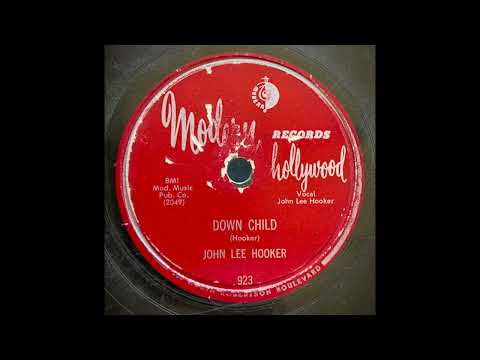
From the first guitar riff you’ll be mesmerized. Early electric blues from 1953 by John Lee Hooker.
Recorded in late 1953
Released as Modern 923.
Credits
John Lee Hooker – vocals, guitar
Eddie Kirkland – guitar
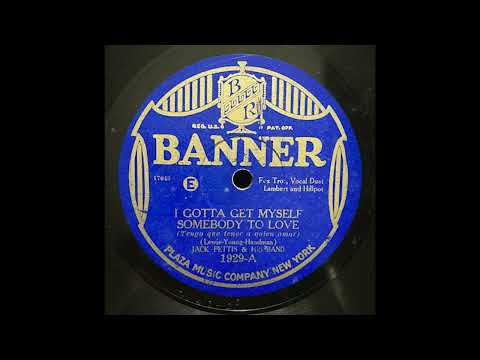
“I’m like a book covered up with dust. Wish I was a hunk of pie with plenty of crust.”
A catchy tune performed by Jack Pettis & his band – which included Eddie Lang on guitar, Joe Venuti (who contributes a violin solo heard in clip two) and Al Goering on piano. Vocal duet by Harold “Scrappy” Lambert and Billy Hillpot.
Recorded in New York City on January 7, 1927. The day before, on January 6, 1927, Sam Lanin recorded the song for Okeh with Red Nichols and Tommy Dorsey. A month later, Annette Hanshaw would record her version.
In addition to being released on the Banner, Domino, Regal, and Oriole labels, the Pettis band version was also released on Broadway, Paramount, Puritan and Silvertone under the pseudonym “The Badgers”.
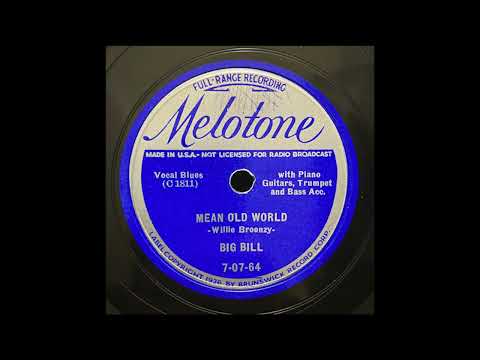
A rollicking Chicago blues number by Big Bill Broonzy about the “mean old world we live in”. Features a swingin’ backup band that includes New Orleans jazz trumpeter Punch Miller.
Recorded in Chicago on Sunday, January 31, 1937.
Released as Melotone 7-07-64
Credits:
Big Bill Broonzy – vocals, guitar
Punch Miller – trumpet
Black Bob – piano
Bill Settles – bass
Fred Williams – drums
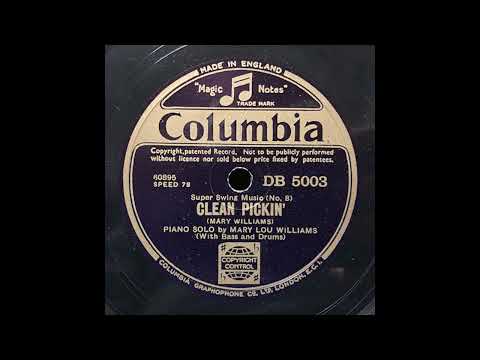
Original jazz composition by the talented Mary Lou Williams on piano accompanied by bass and drums.
Recorded in New York, New York on March 11, 1936.
Released in the U.S. as Decca 1155.
This master pressing was released in the U.K. as Columbia DB 5003
Credits
Mary Lou Williams – piano
Booker Collins – bass
Ben Thigpen – drums
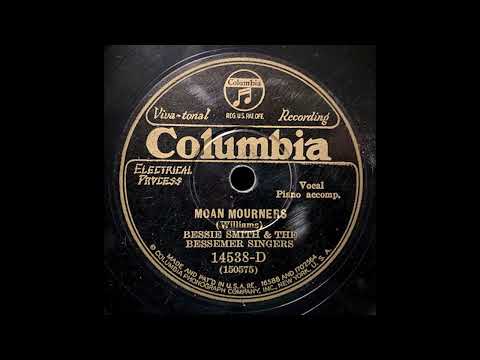
A little Sunday morning sermon for all the backsliders and moanin’ moaners out there from the Queen of the Blues, Bessie Smith.
“Moan Mourners” on Columbia 14538-D is a deep depression-era cut from late in Smith’s career. At this time, the record industry experienced a huge drop in sales and recording sessions for artists. Ms. Smith had seven sessions in 1928, seven in 1929, four in 1930, two in 1931, and none in 1932.
The original title of the tune, composed by Spencer Williams, was “Moan, You Moaners! (A Syncopated Sermon)”. It is not clear why the title was shortened on this record. Typo, perhaps?
Backing vocals are supplied by “The Bessemer Singers” – a pseudonym for the gospel quartet The Dunham Jubilee Singers, who recorded for Gennett and Columbia. Their personnel is not credited but they recorded a week earlier for Columbia with Charlie Alf “Son” Dunham (lead), Rufus Beavers (tenor), Ben Ransaw (baritone), and Leon Patrick (bass).
The identity of the pianist seems to also be disputed – Rust gives Alex Hill while DAHR and Dixon/Godrich credit James P. Johnson.
Recorded in New York City on June 9, 1930.
Credits
Bessie Smith – vocals
The Bessemer Singers – backing vocals
James P. Johnson (?) or Alex Hill (?) – piano
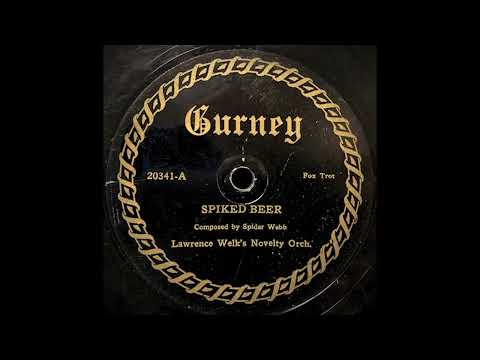
Lawrence Welk left the family farm when he turned 21 with his accordion and set off to make a living in music. He played in a traveling dance band in South Dakota that was known to play hot dance tunes from time to time.
In late 1927 during a blizzard, the band arrived exhausted to Yankton, South Dakota, where they got in touch with Chan Gurney, the son of the President of Gurney’s Seed & Nursery, who operated radio station WNAX. After agreeing to give the boys an audition – which was broadcast live on-air!
Based on their popularity with listeners, they were offered a one-week contract with WNAX that turned into a long and fruitful relationship with the radio station.
The following year, the band traveled to Indiana to record their first record with Gennett. The two sides were released on the Gurney label – funded by the seed company in Yankton.
This release was once considered extremely rare. In 78 Quarterly Volume 12 only two copies were known to exist. Based upon recent conversations with collectors, it appears that a larger number (10-20?) are now known to exist – with perhaps more copies out there yet undiscovered. This copy was found in Vermillion, South Dakota.
Recorded in Richmond, Indiana on November 16, 1928.
Released as Gurney 20341.
(A different take of “Spiked Beer” was released on Gennett 6712 and Champion 15639)
Credits
Lawrence Welk – director, clarinet, alto saxophone, piano-accordion
Leo Fortin – trumpet
Jimmy Garvey – trumpet
Harold “Squeak” Boughton – trombone
Raleigh “Rollie” Chestney – clarinet, alto saxophone, violin, banjo, guitar
Cliff Moore – clarinet, tenor saxophone
Howard Kaiser – clarinet, saxophone
Sidney “Spider” Webb – piano, clarinet
Homer “Smitty” Schmidt – brass bass
Gordon Malie – drums
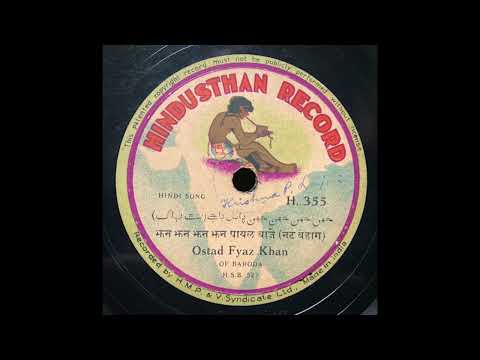
Born on February 8, 1881, Indian vocalist and composer Ustad Faiyaz Khan learned to sing from his grandfather Ghulam Abbas Khan, a great musician who was reputed to live to the age of 125.
In 1915, Faiyaz was employed by the Maharaja of Baroda, thus beginning a lifetime residence in the Baroda state (in present-day Gujarat).
His strong voice was said to move listeners to tears with the beauty of his vocal renderings.
He died on November 4, 1950.
A version of this song, झन झन झन झन पायल बाजे (jhan jhan jhan payal baaje), was later recorded by Bollywood film star Lata Mangeshkar in the 1951 film, Buzdil.
https://www.youtube.com/watch?v=ZFtr82lYWMM&ab_channel=SadabaharHDSongs
Though I am not well-versed in the various genres and styles of Indian classical music, the first time I heard Ustad Faiyaz Khan sing, I also was moved.
Recorded in 1936.
Released as Hindusthan H. 355 (Matrix H.S.B. 527/528).
Notes from “Ustad Faiyazkhan: A Living Legend in his Life Time” by Professor S. R. Mehta, The Record News, Vol 12, Oct. 1993.
Be sure to listen to Johnny Marvin and Ed Smalle’s version of “Blue Skies” and read the early history of the tune I posted there.
“Blue Skies” – Johnny Marvin & Ed Smalle (1927)
https://youtu.be/worniO1uvTs
To continue the story of “Blue Skies” from that post: after the deluge of recorded versions of the tune in early 1927, the decision was made to include it in the new Al Jolson film, “The Jazz Singer”, which was the very first “talkie” film with synchronized music and dialogue. The Jazz Singer went on to be one of the biggest films of 1928, grossing $2.6 million worldwide.
Jazz bands continued to perform and record the tune throughout the 1930s with recordings by:
Benny Goodman (1935)
Bob Pope (1937)
Artie Shaw (1937)
Earl Hines (1937)
Edgar Hayes (1937)
Dixieland Swingsters (1937)
Mario Lorenzi and his Rhythmics (1937)
Maxine Sullivan (1937)
Royal Rhythm Boys (1939)
John Kirby (1939)
Paul Whiteman’s Sax Soctette (1939)
Phillipe Brun (1940)
Sonny Dunham (1940)
Cyril Blake and his Jig’s Club Band (1941)
Tommy Dorsey (1941)
Jimmy Dorsey (1942)
Mel Powell (1942)
After WWII, both Benny Goodman and Count Basie recorded versions of the song which both cracked the top ten list and became popular hits of 1946.
Jazz artists continued to perform the song, with notable versions appearing in the 1950s by Ella Fitzgerald and Oscar Peterson.
Oscar Peterson’s version of Blue Skies:
https://youtu.be/ws5UTJmjYVw
Surprisingly, the most popular version of “Blue Skies” was not performed by a jazz artist at all – but by country singer Willie Nelson, who recorded it in 1978 on his triple platinum album “Stardust”. His version of “Blue Skies” went to #1 on the Billboard Country singles chart.
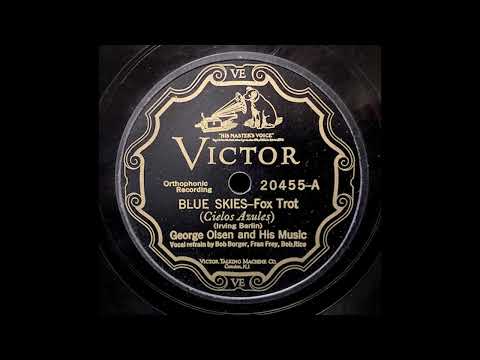
Back to 1927, here we have a peppy version of “Blue Skies” by George Olsen and his Music. The finely crafted arrangement clips along at a faster tempo, verging on hot, and features a beautiful vocal harmony by tenor Bob Borger and baritones Bob Rice and Fran Frey.
Recorded in New York, New York on January 19, 1927.
Released as Victor 20455 in April of 1927.
Credits:
George Olsen – Director
Floyd Rice, Bob Borger – trumpet
Jack Fulton – trombone
Edward Joyce – clarinet, alto sax
Fran Frey – clarinet, alto sax
Milton Neul – clarinet, tenor sax
Larry Murphy – piano
Bob Rice – banjo, guitar
Jack Hansen – tuba
Eddie Kilfeather – arrangement
Unknown artist – violin
Unknown artist – drums
After posting a transfer of Oscar Peterson’s manic 1952 version of “Blue Skies”, a viewer commented that he felt it was too frenetic and I thought it might be interesting to listen to a few earlier versions of the tune to trace its interesting voyage as a jazz standard.
Oscar Peterson’s 1952 version of Blue Skies:
https://youtu.be/ws5UTJmjYVw
“Blue Skies” by Irving Berlin was written for a Broadway musical called Betsy that was not terribly popular, opening on Dec 28, 1926 and closing after 39 performances on January 29, 1927. “Blue Skies”, however, was a hit – audiences loved the song and in mid-January of 1927, record companies scrambled to get recordings out to capitalize on its popularity.
Irving Kaufman seems the first to record it for Columbia’s Harmony label on January 8, 1927. This was followed in rapid succession by:
Jan 10: The Astorites (Harmony)
Jan 12: Giersdorf Sisters (Columbia)
Jan 14: Vincent Lopez and his Casa Lopez Orchestra (Okeh)
Jan 15: The Knickerbockers / Ben Selvin (Columbia)
Jan 17: Don Voorhees (Edison)
Jan 18: Mandel’s Melody Men (Challenge)
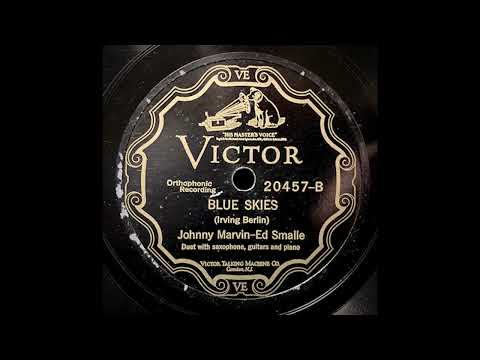
Victor was a little late on the draw, but certainly hot on their heels with this version by Johnny Marvin and Ed Smalle recorded on January 17, which was in turn, followed by George Olsen and his Music’s version two days after that (and Jesse Crawford’s instrumental organ version two days after that!).
Other versions that were recorded in 1927 include: Bob Haring and his Orchestra (Cameo), William Robyn (Cameo), Al Goering’s Collegians (Vocalion), Harry Richman (Vocalion), Pacific Coast Players (Grey Gull), Arthur Fields (Emerson), Frank Dailey Meadowbrook Orchestra (Emerson), Miss Betty Morgan (Pathé), George DeWees (Challenge), Dixie Music Makers (Romeo), Buddy Gravelle (Romeo), and The Artist Ensemble (Columbia).
This version starts with the sounds of a Hawaiian guitar leading us in, with a piano and second guitar accompanying. Marvin and Smalle perform the tune as a duet, with Smalle’s humming and Sannella’s saxophone providing a kind of call and response to Marvin’s lead. The Hawaiian guitar takes a solo in the middle – followed by Marvin and Smalle singing the final chorus together.
Recorded in New York, New York on January 17, 1927.
Released as Victor 20457 in April 1927.
This version stayed in the Victor catalog for four years until it was cut in 1931.
Credits:
Johnny Marvin – vocals, guitar
Ed Smalle – vocals, piano
Andy Sannella – saxophone, guitar
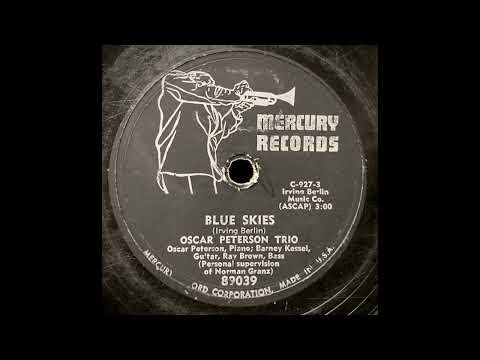
A blazingly fast Oscar Peterson attacks Irving Berlin’s “Blue Skies” supported by Barney Kessel and Ray Brown keeping down the rhythm.
This particular record has no business sounding as good as it does – the surface was trashed with scratches and scuffs and I fully expected it to be a placeholder copy until something better comes along. Sure there are some clicks and tics – but on the whole, it sounds quite enjoyably listenable!
The moment at the 0:08 mark when the bass and guitar kick in is quite good when listening on headphones.
Fans of the 20s versions of “Blue Skies” are gonna spit out their coffee at the screen hearing the manic Peterson bop it up – but you have to admire his furious playing full of zest and stylish panache. A great recording and performance!
Recorded in Los Angeles, CA in early December, 1952.
Released as Mercury 87039 in early 1953.
Credits:
Oscar Peterson – piano
Barney Kessel – guitar
Ray Brown – bass