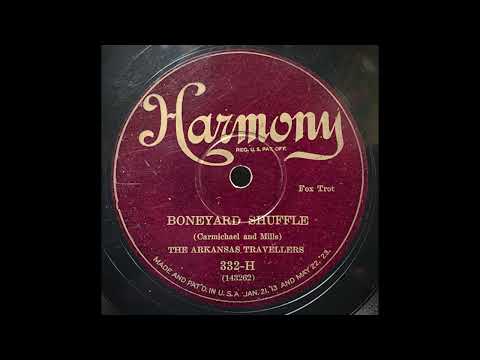
The Arkansas Travellers was one of the many names Red Nichols used for his studio band, alternatively called one of a handful of variations such as Lanin’s Red Heads, Red and Miff’s Stompers, and the Charleston Chasers.
Here, Red states the melody and plays it straight while Miff Mole, Jimmy Dorsey, and even Arthur Schutt take ample time for relaxed solos and hot breaks on Hoagy Carmichael’s “Boneyard Shuffle”.
Recorded in New York, NY on January 4, 1927. Released as Harmony 332-H, Velvet Tone 1332-V, and Diva 2332-G.
Credits: Red Nichols – trumpet Miff Mole – trombone Jimmy Dorsey – clarinet Fred Morrow – alto sax Arthur Schutt – piano Vic Berton – drums
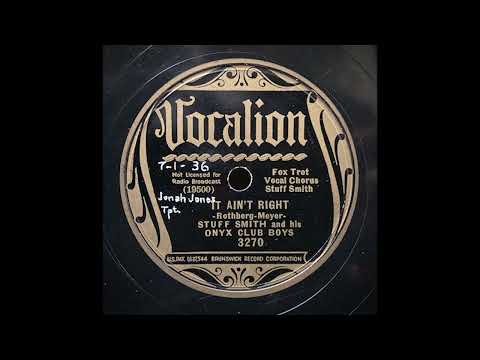
Stuff Smith was one of the early great jazz violin pioneers, along with such contemporaries as Eddie South, Joe Venuti, and Stéphane Grappelli. After moving to NYC in 1935, Smith pulled a swingin’ band together featuring hot trumpeter Jonah Jones and jazz royalty drummer Cozy Cole.
The excellent “It Ain’t Right” was one of a string of records that Stuff and his Onyx Club band recorded for Vocalion in 1936.
Recorded in New York, NY on July 1, 1936. Released as Vocalion 3270.
Credits: Stuff Smith – violin, vocals Jonah Jones – trumpet James Sherman – piano Bobby Bennett – guitar Mack Walker – string bass Cozy Cole – drums
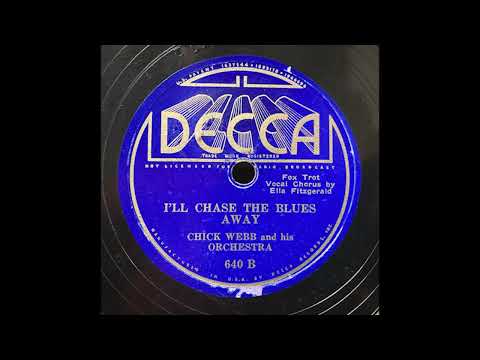
A very early recording of the 18-year-old Ella Fitzgerald singing with Chick Webb and his Orchestra in late 1935.
Recorded in New York, NY on October 12, 1935. Released as Decca 640.
Credits: Chick Webb – drums, director Taft Jordan, Mario Bauza, Bobby Stark – trumpet Sandy Williams, Claude Jones – trombone Edgar Sampson, Pete Clark – alto sax Elmer Williams – tenor sax Wayman Carver – tenor sax, flute, arrangement Don Kirkpatrick – piano John Trueheart – guitar Bill Thomas – string bass
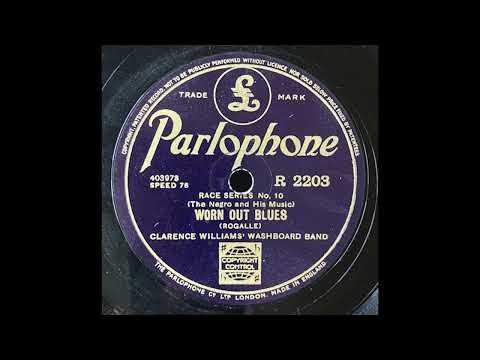
For a “worn out” blues, this certainly has quite a bit of pep!
There is some contention as to the identity of the trumpet player on this 1930 recording by Clarence Williams’ Washboard Band. Contenders nominated by past discographers include Ed Allen, Louis Metcalf, Charlie Gaines, Henry “Red” Allen, Ed Anderson, and Roy Eldridge.
Recorded in New York on April 23, 1930. Originally released in the U.S. as Okeh 8790. Parlophone R 2203 is a U.K. master pressing. This copy is in very fine shape and sounds quite excellent.
Credits: Charlie Gaines or Henry Allen – trumpet Prince Robinson – clarinet, tenor sax Clarence Williams – piano Floyd Casey – washboard
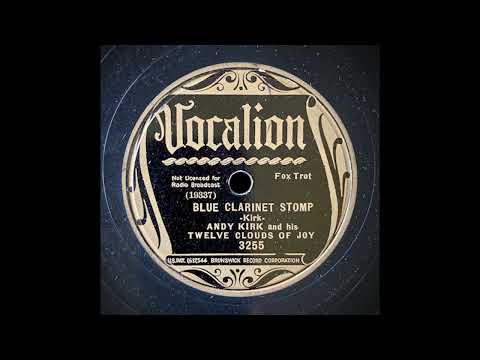
Andy Kirk was a tuba player who grew up in Denver, Colorado where he studied music with the father of Paul Whiteman. From 1925-29, he was a member of a group led by Terence Holder in Dallas, Texas. The group was known as “Clouds of Joy”. In the winter of 1928-29, Holder left the group stranded in Oklahoma City. Kirk become the new band leader, pulled the group together, finished the tour, and began a gig at a ballroom in Kansas City, where they attracted the notice of A&R scouts from Brunswick.
At their audition for Brunswick, their piano player was a no-show, so Saxophonist John Williams called his wife to come in, who was a pianist with perfect pitch and a good ear for jazz. She arrived and played through the band’s charts flawlessly. This was Mary Lou Williams’ big break, as when the band showed up to the recording session with their regular pianist, the A&R scouts insisted that Mary Lou be on the recording – securing her place in the band.
This first recording session resulted in four released tracks, including this tune, “Blue Clarinet Stomp”.
Recorded in Kansas City, Missouri circa November 7-8, 1929. Originally released as Brunswick 4694. This Vocalion dubbed reissue was from the late 1930s.
Credits: Andy Kirk – bass sax, tuba, director Gene Prince, Harry Lawson – trumpet Allen Durham – trombone John Harrington – clarinet, alto sax John Williams – alto sax, baritone sax Lawrence Freeman – tenor sax Claude Williams – violin Mary Lou Williams – piano William Dirvin – banjo, guitar Edward “Crackshot” McNeil – drums
Sources: “Jazz Style in Kansas City and the Southwest” by Ross Russell University of California Press, 1971 pp 163-165
This channel just hit 200 subscribers – so I wanted to give you all a special video to show my thanks for your support.
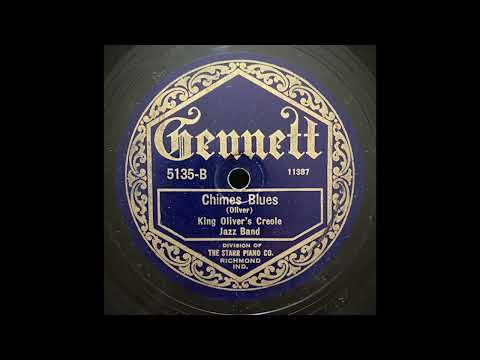
“Chimes Blues” was the first issued recording of a Louis Armstrong solo. Armstrong had just moved to Chicago to join fellow New Orleans cornet player Joe Oliver and his band that played at Lincoln Gardens.
0:00 Intro (Blues in Bb, Ensemble) 1:13 Hear the chimes! (Lil Armstrong on piano) 1:48 Louis Armstrong cornet solo 2:22 Outro and ending
Oliver’s Creole Jazz Band was made up of true jazz giants – Joe Oliver himself, who had been blowing since as early as 1899 in New Orleans during a time when Buddy Bolden, Freddy Keppard, and other legends played.
The great clarinetist Johnny Dodds – who Armstrong humorously remembers was a massive White Sox fan who was obsessed with baseball scores.
Lil Hardin – a valedictorian from Fisk University and classically-trained pianist – who learned to play jazz piano with Joe Oliver, Freddy Keppard, Sugar Johnny, Lawrence Dewey, and other pioneering New Orleans legends.
Drummer Baby Dodds (Johnny’s brother), who Armstrong greatly admired and said “He was a wizard on the drums, and he certainly made me blow my horn… when I heard him beat those sticks behind one of my hot choruses.”
The humble Armstrong noted in his autobiography that when he started playing with Oliver’s band, “I did not take a solo… ahead of Papa Joe because I felt that any glory that came to me must go to him. I was playing second to his lead, and I never dreamed of trying to steal the show or any of that silly rot.”
Despite his humility, he did take a solo – and here we have his first recorded solo. His relaxed, flowing notes perfectly complement the rhythmic momentum and ensemble playing of the band – and also take it a step further – suggesting all the things that jazz was to become.
The Gennett studios in Richmond Indiana used acoustic recording technologies before the advent of electric recording and microphones. The studio location was said to be near a railroad track that frequently interrupted sessions when trains would pass by. Despite this – it is truly a gift that this session happened at all and was captured with such clarity.
A true hallmark achievement of American music!
Ever since I began collecting jazz on 78 rpm records, I dreamed of owning this record. It was only in the past year that I acquired this excellent copy from another collector. Please enjoy my digital transfer and thanks for supporting my channel!
Recorded in Richmond, Indiana on April 5, 1923. Released as Gennett 5135.
Credits: King Oliver, Louis Armstrong – cornet Honore Dutrey – trombone Johnny Dodds – clarinet Lil Hardin – piano Bill Johnson – banjo Baby Dodds – drums
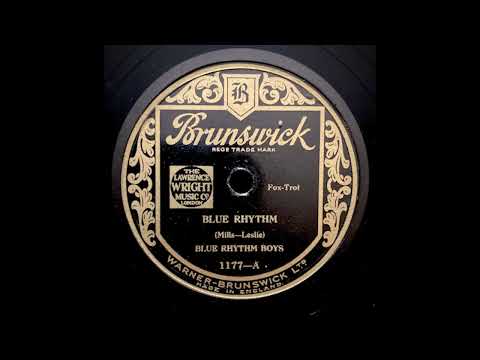
The Blue Rhythm Boys (later named the Mills Blue Rhythm Band) were managed by Irving Mills, who also managed Duke Ellington and Cab Calloway. Along with Ellington and Calloway, they made regular appearances at the Cotton Club in Harlem.
This hot stompin’ early track from 1931 shows what the Blue Rhythm was all about.
Recorded in New York on April 28, 1931. Originally released in the U.S. as Brunswick 6143.
Credits Wardell Jones, Shelton Hemphill, Ed Anderson – trumpet Harry White, Henry Hicks – trombone Charlie Holmes – clarinet, alto sax Ted McCord, Castor McCord – clarinet, tenor sax Edgar Hayes – piano Benny James – banjo Hayes Alvis – string bass WiIlie Lynch – drums Nat Leslie – arranger
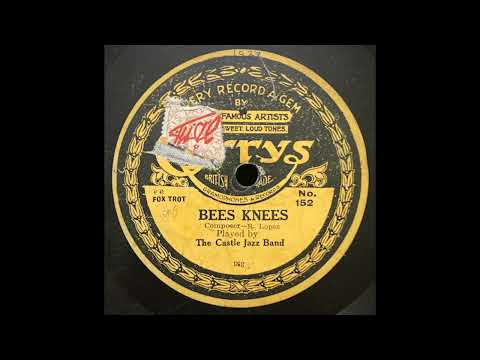
The Curry’s label began in the U.K. at the turn of the century as bicycle manufacturer Curry’s Cycle Co. began selling phonographs and manufacturing records on their own private label.
This release is from the mid-20s, as Currys began using masters from the British Imperial label – which in turn licensed them from the American Plaza Music Company. This Curry’s record proudly proclaims “Every Record a Gem by World Famous Artists” and “Pure, Sweet, Loud Tones”
As was the practice, American band names were given pseudonyms. In this instance “The Castle Jazz Band” was in fact the Original Memphis Five (OM5), who released “Bees Knees” domestically on the Banner, Regal, Emerson, and Grey Gull labels.
The tune was recorded in November of 1922, and includes OM5 regulars minus Miff Mole, who had been replaced on trombone by Charlie Panelli.
A rousing dance tune penned by Ray Lopez with many hot breaks and lively ensemble playing.
Credits: Phil Napoleon – trumpet Charlie Panelli – trombone Jimmy Lytell – clarinet Frank Signorelli – piano Jack Roth – drums
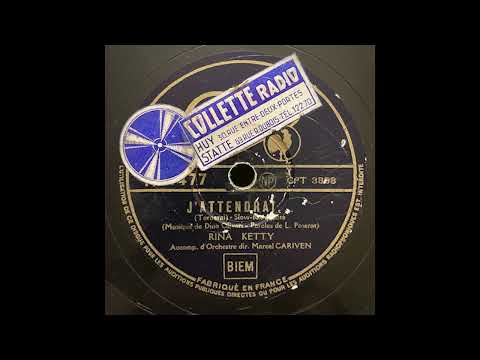
One of the most famous songs in Europe during WWII was recorded before the war began in 1938 by Italian-born singer Rina Ketty (whose birth name was Cesarina Picchetto).
The song tells of a woman’s faithful waiting for her lover to return. It is understandable how this song would appeal to soldiers in the field as they faced the daily horrors of war but were comforted by the thought of a steadfast loved one who would await their return after the war.
J’attendrai I will wait Le jour et la nuit Day and night J’attendrai, toujours I will wait always Ton retour Your return
This record famously is played on a phonograph during a scene in the movie Das Boot, by request from the U-boat’s captain during a lull in the fighting due to a heavy storm.
This Pathé, by its label sticker, appears to have been purchased at a record store in Huy, Belgium. I believe it is the original pressing – and it is amazing that it survived the war and somehow made its way to an institutional collection in South Dakota, where I found it earlier this year.
While the sticker obscures the label, I love such historical ephemera and think it adds to its character and charm.
Oliver Naylor was an Alabamian piano player who formed Naylor’s Seven Aces in Birmingham in 1923 – a band that included a handful of New Orleans players such as Jules Bauduc (brother of Ray Bauduc, the drummer of Johnny Bayersdorffer’s band).
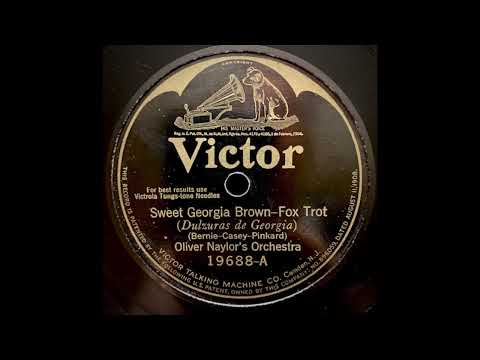
The band toured as the Oliver Naylor Orchestra and played several stints in NYC at the Roseland Ballroom and the Knickerbocker grill before recording this track for Victor in 1925.
Hot, stompin’, and rhythmically surprising at every turn, this tune just cooks! Never a dull moment as the unrelenting hot breaks and ensemble playing continually drives momentum forward.
Recorded in Camden, New Jersey on May 1, 1925. Released as Victor 19688
Credits: Bill Perry – Director, Arranger Edward “Pinky” Gerbrecht – cornet Pete Beilman – trombone Jerry Richel – clarinet, alto sax Jack Howard – alto sax Lester “Gilly” Bouchon – clarinet, tenor sax Oliver Naylor, Bob Zurke – piano Jules Bauduc – banjo Carl Hansen – tuba Louis Darrough – drums