
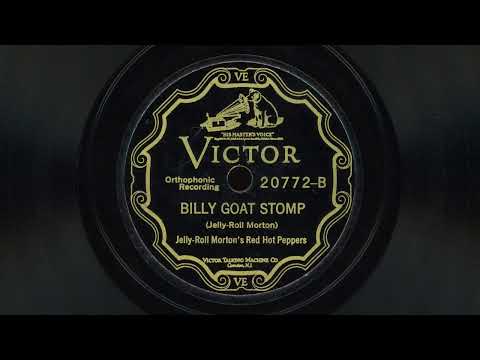
It is not known how or why Morton decided to include Lew LeMar, the Master of Entertainment at the Cafe de Paris in Chicago, on both sides of this record for vocal effects. On the flip side, “Hyena Stomp”, LeMar laughs throughout the song – echoing a novelty tradition going back to George W. Johnson’s “Laughing Song” and the Okeh laughing record.
This side, “Billy Goat Stomp”, opens with LeMar bleating like the eponymous billy goat – followed by a band member shouting: “Man, get that goat outta here!” LeMar continues to bleat at irregular intervals throughout the song – as though a goat really had invaded the recording session and was wreaking havoc around the studio while being chased by staffers while the band plays on! As jarring as his bleats can be, I have to say, I find the whole thing to be hilarious – and pretty punk rock.
Sadly, in an interview in 1936 with Kenneth Hulsizer (Jazz Music magazine, Feb-Mar 1944) Morton apparently told Hulsizer that “he wasn’t proud of the record. I think he was sorry he had made it.” Despite this, every time I hear a band cover the tune – and leave out the bleating goat sounds – it somehow feels diminished. Imagine leaving the bugle part out of the “Bugle Call Rag”! Thus, my message for today is: Respect the GOAT! Baaaaaa-aaaa-aaa!
Once the music starts in earnest, we hear a series of starts and stops punctuated with inventive percussive effects by Baby Dodds – leading into call and responses between band members while goat bleats comedically fill the air. A series of solos follow, each ending with the ensemble joining in. It’s a fun romp that ends up being musically engaging and flippantly challenging simultaneously.
Baby Dodds was playing a trap kit with Chinese Tom-Toms and cymbals – and his solo work here is quite interesting for the time.
Interestingly, Morton had originally composed this tune as a solo piano piece. Baaaaaa-aaaa-aaa!
0:00 intro
0:23 cornet (Mitchell)
0:42 clarinet (Dodds)
1:00 percussion (Baby Dodds)
1:18 ensemble
1:37 alto sax (Evans)
1:55 guitar (Scott)
2:14 trombone (Reeves)
2:32 piano (Morton)
2:51 ensemble
3:10 clarinet (Dodds)
Recorded at Oak Street studio in Chicago, Illinois on June 4, 1927.
Released as Victor 20772.
Credits:
Jelly Roll Morton – piano, director
George Mitchell – cornet
Gerald Reeves – trombone
Johnny Dodds – clarinet
Stump Evans – alto sax
Bud Scott – guitar
Quinn Wilson – tuba
Baby Dodds – drums
Lew LeMar – goat imitation effects
Leave a Reply