Jazz Crazy Records

An Archive of Early Jazz on 78 RPM

Category: Jazz

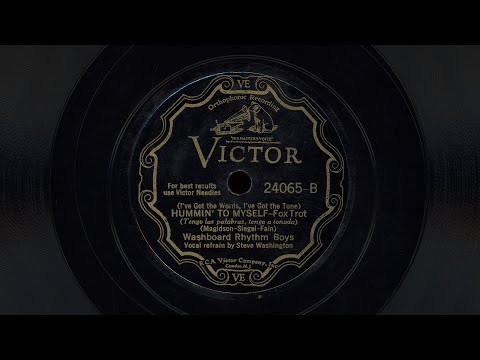
  • “(I’ve Got the Words, I’ve Got the Tune) Hummin’ to Myself” – Washboard Rhythm Boys (1932)

    “(I’ve Got the Words, I’ve Got the Tune) Hummin’ to Myself” – Washboard Rhythm Boys (1932)

    One of my all time favorite Washboard Rhythm Kings records contains two winning numbers that I will post today. This scarce deep depression cut is the Rhythm King’s version of “(I’ve Got the Words, I’ve Got the Tune) Hummin’ To Myself”.

    This one was also recorded by Ben Selvin and his Orchestra in June of 1932 – as well as versions by Bennie Krueger, Johnny Hamp, Lou Gold, Connie Boswell, and Joe Haymes. Again – the Rhythm Kings give it their special treatment and take a big band pop tune and give it a more flavorful and intimate vibe.

    Someone on TikTok recently pointed out to me that the French hip-hop collective known as Chinese Man sampled this record in a 2007 track “I’ve Got that Tune”. The song has been streamed over 38 Million times on Spotify and their music video on YouTube now has an eye-popping 43 Million views:
    https://www.youtube.com/watch?v=kqjeNSNuNPM
    @chinesemanrec

    It was then used by Mercedes Benz in an advertising campaign for the Mercedes Classe A Coupé, which amplified its exposure even further.
    https://www.youtube.com/watch?v=PMWJ4YG6ggA

    Pretty amazing that a record that only sold 2,167 copies when it was released in 1932 is now probably one of the most listened-to records of the jazz age by modern audiences – through its sampling – albeit in altered form.

    Here, then, is the original tune – from a clean copy of the original 78 rpm Victor.

    Recorded in Camden, New Jersey on July 6, 1932.
    Released as Victor 24065.
    Only 2,167 copies sold.

    Credits
    Taft Jordan – trumpet
    Ben Smith – clarinet, alto sax
    Carl Wade – tenor sax
    Eddie Miles – piano
    Steve Washington – banjo, vocals
    Ghost Howell – string bass
    H. Smith – washboard

    The flip side, “Holding My Honey’s Hand” can be found at:
    https://youtu.be/TjYrR9ygxtE
  • “Holding My Honey’s Hand” – Washboard Rhythm Boys (1932)

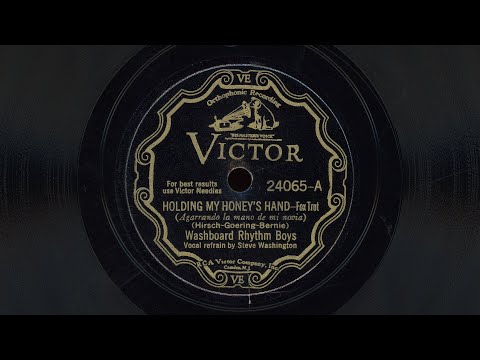
    “Holding My Honey’s Hand” – Washboard Rhythm Boys (1932)

    One of my all time favorite Washboard Rhythm Kings records contains two winning numbers that I will post today. This scarce deep depression cut is the Rhythm King’s version of “Holding My Honey’s Hand” – a tune composed by Ben Bernie and Al Goering with lyrics by Walter Hirsch.

    The song had been extensively recorded in June by big dance bands such as Ben Bernie and his Orchestra, Ben Selvin and his Orchestra, Dick Robertson and his Orchestra, Russ Carlson and his Orchestra, and Waring’s Pennsylvanians.

    While these sweeter versions offer lush orchestration and smoove crooner vocals – the Washboard Kings deliver a small combo performance that is at once familiar, authentic, affable, and a delight to listen to. If you’re used to the sweeter versions, this one might hit different – all I can say is, if you love the Kings, you’ll get hooked on this one right away.

    Recorded in Camden, New Jersey on July 6, 1932.
    Released as Victor 24065.
    Only 2,167 copies sold.

    Credits
    Taft Jordan – trumpet
    Ben Smith – clarinet, alto sax
    Carl Wade – tenor sax
    Eddie Miles – piano
    Steve Washington – banjo, vocals
    Ghost Howell – string bass
    H. Smith – washboard

    The flip side, “Hummin’ To Myself” can be heard at:
    https://youtu.be/DzWRLetsOlg

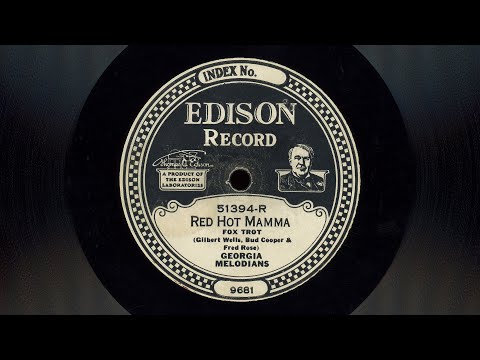
  • “Red Hot Mamma” – Georgian Melodians (1924)

    “Red Hot Mamma” – Georgian Melodians (1924)

    Well, it was bound to happen that Vernon Dalhart would make an appearance on the channel. Luckily, he does so in the good company of the hot and jazzy dance band, Georgia Melodians.

    It should be noted that unlike such acts as the deceptively named California Ramblers and Original Memphis Five, this group was actually from Savannah, Georgia. 1924 was a good year for the Melodians, who recorded many hot sides for the Edison label in that year.

    Here we find the rousing number “Red Hot Mamma” – featuring the merry banjo of Elmer Merry, who, to my ears is one of the unsung heroes of this excellent performance. Fine sax and trumpet solos push this to the hotter side of things and we end on an upward trajectory.

    Recorded in New York City on September 2, 1924.
    Released as Edison 51394 (This is take C)

    Credits:
    Charles Boulanger – director, violin
    Ernie Intlehouse – trumpet
    Herb Winfield – trombone
    Merritt Kenworthy – clarinet
    Clarence Hutchins – tenor sax, baritone sax
    Oscar Young – piano
    Elmer Merry – banjo
    Al Singmore – tuba
    Carl Gerold – drums
    Vernon Dalhart – vocals

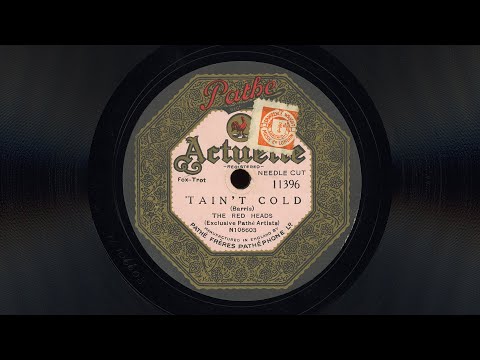
  • ‘Tain’t Cold – The Red Heads (1926)

    ‘Tain’t Cold – The Red Heads (1926)

    An early Red and Miff session from 1926 performing as the Red Heads. Lots of baroque syncopated ensemble playing with a sax solo and trumpet solo towards the end. ‘Tain’t Cold was composed by future Rhythm Boy Harry Barris.

    Red and Miff had just recorded ‘Tain’t Cold for Brunswick with the Original Memphis Five not two weeks before this session.

    Recorded in New York City on February 4, 1926.
    Released in the U.K. as Pathé Actuelle 11396.

    Credits:
    Red Nichols – trumpet
    Miff Mole – trombone
    Jimmy Dorsey – trumpet, clarinet, alto sax
    Alfie Evens (?) – clarinet, tenor sax
    Rube Bloom – piano
    Vic Berton – drums

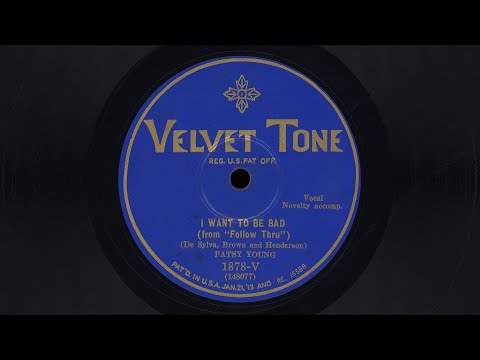
  • “I Want To Be Bad” – Annette Hanshaw (1929)

    “I Want To Be Bad” – Annette Hanshaw (1929)

    Annette Hanshaw singing under the pseudonym Patsy Young, which had her doing her best Helen Kane impersonation backed by some fine jazz band players on leave from Selvin’s orchestra.

    Recorded in New York City on March 14, 1929
    Released as Velvet Tone 1878-V (mx 148077)

    Credits:
    Annette Hanshaw (as Patsy Young) – vocals
    Tommy Dorsey, Tommy Gott (?) – trumpet
    Charlie Butterfield – trombone
    Jimmy Dorsey – clarinet, alto sax
    Hank Sternor or Joe Tarto (?) – tuba
    Unknown Artist – tenor sax, violin (x2), piano, guitar, drums

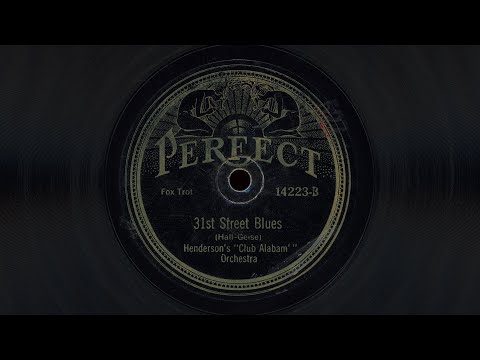
  • “31st Street Blues” – Henderson’s Club Alabam’ Orchestra (1923)

    “31st Street Blues” – Henderson’s Club Alabam’ Orchestra (1923)

    The first record to give label credit to Fletcher Henderson’s Club Alabam’ Orchestra, named after the basement club where the Henderson band took up residence in November of 1923. Located on W. 44th Street, it had been operated as a speakeasy known as the Little Club that was raided by the Feds in April 1923 and closed down as a result.

    31st Street Blues was so named from a popular street in Chicago. Henderson later recorded it with Clara Smith and again with Josie Miles. I’m a big fan of the early Henderson band!

    0:00 Intro
    0:34 ensemble
    0:58 alto sax (Redman)
    1:25 piano (Henderson)
    1:37 tenor sax (Hawkins)
    1:52 cornet (Chambers)
    2:16 clarinet (Redman)
    2:42 cornet (Chambers)

    Recorded in New York City on November 26, 1923
    Released as Perfect 14223 in March 1924.

    Credits:
    Fletcher Henderson – piano, arranger, director
    Elmer Chambers – cornet
    Teddy Nixon (?) – trombone
    Don Redman – clarinet, alto sax, arranger
    Coleman Hawkins – tenor sax
    Billy Fowler – bass sax
    Charlie Dixon (?) – banjo
    Kaiser Marshall – drums

    Sources:
    Hendersonia, Walter C. Allen, Jazz Monographs, 1973, p. 77, 80. 98

  • “Wond’ring Blues” – Gene Rodemich’s Orchestra (1924)

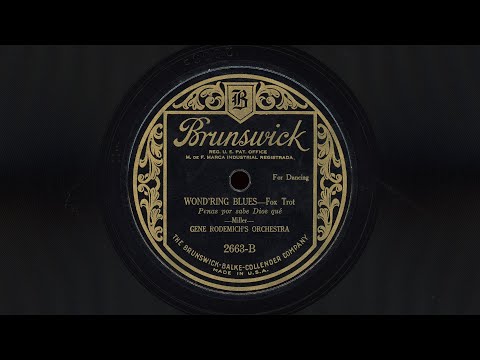
    “Wond’ring Blues” – Gene Rodemich’s Orchestra (1924)

    Eugene F. Rodemich was born in St. Louis in 1890 and studied violin and piano as a child. In 1904, he heard a group of ragtime pianists perform at the 1904 World’s Fair in St. Louis and was immediately hooked. He moved to NYC in 1913 and worked as an accompanist for vaudeville performer Elsie Janis – and later went on tour with her in France to entertain the troops during WWI. After returning to St. Louis in 1918, he started his own orchestra, which hired young saxophonist Frank Trumbauer in 1921.

    The flip side of “Scissor Grinder Joe”, which I posted this morning, “Wond’ring Blues” is just as remarkable as an artfully arranged hot dance number exhibiting jazzy characteristics throughout.

    In this one, we hear doo-wacka-doo trumpets, led by a lead trumpet that gives us a hot muted solo, followed by a trombone solo and numerous others – including a piano solo by bandleader Rodemich himself. Some of the some solos sound composed, though the arrangement is lively and fresh, providing many moments of excitement and jazzy vibes.

    Rust and a few others have attempted to provide personnel for this session – and they are quite different from one another. I’ve listed those that all sources agree upon plus a few suggestions (marked with a ?) on who else is playing.

    Recorded in New York City on June 11, 1924.
    Released as Brunswick 2663.

    Credits:
    Gene Rodemich – piano, director
    Clarence Foster or Jess Walton (?), Charles Werner – cornet
    Jules Blattner (?) – trumpet
    Julius Robb (?), Bill Bailey (?) – clarinet, alto sax
    Allister Wylie (?) – alto sax, 2nd piano
    Jules Silberberg – sax, violin
    Otto Reinert (violin)
    Unknown performer – paper and comb
    Larry Conley – trombone
    Eddie Storman – banjo
    John Bambridge (?) – tuba
    Paul Spoerloder – drums

  • “Scissor Grinder Joe” – Gene Rodemich’s Orchestra (1924)

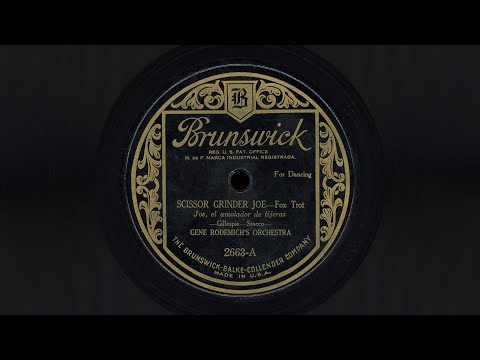
    “Scissor Grinder Joe” – Gene Rodemich’s Orchestra (1924)

    Eugene F. Rodemich was born in St. Louis in 1890 and studied violin and piano as a child. In 1904, he heard a group of ragtime pianists perform at the 1904 World’s Fair in St. Louis and was immediately hooked. He moved to NYC in 1913 and worked as an accompanist for vaudeville performer Elsie Janis – and later went on tour with her in France to entertain the troops during WWI. After returning to St. Louis in 1918, he started his own orchestra, which hired young saxophonist Frank Trumbauer in 1921.

    “Scissor Grinder Joe” was a novelty tune that begins with a melancholic arpeggiated piano line that is decidedly un-jazzy which reappears throughout the piece. The band comes in at a quick clip, artfully articulating the theme with stylistic aplomb. Soon we hear a piano solo followed by what sounds like a paper and comb solo. A sax and trumpet engage in a speedy melodic reparté. Then two muted trumpets battle to see whose wah-wah is most wooing. The whole thing comes to a close as artfully arranged as it began. The last thing we hear is the simple piano riff repeating and gently reminding us of its mournful state.

    The identity of the paper and comb / kazoo soloist is unknown. Curiously, Rust states that “the Mound City Blue Blowers are said to have appeared with this band, as they may have done on the stand, but not in the recording studio.” I wonder if Red McKenzie may be a contender here?

    Rust and a few others have attempted to provide personnel for this session – and they are quite different from one another. I’ve listed those that all sources agree upon plus a few suggestions (marked with a ?) on who else is playing.

    Recorded in New York City on June 11, 1924.
    Released as Brunswick 2663.

    Credits:
    Credits:
    Gene Rodemich – piano, director
    Clarence Foster or Jess Walton (?), Charles Werner – cornet
    Jules Blattner (?) – trumpet
    Julius Robb (?), Bill Bailey (?) – clarinet, alto sax
    Allister Wylie (?) – alto sax, 2nd piano
    Jules Silberberg – sax, violin
    Otto Reinert (violin)
    Unknown performer – paper and comb
    Larry Conley – trombone
    Eddie Storman – banjo
    John Bambridge (?) – tuba
    Paul Spoerloder – drums

  • “A Pane in the Glass” – Clarence Williams and his Jazz Kings (1929)

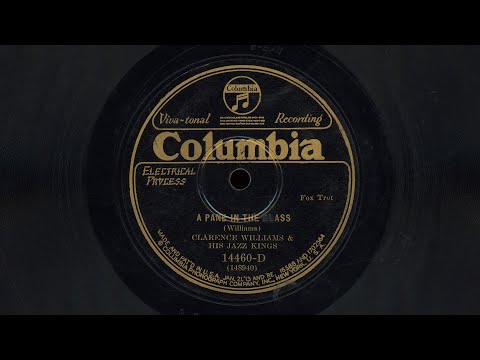
    “A Pane in the Glass” – Clarence Williams and his Jazz Kings (1929)

    Here is the third and final recording of the clever “A Pane in the Glass”, this time with Clarence accompanied by his Jazz Kings. The form is a 12 bar blues in Eb, with solos as follows:

    0:00 Intro
    0:25 Trumpet solo (Ed Anderson)
    0:52 Tenor sax solo
    1:17 Trombone solo (Geechie Fields)
    1:43 Clarinet solo
    2:08 Trumpet solo (Ed Allen)
    2:33 Ensemble

    There is (as always seems to be the case), some disagreement on the identities of the reedmen on this recording – and I give Rust’s personnel as a starting point for discussion. The other interesting player on this session seems to be Geechie Fields of Jelly Roll Morton’s Red Hot Peppers.

    You will note that the previous caretaker of this disc mischievously attempted to make the innuendo of the title a tad more explicit by attempting to cover up the “G” and “L” in the word “Glass” on the label.

    Recorded in New York City on August 26, 1929.
    Released as Columbia 14460-D.

    Credits:
    Ed Allen, Ed Anderson – cornet
    Geechie Fields – trombone
    Russell Procope (?) – clarinet, alto sax
    Arville Harris (?) – clarinet, tenor sax
    Clarence Williams – piano
    Leroy Harris – banjo
    Cyrus St. Clair – tuba

  • “A Pane in the Glass” – Clarence Williams (1929)

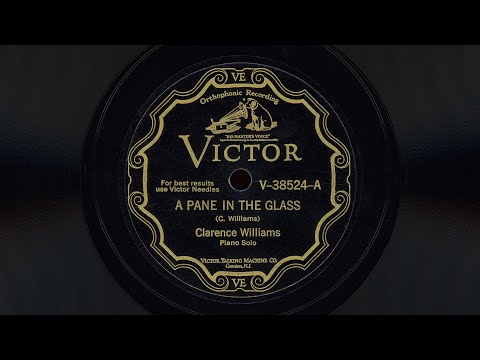
    “A Pane in the Glass” – Clarence Williams (1929)

    This session is Clarence Williams’ first for Victor involving a cleverly-named tune that he first recorded three months earlier for Paramount with King Oliver sitting in with his Blue Five. He would go on to record it one more time with his Jazz Kings for Columbia a few months later (a recording I will post later today!)

    In “Clarence Williams”, Tom Lord reports: “it was recorded in their 46th Street Studio between 10:45 and 12:45. Two takes were recorded of each performance. It’s hard to decide just why Victor decided to begin with two piano solos. I don’t imagine that piano solos were very big sellers in any market. Perhaps Victor decided on them for reasons of economy.”

    Also curious, as Williams was not known as a flashy stride player like James P. Johnson or a showman like Jelly Roll Morton. In fact, a good many jazz writers have described Williams as “only a fair pianist.” Yet one and all are quick to recognize his ability as a stylist and composer.

    In the book “New Orleans Style” by Bill Russell, Frank Walker at Columbia Recordings described Williams’ piano style:
    “Clarence [Williams] really wasn’t much of a pianist though, he’ll tell you that himself. When he was back home in New Orleans he played piano in one of those honky-tonks and could only play by ear-maybe knowing a half-dozen songs. Then some inebriate might come in and ask for a song he didn’t know, and Clarence would say, “Come back tomorrow night.” The next day he’d go down to the five-and-ten-cent store, to the sheet music counter, and pull out the song for the piano player to demonstrate. He would hear it once and know it. If that customer came back, Clarence would play the song and maybe pick up a dime tip.

    I find this solo work interesting as a lens into hearing a work as he likely originally composed it – and then listening to the other recorded versions arranged for small combos. It gives you a sense of his compositional style and a window into the aesthetics of his arrangement choices.

    This release was a part of the Victor V-38500 series, which mainly was full of recordings by jug band, blues and gospel artists such as Memphis Jug Band, Cannon’s Jug Stompers, Frank Stokes, and Victoria Spivey.

    Recorded in New York City on February 12, 1929.
    Released as Victor V-38524.

    Credits:
    Clarence Williams – piano