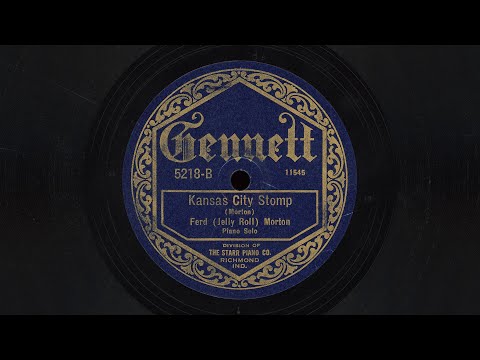
Oh, to be a fly on the wall in Gennett studios on July 17-18 during the summer of 1923 when Jelly Roll Morton went into the studio for his second recording session (the first was with Paramount a month earlier).
On the 17th, he spent the day alternating between recorded performances with the New Orleans Rhythm Kings and recording his own piano solos. 16 takes of 7 different tunes were recorded that day. On the 18th, Morton started with more solo piano recordings (including this one) and then finished the day recording London Blues, Milenberg Joys, and Mad (Cause You Treat Me This Way) with NORK.
For fun, also listen to the later 1928 recording of this same tune with the full Red Hot Peppers accompaniment: https://youtu.be/jdQsglyv-U8
Recorded in Richmond, Indiana on July 18, 1923. Released as Gennett 5218.
W. C. Handy first met J. Paul Wyer in Memphis in the early 1910s. He recounts:
“One evening when we were getting off the excursion steamer Pattona, a shy stranger approached me and said he had heard that I needed another good clarinetist. It was easy to see that he had been having his downs. He reminded me of myself back on the levee at St. Louis. He told me his name was J. Paul Wyer.”
Turns out Wyer’s father was a noted army bandsman who had led an orchestra in Pensacola, Florida that Handy was familiar with. Wyer had played in his father’s theatre orchestra and could sight read music.
“I took him on for the night and gave him a chance to play with our large group… under rather trying circumstances. He was asked to play second clarinet without a prepared part. But the young musician improvised a part better than if one had been written. I was deeply impressed and genuinely sorry when I had to tell him that I couldn’t see my way clear to hire a second clarinetist at the moment.
‘But I can play the violin, too,’ he suggested.
He gave us a demonstration. To my surprise, he could play any standard opera and many violin solos from memory. He left us all aghast.
‘You must have been tops in your daddy’s band,’ I said.
‘Oh, no,’ he answered promptly. ‘Not quite tops. My brother Ed has me beat.’ Naturally, I kept young Paul and lost no time sending for his brother Ed. From that time forward the boom was on where the Handy dance orchestra was concerned. Calls came from the towns and great houses down on the roads that crossed the Dog. Jim (Turner) knew every pig path in Mississippi and Alabama. He had also played the river and was favorably known in Louisiana and Arkansas. All this territory we took under control and made it our stamping ground.”
Turns out Wyer also was a close friend of Jelly Roll Morton, who he had met in 1906 while playing pool. Morton even had a nickname for him: “Pensacola Kid”.
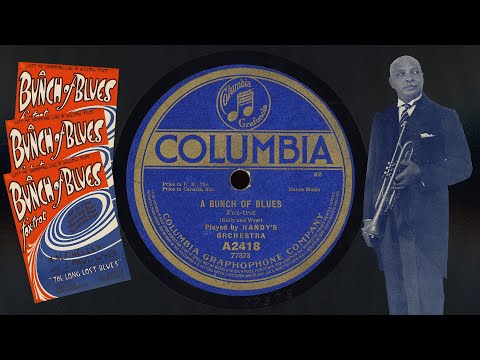
“Bunch of Blues” was a Wyer composition (with lyrics by H. Alf Kelly) that was a medley of “The Weary Blues”, “The String Beans Blues”, “Ship Wreck Blues”, and “The Long Lost Blues.” It was recorded by Handy for a marathon session for Columbia in NYC. Over a five day period, the band prolifically recorded 34 takes of 15 tunes that resulted in 10 released sides.
While J. Paul Wyer had left the band by this point, Ed Wyer was supposed to be in on this session, but he had moved to Chicago and the musician’s union there (Local 208) had told him he’d be fined up to $500 if he left town with Handy.
While J. Paul Wyer is not a well-known name in jazz and blues history – his story has a happy ending – in 1919 he joined the New York Syncopated Orchestra (NYSO) and traveled to Europe with them. In 1923 he travelled to Buenos Aires where he had a long and successful career as a bandleader. He died there in 1959.
Recorded in New York City on September 24, 1917. Released as Columbia A2418.
Credits: W. C. Handy – director, trumpet Sylvester Bevard, – trombone Wilson Townes, Alex Poole – clarinet, alto sax Charles Harris, Nelson Kincaid – clarinet, tenor sax Edward Alexander, William Tyler, Darnell Howard – violin Henry Graves – violincello Charles Hillman – piano Archie Walls – tuba Jasper Taylor – drums, xylophone
SOURCES: Father of the Blues: An Autobiography – W.C. Handy “Paul Wyer O La Metáfora Corporizada Del Atlántico Negro En La Argentina” by Berenice Corti
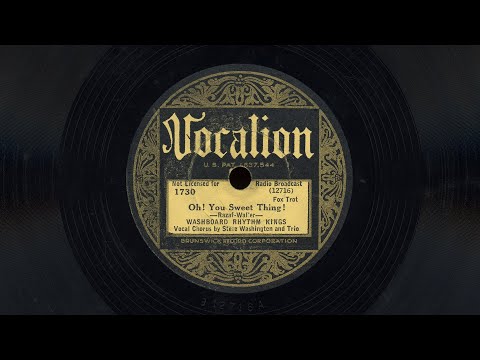
This deep depression cut featuring some lovely vocal harmonizing from the Washboard Rhythm Kings arrived courtesy of fellow WRK fanatic Ricky Hernandez (Wacko_Shellacko).
Did WRK ever make a bad record? No, I think not. To paraphrase Vizzini, that would be quite inconceivable. Ever since I heard their absolutely ripping version of “Tiger Rag”, I’ve been a diehard fan. I could add a few more gushing remarks, but I’ll leave you to enjoy the rapturous “Oh! You Sweet Thing!”
Recorded in New York City on December 14, 1932. Released as Vocalion 1730.
Credits: Steve Washington – banjo, vocals Carl Wade – tenor sax Ghost Howell – bass Unknown Artist – trumpet Unknown Artist – clarinet, alto sax Unknown Artist – alto sax Unknown Artist – piano Unknown Artist – washboard
The flip side, “Something’s Gotta Be Done” is excellent too – and I have already made a transfer of it from a British master pressing on the Decca label if you’d like to listen to it here: https://youtu.be/bMKrXRUP3qQ
This one has been in my transfer queue for quite some time – and until recently I did not know much about Abe Small, the cornetist who led this small band. However, about six months ago jazz historian Colin Hancock (who is behind the excellent YouTube channel @Desdemona202 ) did a great writeup on Abe Small which you can read at the link below.
A version of this tune appears in Colin’s video from a different session for the Strong label. This version with a different matrix is from a Federal session from the same month. I add it here since I don’t see it anywhere on YouTube yet. Had to pitch this one down a bit to around 75 rpm to get it in key.
Recorded in New York City in January, 1923. Released as Federal 5228 (mx. 1-1647)
If you’d like to hear the rest of Abe Small’s recorded output, be sure to watch @Desdemona202 ‘s excellent video “Abe Small–Brooklyn Cornetist (Gennett, Strong, and Federal Recordings: 1922-1923)” at: https://www.youtube.com/watch?v=4iWnpY5TQk4
This one has been in my transfer queue for quite some time – and until recently I did not know much about Abe Small, the cornetist who led this small band. However, about six months ago jazz historian Colin Hancock (who is behind the excellent YouTube channel @Desdemona202) did a great writeup on Abe Small which you can read at the link below.
This record did not appear in Colin’s video, so I add it here since I don’t see it anywhere on YouTube yet. Had to pitch this one down a bit to around 75 rpm to get it in key.
Recorded in New York City in January, 1923. Released as Federal 5228 (mx. 1-1640)
If you’d like to hear the rest of Abe Small’s recorded output, be sure to watch @Desdemona202’s excellent video “Abe Small–Brooklyn Cornetist (Gennett, Strong, and Federal Recordings: 1922-1923)” at: https://www.youtube.com/watch?v=4iWnpY5TQk4
After Jean Goldkette and his Orchestra’s most famous configuration that featured Bix, Tram, Venuti, and Lang broke up in the autumn of 1927, Goldkette reconfigured the band in Kansas City with members of an Indianapolis band called the Royal Peacocks. Goldkette got an engagement with the lush Pla-Mor Ballroom.
This recording was made during that time in Kansas City at a temporary studio Victor set up.
This disc, while the grooves were in great condition, had some rippling warps emanating from the center of the record – possibly due to heat damage – that gave the stylus a wild ride. This made it necessary to transfer at a gentle 16 rpm and then correct the speed digitally.
Recorded in Kansas City, Missouri on December 12, 1927. Released as Victor 21150.
Credits: Myron Schulz – violin, director Nat Natoli, Andy Secrest, Sterling Bose – trumpet Lorin Schulz, Red Ginsler – trombone Larry Tice, Bob Hutsell – clarinet, alto sax Reggie Byleth (Severance), Ray Porter – clarinet, alto sax, tenor sax Harold Stokes – piano-accordion, arranger Harry Bason – piano Hoagy Carmichael – piano, vocals Joe Galbraith – banjo Harold George – tuba Mel Miller – drums
Sources consulted: Jazz and Ragtime Records, Brian Rust, 6th Edition “Jean Goldkette’s Post-Bix Recordings: the Don Redman Arrangements – Part One”, Nick Dellow and Albert Haim, Vintage Jazz Mart
The identity of Miss Frankie is unknown. While Jane Howard used the pseudonym on some labels, her participation in this release has not been fully confirmed – and Dixon & Godrich note that the cuts from this session “reportedly sounds very unlike Jane Howard.”
So this is likely an unknown vocalist whose identity has completely disappeared – my guess from her crisp enunciation is that she was likely an actress in the vein of Ethel Waters.
Eubie Blake has been listed as the accompanist, but in every source it was cited, there was a question mark as to whether it was definitively confirmed as Eubie.
At normal running speed, this record was pitched in the key of B – which is an unusual key for a piano blues. Slowing to about 73-74 rpm delivered what I believe is the correct key of B flat.
Recorded in New York City in December, 1926. Released as Radiex 7021.
Credits: Miss Frankie – vocals Eubie Blake (?) – piano
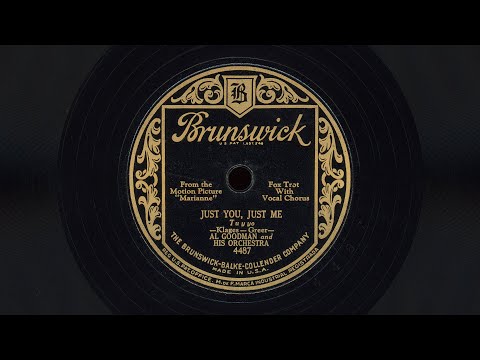
Ever since posting that Monk recording “Evidence”, I’ve been listening to versions of the tune its chord progression was based on: “Just You, Just Me”. I find it quite fascinating to trace how songs like this were originally played, and how jazz artists throughout the decades have reinterpreted and reimagined them.
Here we have a recording very close to when the song was first published, by Ukranian-born bandleader Al Goodman – who at the time was quite busy conducting orchestras for Broadway productions. The tune was composed by Jesse Greer and Raymond Klages for the film “Marianne”, which was released in 1929. Who knew this minor song in a relatively minor film would go on to become known as a jazz standard – recorded by luminaries such as Ella, Sinatra, Bing, and Nat King Cole over 25-30 years later!
This early version is a straightforward dance band arrangement without much “jazz interest” as Brian Rust might say. Yet the chord progression was of interest to later jazz players. I’ll post a jazzier version recorded about 15 years after this one later today.
Recorded in New York City in August, 1929. Released as Brunswick 4487
Credits: Al Goodman – director Vocals – Harold “Scrappy” Lambert Unknown Artists – trumpets (2-3), trombone (2), clarinet-alto sax (2-3), tenor sax, violin, cello, piano, banjo, tuba, drums
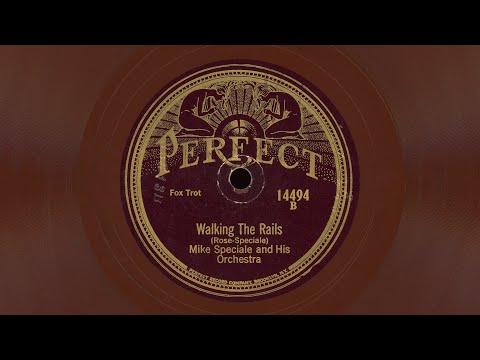
An excellent hot dance record by Mike Speciale and his Orchestra, sure to furnish followers of the terpischorean art with sufficient jazz to inject pep and make the dance worthwhile, to paraphrase a reviewer from 1929. Well, viewers, we’ve learned a new word: terpischorean – in homage to the muse Terpsichore, patron of dance – meaning those who enjoy dancing.
Speciale and his band started their career playing at the Carlton Terrace Hotel at Broadway and 100th Street in New York City, where they assuredly kept the terpischorean population satisfied.
This tune is one of their hotter numbers – an original composition by Speciale and his pianist, Sam Rose. If any of my learned viewers has an updated personnel list, I’d be most obliged – mine comes from Rust’s American Dance Band Discography.
Other than that – not much else to do but follow one’s terpischorean impulses and get out there on the dance floor!
Recorded in New York City on September 11, 1925. Released as Perfect 14494 and Pathé Actuelle 36313.
Credits: Mike Speciale – violin, director Red Nichols, Earl Oliver (?) – trumpet Unknown Artist – trombone Jessie Berkman – clarinet, alto sax, soprano sax Unknown Artist – tenor sax, bass sax Sam Rose – piano Lou de Fabbia – banjo Tom Speciale – tuba Herman Berkin – drums
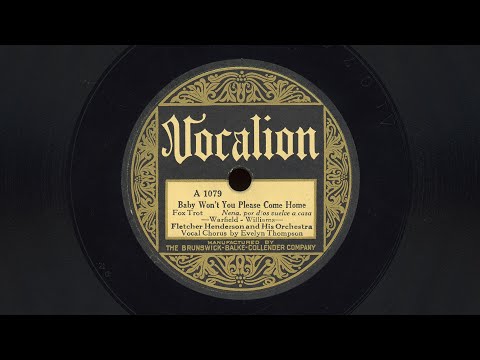
Here’s a scarce Henderson record on the Vocalion 1000 series.
This session finds the band coming off a three month stint gigging in NYC – primarily at the Roseland Orchestra, playing with the Jean Goldkette band in October 0f 1926 and Jacques Green in November. These shows were apparently broadcast live on NYC radio station WHN – can you imagine!?!
They also did shows at Small’s Paradise, Savoy Ballroom and on January 5, 1927, played with Cliff Jackson and his Krazy Kats at the short-lived Murray’s Roseland. Again – imagine going to THAT show!
This record features vocalist Evelyn Preer – a well-known actress who developed her credentials appearing in the trailblazing silent films of black director Oscar Micheaux (who founded his film company in Sioux City, Iowa!).
Preer does a fine job in an amazing Redman arrangement that features soloist after soloist popping in one after another at a galloping pace. Standouts to my ears are Tommy Ladnier, Hawkins and the excellent but brief trombone solo by Harrison right after the vocals.
They followed this outstanding session for Vocalion in short order with equally excellent sessions for Harmony (Jan. 20), Columbia (Jan. 21), and again for Vocalion (Jan 22) before setting off for Detroit on January 25 for two weeks at the Graystone Ballroom, followed by a short Midwestern tour with stops in Chicago, St. Louis, and Kansas City.
This should give you a real sense of how busy the band was during this period and the high level of professionalism of its musicians – who could likely play these songs backwards in their sleep!
Recorded in New York City on January 19, 1927. Released as Vocalion 1079. While some Vocalion pressings of this tune are known to have alternate takes, this one is the common take (mx. E-4394).
Credits: Fletcher Henderson – director, piano Russell Smith, Joe Smith, Tommy Ladnier – trumpet Benny Morton, Jimmy Harrison – trombone Buster Bailey – clarinet, alto sax Don Redman – clarinet, alto sax, arranger Coleman Hawkins – clarinet, tenor sax Charlie Dixon – banjo, guitar June Cole – tuba Kaiser Marshall – drums Evelyn Preer Thompson – vocals