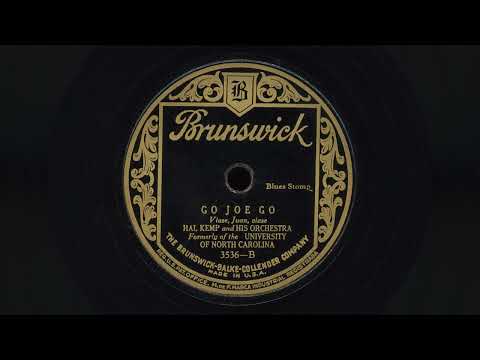
Ending our look at a few hot dance bands on the Brunswick label this week, we return to Hal Kemp with a interesting arrangement of a tune written by Phil Napoleon and Frank Signorelli of the Original Memphis Five.
The curious thing about this record is that it prominently features a guitar – but no guitarist is listed with the band in Brian Rust’s credits. While there is a banjo player credited (Olly Humphries), I’m not hearing a banjo at all. Also, the guitarist on this record sounds quite fluid and relaxed in his playing – wondering if this is Olly giving the guitar a go or an uncredited guest?
Guitarist Gene “Pinky” Kintzle (who I just found out was from Bix’s hometown here in Iowa) played extensively with Hal Kemp but did not join the group until 1929 – and I’m not even sure if he was in NYC this early.
The tune has a choppy start-and-stop arrangement that makes it a bit cerebral. Quite the highbrow approach for a record labeled as a “blues stomp”! The lush guitar interludes give moments of pleasure, along with Schegel’s trumpet solo and John Scott Trotter’s tuba-accompanied piano breaks.
But things really start to heat up around the two minute mark when Schlegel’s peppy trumpet breathes some fire into the tune during his second solo.
Now I need to go find a copy of Phil Napoleon’s version of this tune on Edison 51908 and Harmony 383-H – and the OM5 version on Pathé Actuelle 36576.
Recorded in New York City on May 5, 1927. Released as Brunswick 3536
Credits Hal Kemp – director, clarinet, alto sax Wade Schlegel – trumpet Keith Roberts – trombone Ben Williams – clarinet, alto sax, baritone sax Saxie Dowell – clarinet, tenor sax John Scott Trotter – piano Olly Humphries (?) – guitar Jim Mullen – tuba Skinny Ennis – drums
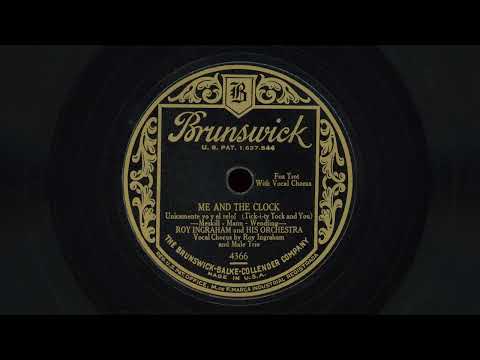
Continuing with this week’s theme of jazzy dance bands on electric Brunswick, we have a somewhat scarce disc from the short-lived Roy Ingraham orchestra.
Edward Roy Ingraham was the younger brother of Bert Ingraham, the very early 20th century composer of popular tunes who tragically died in 1910 at the age of twenty seven. Roy followed in his brother’s footsteps, both as a performer and composer, and around this time was conducting the orchestra at the newly constructed Paramount Hotel on 46th St in NYC. The grill room at the Paramount had a 19-foot ceiling and room for 850 dancers.
Roy only recorded three discs for Brunswick in 1929 and this tune is from his first session. He then got into composing for film and then got into radio broadcasting. He lived to the ripe old age of 93 and died in 1988 in Los Angeles.
“Me and the Clock (Tick-i-ty Tock and You)” is a pleasant tune with jazzy solos throughout. Not sure why this one didn’t make the cut in Rust’s seminal “Jazz and Ragtime Records” discography. Unfortunately I don’t have a lot of information on personnel. Ingraham himself was said to be the vocalist. Highlights include:
0:00 Intro / Vocal 0:43 Trumpet solo 1:02 Piano solo 1:12 Trumpet solo 1:23 Ensemble 2:09 Trombone solo 2:30 Ensemble
This disc is quite clean, but had some strange heat marks on one side that caused warpage. I had to record this at 16 rpm to prevent the cartridge from jumping out of the grooves. Even so – I suspect perhaps the grooves had been also damaged by a dull steel needle, as you can hear some blasting distortion on louder transients throughout.
Recorded in New York City in May 1929. Released as Brunswick 4366.
Credits: Roy Ingraham – director Instrumentation and personnel unknown.
Before I got distracted by Johnny Johnson and Roth’s Gang, I was planning to share a few electric Brunswicks of jazzy dance bands from the late 20s – so here’s the second: a tune from the 1929 Paramount motion picture “Illusion” performed by Bob Haring and his Orchestra with vocals by Dick Robertson.
There’s not much musically revolutionary about “Revolutionary Rhythm”, but it’s a catchy upbeat number with fine playing and a whimsical clarinet solo (Sannella?) starting around 2:41.
Recorded in New York City in September 1929. Released as Brunswick 4545.
Bob Haring – director Manny Klein, Bob Effros, Mike Mosiello – trumpet Chuck Campbell, Charlie Butterfield – trombone Andy Sannella, clarinet, alto sax Unknown artist – clarinet, alto sax Unknown artist – clarinet, tenor sax, Unknown artist – violin Unknown artist – piano John Cali (?) – banjo John Helleberg – tuba Stan King – drums Dick Robertson – vocals
After discovering that the identity of “Roth’s Gang” on Challenge 747 is very likely Johnny Johnson’s band, I immediately dug out a few Johnson records from the vault and had a listen. Thought I’d share two of my favorite tracks.
The second, a recording of the Rodgers and Hart tune “Thou Swell” (famously recorded by both Bix Beiderbecke and Jabbo Smith a few months later) features what I believe is the debut recording of trombonist Jack Teagarden. He also recorded on this same day with “Wingy” Mannone for Vocalion, however those two recordings were unissued.
Recorded in New York City on December 2, 1927. Released as Victor 21113.
Credits: Johnny Johnson – director, piano Frank Cush – trumpet Jack Teagarden – trombone Charles Murray – clarinet, alto sax, vocals Walter Botsford – clarinet, tenor sax Roy Strom – violin, vocals Sam Browne – banjo, vocals Johnny Porpora – string bass Bob Treaster – drums, vocals
Harry Shackleford is credited in Rust on tuba, but unless my ears are playing tricks on me, I don’t hear a tube on this one.
After discovering that the identity of “Roth’s Gang” on Challenge 747 is very likely Johnny Johnson’s band, I immediately dug out a few Johnson records from the vault and had a listen. Thought I’d share two of my favorite tracks.
The first, “Together We Two” is a pleasant upbeat dance tune by Irving Berlin. I particularly enjoyed the suave trumpet of Frank Cush in the first section, the violin break at 0:49 – and the sax solos at 0:58 and in particular, 1:17, where we hear a little of the adventurousness we heard with “Roth’s Gang”. Johnny Porpora’s bass is quite refreshing also.
Throughout, the ensemble playing is excellent on this one and it made quite a nice transfer – other than some classic Victor graininess in the grooves which can make even a clean pristine record like this one sound a little noisy.
Malcolm “Johnny” Johnson was Indiana-born and is an Indiana University alum (class of 1919). He started touring with a military band and then began playing piano with the Ben Bernie orchestra. He formed his own orchestra in 1920 – their first recordings were for the Cameo label in late 1923 and featured Red Nichols on trumpet.
This is their first session for Victor – and you’ll definitely notice a huge improvement in the sound quality of this electrically recorded session from the low budget “Roth’s Gang” recording, which used the “electrosonic” process developed by Emerson in the waning days of the label.
Their real heyday was yet to come – in the 1930s they recorded quite extensively and were featured on a popular radio show on NBC.
Recorded in New York City on October 14, 1927. Released as Victor 21016.
Credits: Johnny Johnson – director, piano Frank Cush – trumpet Eddie Lappe – trombone Charles Murray – clarinet, alto sax, vocals Walter Botsford – clarinet, tenor sax Roy Strom – violin, vocals Sam Browne – banjo, vocals Johnny Porpora – string bass Bob Treaster – drums, vocals Franklyn Baur – vocals
A bit of a mystery record that I found in rough shape – but one worth giving a listen if only to hear the inspired saxophone solo starting at 0:44, which to my ears sounds quite thrillingly modern for its time – quite wild and unruly for a dance band record! The bouncy pianist was on quite a roll too – and delivers a solo of interest around 2:06. I went down a rabbit-hole trying to discover the identity of this orchestra – which might then lead to the identity of this saxophonist and pianist.
Up for an mystery? Read on.
The Challenge label (1927-1931) was considered the budget label of the budget Silvertone label pressed from masters made by other labels and sold by Sears and Roebuck for a mere 24 cents apiece. It has been said that the price of their records was low because recordings on the Challenge label often did not require royalty payments to be made. Artists on the Challenge label generally were (seemingly randomly) renamed with pseudonyms – which make them difficult to track down.
The band name “Roth’s Gang” appeared on several Challenge sides, including the flip side of this record, “A Shady Tree”, which has a matching matrix (7482-2) to a Sam Lanin recording from August 31, 1927. However, the recording Lanin made of “Miss Annabelle Lee” on August 8, 1927 does not match the matrix of this version. I have the Lanin version on the Lincoln label – and it is most certainly not this recording.
My next guess was Nathan Glantz – as some of his saxophone work has certainly surprised me in the past. Indeed, he recorded this tune with his orchestra on July 8, 1927 and it appeared domestically on the Banner, Domino, Regal, and Silvertone labels. However, that recording was under the matrix 7385. On the runout of this Challenge record it shows a matrix of 31167-1, which does not match. Additionally, listening to the Glantz record – it does not sound at all like this version.
I also struck out listening to versions by Ben Bernie, Ben Selvin (as The Knickerbockers), Ted Weems, Frank Farrell and his Greenwich Village Inn Orchestra, and Justin Ring – all polished versions but missing the raw intensity that the saxophone solo gave this one.
Hotter versions by London’s George Fisher and his Kit Kat Band and the California Ramblers also ended up not matching – either in matrix number or sound.
After about an hour of combing through various discographies, I found that this recording was also issued under the same matrix under the name “Imperial Orchestra” by the Bell label in mid-1927 (as Bell 528). Bell records – whieh were sold at W.T. Grant dime stores – did not have its own studio at this time and pressed masters from Emerson recordings – so this was finally a step in the right direction.
In the Emerson discography by Allan Sutton I finally found this matrix listed as being from Consolidated Record Corporation masters. Consolidated continued to produce masters for Bell and other labels even after the Emerson label ceased to be in June of 1927. This arrangement lasted until December of 1927, when W.T. Grant dropped the Bell label entirely in favor of the Diva label, produced by Columbia. This places the production of this side as occurring sometime between May and December of 1927.
Unfortunately, this matrix is listed in the Emerson discography as being recorded by an “unknown dance orchestra”. It notes that many “unknown orchestras” were attributed in various discographies to Fred Hall’s Orchestra – since he was Consolidated’s musical director starting in January of 1926. Although there is no real evidence that this is the case, it would seem this could be a situation not unlike the various Grey Gull studio bands that were made up of ad hoc combinations of players led by Mike Mosiello and Andy Sannella.
However – as many astute viewers have pointed out, immediately following this matrix is a tune by the Johnny Johnson band that also includes a vocal trio. Listening to that session, I’m now convinced this is Johnny Johnson and his Club Mirador Orchestra.
When making this transfer, I initially thought the record itself must have been fairly beat up, as there was some shrill distortion present that I had to work hard to tame. The distortion seemed most noticeable on loud transients and the vocal passage – which sounds quite nasally even by 20s standards. If this was recorded at Emerson in mid-1927, it likely was recorded using Emerson’s “Electrosonic” process – which is noted in the Emerson discography as being a “distortion-prone electrical process of unknown origin.” So perhaps the record condition is not totally at fault here.
Released as Challenge 747 (mx. 31167-1) and Bell 528.
I’ve been going through some electric Brunswicks in the dance band section of the jazz bunker and have a few that I’ll be sharing over the next week or so.
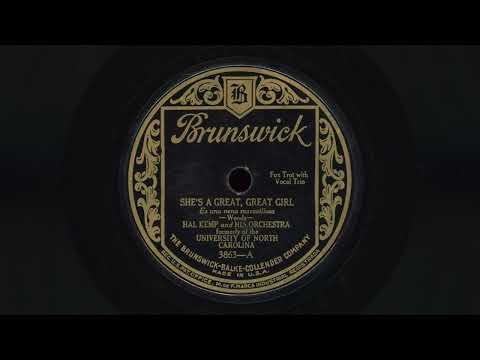
First up is a snappy sweet-n-hot dance record from Hal Kemp that includes a fine arrangement and endearing vocal trio performance by Kemp accompanied by Saxie Dowell and Skinny Ennis (who later became a well known bandleader in his own right).
We get a jolly trumpet solo (Bob Mayhew?) around the 2:22 mark that keeps close to the melody until the last measure when it gets a little creative with the break into the next section.
This was recorded when Kemp was 24 – having just graduated from the University of North Carolina in 1926, where he led a campus band known as the Carolina Club Orchestra. Interesting that they noted his Alma Mater on this record label.
He later went on to find national fame in the 30s recording sweeter tunes that became big hits. So after hearing this record you can now join the club of curmudgeons who “prefer his earlier stuff.”
Recorded in New York City on March 7, 1928. Released as Brunswick 3863.
Credits: Hal Kemp – director, clarinet, alto sax, vocals Bob Mayhew, Earl Geiger – trumpet Wendell “Gus” Mayhew – trombone Jack Mayhew – clarinet, alto sax Ben Williams – clarinet, alto sax, baritone sax Saxie Dowell – clarinet, tenor sax, vocals Bromo Sulser – violin John Scott Trotter – piano, arranger Olly Humphries – banjo Jim Mullen – tuba Skinny Ennis – drums, vocals
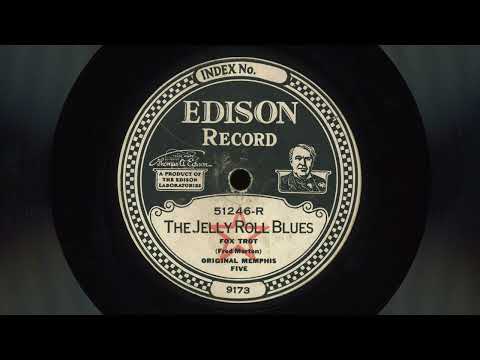
“Jelly Roll Blues” was composed by Jelly Roll Morton and was published by Will Rossiter in Chicago in 1915, making it his first – if not THE first – published jazz composition. Morton himself did not begin recording until 1923 – and it was not until 1924 that he himself recorded a version of “Jelly Roll Blues” (Gennett 5552).
It is unclear how Original Memphis Five (OM5) came to record this tune – perhaps learning of the successful collaboration between Jelly Roll Morton and the New Orleans Rhythm Kings for Gennett in June of 1923 prompted an interest in his compositions.
During this period, OM5 were playing live regularly in Brooklyn at the Rosemont Ballroom on Fulton and Flatbush with acts such as Colony Club Orchestra and Jules Berkin’s Orchestra. Their concerts were advertised as dances – often with flashy promotions such as “Clown Night” and “Waltz Night” to bring in the crowds.
I found when transferring this one, that the speed was a bit north of 82 rpm to get the key correct. Thankfully I was able to procure a fairly clean copy of this one, though there is some degree of surface noise. Let me know how it sounds to your ear.
Curiously, this recording is not currently available either on Spotify or Apple Music. Another example of why the relatively small band of collectors on YouTube and Instagram who share their transfers is so important when it comes to music discovery of early jazz.
Recorded in New York City on September 22, 1923. Released as Edison 51246. This is take B.
Credits Phil Napoleon – trumpet Charlie Panelli – trombone Jimmy Lytell – clarinet Frank Signorelli – piano Jack Roth – drums