Jazz Crazy Records

An Archive of Early Jazz on 78 RPM

Category: Jazz

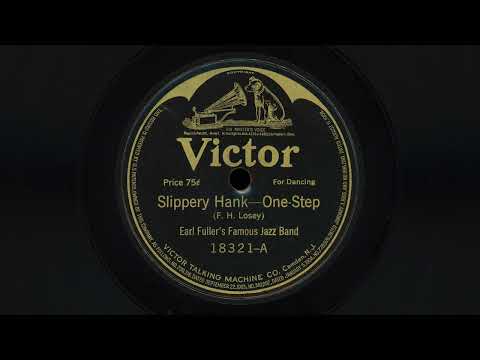
  • “Slippery Hank” – Earl Fuller’s Famous Jazz Band (1917) Madcap Rag-a-Jazz Romp!

    “Slippery Hank” – Earl Fuller’s Famous Jazz Band (1917) Madcap Rag-a-Jazz Romp!

    After the Original Dixieland Jazz Band (ODJB) recorded what is considered the first jazz record with Victor in late February of 1917, they began playing at Reisenweber’s Cafe in New York to growing crowds interested in this new music.

    Earl Fuller led his DeLuxe Orchestra at Rector’s Restaurant. After hearing ODJB, Fuller formed an impromptu small combo jazz act to compete with the upstart New Orleans band at the competing venue.

    While many jazz historians write off Fuller’s band as a crude attempt to imitate jazz, I’d like to suggest perhaps it had a more expansive role. I’ve loved this record since I first heard it – and can’t imagine what the reaction to this wild spastic noise-fest must have been in 1917!

    To me, the beauty of Earl Fuller’s Famous Jazz Band was that at base, it was a fun chaotic romp. The unbridled cacophony of “Slippery Hank” may have used jazz as cover – but this was music that was not trying to cloyingly ingratiate itself to the general public – rather, it beat the audience over the head with thundering spastic snare drums, howling warbling clarinet lines, and a dive-bombing trombone that sends the listener running for cover without warning.

    This was all by design – Victor Records in its promotional materials described the sound of Ted Lewis’ clarinet as “a dog in his dying anguish.” The punk rocker in me adores this no-holds-barred assault on musical sensibilities. This was music that I find as culturally relevant to the time as the Dadaists performing at the Cabaret Voltaire in ZΓΌrich.

    Fuller’s band recorded several more records for Victor, Emerson, Gennett, and Edison from 1917-1918 before members went their separate ways. Ted Lewis poached Kahn, Raderman, and Lucas to start his own band at the end of 1918 – and they released their first record in September of 1919.

    Recorded in New York City on June 4, 1917.
    Released as Victor 18321.

    Credits:
    Earl Fuller – piano, director
    Walter Kahn – cornet
    Harry Raderman – trombone
    Ted Lewis – clarinet
    John Lucas – drums
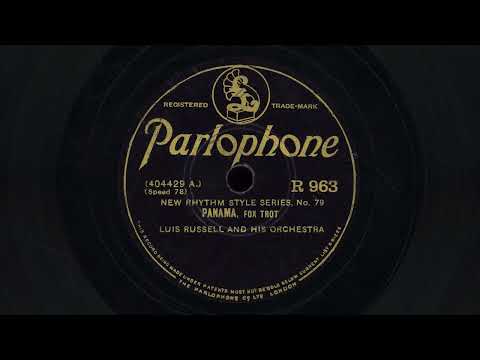
  • “Panama” – Luis Russell and his Orchestra (1930) Hot! πŸ”₯πŸ”₯πŸ”₯

    “Panama” – Luis Russell and his Orchestra (1930) Hot! πŸ”₯πŸ”₯πŸ”₯

    The last – and hottest – of three recordings the great Luis Russell orchestra made during a fantastic 1930 session that I highlighted this week.

    “Panama” was originally published in 1912 by ragtime composer William Henry Tyers and was recorded by New Orlean’s Rhythm Kings in 1922, quickly becoming standard fare and was subsequently recorded by W. C. Handy in 1923 Johnny De Troit, Henry Halstead, and McKenzie’s Candy Kids in 1924 – and by Fletcher Henderson in 1925.

    Things really get cookin’ around 0:41 as a hot Pops Foster bass break leads into a Henry “Red” Allen trumpet solo, followed by a trombone solo from J.C. Higginbotham, a tenor sax solo from Greely Walton, a clarinet solo from Albert Nicholas, an alto solo from Charlie Holmes, and a wild ensemble show-stopper ending that brings the house down and then some.

    Surely a recording that showcases the Russell band at the top of their game!

    Recorded in New York City on September 5, 1930.
    Released in the U.K. as Parlophone R 963.
    (Original domestic release = Okeh 8849)

    Credits
    Luis Russell – piano, director
    Otis Johnson, Henry “Red” Allen – trumpet
    J.C. Higginbotham – trombone
    Charlie Holmes – alto sax
    Albert Nicholas – alto sax, clarinet
    Greely Walton – tenor sax
    Will Johnson – banjo, guitar
    George Pops Foster – string bass
    Paul Barbarin – drums

    The two other recordings from this same session:

    “High Tension”
    https://youtu.be/yei7nN1iRL0

    “Muggin’ Lightly”
    https://youtu.be/uezEjgzmt8E

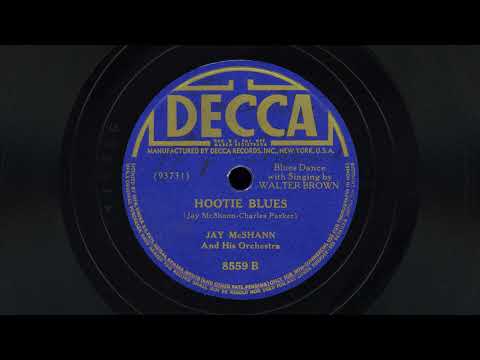
  • “Hootie Blues” – Jay McShann and his Orchestra (1941) Featuring Charlie Parker

    “Hootie Blues” – Jay McShann and his Orchestra (1941) Featuring Charlie Parker

    While technically not the first recording of Charlie Parker, this was the first released recording that he appeared on with a solo – and an arranger credit.

    Parker’s tone is unmistakeable and starts around the 0:36 mark. He is relaxed and confident – with a few flourishes within his blues lines that serve as foreshadowing for his later work.

    Jay McShann had been active in the Kanasas City music scene throughout the 1930s, and he formed his own unit in 1939. His nickname was “Hootie” – so this tune is his blues.

    Recorded in Dallas, Texas on April 30, 1941.
    Released as Decca 8559.

    Credits:
    Jay McShann – piano, leader
    Buddy Anderson, Harold Bruce, Orville Minor – trumpet
    Joe Taswell Baird – trombone
    John Jackson, Charlie Parker – alto sax
    Harold Ferguson, Bob Mabane – tenor sax
    Gene Ramey – bass
    Gus Johnson – drums
    Walter Brown – vocals

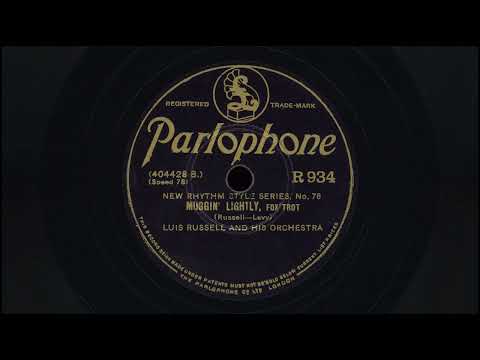
  • “Muggin’ Lightly” – Luis Russell and his Orchestra (1930)

    “Muggin’ Lightly” – Luis Russell and his Orchestra (1930)

    The second of three recordings the great Luis Russell orchestra made during a fantastic 1930 session that I am highlighting this week.

    “Muggin’”, according to Cab Calloway’s 1938 Hepster’s Dictionary, is defined as “making ’em laugh, putting on the jive.” while “Muggin’ Lightly” is defined as a “light staccato swing” and as such, this tune composed by Russell is a relaxed romp that has some very interesting compositional elements.

    Jazz Historian K.B. Rau analyzed the composition on his excellent website, “Investigating Jazz Recordings” at https://www.harlem-fuss.com/ and I’ve attempted to translate his analysis into YouTube chapters to help facilitate understanding how this complex composition is arranged:

    0:00 A section: “Simple smooth melody presented by the tenor sax” (8 bars)
    0:10 A section: “Interrupted by some trumpet led saxes” (8 bars)
    0:20 A section: Repeat (8 bars)
    0:30 A section: “Swinging jazzy tenor sax phrase” (8 bars)
    0:41 Trombone chorus – J.C. Higginbotham (16 bars)
    1:01 Alto sax chorus – Charlie Holmes (16 bars)
    1:21 B section: Modulation of the ensemble from B major to Bb major (8 bars)
    1:32 C section: “A beautifully swinging tutti” (24 bars)
    2:03 D section: Closely arranged ensemble (16 bars)
    2:23 E section: For the sax section – starting in F sharp (16 bars)
    2:44 D section: Ensemble in “smoothly swinging laidback back-beat phrasing. Simply Great!” (8 bars)

    Recorded in New York City on September 5, 1930.
    Released in the U.K. as Parlophone R 934.
    (Original domestic release = Okeh 8830)

    Credits
    Luis Russell – piano, director
    Otis Johnson, Henry Red Allen – trumpet
    J.C. Higginbotham – trombone
    Charlie Holmes – alto sax
    Albert Nicholas – alto sax, clarinet
    Greely Walton – tenor sax
    Will Johnson – banjo, guitar
    George Pops Foster – string bass
    Paul Barbarin – drums

    The two other recordings from this same session:

    “High Tension”
    https://youtu.be/yei7nN1iRL0

    “Panama”
    https://youtu.be/WeryW5ri6yU

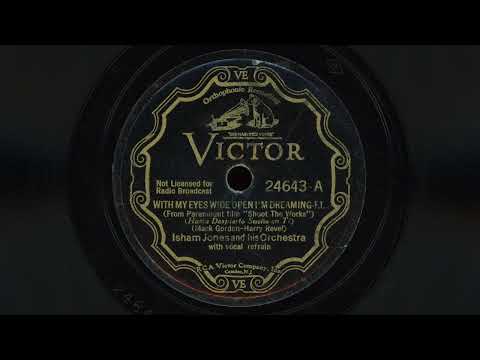
  • “With My Eyes Wide Open I’m Dreaming” – Isham Jones and his Orchestra (1934)

    “With My Eyes Wide Open I’m Dreaming” – Isham Jones and his Orchestra (1934)

    The recorded output of Isham Jones on the Victor label is known as some of the finest dance music recorded during the depths of the Great Depression.

    Jones led his band in Chicago from 1920-1927 and 1929-1932 in Chicago and recorded extensively on the Brunswick label. After regrouping in New York, Jones signed with the Victor label and recorded over 50 sides over two years, until switching to the Decca label in the summer of 1934.

    This show tune was from the film “Shoot the Works”, a Paramount comedy in which the song plays a role, sung by Dorothy Dell accompanied by the Ben Bernie orchestra. The 19-year-old Dell was tragically killed in a car accident in June of 1934 – a month before the film’s public release.

    Recorded in New York City on May 10, 1934.
    Released as Victor 24643

    Credits
    Isham Jones – leader, tenor sax
    George Thow, Johnny Carlson, Joe Hostetter – trumpet
    Mark Bennett, Russ Jenner – trombone
    Milt Yaner, Victor Hauprich – clarinet, alto sax
    Saxie Mansfield – tenor sax
    Eddie Stone – violin
    Harold Smith or James Noble – piano
    George Wartner or Jack Blanchette – guitar
    Richard Kissinger – tuba
    Walter Lageson – drums
    Joe Martin – vocals

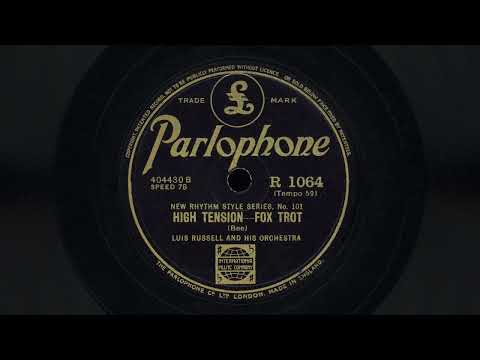
  • “High Tension” – Luis Russell and his Orchestra (1930)

    “High Tension” – Luis Russell and his Orchestra (1930)

    One of three recordings the great Luis Russell orchestra made during a fantastic 1930 session that I’ll be highlighting over the next week.

    This tune composed by Belgian David Bee has been called “hectic” and “quirky” – but seems to fit into a genre of jazz composition about strange mental states (think Arthur Schutt’s “Delirium” or Fletcher Henderson’s “Jangled Nerves” or “Queer Notions”), which are among my favorite compositions!

    In any case, there are many delightful moments to be enjoyed on this record – as solos begin after the first 54 seconds. We hear a rapid fire line of 8 bar solos with standout moments from Higginbotham and also from the trio of Russell, Foster, and Barbarin.

    Recorded in New York City on September 5, 1930.
    Released in the U.K. as Parlophone R 1064.
    (Original domestic release = Okeh 8849)

    Credits
    Luis Russell – piano, director
    Otis Johnson, Henry Red Allen – trumpet
    J.C. Higginbotham – trombone
    Charlie Holmes – alto sax
    Albert Nicholas – alto sax, clarinet
    Greely Walton – tenor sax
    Will Johnson – banjo, guitar
    George Pops Foster – string bass
    Paul Barbarin – drums

    The two other recordings from this same session:

    “Muggin’ Lightly”
    https://youtu.be/uezEjgzmt8E

    “Panama”
    https://youtu.be/WeryW5ri6yU

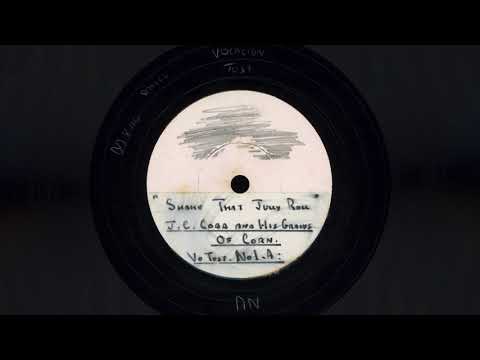
  • “Shake that Jelly Roll” – Junie C.  Cobb and his Grains of Corn (1929) Test Pressing!

    “Shake that Jelly Roll” – Junie C. Cobb and his Grains of Corn (1929) Test Pressing!

    If you really want to hear what music from the jazz age can sound like – take a listen to this amazing-sounding test pressing of Vocalion 1263! When the string bass takes a solo at 2:22 you’ll see what I mean!

    Probably one of the cleanest 78 rpm records I’ve ever heard! Apparently, U.K. audio engineer John R.T. Davies had gotten a hold of the metal masters and had this pressed up in vinyl. The surface noise is barely audible at all and the purity of sound on this transfer really delighted my ears!

    Junie Cobb was born in Hot Springs, Arkansas in 1896 who learned to play a variety of instruments. He moved to Chicago in the early 1920s and played with King Oliver and Jimmie Noone before putting together his own band with his brother, Jimmy, on trumpet.

    “Shake That Jelly Roll” is Cobb original – though a Lester Melrose credit appears on the record label – one of the Melrose brothers who owned a music publishing business in Chicago and would often write “lyrics” for instrumental tunes so that they would get part of the royalty.

    The tune starts off as though the band were about to play “Copenhagen” – but after a five second fake-out, the band launches into some hot fun, with hype man Junie Cobb braying out rejoinders such as “Oh Look at that Gal Shakin’ that Jelly Roll!” to keep the band fired up.

    Recorded in Chicago, Illinois on February 7, 1929.
    Originally released as Vocalion 1263.

    Credits:
    Jimmy Cobb – cornet
    Darnell Howard – clarinet, alto sax
    Junie Cobb – tenor sax, violin, clarinet, vocals
    Bob Waugh – violin
    Alex Hill – piano
    Eustern Woodfork – banjo
    Bill Johnson – string bass
    W. E. Burton – drums

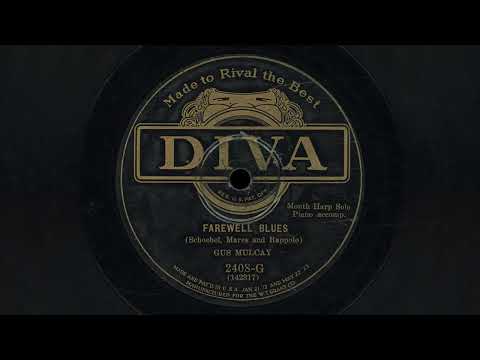
  • “Farewell Blues” – Gus Mulcay (1926) – Early Jazz Harmonica

    “Farewell Blues” – Gus Mulcay (1926) – Early Jazz Harmonica

    Recorded in New York City on June 18, 1926.
    Released as Diva 2408-G.

    Credits
    Gus Mulcay – mouth harp
    Irving Sherman – piano

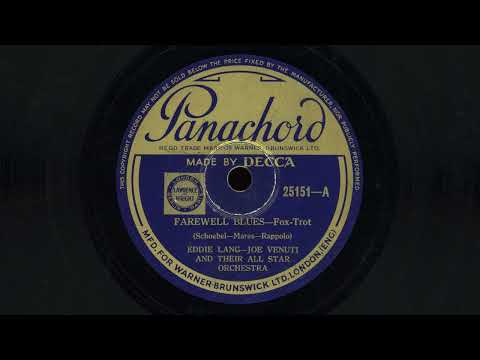
  • “Farewell Blues” – Eddie Lang – Joe Venuti and their All Star Orchestra (1931)

    “Farewell Blues” – Eddie Lang – Joe Venuti and their All Star Orchestra (1931)

    A rousing deep-depression cut from Lang and Venuti and friends. The boys take on the early standard “Farewell Blues”, written and recorded by members of the New Orleans Rhythm Kings almost a decade earlier.

    Lang and bassist Ward Lay keep a stompin’ rhythm throughout as we hear a rotating selection of outstanding soloists, including Benny Goodman on clarinet, Venuti on violin, Jack Teagarden on trombone, and Charlie Teagarden on trumpet.

    Recorded in New York City on October 22, 1931.
    Released as Panachord 25151

    Credits
    Charlie Teagarden – trumpet
    Jack Teagarden – trombone
    Benny Goodman – clarinet
    Joe Venuti – violin
    Frank Signorelli – piano
    Eddie Lang – guitar
    Ward Lay – string bass
    Neil Marshall – drums

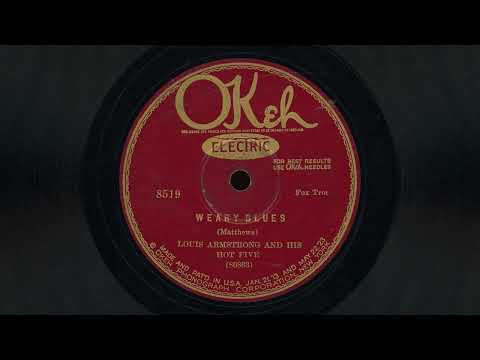
  • “Weary Blues” – Louis Armstrong and his Hot Seven (1927)

    “Weary Blues” – Louis Armstrong and his Hot Seven (1927)

    Clarinet Week on the channel wraps up today with one of my favorite players, the great Johnny Dodds, playing with Louis Armstrong and his Hot Seven – somehow mislabeled on this record as his Hot Five.

    Dodds comes storming out of the gate on this one – playing loop-de-loops around Armstrong as Satch states the rhythmic melody in the introductory section. A few hot banjo and tuba breaks later, Armstrong drives home an energetic solo which is abruptly taken over by Dodds playing a syncopated riff in a very low register – which he stays within throughout the rest of his solo.

    John Thomas follows with a trombone solo which is followed by Satch and his cornet leading us back to the ensemble for a rousing end.

    Recorded in Chicago, Illinois on May 11, 1927.
    Released as Okeh 8519.

    Credits:
    Louis Armstrong – cornet
    John Thomas – trombone
    Johnny Dodds – clarinet
    Lil Armstrong – piano
    Johnny St. Cyr – banjo
    Pete Briggs – tuba
    Baby Dodds – drums