Thanks to the watchful eye of @atertiary78 for spotting this on Discogs right after it was listed and messaging me about it.
It nearly did not make it to me, as the seller did not want to pack it using tried-and-true methods of safely shipping 78s. When I protested that using LP mailers or pizza boxes were very risky, he insisted that he would be using a “method passed down from his grandfather” to pack it. It arrived in a glorified pizza box with some bubble wrap. Perhaps pizza boxes were made of oak crates back in Grandpa’s day. In any case, somehow it survived the trip. The 78 gods truly do work in mysterious ways.
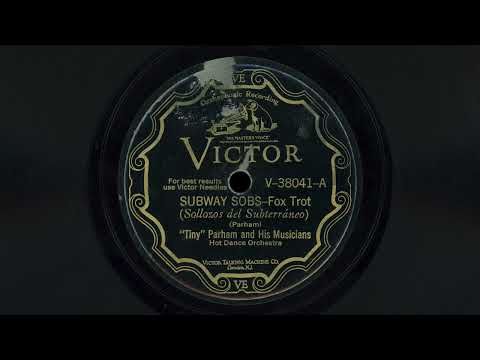
This copy has some surface noise – but every time Quinn Wilson’s tuba starts this one off, I can’t help but listen to the whole thing despite the sizzle of that Victor shellac in the background. The performances are so wonderful on this one – from the clarinet to the violin to the trombone to the guitar to the tuba! One of those 20s jazz bands that definitely merits more spotlight!
Recorded in Chicago, Illinois on February 2, 1929. Released as Victor V-38041. Later reissued as Bluebird B-6031.
Credits Tiny Parham – piano, director Roy Hobson – cornet Charles Lawson – trombone Charles Johnson – clarinet, alto sax Elliott Washington – violin Mike McKendrick – guitar Quinn Wilson – tuba Ernie Marrero – drums
I know very little about British jazz and dance bands, so last year I asked a friend in the U.K. to pick out a few discs out for me.
From what I’ve learned about Roy Fox – he was born in Denver, Colorado, grew up in Los Angeles, and lived in the U.S. until 1929, when he moved to London to lead a band there.
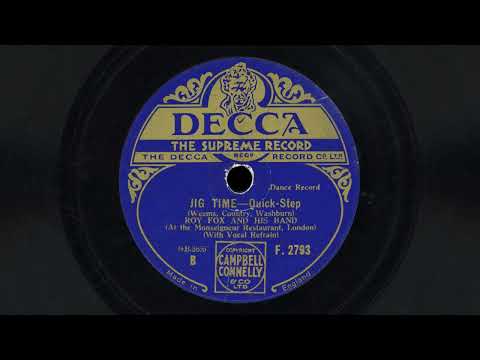
1932 finds Fox leading a band at the Monseigneur restaurant in London featuring rising musical stars such as Al Bowlly, Nat Gonella, and Lew Stone.
This tune is a fun hot dance tune – and you may certainly feel like doing a jig of your own once the band fires up.
Bowlly opines: “You heard a lot of talk about rhythm, and how it affects the mind. Some folks like a dreamy waltz, some like another kind!”
Recorded in London UK on January 21, 1932 at the Monseigneur Restaurant. Released as Decca F.2793.
Credits Roy Fox – cornet, director Nat Gonella, Sid Buckman – trumpet Joe Ferrie – trombone Jim Easton, Ernest Ritte, clarinet, alto sax, baritone sax Harry Berly – tenor sax Lew Stone, piano Al Bowlly, guitar, vocals Don Stuteley – string bass Bill Harty – drums
Lt. James Reece Europe’s 369th U.S. Infantry “Hell Fighters” Band is well known in jazz circles. Lesser known are the small handful of vocal quartet recordings made during his prolific recording sessions for Pathé in March of 1919.
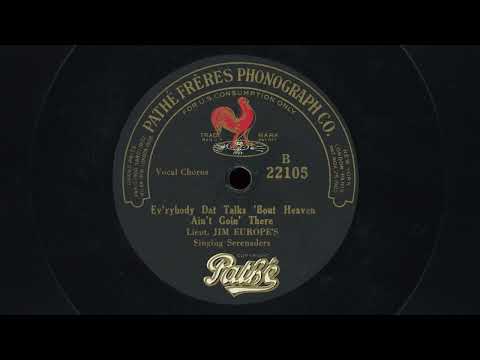
Here we have an acapella vocal quartet singing a variation of a traditional African-American gospel song “All God’s Chillun Got Shoes” – with the addition of a wonderful line that was made the title of the song: Ev’rybody Dat Talks ‘Bout Heaven Ain’t Goin’ There. I find this apt social commentary to be quite interesting.
Recorded in New York City in March 1919. Released as Pathé 22105.
Credits: Unknown artists (perhaps Creighton Thompson and Noble Sissle?)
This one was a little beat, and I wondered if it was worth posting at all – but it was so invigorating that my enthusiasm got the best of me and here it is.
This hot session is just a whole lot of fun. The band is tight and is trading solos so fast that one’s head starts to spin. It’s also always nice to hear a great bass sax player who is not Adrian Rollini or Coleman Hawkins. A delightful romp.
0:00 intro 0:24 sax solo 0:40 muted trumpet solo 0:38 sax solo 0:56 trumpet solo 1:12 bass sax solo 1:21 trumpet lead 1:35 clarinet solo 1:51 trombone solo 1:59 clarinet solo 2:05 ensemble
Erudite viewer @jslas2-590 has informed me that this is not a Harry Reser-led session as Rust reports but instead a session led by William Covington “Bill” Perry. I’ve updated the credits below as per his instruction.
Recorded in New York City in January 1926. Released as Silvertone 3504 (mx. 2391). Original issue: Paramount 20434
Credits: Andy Bossen (?) – trumpet Miff Mole (?) – trombone Ken “Goof” Moyer – clarinet, alto sax, baritone sax Jimmy Johnston – bass sax William Covington “Bill” Perry (?) – piano, leader, arranger Harry Reser – banjo Milton Sands (?) – drums
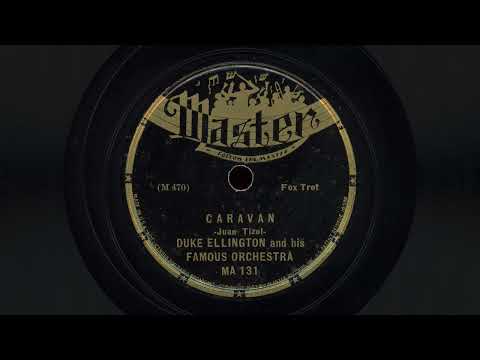
Earlier this year I posted the original recording of this Juan Tizol tune, “Caravan” on the Variety label from December of 1936 featuring a smaller subset of the Ellington orchestra billing themselves as Barney Bigard and his Jazzopaters: https://youtu.be/M17eZcf_hOw
Here, in this recording from about five months later, we hear the tune with the full Ellington orchestra with a few interesting differences. There is a more complex polyrhythmic introduction by Sonny Greer on drums that goes on for a few more bars, setting a tone that feels both Cuban and North African simultaneously. This is followed by Juan Tizol’s trombone laying down the theme, very softly accompanied by a reedman. The unmistakable growl of Cootie Williams’ trumpet then can be heard simmering in the background.
Barney Bigard’s clarinet then takes a solo, followed by Williams. All-in-all, this version seems to be more complex and subdued that the original, swinging a little less but more richly ornamental and evocative. Even though the entire Ellington orchestra is credited, this recording has a very intimate feel due to the focused arrangement.
Recorded in New York City on May 14, 1937. Released as Master MA 131. Later reissued as Brunswick m7997 and Columbia 36120.
The Master label was created in 1936 by Ellington manager Irving Mills (along with the Variety label). Only 40 records were issued by Master and it folded in 1937, with some of its masters then being reissued by Brunswick.
Credits (as per Brian Rust’s “Jazz and Ragtime Records, 1897-1942”, 6th Ed.) Duke Ellington – piano, arranger, director Wallace Jones, Cootie Williams – trumpet Rex Stewart – cornet Joe Nanton, Lawrence Brown – trombone Juan Tizol – valve trombone Barney Bigard – clarinet Johnny Hodges – clarinet, soprano sax, alto sax Harry Carney – clarinet, alto sax, baritone sax Otto Hardwick – alto sax, bass sax Fred Guy – guitar Hayes Alvis, Billy Taylor – string bass Sonny Greer – drums
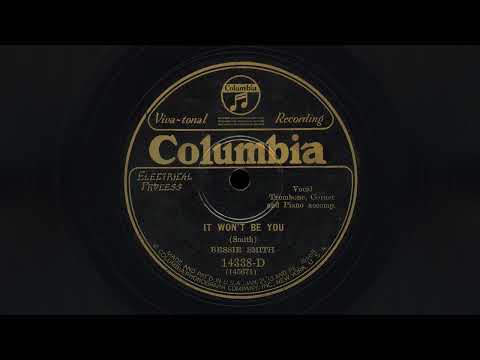
These electrically-recorded Viva-tonal Columbias from the late 20s and early 30s are some of Bessie’s best.
On this pristine copy we can hear her bluesy accompanists quite well – which include the great Charlie Green on trombone.
“It Won’t Be You” is a self-penned original breakup song whose sentiments are as old as time. Smith begins a little broken-hearted and jilted – but quickly gets to the knife-twisting chorus, in which she assures her ex that her next beau, “No matter how cruel he may be” will give her the consolation and satisfaction that “It won’t be you.”
A great kiss-off by the Empress of the Blues herself.
Reminds me of a recent Courtney Barnett tune in which she sang “I may not be 100% happy but at least I’m not with you.”
Recorded in New York City on February 21, 1928. Released as Columbia 14338-D.
Credits: Bessie Smith – vocals Demas Dean – trumpet Charlie Green – trombone Fred Longshaw – piano
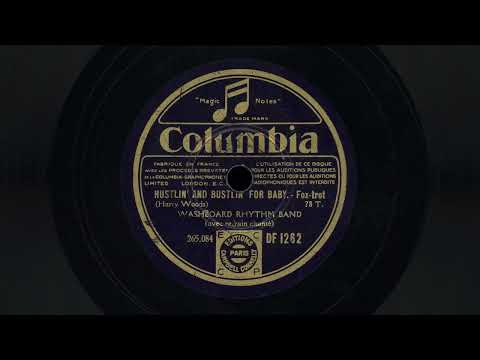
Another deep depression cut from the Washboard Rhythm Kings (here as Washboard Rhythm Band) that was only issued in Europe. It’s not clear why, but only two of the eight tunes recorded at this session were released in the U.S.
Louis Armstrong famously recorded this tune with his orchestra in January 1933, followed by a slightly peppier version by Adrian Rollini’s Orchestra in February. Here the Rhythm Band give it their own unique twist, with Taft Jordan’s droll delivery that verges on comedy. I feel Taft and the Rhythm Kings must have been one of the more enjoyable groups to play with back in the day.
Recorded in New York City on March 8, 1933. Released as Columbia DF 1262 in France.
Credits Taft Jordan – trumpet, vocals Ben Smith – clarinet, alto sax Jerome Carrington (?) – alto sax Carl Wade – tenor sax Clarence Profit (?) – piano Steve Washington – banjo, guitar Unknown artist – trombone, washboard
A deep depression cut from the Washboard Rhythm Kings (here as Washboard Rhythm Band) that was only issued in Europe. It’s not clear why the tunes in this session never got an American release –
Recorded from one of my favorite sessions with the WRK, as Taft Jordan’s wry vocals were on a roll after recording the outstanding “Midnight Rhythm” and “A Ghost of a Chance” earlier in the day.
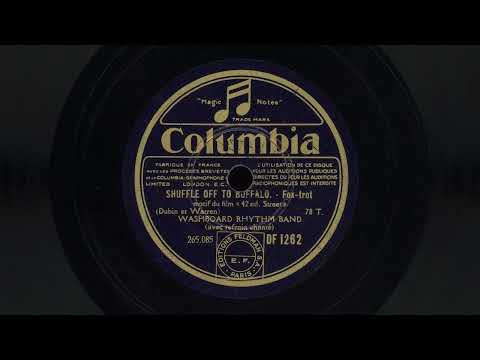
Here they take a popular show tune from the hit 1933 film “42nd Street” (which featured the song in a big production number choreographed by Busby Berkeley) and gave it the washboard treatment – with a cheeky vocal send-up by Jordan and plenty of solos replete with their characteristic laid back elegance.
Recorded in New York City on March 8, 1933. Released as Columbia DF 1262 in France.
Credits Taft Jordan – trumpet, vocals Ben Smith – clarinet, alto sax Jerome Carrington (?) – alto sax Carl Wade – tenor sax Clarence Profit (?) – piano Steve Washington – banjo, guitar Unknown artist – trombone, washboard
Possibly one of the most debated and misunderstood of Ellington’s early works – this one had many contemporary critics howling and, years later, many others who admired it and noted its pioneering importance in jazz composition.
On May 26, 1935, Duke’s mother Daisy Ellington passed away at age 56 in Detroit. Duke began composing the long-form composition “Reminiscing in Tempo” in her memory. The piece ended up being nearly 13 minutes long – and had to be recorded over four sides of two 10″ 78 rpm records – which could only hold a little over 3 minutes of music per side.
Sadly, when it was released, some jazz critics panned it. John Hammond called it pretentious, sterile, formless, and vapid, “without the slightest semblance of guts”. Edgar Jackson was intrigued and fascinated by the work, but felt the music was weak and “is not worth while.” He admitted, “I candidly confess I have no idea what Ellington is driving at.”
Even those who appreciated the work felt that only part four was worthy of consideration. Enzo Archetti felt the first three sides were “rather unnecessary” and developed a theory that the first three sides were made up of fragmentary vignettes and rough sketches of ideas that would only come to fruition in part 4.
It took time for the critics to catch up – and it was not until the late 50s, when it was revived by Gunther Schuller, that the work was revisited. Schuller wrote in “The Swing Era” that he considered it “one of the most successful of Ellington’s extended works” – and praised its structural unity and harmonic richness. For him, the tune “burst the pre-set molds established for jazz once and for all” and stood apart from “the pop-tune mentality” that confined jazz to three-minute 12- or 32-bar dance tunes.
A.J. Bishop wrote in 1964 that “‘Reminiscing in Tempo’ is completely different from any other jazz of the middle thirties… [and] has more in common with the ‘cool’ jazz of ten years later than with the jazz of its own time.”
As for the composer himself, he describes the work as “a detailed account of my aloneness after losing my mother.”
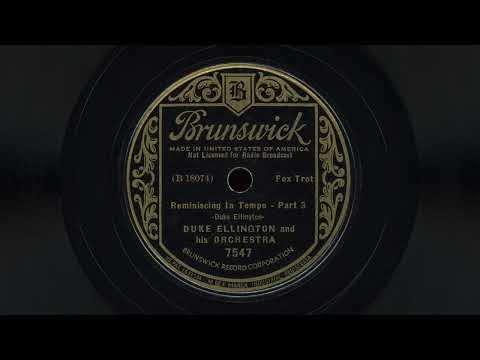
Here, for your listening pleasure, I have made transfers of all four sides from two records: one, a British Brunswick issue (02103), and the other, a domestic Brunswick issue (7547). Give it a listen and see what you think.
Recorded in New York City on September 12, 1935. Released in the U.S. as Brunswick 7546 and 7547.
Credits Duke Ellington – piano, arranger, director Arthur Whetsel, Cootie Williams – trumpet Rex Stewart – cornet Joe Nanton, Lawrence Brown – trombone Juan Tizol – valve trombone Barney Bigard – clarinet Johnny Hodges – clarinet, soprano sax, alto sax Harry Carney – clarinet, alto sax, baritone sax Otto Hardwick – alto sax, bass sax Fred Guy – guitar Hayes Alvis, Billy Taylor – string bass Sonny Greer – drums
Ever since listening to Colin Hancock’s excellent “The Moaningest Moan of them All” CD release on Archeophone Records, I always keep an eye out for records that feature saxophonist Loren McMurray. A few months ago I was digging in a large private collection in an Iowa basement and pulled this record out. I knew McMurray had recorded with a band that began with “Eddie” but got it confused with Eddie Elkins and couldn’t remember at the time if this record featured McMurray or not.
I took a chance on it and after getting home happily discovered that both sides of this disc did indeed feature McMurray. It looked a bit worn but I think it ended up making a decent transfer.
McMurray can be heard letting loose starting at 1:56, playing hot breaks in a call and response with the band.
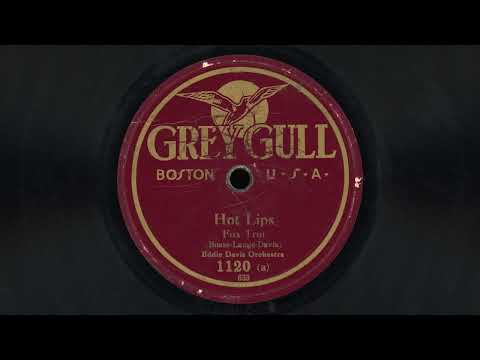
“Hot Lips” was a tune composed by Henry Busse in 1922 that was recorded that year by many hot dance orchestras and jazz bands such as California Ramblers, Bailey’s Lucky Seven, Paul Whiteman, Paul Specht, Synco Jazz Band, Tampa Blue Jazz Band, The Cotton Pickers, and Jazz-Bo’s Carolina Serenaders. Blues singer Lizzie Miles also performed a vocal version on OKeh.
Colin Hancock reports that this band’s lineup was essentially the Markels Orchestra under the name of their violinist, Eddie Davis.
Recorded in New York City circa September, 1922. Released as Grey Gull 1120.
Credits: Eddie Davis – violin, director Loren McMurray, Gene Fosdick – alto sax Mike Markel – piano Unknown artists – trumpet (x2), trombone, bass sax, banjo, drums