
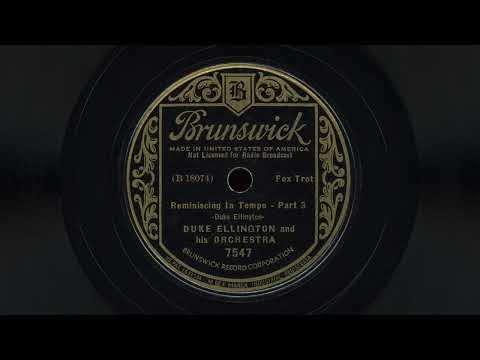
Possibly one of the most debated and misunderstood of Ellington’s early works – this one had many contemporary critics howling and, years later, many others who admired it and noted its pioneering importance in jazz composition.
On May 26, 1935, Duke’s mother Daisy Ellington passed away at age 56 in Detroit. Duke began composing the long-form composition “Reminiscing in Tempo” in her memory. The piece ended up being nearly 13 minutes long – and had to be recorded over four sides of two 10″ 78 rpm records – which could only hold a little over 3 minutes of music per side.
Sadly, when it was released, some jazz critics panned it. John Hammond called it pretentious, sterile, formless, and vapid, “without the slightest semblance of guts”. Edgar Jackson was intrigued and fascinated by the work, but felt the music was weak and “is not worth while.” He admitted, “I candidly confess I have no idea what Ellington is driving at.”
Even those who appreciated the work felt that only part four was worthy of consideration. Enzo Archetti felt the first three sides were “rather unnecessary” and developed a theory that the first three sides were made up of fragmentary vignettes and rough sketches of ideas that would only come to fruition in part 4.
It took time for the critics to catch up – and it was not until the late 50s, when it was revived by Gunther Schuller, that the work was revisited. Schuller wrote in “The Swing Era” that he considered it “one of the most successful of Ellington’s extended works” – and praised its structural unity and harmonic richness. For him, the tune “burst the pre-set molds established for jazz once and for all” and stood apart from “the pop-tune mentality” that confined jazz to three-minute 12- or 32-bar dance tunes.
A.J. Bishop wrote in 1964 that “‘Reminiscing in Tempo’ is completely different from any other jazz of the middle thirties… [and] has more in common with the ‘cool’ jazz of ten years later than with the jazz of its own time.”
As for the composer himself, he describes the work as “a detailed account of my aloneness after losing my mother.”
Here, for your listening pleasure, I have made transfers of all four sides from two records: one, a British Brunswick issue (02103), and the other, a domestic Brunswick issue (7547). Give it a listen and see what you think.
Recorded in New York City on September 12, 1935.
Released in the U.S. as Brunswick 7546 and 7547.
Credits
Duke Ellington – piano, arranger, director
Arthur Whetsel, Cootie Williams – trumpet
Rex Stewart – cornet
Joe Nanton, Lawrence Brown – trombone
Juan Tizol – valve trombone
Barney Bigard – clarinet
Johnny Hodges – clarinet, soprano sax, alto sax
Harry Carney – clarinet, alto sax, baritone sax
Otto Hardwick – alto sax, bass sax
Fred Guy – guitar
Hayes Alvis, Billy Taylor – string bass
Sonny Greer – drums
Leave a Reply